








Global Business Services (GBS) organisations are under increasing pressure to improve operational efficiency, reduce costs, accelerate service delivery, and manage growing process complexity. Automation plays a central role in achieving these objectives, but choosing the right technology is not always straightforward. Robotic Process Automation (RPA), Large Language Models (LLMs), and AI agents can all improve business operations, yet they address different types of work and require different levels of control.
A structured RPA vs LLM vs agent decision framework helps GBS leaders evaluate processes based on their characteristics rather than selecting technology simply because it is new or widely discussed. The objective is to identify which technology delivers the right balance of efficiency, accuracy, flexibility, cost, and risk.
Why GBS Organisations Need a Structured Technology Selection Approach
GBS operations bring together processes across finance, procurement, human resources, customer service, supply chain, and other business functions. Although some activities follow predictable workflows, others involve unstructured information, frequent exceptions, and decisions that depend on business context.
For example, invoice posting may follow a consistent sequence of steps, making it suitable for rule-based automation. Supplier email classification may require language understanding, while resolving a complex invoice dispute could involve reviewing documents, checking multiple systems, applying business policies, and coordinating follow-up actions.
Applying the same automation technology to all three activities can create unnecessary complexity. A rule-based bot may struggle with unstructured information, while an AI agent may introduce avoidable costs and governance requirements into a simple, repetitive task.
A practical RPA vs LLM vs agent decision framework therefore begins with understanding the work itself. Technology selection should follow process evaluation, not the other way around.
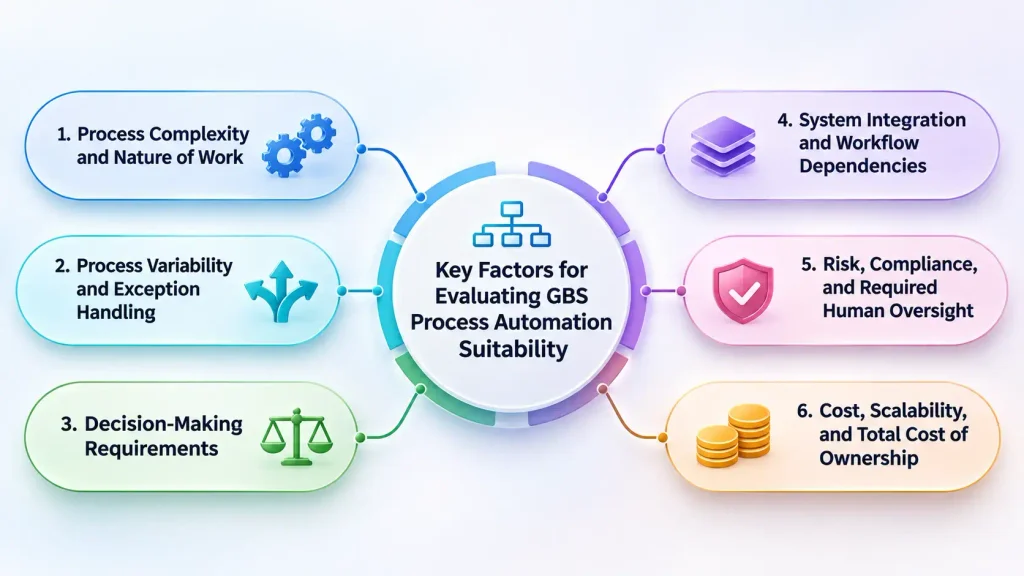
Key Factors for Evaluating GBS Process Automation Suitability
Before choosing between RPA, an LLM, or a full AI agent, GBS teams need to examine how a process operates, what information it uses, how frequently it encounters exceptions, and what decisions it requires. The following factors help determine the level of intelligence and autonomy that a process actually needs.
1. Process Complexity and Nature of Work
The first consideration is whether the process consists primarily of predictable, structured tasks or requires interpretation and reasoning.
RPA is generally suitable for activities that follow clearly defined rules and repeat the same sequence of steps. Examples include copying information between systems, updating records, downloading reports, validating mandatory fields, and processing standard transactions.
LLMs become more useful when the work involves interpreting language or extracting meaning from unstructured information. In accounts payable, for instance, an LLM can review supplier emails, identify the purpose of a message, summarise an invoice query, or extract relevant information from supporting documents.
AI agents are more appropriate when a process requires multiple connected actions and decisions. Consider a supplier onboarding process in which information must be collected, documents reviewed, records checked, missing details requested, and progress tracked across several systems. An agent can coordinate these activities according to defined objectives and permissions.
The RPA vs LLM vs agent decision framework should distinguish between executing instructions, interpreting information, and coordinating actions. These are different operational requirements and should not automatically be assigned to the same technology.
2. Process Variability and Exception Handling
Process variability is another important factor. Some GBS activities follow consistent patterns, while others change depending on the transaction, supplier, customer, document, or business situation.
For example, a standard purchase order invoice may follow a predictable validation and posting workflow. An RPA bot can compare invoice details against purchase order and goods receipt information. However, invoices containing missing purchase order numbers, inconsistent descriptions, or unusual supporting documents may require additional interpretation.
An LLM can help classify these exceptions, extract relevant details, and summarise the issue for an operations employee. It can also identify whether an email relates to a payment delay, pricing disagreement, or missing documentation.
A full AI agent may be appropriate when exceptions require several follow-up activities. It could retrieve related records, check approved business policies, request missing information, update a case, and route unresolved issues to the appropriate team.
The deciding factor is not simply how many exceptions a process encounters. It is whether those exceptions can be handled through predefined rules, require language-based interpretation, or demand coordinated actions across multiple systems.
3. Decision-Making Requirements
GBS processes differ significantly in the type of decisions they require. Some involve straightforward rule checks, while others depend on context, business policies, or information gathered from different sources.
RPA works well when decisions can be expressed as explicit conditions. For example, a bot can flag an invoice when the amount exceeds an approved threshold or when a mandatory field is missing.
LLMs can support decisions that involve understanding and interpreting information. An LLM might analyse a supplier complaint, identify the underlying issue, and recommend the appropriate response based on approved guidance. However, its output should be validated, particularly when the decision affects payments, compliance, or contractual obligations.
AI agents can manage more complex decision workflows. They can gather information, evaluate available options against defined policies, select an authorised next step, and initiate an action. Their autonomy must remain within clearly established boundaries.
A useful RPA vs LLM vs agent decision framework asks whether the process requires rule execution, contextual interpretation, or multi-step decision-making. This distinction helps prevent organisations from using probabilistic AI where deterministic rules would be more reliable.
4. System Integration and Workflow Dependencies
The number and type of systems involved also influence technology selection. Many GBS processes operate across ERP platforms, procurement applications, HR systems, ticketing tools, document repositories, and communication platforms.
RPA can interact with existing applications through their user interfaces, making it useful when direct system integration is unavailable or difficult. It is particularly effective for repetitive data movement between systems.
LLMs can work with information retrieved from connected systems, helping employees understand records, summarise cases, or generate responses. However, an LLM does not automatically have access to business applications. Integrations and permissions must be established separately.
AI agents can coordinate workflows across multiple connected tools. For example, an agent handling a procurement query could retrieve purchase order information, review supplier correspondence, check delivery status, and create a follow-up task. Each system interaction must be supported by an authorised integration or tool.
When evaluating this factor, GBS leaders should consider not only how many systems are involved but also whether the workflow requires coordinated actions, real-time information, and consistent data exchange.
5. Risk, Compliance, and Required Human Oversight
Technology selection must account for the consequences of an incorrect action. A mistake in formatting an internal report has a different impact from an incorrect payment, payroll change, or compliance decision.
RPA can provide predictable execution when rules and inputs are stable, but poorly designed bots can repeat incorrect actions at scale. LLMs can produce inaccurate or unsupported responses, particularly when information is incomplete or ambiguous. AI agents introduce additional considerations because they may perform several actions across connected systems.
GBS teams should define approval requirements according to the sensitivity of each activity. For example, an agent might prepare a supplier payment exception report and recommend a resolution, while final payment approval remains with an authorised employee.
A sound RPA vs LLM vs agent decision framework should include access controls, audit trails, escalation rules, human approvals, and clear limits on autonomous execution. Higher autonomy should only be introduced when the process has appropriate controls and the organisation can monitor its outcomes.
6. Cost, Scalability, and Total Cost of Ownership
The most advanced technology is not necessarily the most economical option. GBS organisations need to evaluate implementation costs, licensing, infrastructure, integration, maintenance, monitoring, and ongoing governance.
RPA can be cost-effective for stable, high-volume processes, although frequent application changes and brittle workflows may increase maintenance effort. LLM-based solutions introduce costs related to model usage, document processing, integration, and output validation. AI agents may require additional investment in orchestration, tool connections, permissions, monitoring, and exception management.
The business case should consider the total cost of operating the solution rather than focusing only on initial implementation. It should also measure the expected improvement in processing time, error rates, employee productivity, and service quality.
A RPA vs LLM vs agent decision framework should ultimately identify the simplest technology that meets the process requirements while delivering measurable business value.
Comparing RPA, LLMs, and AI Agents for GBS Operations
Although these technologies can work together, their core capabilities are different. RPA focuses on executing structured instructions, LLMs interpret and generate language, and AI agents coordinate multi-step activities using connected tools and defined objectives.
The following comparison provides a practical starting point for GBS technology selection. It also highlights where one technology may be sufficient and where a combination may deliver better results.
| Evaluation area | RPA | LLM | AI agent |
| Primary capability | Rule-based task execution | Language understanding and generation | Multi-step workflow coordination |
| Typical inputs | Structured data and predefined instructions | Text, documents, and other supported inputs | Business context, objectives, and connected tools |
| Process variability | Best with low variability | Handles varied language and information | Can manage changing workflows within defined boundaries |
| Decision-making | Predefined rules | Contextual interpretation and recommendations | Decisions and actions across multiple steps |
| Exception handling | Rule-based exception paths | Classifies and explains exceptions | Investigates and coordinates exception resolution |
| Autonomy | Executes programmed tasks | Generates outputs when prompted | Can plan and execute authorised actions |
| Suitable GBS use cases | Data entry, reconciliation, report generation | Email classification, document extraction, case summarisation | Supplier onboarding, complex query resolution, workflow coordination |
These technologies are not mutually exclusive. An LLM can interpret an invoice query, an RPA bot can update a legacy application, and an AI agent can coordinate the overall workflow. The right combination depends on process requirements, integration capabilities, and risk controls.
Applying the Framework to a Real GBS Process: Accounts Payable
Accounts payable provides a useful example because it includes structured transactions, unstructured communication, and complex exception handling. Instead of assigning one technology to the entire function, GBS teams can evaluate individual activities and select the most appropriate solution for each.
This example demonstrates how the RPA vs LLM vs agent decision framework can be applied at the activity level rather than treating an entire business function as a single automation opportunity.
1. Use RPA for Standard Invoice Processing
When invoices contain consistent information and follow established validation rules, RPA can automate repetitive activities. A bot can retrieve invoice records, compare purchase order details, validate required fields, update the ERP system, and generate processing reports.
This approach is particularly useful for high-volume transactions where the workflow is predictable and exceptions can be identified through predefined conditions.
2. Use an LLM for Invoice Queries and Document Interpretation
Supplier communication frequently arrives through emails and attachments that vary in format and wording. An LLM can classify incoming queries, extract relevant information, summarise supporting documents, and prepare response drafts.
For example, when a supplier asks why an invoice has not been paid, the LLM can identify the query, extract the invoice reference, and summarise the issue for the accounts payable team. Any financial commitment or sensitive response should remain subject to the organisation’s approval requirements.
3. Use an AI Agent for Multi-Step Exception Resolution
Some invoice exceptions require more than classification or data entry. An AI agent could retrieve the invoice, check purchase order details, review goods receipt information, examine relevant correspondence, and identify the likely cause of the mismatch.
Depending on its permissions, it could request missing documentation, create a case, update workflow status, or route the issue to an employee for approval. This is where the RPA vs LLM vs agent decision framework becomes especially useful: it helps distinguish a simple exception from a workflow that requires coordinated investigation and action.
Moving from Technology Selection to Controlled GBS Implementation
Selecting the right technology is only the beginning. GBS organisations also need a structured implementation approach that ensures automation delivers sustainable operational improvements. A technology that performs well in a controlled demonstration may behave differently when exposed to real transaction volumes, incomplete information, and changing business conditions.
The following steps help organisations validate their choices before expanding automation across larger operations.
1. Start with Process-Level Assessment
Rather than selecting a technology for an entire function, break the process into individual activities. Map inputs, outputs, systems, decisions, exceptions, and approval points. This reveals where rule-based automation is sufficient, where language interpretation is needed, and where multi-step orchestration could add value.
2. Pilot Solutions Against Measurable Outcomes
Pilot the selected technology on a process with a clearly defined scope. Establish baseline metrics such as processing time, error rates, exception volumes, cost per transaction, and employee effort. Compare results against these baselines before expanding the solution.
3. Establish Governance Before Increasing Autonomy
Define who can access systems, what actions can be performed, which decisions require approval, and how exceptions are escalated. Maintain logs of important actions and establish monitoring to detect unexpected behaviour. These controls become particularly important when AI agents interact with financial or employee records.
The RPA vs LLM vs agent decision framework should be treated as an ongoing assessment method, not a one-time technology selection exercise. As process volumes, business rules, systems, and organisational capabilities change, GBS teams should periodically review whether the selected solution remains appropriate.
Conclusion
Choosing between RPA, LLMs, and AI agents requires a clear understanding of the work being automated. RPA is most effective for predictable, rule-driven activities. LLMs add value when processes involve unstructured information, language interpretation, and contextual understanding. AI agents are better suited to workflows that require coordinated actions, multiple decisions, and controlled interaction with connected systems. To understand the broader differences between automation and artificial intelligence, explore our guide on RPA vs AI.
For GBS leaders, the objective should not be to maximise autonomy or adopt the newest technology across every function. It should be to match technology capabilities with process complexity, variability, decision-making requirements, risk, and total cost of ownership.
A well-designed RPA vs LLM vs agent decision framework helps organisations make these choices systematically, combine technologies where necessary, and scale automation without introducing unnecessary complexity. The result is a more controlled, efficient, and adaptable GBS operating model that delivers measurable business value.