









A modern Global Business Services (GBS) organization does much more than centralize back-office operations. It connects people, processes, technology, and data to help businesses operate more efficiently across functions and regions. Understanding the GBS organization structure helps explain how these teams manage daily activities, solve operational challenges, and support better business decisions.
For CXOs, digital leaders, and consultants exploring enterprise transformation, GBS provides a practical way to rethink how they get work done. From processing invoices and supporting employees to analyzing performance and improving workflows, a modern GBS organization handles a wide range of responsibilities that keep a business running.
But what does that work actually look like on an ordinary day? Let’s explore the activities, teams, technologies, and decisions that shape daily operations in a modern GBS organization.
What Is a Modern GBS Organization?
A global business services organization brings together business support activities that may previously have operated independently across departments, countries, or business units. These activities can include finance, human resources, procurement, customer operations, information technology, and other shared services.
Traditional shared services often focus on consolidating similar tasks to reduce costs and improve consistency. A modern GBS organization takes a broader approach by coordinating services across functions, improving end-to-end processes, and using technology and data to create greater business value.
The GBS organization structure determines how these responsibilities are distributed, who owns specific processes, how teams collaborate, and how performance is measured.
For example, instead of having separate finance teams in multiple countries manage similar invoice processing activities, a business might establish a coordinated GBS model with standardized processes, shared technology, and clearly defined service responsibilities.
The goal is not simply to move work into one department. It is to make business operations more connected, transparent, and effective.
What Does a Modern GBS Organization Do Every Day?
A modern GBS organization balances routine service delivery with performance management, cross-functional coordination, problem-solving, and continuous improvement. Although specific responsibilities depend on the organization’s scope and maturity, the following activities are common across many GBS environments.
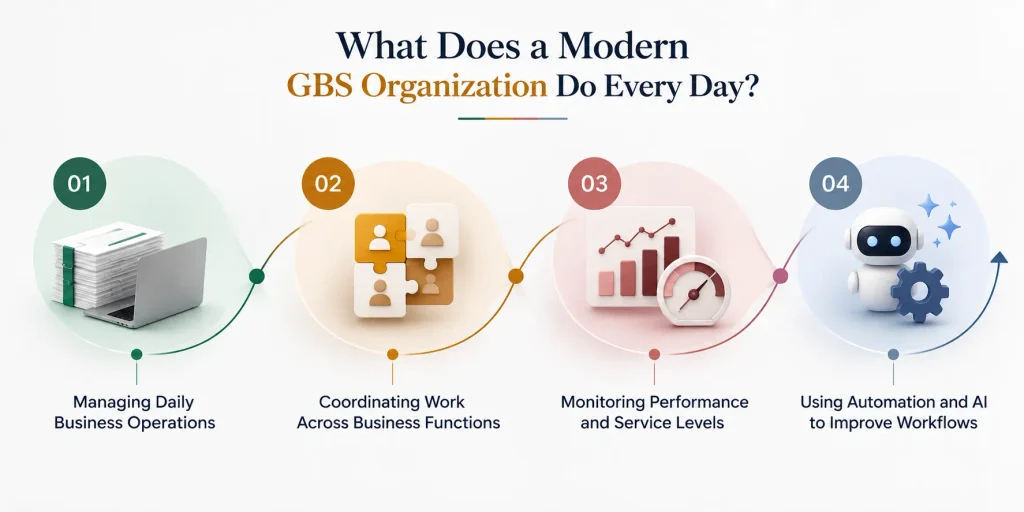
1. Managing Daily Business Operations
One of the most important responsibilities of a GBS organization is ensuring that routine business activities happen accurately and on time. These activities may appear straightforward, but they involve thousands of transactions, requests, approvals, and interactions across an enterprise.
Depending on its scope, a GBS team may handle:
- Processing supplier invoices and employee expense claims.
- Managing payroll inputs and employee service requests.
- Supporting purchase orders and supplier onboarding.
- Responding to customer billing and account inquiries.
- Managing IT service requests and access permissions.
- Maintaining business records and updating operational systems.
The GBS organization structure helps establish clear ownership for these activities, ensuring that requests reach the right teams and that responsibilities do not overlap unnecessarily. For instance, when an employee submits an expense claim, the process might involve checking documentation, validating policy compliance, obtaining approvals, processing reimbursement, and updating financial records.
A well-coordinated GBS team manages these steps through defined workflows rather than relying on disconnected departments and manual follow-ups.
The result is more predictable service delivery, fewer avoidable errors, and better visibility into operational performance.
2. Coordinating Work Across Business Functions
Modern enterprises rarely operate through isolated departments. Finance depends on procurement data, HR relies on IT systems, and customer operations need accurate information from sales and billing teams.
A GBS organization helps coordinate these interconnected activities.
Consider the procure-to-pay process. It begins when a business identifies a purchasing requirement and continues through requisition, purchase order creation, goods or services confirmation, invoice processing, and supplier payment.
Although different teams may participate in this process, fragmented responsibilities often lead to delays. A modern GBS model can help connect these activities through common workflows, shared performance measures, and clearer process ownership.
The GBS organization structure plays an important role here because it defines whether teams are organized by function, geography, end-to-end process, or a combination of these approaches.
Instead of measuring each department’s performance in isolation, leaders can evaluate the complete process and identify where delays, rework, or unnecessary approvals occur.
This broader perspective helps organizations move from managing individual tasks to improving the entire business workflow..
3. Monitoring Performance and Service Levels
A modern GBS organization does not simply complete work and move on. It also monitors whether services are meeting business expectations. Teams regularly review operational metrics, service-level agreements (SLAs), backlogs, turnaround times, accuracy rates, and customer satisfaction.
Common performance indicators include:
- Turnaround time: How long does it take to complete a request?
- Accuracy rate: How often is work completed without errors?
- SLA compliance: Are agreed service commitments being met?
- Backlog volume: How many requests or transactions remain unfinished?
- Cost per transaction: How much does it cost to complete a specific activity?
- Customer satisfaction: How do employees, suppliers, and internal business partners rate the service?
These measures help GBS leaders identify problems before they become larger operational issues.
For example, a finance team might notice that invoice processing times are increasing despite stable transaction volumes. Further investigation could reveal missing purchase order information, delayed approvals, or repeated manual data entry.
Rather than simply asking employees to work faster, the team can address the underlying cause. A clearly defined GBS organization structure establishes who reviews these metrics, who investigates performance gaps, and who is accountable for corrective action.
This creates a more disciplined approach to service management and continuous improvement.
4. Using Automation and AI to Improve Workflows
Technology is becoming an increasingly important part of everyday GBS operations. Automation can handle repetitive activities such as data extraction, invoice matching, report generation, and routine request routing. Artificial intelligence can support more complex tasks, including document classification, information retrieval, anomaly detection, and employee or customer assistance.
A modern GBS organization may use technologies such as robotic process automation (RPA), workflow platforms, AI-powered assistants, analytics tools, and enterprise resource planning (ERP) systems.
For example, an automated accounts payable workflow might extract invoice information, compare it with purchase orders, flag discrepancies, and route exceptions to the appropriate employee.
Similarly, an AI-powered employee support assistant might answer common questions about company policies or direct employees to the correct HR service.
However, automation does not eliminate the need for human oversight. Exceptions, sensitive decisions, unusual transactions, and policy-related judgments may still require experienced employees.
The GBS organization structure must therefore define how technology teams, process owners, business stakeholders, and risk functions collaborate. Daily responsibilities may include monitoring automated workflows, reviewing exceptions, evaluating AI outputs, resolving failed transactions, and identifying additional opportunities for improvement. The objective is to make work more efficient while maintaining accuracy, accountability, and appropriate controls.
What Does a Typical Day in GBS Look Like?
Although responsibilities vary by organization, a typical day may follow a pattern that combines operational execution, performance monitoring, problem-solving, and improvement.
Morning: Review priorities and service performance
Teams review outstanding requests, overnight processing results, service-level performance, system alerts, and unresolved exceptions. Managers identify urgent issues and allocate resources.
Midday: Execute work and resolve problems
Employees process transactions, respond to requests, coordinate with stakeholders, and investigate exceptions. Automation and AI tools handle suitable routine activities, while employees focus on judgment-intensive tasks.
Afternoon: Analyze results and improve processes
Teams review performance dashboards, discuss recurring issues, investigate root causes, and work on improvement initiatives. Leaders may meet with business stakeholders to discuss service performance and upcoming requirements.
End of day: Close activities and prepare for handovers
Teams update records, escalate unresolved issues, document important decisions, and prepare handovers where work spans multiple time zones.
This is an illustrative pattern, not a universal schedule. Some GBS operations run around the clock, while others follow local business hours or organize work around financial reporting cycles.
The important point is that a modern GBS organization balances daily service delivery with coordination, governance, and ongoing improvement.
How Is the GBS Organization Structure Evolving?
The GBS organization structure continues to evolve as enterprises seek greater integration across functions, geographies, and technology platforms.
Historically, many shared services models emphasized functional specialization and transaction efficiency. Modern GBS models increasingly combine this expertise with end-to-end process ownership, digital capabilities, analytics, and closer business alignment.
Several changes are shaping this evolution.
- From functional silos to process ownership: Teams increasingly focus on complete workflows rather than isolated activities.
- From manual execution to intelligent operations: Automation and AI help manage routine work and identify exceptions.
- From activity reporting to business outcomes: Performance measurement increasingly includes quality, resilience, experience, and value creation.
- From reactive support to proactive problem-solving: Data helps teams identify operational risks and inefficiencies earlier.
- From centralized control to connected delivery: Global standards can coexist with local expertise and regional requirements.
Not every organization will adopt the same model. The right approach depends on business size, geographic footprint, regulatory environment, process complexity, technology maturity, and strategic objectives.
For leaders exploring transformation, understanding these shifts is a useful starting point for evaluating how their existing operating model could evolve.
Conclusion
A modern GBS organization does far more than process transactions. It manages daily business services, connects cross-functional workflows, monitors performance, resolves exceptions, supports stakeholders, improves processes, and maintains operational controls.
Its effectiveness depends on how well people, processes, technology, and governance work together. The GBS organization structure provides the foundation for coordinating these elements, assigning accountability, and aligning service delivery with enterprise priorities.
For CXOs, digital leaders, and transformation consultants, the key question is not simply how much work can be centralized. It is how business services can become more connected, reliable, responsive, and intelligent.
Understanding what GBS teams do every day makes it easier to identify operational gaps, recognize opportunities for automation, and explore a more effective way to deliver business services.