








Key Takeaways
- RPA, AI, and Agentic AI solve different business challenges. RPA automates repetitive rule-based tasks, AI provides intelligence through analysis and predictions, while Agentic AI enables autonomous decision-making and execution.
- RPA remains valuable for stable, structured workflows. Organizations can achieve quick ROI with RPA for repetitive processes such as data entry, invoice processing, and rule-based approvals, but it struggles with changing environments and exceptions.
- AI adds intelligence but does not always drive action. AI can interpret complex data, identify patterns, and generate insights, but it typically requires humans or automation workflows to execute the next steps.
- Agentic AI enables autonomous, goal-driven automation. By combining reasoning, planning, and execution capabilities, Agentic AI can manage complex workflows, handle exceptions, and coordinate actions across multiple systems.
- The future of enterprise automation combines all three technologies. Successful automation strategies use RPA, AI, and Agentic AI together, selecting the right technology based on process complexity, data requirements, and desired level of autonomy.
If you’re evaluating automation options for your business, you’ve probably run into three terms that get used interchangeably and shouldn’t be: RPA, AI, and Agentic AI. Vendors often blur the lines between them because it helps close deals, but that blurring is precisely what leads teams to buy the wrong tool, underestimate implementation timelines, or miss ROI targets by a mile.
This guide explains what each technology does, where it excels and falls short, and how to choose the right one or combination for your workflows. By the end, you’ll have a clear framework for evaluating vendors and building a business case, not just a glossary of buzzwords.
The Short Answer
- PA (Robotic Process Automation) follows fixed, rule-based steps to automate repetitive digital tasks. It’s fast, cheap, and predictable, but it breaks the moment a process changes.
- AI (Artificial Intelligence) interprets unstructured data, recognizes patterns, and makes predictions or classifications. It handles ambiguity that RPA can’t, but on its own it doesn’t act; it only informs.
- Agentic AI combines reasoning, planning, and autonomous decision-making with the ability to take multi-step action across systems, adapting as conditions change, without a human scripting every step in advance.
They aren’t competitors on a single spectrum from “basic” to “advanced.” They solve different problems, and most mature automation strategies end up using all three together.
Side-by-Side Comparison
| Dimension | RPA | AI | Agentic AI |
| Core function | Executes predefined rules on structured tasks | Analyzes data, predicts, classifies, generates | Plans, decides, and acts autonomously toward a goal |
| Handles unstructured data | No | Yes | Yes |
| Adapts to change without reprogramming | No | Partially (within its trained scope) | Yes |
| Makes independent decisions | No | Limited (suggests, scores, ranks) | Yes (within defined guardrails) |
| Executes multi-step workflows across systems | Yes, if scripted step-by-step | No, typically feeds a decision to a human or system | Yes, dynamically |
| Implementation speed | Fast (days to weeks) | Moderate (weeks to months, needs data/training) | Slower (months; needs orchestration, governance) |
| Maintenance burden | High — breaks with UI/process changes | Moderate — needs retraining as data drifts | Moderate to high — needs monitoring of autonomous actions |
| Best-fit tasks | Data entry, invoice processing, report generation | Document classification, fraud detection, demand forecasting | End-to-end case resolution, dynamic customer service, complex approvals |
| Human oversight required | Low, once configured | Medium (review AI outputs) | Medium to high (approve/audit agent decisions) |
RPA: The Reliable Workhorse for Repetitive Tasks
RPA software “robots” mimic the exact clicks, keystrokes, and data transfers a human would perform in a digital interface. Think of it as recording a macro that never gets tired, never makes a typo, and can run 24/7.
Where RPA shines:
- Copying data between systems that don’t have a native integration (e.g., moving order details from an email into an ERP)
- Rule-based approvals with no judgment calls (“if invoice total < $500, auto-approve”)
- High-volume, repetitive back-office tasks like payroll processing or reconciliation
Where RPA breaks down:
- Any task requiring interpretation, reading a handwritten note, judging sentiment, or handling an exception that wasn’t scripted
- Processes that change frequently, since every UI update or workflow tweak can break the bot
- Anything involving unstructured inputs like PDFs with inconsistent formatting, images, or free-text customer messages
RPA delivers fast, measurable ROI on narrow, stable processes. It’s often the first automation investment companies make and the one that eventually hits a ceiling.
AI: Intelligence Without Autonomous Action
Where RPA follows instructions, AI interprets. Machine learning models and generative AI systems can read a contract and flag risky clauses, predict which customers are likely to churn, or classify support tickets by intent even when the input varies wildly in format and language.
Where AI shines
- Extracting meaning from unstructured data (documents, images, voice, free text)
- Forecasting and pattern detection at a scale humans can’t match
- Augmenting human decision-making with recommendations, risk scores, or summaries
Where AI falls short on its own:
- It typically stops at insight. A model might flag a fraudulent transaction, but something else—a human or a workflow—has to act on that flag
- Without orchestration, AI outputs often sit in a dashboard rather than triggering downstream action
- Model drift and the need for ongoing retraining mean AI isn’t “set and forget” the way RPA can be for stable processes
This is the critical distinction that trips up many buyers: AI tells you what’s likely true. It doesn’t, by itself, go do something about it.
Agentic AI: Reasoning Plus Autonomous Execution
Agentic AI is where the “tells you” and the “does it” merge. An AI agent can break a goal into steps, decide which tools or systems to use, execute those steps across multiple applications, evaluate the outcome, and adjust course, all with minimal human intervention, within guardrails you define.
Where Agentic AI shines:
- End-to-end processes with branching logic and exceptions, like resolving a customer dispute that requires checking order history, issuing a refund, and updating a CRM, all based on context that changes case by case
- Workflows that span multiple systems and require judgment about which action to take next, not just execution of a fixed sequence
- Reducing the “swivel-chair” work where a human currently has to interpret AI output and then manually trigger the next step
Where Agentic AI requires caution:
- Autonomous action carries real risk if guardrails aren’t well-defined, you need approval thresholds, audit trails, and rollback plans
- It’s the newest and most complex of the three, so implementation typically requires stronger data infrastructure and change management
- Governance and explainability matter more here than with RPA or narrow AI, especially in regulated industries
AI isn’t “RPA with extra steps” or “AI with a nicer UI.” It’s a genuinely different capability: the system decides and acts, adapting to situations no one explicitly scripted.
How to Choose: A Practical Decision Framework
Ask these three questions about the process you’re trying to automate:
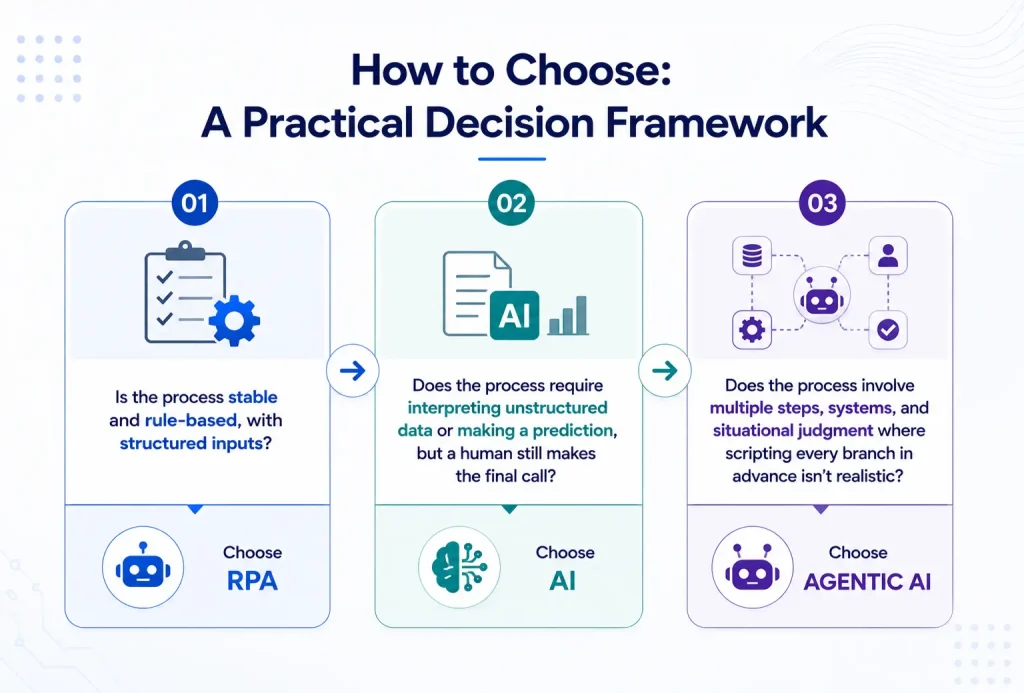
1. Is the process stable and rule-based, with structured inputs? If yes, and it doesn’t require judgment calls, RPA alone will likely deliver the fastest ROI.
2. Does the process require interpreting unstructured data or making a prediction, but a human still makes the final call? This is AI-augmented territory — use AI to generate the insight, and either RPA or a human to act on it.
3. Does the process involve multiple steps, systems, and situational judgment where scripting every branch in advance isn’t realistic? This is where Agentic AI earns its complexity. You’re not just automating a task, you’re delegating a goal.
Most organizations don’t pick one lane. A common pattern looks like this: AI classifies and extracts data from an incoming document → RPA moves that data into the right system → an agentic layer decides how to handle exceptions and coordinates the multi-step resolution. Each technology does the part it’s actually best at.
A Realistic Example: Insurance Claims Processing
- RPA pulls claim data from the intake form into the claims management system.
- AI reads the submitted documents, extracts relevant details, and flags claims that look potentially fraudulent based on historical patterns.
- Agentic AI takes the flagged and unflagged claims, decides the appropriate next step for each (auto-approve, route to adjuster, request more documentation), executes those actions across systems, and escalates only the cases that fall outside its confidence threshold.
The result isn’t “AI replacing RPA”, it’s three layers working together, each doing the job it’s actually built for.
Common Questions
Is agentic AI just a more advanced form of AI? Not exactly. Traditional AI is primarily analytical, it classifies, predicts, or generates. Agentic AI adds planning and autonomous execution on top of that analysis, so it acts rather than just informs.
Can RPA and AI work together without going “agentic”? Yes, and many organizations do exactly this today. AI handles interpretation, RPA handles execution, but a human or fixed workflow still decides which path each case takes. This is often called “intelligent automation” and is a reasonable middle step before adopting agentic systems.
Does Agentic AI eliminate the need for RPA? No. Agentic AI often still relies on RPA-style connectors to actually interact with legacy systems that don’t have modern APIs. Think of RPA as the “hands” an agent can use, not a technology it replaces.
What’s the biggest implementation risk with each? For RPA, it’s fragility, bots break when the underlying UI or process changes. For AI, it’s data quality and model drift. For Agentic AI, it’s governance, making sure autonomous decisions stay within acceptable bounds and remain auditable.
Choosing the Right Path Forward
There’s no universal “best” answer between RPA, AI, and Agentic AI, the right choice depends on how structured your processes are, how much judgment they require, and how much autonomous action you’re ready to govern. Many teams start with RPA for quick wins, layer in AI for the tasks that need interpretation, and adopt agentic capabilities once they’ve built the data foundation and governance model to support autonomous execution safely.
If you’re mapping out which of your processes fit where, it often helps to walk through your specific workflows with a team that’s done this evaluation before; the right architecture usually isn’t a single tool but the right combination for your environment. Reach out if you’d like a second set of eyes on your automation roadmap.