








Key Takeaways
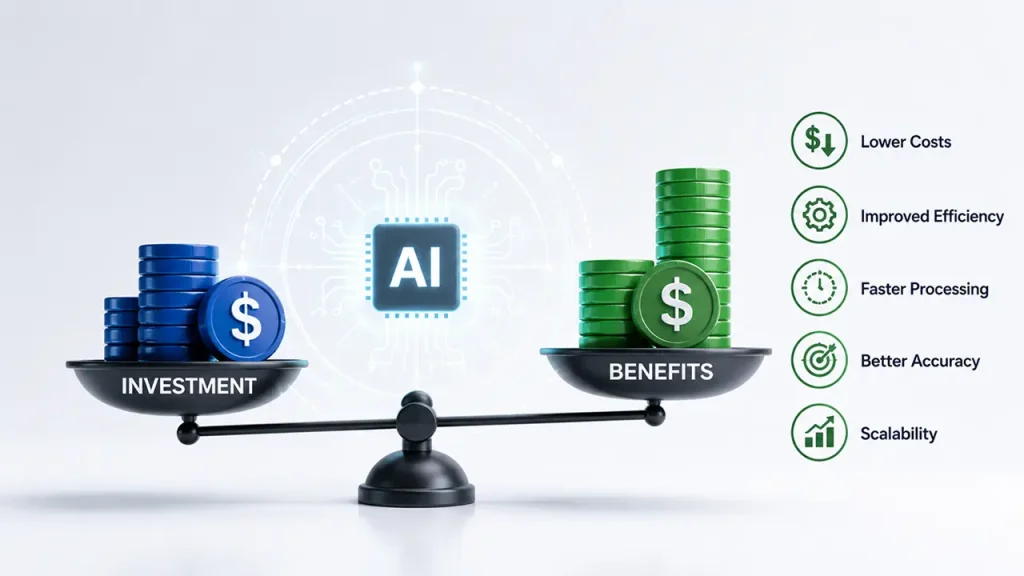
- AI alone cannot transform finance. While AI excels at generating insights and predictions, real business value comes from combining AI with automation, orchestration, governance, and enterprise integration.
- Execution is the missing link in finance transformation. Finance organizations achieve better outcomes when AI-driven insights automatically trigger workflows, approvals, and business actions instead of relying on manual intervention.
- A strong foundation is essential for scalable AI. High-quality data, standardized processes, and robust governance are critical to ensuring AI delivers accurate, compliant, and trustworthy results.
- Autonomous finance is the next evolution of AI in finance. Organizations are moving beyond standalone AI tools toward intelligent operating models where AI, automation, and human expertise work together to execute end-to-end finance processes.
- Future-ready finance teams will focus on strategy, not transactions. By automating repetitive work and embedding AI into enterprise workflows, finance professionals can spend more time on forecasting, risk management, business partnering, and strategic decision-making.
Artificial intelligence has become one of the most significant technology shifts in modern finance. Across industries, finance leaders are investing in AI to improve forecasting, automate reporting, strengthen controls, and accelerate decision-making.
The opportunity is substantial. AI can analyze complex financial data, identify patterns, generate insights, and support finance professionals in making faster and more informed decisions.
However, as organizations move from experimentation to enterprise deployment, a critical realization is emerging: AI alone is not enough.
The challenge facing finance organizations today is not the availability of intelligence. Most enterprises already have access to large volumes of financial data, advanced analytics platforms, and sophisticated reporting systems.
The challenge is transforming intelligence into action.
Finance functions continue to operate across fragmented systems, manual processes, disconnected workflows, and complex approval structures. As a result, even the most advanced AI solutions often remain limited to providing recommendations rather than driving measurable operational change.
The next phase of finance transformation will not be defined by adopting more AI tools. It will be defined by creating intelligent operating models where AI works together with automation, enterprise systems, governance frameworks, and human expertise.
Finance Does Not Need More Intelligence—It Needs Intelligent Execution
Finance has always been a data-driven function.
Organizations rely on financial data to understand performance, manage risks, optimize costs, and make strategic decisions. Today, AI in finance is enhancing these capabilities by enabling faster analysis and more predictive insights.
For example, AI can help finance teams:
- Predict cash flow trends
- Identify unusual transactions
- Analyze spending patterns
- Generate financial reports
- Support forecasting activities
- Improve risk detection
These capabilities create significant value. However, insights alone do not transform finance operations.
A finance leader may know that a customer is likely to delay payment. But business value comes from what happens next:
- Does the system automatically prioritize collections?
- Are account managers notified?
- Are payment risks reflected in forecasts?
- Are alternative actions recommended?
- Are workflows triggered automatically?
Without execution capabilities, AI remains an intelligent assistant rather than an autonomous business capability. This distinction is becoming increasingly important as organizations move beyond AI experimentation and focus on measurable enterprise outcomes.
Why AI Alone Cannot Deliver End-to-End Finance Transformation
AI provides intelligence, but finance requires orchestration Enterprise finance processes are not isolated activities. They involve multiple systems, stakeholders, controls, and decisions.
Consider the accounts payable process. AI can read invoices, extract information, identify duplicate payments, and recommend approval decisions.
However, a complete accounts payable transformation requires much more:
- Matching invoices with purchase orders
- Validating supplier information
- Applying business rules
- Routing approvals
- Updating ERP systems
- Managing payments
- Maintaining audit trails
AI can support each step, but it cannot independently manage the entire process without an underlying operating framework. This is why many organizations experience a gap between AI investment and business value. They introduce AI into existing processes without redesigning how work flows across the enterprise. The result is improved individual tasks but limited end-to-end transformation.
The Shift from AI Tools to Autonomous Finance Operations
The future of finance will not be built around standalone AI applications. It will be built around autonomous operating models that combine intelligence, automation, and orchestration.
An autonomous finance model brings together multiple capabilities:
1. Artificial Intelligence
AI provides reasoning, prediction, and decision support by analyzing large volumes of financial information.
2. Intelligent Automation
Automation executes repetitive activities such as data processing, reconciliation, reporting, and transaction management.
3. Workflow Orchestration
Orchestration connects processes, systems, and teams to ensure actions happen at the right time and in the right sequence.
4. Enterprise Integration
Integrated systems allow financial processes to move seamlessly across ERP, procurement, customer, and operational platforms.
5. Human Oversight
Finance professionals remain responsible for strategic decisions, complex exceptions, and business judgment.
Together, these capabilities create a finance function that is not only intelligent but also operationally responsive.
Three Foundations Required to Scale AI in Finance
Organizations that successfully scale AI in finance typically focus on three critical foundations.
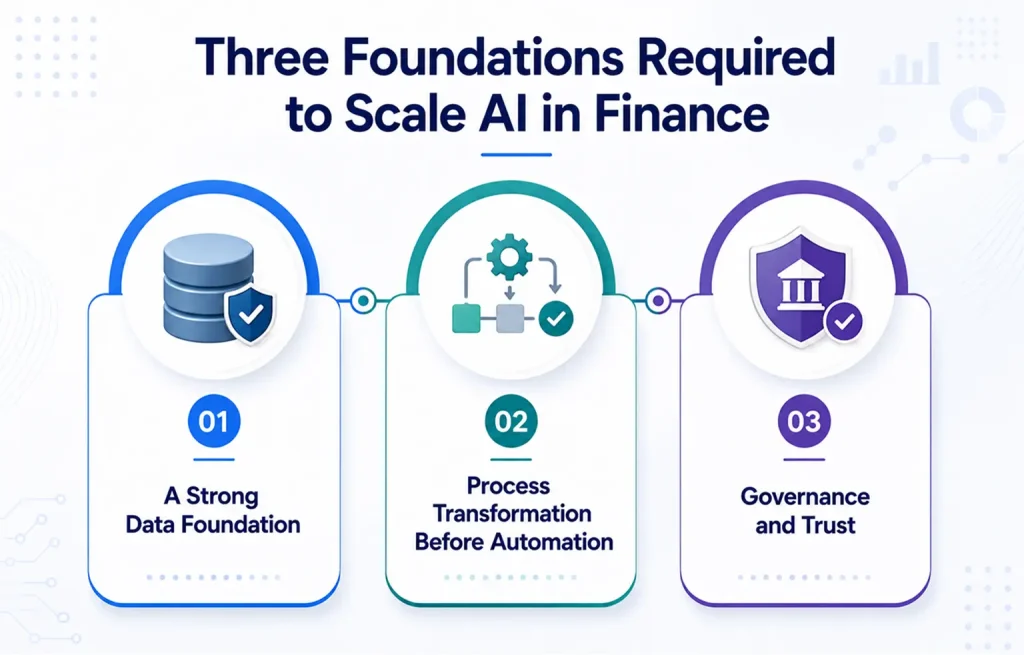
1. A Strong Data Foundation
AI systems are only as effective as the data they can access. Finance data is often distributed across multiple applications, business units, and geographies. Inconsistent data structures and disconnected systems can limit AI effectiveness.
A successful AI strategy requires:
- Unified financial data
- Real-time information access
- Data quality management
- Enterprise-wide visibility
Without reliable data, AI recommendations may lack accuracy, context, or business relevance.
2. Process Transformation Before Automation
Many organizations attempt to automate inefficient processes. However, AI does not eliminate process complexity—it can amplify it. Before implementing AI, finance leaders must evaluate:
- Which processes create unnecessary effort?
- Where do manual handoffs occur?
- Which decisions follow predictable rules?
- Where can automation create the highest impact?
Process optimization ensures that AI is applied to redesigned workflows rather than outdated operating models.
3. Governance and Trust
Finance operates in an environment where accuracy, compliance, and transparency are essential.
AI adoption requires strong governance frameworks that address:
- Data security
- Model monitoring
- Decision transparency
- Regulatory compliance
- Human accountability
Trust is a critical factor in scaling AI across enterprise finance. Without governance, organizations may limit AI adoption due to concerns around reliability and control.
Building an AI-Native Finance Operating Model
The true opportunity of AI in finance is not simply to reduce manual work. It is redefining how finance creates value. An AI-native finance operating model enables organizations to shift from transaction processing toward strategic business partnership.
In this model:
- Digital workers manage repetitive activities
- AI agents support analysis and decisions
- Automated workflows execute processes
- Finance teams focus on strategy and insights
- Leaders access real-time business intelligence
This creates a more agile finance function capable of responding faster to changing market conditions. For example, instead of finance teams spending significant time collecting and validating information for monthly reporting, AI-enabled systems can continuously analyze business performance and highlight important trends.
Finance leaders can then spend more time on strategic questions:
- Where should investments increase?
- How can profitability improve?
- What risks require attention?
- Which opportunities should be prioritized?
The role of finance evolves from reporting what happened to helping shape what happens next.
The Future of Finance: Moving Beyond AI Adoption
The conversation around AI in finance is entering a new phase. The question is no longer whether AI can improve finance processes. The question is how organizations can redesign finance operations to fully capture AI’s potential.
Successful enterprises will move beyond isolated AI implementations and create connected ecosystems where AI, automation, data, and human expertise work together.
The organizations that achieve the greatest impact will recognize that AI is not the destination.
It is a foundational capability within a broader transformation strategy.
The future of finance will belong to organizations that combine:
- AI-driven intelligence
- Automated execution
- Connected enterprise systems
- Strong governance
- Human expertise
AI can help finance understand more. But when combined with automation and intelligent operating models, it can help finance achieve more. The next generation of finance transformation will not be about making machines smarter.
It will be about creating finance organizations that are faster, more adaptive, and capable of continuously delivering business value.