









Key Takeaways
- AI modernizes revenue cycle management by automating complex financial processes, improving operational efficiency, and enabling faster, more accurate revenue realization across industries.
- Traditional revenue cycle management struggles to scale due to manual workflows, fragmented systems, revenue leakage, and limited real-time financial visibility.
- AI-powered technologies such as machine learning, intelligent document processing, predictive analytics, and natural language processing enhance billing, collections, dispute resolution, forecasting, and fraud detection.
- Organizations adopting AI gain measurable business benefits, including improved cash flow, reduced operational costs, greater financial accuracy, lower revenue leakage, and stronger customer experiences.
- The future of revenue cycle management is autonomous, with Agentic AI and intelligent automation enabling end-to-end financial operations that continuously optimize revenue performance and support strategic business growth.
Revenue is the lifeblood of every business, but managing the processes that generate, capture, and collect that revenue has become increasingly complex. Organizations today operate across multiple channels, serve diverse customer bases, and process thousands—or even millions—of transactions daily. Consequently, traditional revenue cycle management (RCM) processes often fail to meet increasing operational demands, resulting in billing errors, delayed payments, revenue leakage, and poor customer experiences.
Artificial intelligence is changing that landscape. Rather than simply automating repetitive tasks, AI enables organizations to predict payment risks, identify anomalies, streamline billing operations, improve collections, and optimize financial decision-making. By combining machine learning, natural language processing, intelligent document processing, and predictive analytics, businesses can transform revenue cycle management into an intelligent, data-driven function that continuously improves performance.
While revenue cycle management is commonly associated with healthcare, its principles extend far beyond hospitals and medical providers. Industries such as insurance, telecommunications, banking, utilities, manufacturing, logistics, subscription services, and SaaS all rely on efficient revenue cycles to maintain healthy cash flow and sustain profitability. Across these sectors, AI is helping organizations accelerate revenue realization, reduce operational costs, and improve financial resilience.
This article explores how AI is reshaping revenue cycle management, the technologies driving this transformation, practical use cases across industries, and the strategies organizations should adopt to build a future-ready revenue management ecosystem
What Is Revenue Cycle Management?
Revenue cycle management refers to the end-to-end process of managing every activity involved in generating and collecting revenue. It begins when a customer initiates a transaction or requests a service and continues through invoicing, payment collection, reconciliation, dispute resolution, and financial reporting.
Although the specific workflows differ across industries, the objective remains the same: ensure that every legitimate transaction is accurately billed, collected, reconciled, and recorded while minimizing delays, errors, and revenue leakage.
A typical revenue cycle includes:
- Customer onboarding and account creation
- Order or service validation
- Contract and pricing verification
- Invoice generation
- Payment processing
- Collections and follow-ups
- Dispute and deduction management
- Payment reconciliation
- Financial reporting and revenue analytics
Historically, many of these activities have relied heavily on manual intervention. Finance teams spend considerable time validating invoices, matching payments, responding to customer disputes, resolving billing inconsistencies, and generating financial reports. As transaction volumes increase, these manual processes become difficult to scale, creating bottlenecks that affect both operational efficiency and customer satisfaction.
Modern revenue cycle management is therefore evolving beyond process automation toward intelligent decision-making, where AI continuously analyzes data, identifies patterns, and recommends or executes actions with minimal human intervention.
Why Traditional Revenue Cycle Management Falls Short
Despite significant investments in enterprise resource planning (ERP), customer relationship management (CRM), and financial systems, many organizations still rely on fragmented and manual revenue cycle management processes. As businesses expand across geographies, channels, and customer segments, the complexity of managing billing, collections, reconciliations, and revenue reporting continues to grow.
Traditional automation can handle repetitive tasks based on predefined rules, but it struggles when exceptions arise. Disputed invoices, incomplete customer information, changing contract terms, delayed payments, or fluctuating pricing models often require human intervention. As a result, finance teams spend valuable time resolving issues instead of focusing on strategic initiatives.
Some of the most common challenges include:
1. Data Silos Across Business Functions
Revenue-related data is often distributed across CRM platforms, ERP systems, billing applications, payment gateways, procurement systems, and customer support tools. Without a unified view, finance teams must manually consolidate information, increasing the risk of delays and errors.
2. Revenue Leakage
Incorrect pricing, duplicate invoices, missed billing opportunities, unauthorized discounts, and delayed collections can significantly impact profitability. Even small inaccuracies, when multiplied across thousands of transactions, result in substantial revenue loss.
3. Slow Collections and Cash Flow Constraints
Manual follow-ups and reactive collections processes extend payment cycles and increase Days Sales Outstanding (DSO). Delayed cash inflows affect working capital and limit an organization’s ability to invest in growth initiatives.
4. High Volume of Exceptions
No two customers behave exactly alike. Payment disputes, deductions, contract amendments, partial payments, and compliance requirements create numerous exceptions that traditional workflow automation cannot easily resolve.
5. Limited Financial Visibility
Many organizations generate financial reports after transactions have already occurred. This reactive approach makes it difficult to identify risks early, forecast revenue accurately, or make informed business decisions based on real-time insights.
As organizations grow, these inefficiencies become increasingly expensive. Finance leaders are therefore looking beyond conventional automation toward intelligent technologies capable of learning from data, adapting to changing business conditions, and continuously optimizing financial operations.
How AI Is Transforming Revenue Cycle Management
Artificial intelligence is fundamentally redefining revenue cycle management by moving finance operations from rule-based execution to intelligent decision-making. Rather than simply automating repetitive tasks, AI analyzes large volumes of structured and unstructured data to identify patterns, predict outcomes, and recommend the most effective actions in real time.
This enables organizations to proactively manage revenue instead of reacting to issues after they occur.
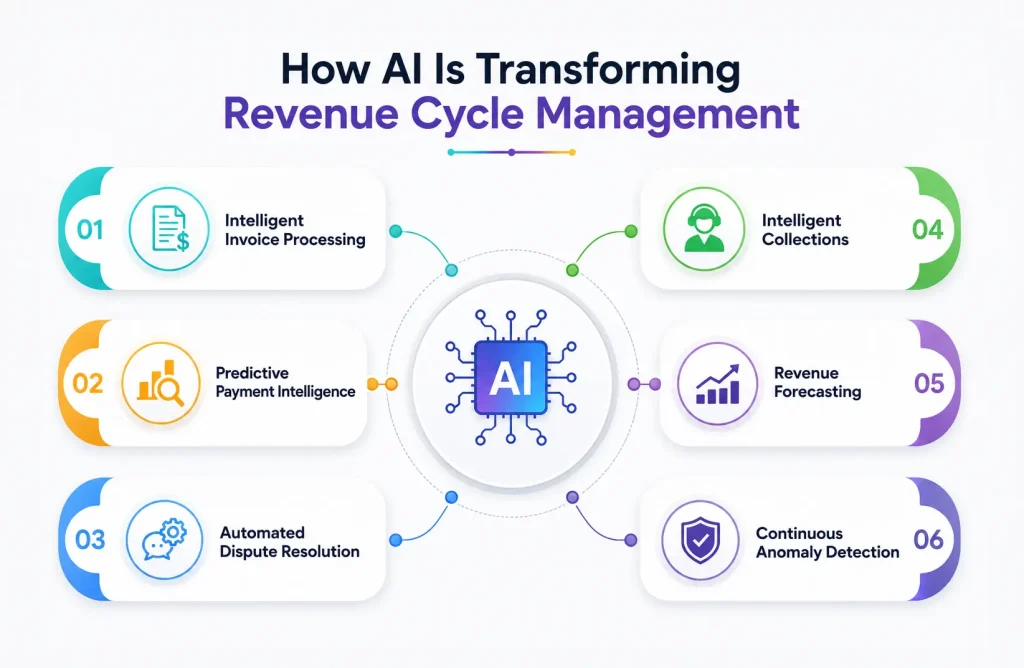
1. Intelligent Invoice Processing
AI-powered Intelligent Document Processing (IDP) extracts data from invoices, purchase orders, contracts, emails, and supporting documents with high accuracy. Machine learning models validate extracted information against business rules, reducing manual data entry while improving invoice accuracy and processing speed.
2. Predictive Payment Intelligence
Instead of waiting for invoices to become overdue, AI analyzes historical payment behavior, customer risk profiles, seasonal trends, and external market factors to predict delayed payments. Finance teams can prioritize high-risk accounts and initiate proactive collection strategies before cash flow is affected.
3. Automated Dispute Resolution
Customer disputes often involve reviewing contracts, invoices, emails, payment records, and supporting documentation. AI can consolidate relevant information, identify the root cause of disputes, recommend appropriate resolutions, and even generate responses for customer communication, significantly reducing resolution time.
4. Intelligent Collections
Modern AI systems move beyond generic payment reminders by personalizing collection strategies based on customer behavior. They determine the optimal communication channel, timing, and messaging for each customer, improving recovery rates while maintaining stronger customer relationships.
5. Revenue Forecasting
Machine learning continuously evaluates historical revenue patterns, payment cycles, customer purchasing behavior, and market conditions to produce more accurate revenue forecasts. Finance leaders gain better visibility into expected cash flow and can make more informed strategic decisions.
6. Continuous Anomaly Detection
AI continuously monitors financial transactions to detect duplicate invoices, pricing inconsistencies, unusual payment patterns, unauthorized discounts, or fraudulent activities. Early identification allows organizations to minimize financial losses and strengthen governance.
Unlike traditional automation, AI improves over time. As more transactions are processed, machine learning models become increasingly accurate, enabling revenue cycle management processes to adapt to changing customer behaviors, evolving regulations, and dynamic market conditions without extensive manual reconfiguration.
The result is a more intelligent, scalable, and resilient revenue cycle management function—one that not only reduces operational costs but also supports faster revenue realization, better customer experiences, and stronger financial performance.
The Future of AI in Revenue Cycle Management
The future of revenue cycle management extends beyond automation toward autonomous financial operations powered by intelligent agents. Advances in Agentic AI, generative AI, and predictive analytics are enabling organizations to build revenue processes that not only execute tasks but also make informed decisions, coordinate workflows, and continuously improve performance.
Future AI solutions will be capable of independently monitoring revenue operations, identifying bottlenecks, initiating corrective actions, and collaborating across enterprise systems with minimal human intervention. Instead of simply processing invoices or matching payments, AI agents will orchestrate end-to-end revenue workflows—from customer onboarding and billing to collections, dispute resolution, and financial reporting.
Generative AI will further enhance customer communication by drafting personalized payment reminders, generating dispute responses, summarizing contracts, and assisting finance teams with financial documentation. Meanwhile, predictive models will continue to improve revenue forecasting, customer risk assessment, and pricing optimization, enabling organizations to anticipate challenges before they affect business performance.
As AI technologies mature, revenue cycle management will evolve from a back-office operational function into a strategic driver of business growth, customer satisfaction, and financial resilience.
Conclusion
As organizations navigate increasing transaction volumes, evolving customer expectations, and growing financial complexity, traditional approaches to revenue cycle management are no longer sufficient. Manual processes, disconnected systems, and reactive decision-making create inefficiencies that slow revenue realization and limit business growth.
Artificial intelligence is transforming revenue cycle management by combining intelligent automation with predictive insights across billing, collections, reconciliation, dispute management, forecasting, and financial reporting. Rather than replacing finance professionals, AI empowers them with faster access to information, greater operational visibility, and the ability to make smarter, data-driven decisions.
Organizations that adopt AI strategically—aligning technology with business objectives and integrating it seamlessly into existing financial ecosystems—will be better positioned to reduce operational costs, improve cash flow, minimize revenue leakage, and enhance customer experiences. As intelligent automation continues to evolve, AI will become a foundational capability for organizations seeking to build agile, scalable, and future-ready revenue operations.
Whether you’re beginning your AI journey or looking to scale existing automation initiatives, investing in intelligent revenue cycle management today can create long-term competitive advantages that extend far beyond operational efficiency.