









Key Takeaways
- Collections automation accelerates payments by automating reminders, follow-ups, and collection workflows.
- Smart prioritization improves efficiency by directing collectors toward high-value and high-risk accounts.
- Automation boosts productivity by reducing manual work and allowing teams to focus on customer interactions.
- Tracking KPIs beyond DSO provides deeper insights into collections performance and cash flow health.
- Successful implementation requires the right strategy, including standardized processes, system integration, and continuous optimization.
For most finance leaders, improving cash flow starts with one metric: Days Sales Outstanding (DSO). Every extra day that invoices remain unpaid ties up working capital, increases borrowing needs, and creates uncertainty across the business.
Traditionally, organizations have attempted to reduce DSO by hiring more collection agents, increasing customer follow-ups, or tightening credit policies. While these approaches can help, they often become less effective over time because they rely heavily on manual effort.
This is where collections automation is making a difference. Rather than replacing collection teams, automation enables them to prioritize the right accounts, communicate with customers at the right time, and resolve payment issues faster.
But does automation actually reduce DSO, or is it simply another technology trend?
The available data suggests that organizations adopting collections automation consistently experience measurable improvements in collection efficiency, cash flow visibility, and overdue receivables. While results vary by industry, company size, and implementation strategy, the evidence points in the same direction: automation helps businesses collect faster by making the collections process more intelligent and consistent.
Why DSO Remains One of Finance’s Most Important KPIs
DSO measures the average number of days it takes a company to collect payment after making a sale. A lower DSO generally indicates healthier cash flow and more efficient accounts receivable operations.
A high DSO can create several business challenges, including:
- Reduced working capital
- Delayed investments
- Higher financing costs
- Increased bad debt risk
- Poor cash flow forecasting
- Greater administrative effort
Even businesses with strong revenue growth can face liquidity issues if receivables remain outstanding for too long. This is why CFOs increasingly view collections as a strategic process rather than simply an operational task.
Why Traditional Collections Often Struggle
Many organizations still rely on manual collection processes that include spreadsheets, shared inboxes, and individual collector judgment.
These methods create several common problems:
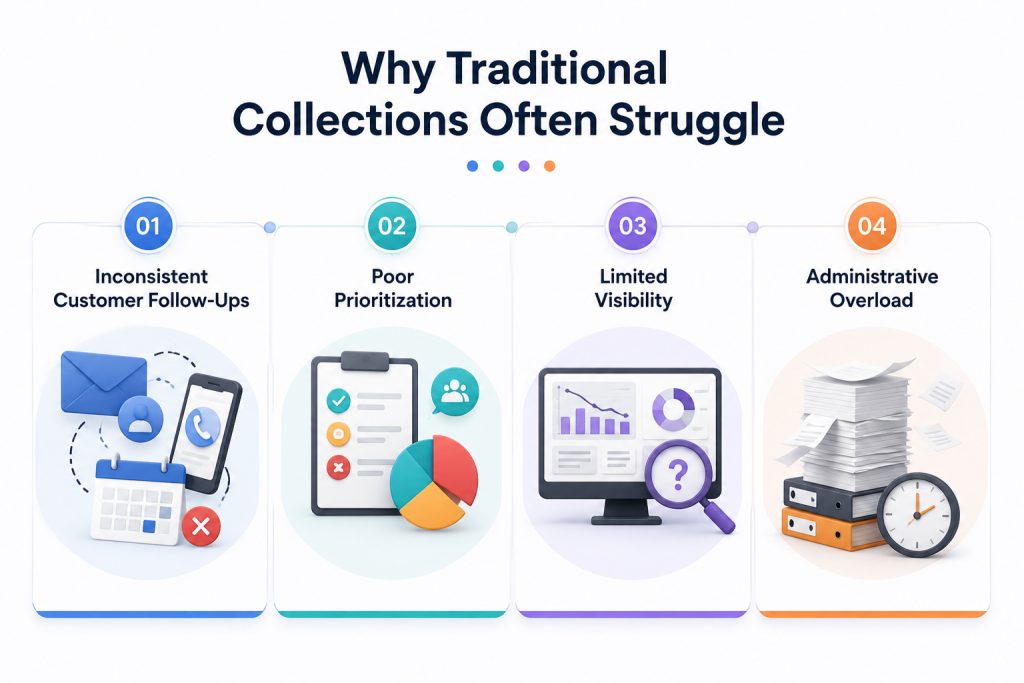
1. Inconsistent Customer Follow-Ups
Some customers receive reminders too frequently, while others receive none at all.
2. Poor Prioritization
Collectors often work accounts based on aging reports instead of payment probability or customer risk.
3. Limited Visibility
Managers struggle to understand which accounts require immediate attention.
4. Administrative Overload
Collectors spend significant time preparing emails, updating notes, searching ERP systems, and generating reports instead of speaking with customers. As invoice volumes increase, these inefficiencies become even more pronounced.
What Collections Automation Actually Does
Rather than automating only reminder emails, modern collections automation manages the entire collection workflow.
Typical capabilities include:
| Manual Process | Collections Automation |
| Manual reminder emails | Automated communication workflows |
| Spreadsheet tracking | Real-time dashboards |
| Static aging reports | Risk-based prioritization |
| Manual task assignments | Intelligent work queues |
| Separate ERP updates | Automated ERP synchronization |
| Manual reporting | Live performance analytics |
Automation creates standardized processes while allowing collectors to focus on high-value customer conversations.
What the Data Says About DSO Reduction
Although every organization starts from a different baseline, multiple industry studies and finance transformation reports consistently show several measurable improvements after implementing collections automation.
1. Faster Customer Follow-Up
Research consistently shows that invoices contacted early are significantly more likely to be paid on time. Automation ensures that reminders are sent immediately according to predefined schedules instead of waiting for manual action.
This reduces delays that often occur because collectors are handling hundreds or thousands of open invoices simultaneously.
2. Better Collector Productivity
Studies frequently report productivity improvements because collectors spend less time on repetitive administrative work.
Instead of manually:
- finding overdue invoices,
- preparing reminder emails,
- updating collection notes,
- generating reports,
Automation completes these activities automatically, allowing collectors to dedicate more time to dispute resolution and customer negotiations, which have a greater impact on payment speed. Collectors can then dedicate more time to dispute resolution and customer negotiations, activities that have a greater impact on payment speed.
3. Improved Prioritization
One of the strongest findings across finance transformation projects is that not every overdue invoice deserves equal attention.
Collections automation helps organizations prioritize accounts based on factors such as:
- payment history
- invoice value
- customer risk
- promise-to-pay status
- aging
- dispute history
Rather than contacting every customer equally, collectors focus first on accounts with the highest financial impact.
Why Automation Reduces DSO
The relationship between automation and DSO isn’t based on sending more emails.
Instead, automation removes delays throughout the collections lifecycle.
For example:
| Manual Delay | Automated Improvement |
| Reminder sent several days late | Scheduled automatically |
| Collector misses follow-up | Automated task creation |
| Customer dispute overlooked | Workflow escalation |
| Payment promises forgotten | Automated reminders |
| Aging reports updated weekly | Real-time monitoring |
Small improvements at every stage collectively shorten the average collection cycle.
Measuring the Success of Collections Automation
Reducing DSO is only one indicator of success.
Organizations should also monitor metrics such as:
| KPI | Why It Matters |
| Days Sales Outstanding | Measures overall collection efficiency |
| Collection Effectiveness Index (CEI) | Evaluates collection performance |
| Percentage of overdue invoices | Shows aging improvement |
| Promise-to-pay fulfillment | Indicates customer commitment |
| Collector productivity | Measures operational efficiency |
| Bad debt write-offs | Reflects long-term collection quality |
| Cash collected per collector | Demonstrates workforce effectiveness |
Tracking multiple KPIs provides a more complete picture of business impact.
Best Practices for Successful Collections Automation
Technology alone does not guarantee lower DSO.
Organizations achieve stronger results when they:
- Standardize collection workflows before automation.
- Keep customer communication professional and personalized.
- Integrate automation with ERP and CRM systems.
- Continuously review collection rules.
- Use dashboards to monitor performance.
- Train collectors to focus on relationship management rather than repetitive administration.
- Measure outcomes and optimize processes regularly.
Successful implementations combine technology with process improvement.
Common Misconceptions About Collections Automation
Several myths still discourage organizations from adopting automation.
1. Myth: Automation replaces collectors.
Reality: Automation handles repetitive tasks while collectors focus on complex customer interactions.
2. Myth: Automated emails damage customer relationships.
Reality: Well-designed communication workflows provide timely, consistent, and professional interactions that often improve the customer experience.
3. Myth: DSO reduction happens immediately.
Reality: Most organizations see gradual improvements as workflows mature, data quality improves, and teams optimize collection strategies.
Conclusion
The evidence increasingly shows that collections automation is more than a productivity tool—it is a practical way to improve cash flow by reducing inefficiencies throughout the collections process.
While the exact level of DSO reduction varies across organizations, the underlying drivers remain consistent. Faster follow-ups, intelligent prioritization, standardized workflows, and real-time visibility enable finance teams to collect payments more efficiently without increasing manual effort.
As businesses continue to modernize finance operations, collections automation is becoming an essential capability for organizations seeking stronger cash flow, improved customer experiences, and more predictable financial performance. Rather than simply chasing overdue invoices, finance teams can shift toward proactive, data-driven collections that support sustainable growth.
By combining automation with analytics and AI, organizations are better positioned to reduce DSO, strengthen working capital, and build a more resilient accounts receivable function for the future.