






Key Takeaways
- Manual invoice processing costs far more than labor alone, creating hidden financial drains through missed discounts, duplicate payments, compliance efforts, late fees, and operational inefficiencies.
- Organizations processing thousands of invoices annually can recover hundreds of thousands of dollars by reducing invoice cycle times, eliminating errors, and increasing straight-through processing rates.
- The biggest hidden cost is opportunity cost—highly skilled AP professionals spend valuable time on data entry and exception handling instead of strategic finance activities and vendor management.
- A strong business case for invoice automation starts with measuring current invoice volumes, processing costs, cycle times, payment delays, and exception rates using internal data rather than industry averages.
- Modern invoice automation solutions integrate with existing ERP systems, improve visibility, strengthen fraud controls, accelerate approvals, and often deliver payback within months rather than years.
Your AP team processes hundreds of invoices a week. They’re diligent, experienced, and careful. And yet, somewhere in that stack of PDFs, email threads, and spreadsheet lookups, your organization is quietly bleeding money — in ways that never appear on a single line item.
Most finance leaders know manual invoice processing isn’t ideal. What they underestimate is the full magnitude of the cost — not just the labor hours, but the compounding inefficiencies, risk exposure, and strategic opportunity cost that quietly erode margins year after year.
This guide quantifies what you may already suspect, gives you the frameworks to build an internal business case, and shows what modern invoice automation actually delivers — beyond the vendor pitch deck.
The Visible Costs (That CFOs Already Know)
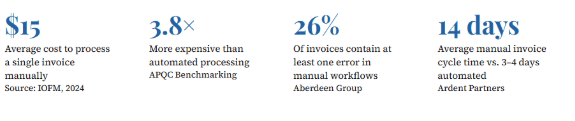
Let’s start with what appears on the P&L — labor. A full-time AP clerk processing invoices 8 hours a day, five days a week, handles roughly 5–8 invoices per hour when tasks include data entry, GL coding, routing for approval, and matching to POs.
At $55,000 annual fully-loaded cost per AP specialist and an average manual processing cost of $15/invoice, an organization processing 50,000 invoices per year is spending $750,000 annually on direct processing costs alone — before a single error, late payment, or compliance failure enters the picture.
| Cost Category | Manual | Automated | Status |
| Cost per invoice | $12–$18 | $3–$5 | 3× higher |
| Average cycle time | 10–18 days | 3–5 days | 4× slower |
| Error / exception rate | 20–30% | 2–4% | 10× more errors |
| Early payment discount capture | 15–25% | 75–90% | Missed savings |
| Duplicate payment rate | 0.5–1.5% | <0.05% | Fraud exposure |
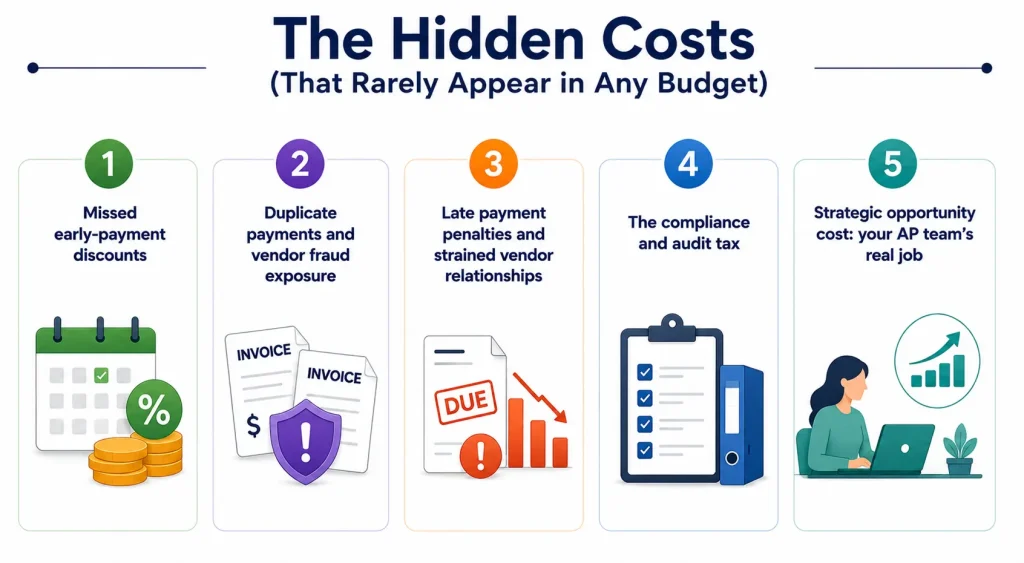
The Hidden Costs (That Rarely Appear in Any Budget)
This is where the real CFO conversation begins. The visible labor cost is only the surface. Below it sits a web of harder-to-quantify, but entirely real, financial drains.
1. Missed early-payment discounts
Most vendor contracts offer 1–2% discounts for payment within 10 days (net-10). With a 14-day average processing cycle, manual operations almost never qualify. For a company with $20M in annual payables, capturing even 1% early-pay discounts consistently represents $200,000 in recovered cash — money that requires no new revenue, no headcount, and no negotiation.
“We had no idea we were leaving $180,000 on the table annually just from missed early-pay discounts. The invoice automation ROI calculation became very simple after that.”
— VP Finance, mid-market manufacturer (250 employees)
2. Duplicate payments and vendor fraud exposure
Industry benchmarks suggest that 0.5–1.5% of manually processed invoices result in duplicate payments. This happens when the same invoice arrives via email and postal mail, when invoice numbers are slightly varied, or when approval workflows lose track of prior payments. For a $20M payables operation, that’s $100,000–$300,000 paid twice — some of which is never recovered.
Manual processing also increases exposure to business email compromise (BEC) and vendor impersonation fraud, which the FBI’s IC3 report identified as the top financial cybercrime category, costing US businesses over $2.9 billion in 2023 alone.
3. Late payment penalties and strained vendor relationships
When invoices sit in inboxes or physical trays awaiting review, late fees accumulate. Standard vendor contracts often include 1.5% monthly interest on overdue balances — and vendors who repeatedly experience payment delays quietly adjust pricing, deprioritize orders, and withdraw favorable terms at contract renewal time. These costs are real but never appear in an AP budget line.
4. The compliance and audit tax
Manual invoice workflows generate inconsistent records. Approval chains live in email. Supporting documentation is scattered across file servers. When audit season arrives — whether internal, external, or regulatory — your finance team spends weeks reconstructing paper trails that automated systems would have captured automatically. Time is money, and audit readiness is a measurable operational cost.
5. Strategic opportunity cost: your AP team’s real job
Perhaps the most significant hidden cost is the one that never shows up in any expense report: what your AP team could be doing instead. Skilled finance professionals handling data entry and PDF wrangling aren’t doing vendor analysis, cash flow optimization, or strategic sourcing support. When invoice automation handles the transactional work, finance talent shifts to high-value activity.
The best finance teams don’t process invoices. They analyze spend patterns, negotiate better terms, and identify savings opportunities. Automation makes that possible at sca
Building the Business Case: A CFO’s ROI Framework
The challenge finance leaders face internally isn’t whether invoice automation delivers ROI — the data is clear that it does. The challenge is building a number that withstands board scrutiny and CFO sign-off. Here’s how to structure it.
Step 1: Establish your current cost baseline
Pull three data points: total invoices processed annually, total AP headcount (fully loaded), and your current cycle time. From these, you can calculate your actual cost per invoice. Most organisations find that their true cost-per-invoice is higher than they assumed once they include overhead, rework, and exception handling.
Step 2: Quantify your specific leakage categories
Don’t use generic benchmarks in your board deck — use your own numbers. Review 90 days of invoices for duplicate payments, late fees paid, early-pay discounts missed, and exception processing time. The specificity makes the case compelling and resistant to challenge.
Step 3: Model the automation scenario
A well-implemented invoice automation platform typically achieves: 70–80% straight-through processing (no human touch), cost-per-invoice reduction to $3–5, cycle time compression to 3–4 days, and error rates below 3%. Use these as conservative targets in your model.
Illustrative scenario · 50,000 invoices / year · $20M payables
$680,000 – $1.1M annual value recoveredBreakdown: $500K labor savings (2 FTE redeployment) + $200K early-pay discounts captured + $120K duplicate payment elimination + $80K late fee avoidance + $100K audit efficiency gains. Automation platform cost: $120–180K annually. Payback: 4–7 months.
What Good Invoice Automation Actually Looks Like
The market is crowded with AP automation vendors making similar promises. CFOs evaluating solutions should look beyond feature checklists and interrogate three things: integration depth, exception handling quality, and total cost of ownership.
- ERP-native integration: True automation connects directly to your ERP (SAP, Oracle, NetSuite, Dynamics) for real-time GL coding, PO matching, and approval routing — not a nightly file transfer.
- Intelligent data capture: OCR alone is 1990s technology. Modern platforms use machine learning trained on millions of invoice formats to extract data with 98%+ accuracy across structured and unstructured formats.
- Configurable approval workflows: Approval rules should mirror your actual authorization matrix — by amount, department, vendor category, and business unit — without expensive professional services to reconfigure.
- Real-time visibility dashboard: CFOs need to see invoice aging, bottlenecks, and cash commitment at any moment — not wait for a monthly AP report.
- Vendor portal self-service: Vendors should be able to check payment status without calling AP. This single feature eliminates 30–40% of inbound AP inquiries.
- Fraud and duplicate detection: Automated rules that flag duplicate invoice numbers, mismatched remittance details, and unusual payment patterns before they’re processed — not after.
Implementation Reality: What CFOs Need to Manage
Every automation project carries change management risk, and AP is no exception. Here’s what experienced finance leaders say they wish they’d known before go-live
1. Data quality before automation
Garbage in, garbage out. If your vendor master is messy — duplicate entries, inconsistent naming, outdated bank details — automation will process those errors faster and at scale. A vendor master cleanup sprint before implementation is not optional.
2. Phased rollout reduces risk
Start with a single invoice type or supplier tier. Domestic, PO-backed invoices from your top 20 vendors are the easiest to automate and generate quick wins that build organizational confidence in the platform.
3. AP team communication is critical
The most common cause of implementation failure isn’t technical — it’s people. AP staff who fear automation are more likely to create workarounds or escalate every exception. Framing automation as a tool that handles the tedious work while elevating their role to exception resolution and vendor strategy typically drives adoption.
“Our AP team was skeptical at first. Six months post-implementation, they were the strongest internal advocates — because they finally had time to do meaningful work instead of data entry.”
— Controller, regional healthcare organization (1,200 employees)
The Compounding Cost of Waiting
One final consideration that rarely makes it into ROI models: every quarter you delay invoice automation is a quarter of leakage that compounds. If your organization is leaving $600,000 annually on the table, a 12-month evaluation and procurement process costs you $150,000 in lost value — before implementation even begins.
The CFOs who move fastest on invoice automation don’t do so because they’re reckless. They do so because they know the cost of inaction is a precise dollar figure that hits the P&L, even if it doesn’t appear in any budget line.
Ready to quantify your organization’s invoice processing costs?
Get in touch with us today, and we will help you build a customized ROI model in under 10 minutes – with data points your board will trust.