









Key Takeaways
- Cash application automation uses AI, RPA, and Intelligent Document Processing (IDP) to automatically match customer payments with invoices, reducing manual effort and improving accuracy.
- By automating payment matching and reconciliation, organizations can lower Days Sales Outstanding (DSO), reduce unapplied cash, and improve overall cash flow visibility.
- Intelligent automation handles complex payment scenarios—including partial payments, multiple invoices, and customer deductions—while routing only exceptions for manual review.
- Finance teams benefit from faster payment processing, reduced operational costs, improved compliance, and greater productivity by eliminating repetitive manual tasks.
- Implementing cash application automation with clean master data, ERP integration, standardized payment processes, and continuous performance monitoring enables businesses to build a scalable, future-ready accounts receivable function.
For finance teams, receiving customer payments is only half the battle. The real challenge begins when finance teams must identify those payments, match them with invoices, and record them accurately in the ERP system. This process, known as cash application, is critical for maintaining healthy cash flow and accurate financial records. Yet, many organizations still rely on spreadsheets, manual data entry, and time-consuming reconciliation.
As payment volumes continue to grow and customers use multiple payment methods, manual cash application becomes increasingly difficult to manage. Delays in matching payments lead to inaccurate accounts receivable balances, higher Days Sales Outstanding (DSO), customer disputes, and unnecessary operational costs.
This is where cash application automation transforms finance operations. By leveraging artificial intelligence (AI), intelligent document processing (IDP), robotic process automation (RPA), and machine learning, businesses can automatically match incoming payments with open invoices, reduce manual intervention, and accelerate the order-to-cash cycle.
In this guide, we’ll explore how cash application automation works, its business benefits, implementation best practices, and why it has become a strategic investment for modern finance organizations.
What Is Cash Application Automation?
Cash application automation is the process of automatically matching customer payments to outstanding invoices using intelligent automation technologies instead of manual processing.
The solution collects payment information from multiple sources, including:
- Bank statements
- Electronic payment files
- ACH transfers
- Wire payments
- Lockbox files
- Credit card transactions
- Customer remittance advices
- Email attachments
Using AI-powered matching algorithms, the system identifies corresponding invoices, validates payment details, handles exceptions, and posts transactions directly into the ERP or accounting system.
Unlike traditional rule-based automation, modern cash application automation continuously learns from historical payment behavior, making matching more accurate over time while reducing manual intervention.
Why Manual Cash Application No Longer Works
Many finance departments still spend hours every day matching payments with invoices manually. While this approach may have worked when transaction volumes were lower, it creates significant challenges as businesses scale.
Common problems include:
- Missing or incomplete remittance information
- Multiple invoices paid through a single transaction
- Partial payments
- Short payments
- Customer deductions
- Payment references that don’t match invoice numbers
- High processing volumes during month-end
Finance teams often make the process slow and error-prone by needing to search emails, customer portals, bank files, and ERP systems to locate payment details.
Manual cash application often results in:
- Delayed payment posting
- Increased unapplied cash
- Higher DSO
- Customer disputes
- Poor visibility into receivables
- Reduced productivity
As organizations grow, these inefficiencies directly impact working capital and customer relationships.
How Cash Application Automation Works
Modern cash application automation combines multiple intelligent technologies to streamline the entire payment matching process.
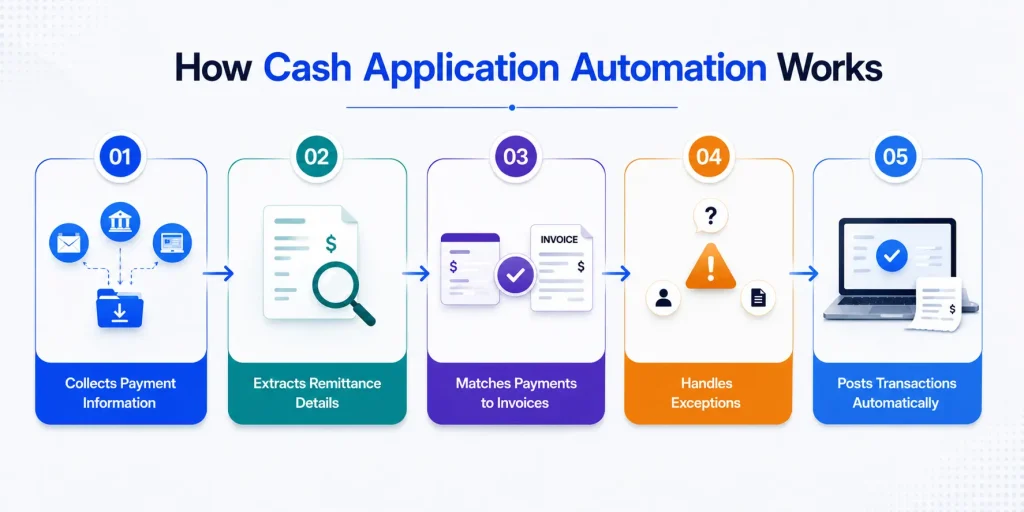
1. Collects Payment Information
The system gathers payment data from various sources automatically, including banking platforms, lockboxes, payment gateways, customer emails, and ERP systems.
Instead of employees downloading files manually, payment information flows directly into the automation platform.
2. Extracts Remittance Details
Using Intelligent Document Processing (IDP), the solution extracts important information from structured and unstructured documents such as PDFs, Excel files, scanned remittances, and emails.
Key data includes:
- Customer name
- Invoice numbers
- Payment amount
- Reference numbers
- Purchase orders
- Payment dates
3. Matches Payments to Invoices
AI-powered matching engines compare payment information with open invoices.
The system can automatically handle:
- Exact matches
- Multiple invoice payments
- Partial payments
- Overpayments
- Underpayments
- Customer-specific payment behavior
Machine learning continuously improves matching accuracy by learning from previous corrections.
4. Handles Exceptions
Payments that cannot be confidently matched are routed to finance staff for review. Instead of reviewing every transaction manually, employees only focus on exceptions, dramatically improving efficiency.
5. Posts Transactions Automatically
Once validated, matched payments are posted directly into the ERP system. This updates customer balances, reduces unapplied cash, and keeps financial records current without manual data entry.
Key Benefits of Cash Application Automation
Some of the benefits of cash application automation are as follows:
1. Faster Payment Processing
Automated matching significantly reduces the time required to process incoming payments. Many organizations move from hours or days of processing to near real-time cash application.
This accelerates the entire order-to-cash cycle and improves working capital visibility.
2. Improved Matching Accuracy
AI-powered automation can accurately identify payments even when customers provide incomplete or inconsistent remittance information.
This reduces manual errors and improves financial accuracy.
3. Lower Days Sales Outstanding (DSO)
Faster payment application improves visibility into outstanding receivables, enabling collections teams to focus on genuinely overdue accounts. As a result, businesses often reduce DSO and strengthen cash flow.
4. Reduced Operational Costs
Finance teams spend far less time performing repetitive payment matching. Instead of hiring additional staff as payment volumes increase, organizations can scale efficiently through automation.
5. Better Customer Experience
Customers receive faster confirmation that payments have been applied correctly. This minimizes disputes, prevents duplicate collection efforts, and improves overall customer satisfaction.
6. Increased Finance Productivity
Automation frees accounts receivable teams from repetitive administrative work, allowing them to focus on higher-value activities such as customer communication, dispute resolution, and cash flow analysis.
7. Better Compliance and Audit Readiness
Every automated transaction creates a detailed audit trail. Finance leaders gain complete visibility into payment processing activities while simplifying internal and external audits.
Best Practices for Successful Implementation
Successful cash application automation goes beyond deploying software. Organizations should follow a structured implementation approach.
1. Standardize Payment Processes
Create consistent payment reference formats wherever possible to improve automated matching accuracy.
2. Integrate with Existing Systems
Ensure seamless integration with ERP platforms, banking systems, CRM applications, and payment gateways.
3. Clean Customer Master Data
Accurate customer records improve matching performance and reduce processing exceptions.
4. Monitor Automation Performance
Track key performance indicators such as:
- Auto-match rate
- Processing time
- Exception rate
- Unapplied cash
- DSO
- Manual intervention percentage
Continuous monitoring helps identify opportunities for further optimization.
The Future of Cash Application Automation
Cash application automation continues to evolve with advances in artificial intelligence and intelligent finance platforms.
Future capabilities will include:
- Predictive payment matching
- AI-powered deduction management
- Autonomous dispute resolution
- Real-time payment reconciliation
- Conversational finance assistants
- Self-learning automation models
- End-to-end autonomous accounts receivable processes
As finance organizations embrace intelligent automation, cash application will become increasingly autonomous, allowing teams to focus on strategic financial planning rather than transactional processing.
Organizations that invest early in AI-powered finance automation will be better positioned to improve cash flow, reduce operating costs, and deliver superior customer experiences.
Final Thoughts
Cash application is one of the most critical processes within the accounts receivable function, yet it remains heavily manual in many organizations. As transaction volumes increase and payment methods become more complex, relying on spreadsheets and manual reconciliation is no longer sustainable.
Cash application automation enables organizations to automatically capture payment information, intelligently match transactions with invoices, handle exceptions efficiently, and update financial systems in real time. The result is faster payment processing, lower operational costs, improved cash flow, reduced DSO, and stronger customer relationships.
Beyond operational efficiency, automation gives finance leaders greater visibility into receivables, enhances compliance through complete audit trails, and allows teams to shift their focus from repetitive administrative work to strategic financial decision-making.
Businesses that modernize their cash application process today will build a more agile, scalable, and resilient finance function—one that is equipped to support growth, improve working capital, and thrive in an increasingly digital economy.