







Key Takeaways
- Build your AP automation business case around measurable business outcomes, not operational improvements.
- Quantify ROI using executive-focused metrics such as TCO, processing costs, and working capital gains.
- Align your proposal with the priorities of CFOs, CIOs, controllers, and procurement leaders.
- Evaluate AP automation vendors based on long-term value, scalability, and integration capabilities.
- Avoid common business case pitfalls by focusing on strategic impact and realistic implementation planning.
For enterprise finance leaders, the decision to automate accounts payable is rarely constrained by awareness of the technology. The real challenge lies in securing executive approval for the investment. Every automation initiative competes with broader transformation priorities—from ERP modernization and AI adoption to cybersecurity and data governance. As a result, a compelling AP automation business case must do more than promise operational efficiency; it must demonstrate strategic value, measurable financial returns, and alignment with enterprise objectives.
CFOs, controllers, and transformation leaders increasingly evaluate automation investments through the lens of total business impact. They expect a clear investment thesis supported by AP automation ROI projections, implementation risk assessments, governance considerations, and a roadmap for value realization. Organizations that present automation as a tactical process improvement often struggle to gain approval, while those that position it as a finance transformation initiative are far more likely to secure funding.
This guide outlines how to build an executive-ready AP automation business case that resonates with modern buying committees and accelerates investment decisions.
What Is an AP Automation Business Case?
An AP automation business case is a structured financial and strategic proposal that demonstrates why an organization should invest in automating its accounts payable processes. It goes beyond explaining the operational benefits of reducing manual invoice processing and establishes the expected business value of the investment, including cost savings, productivity improvements, working capital benefits, and reduced financial and compliance risks. A well-developed business case also provides a foundation for measuring AP automation ROI against the organization’s current AP performance and investment requirements.
A business case is particularly important for CFOs, AP managers, controllers, and shared services directors who need to evaluate whether automation can deliver measurable returns at an enterprise level. Rather than presenting AP automation as simply a technology upgrade, the business case gives decision-makers a clear view of the current cost of AP operations, the expected investment, and the financial and operational outcomes the organization can achieve. It also helps stakeholders understand the broader AP automation benefits, from lower processing costs and faster invoice cycles to improved visibility, stronger controls, and greater finance team productivity.
A strong AP automation business case should typically include ROI projections, cost savings, payback period, total cost of ownership, and risk mitigation benefits. It should also connect these metrics to broader finance priorities such as improving working capital, strengthening controls, increasing processing capacity, and enabling scalable finance operations. By quantifying both financial and operational outcomes, organizations can build a clear case for AP automation ROI while demonstrating how the broader benefits of automation contribute to long-term finance transformation.
Build Your Business Case Around the Metrics That Matter to CFOs
Executive approval depends on measurable outcomes, not feature lists. An effective AP automation business case should quantify both the current cost of manual operations and the projected value after automation.
Key performance indicators typically include:
| Executive KPI | Business Impact |
| Cost per invoice | Reduced operating expenses |
| Invoice cycle time | Faster approvals and payments |
| Touchless invoice rate | Higher productivity and scalability |
| Exception rate | Lower manual intervention |
| Duplicate payments | Reduced financial leakage |
| Early-payment discounts captured | Improved EBITDA |
| Days Payable Outstanding (DPO) visibility | Better working capital management |
| Audit preparation effort | Improved compliance and governance |
Rather than simply stating that automation reduces manual work, estimate the financial value associated with each improvement. This creates a data-driven investment narrative that aligns with executive expectations.
Key Metrics Every Business Case Needs
A credible AP automation business case needs more than a projected ROI percentage. Finance leaders should establish a clear baseline for current AP performance and quantify how automation is expected to change cost, speed, productivity, and cash management. Because AP is part of the broader procure-to-pay lifecycle, understanding how automation connects invoice processing with purchasing, approvals, matching, and payments can help organizations evaluate the full value opportunity. For a broader view of how these processes connect, see What Is Procure-to-Pay (P2P) Automation?.
| Metric | What It Measures | Why It Matters |
| Cost per invoice | Total AP cost ÷ invoices processed | Establishes the baseline for calculating AP automation ROI and projected cost savings. |
| Invoice cycle time | Time from invoice receipt to payment | Faster processing improves operational efficiency and can support better working capital management. |
| Touchless rate | % of invoices processed without human intervention | A higher touchless rate generally means lower processing costs and greater scalability. |
| Exception rate | % of invoices requiring manual intervention | A lower exception rate indicates more efficient workflows and less AP team effort. |
| FTE savings | Hours saved × fully loaded hourly rate | Quantifies the direct labor savings created by automation. |
| Discount capture rate | % of eligible early-payment discounts captured | Measures the potential direct financial impact of faster invoice processing and approvals. |
| Duplicate payment rate | % of payments identified as duplicate or erroneous | Quantifies financial leakage and the potential savings from automated validation and controls. |
| Spend Visibility | Visibility into where, how, and with which suppliers the organization is spending | Helps identify spending patterns, savings opportunities, supplier consolidation opportunities, and areas of maverick spend. See Spend Visibility Through Automation |
| Approval time | Time required for invoices to move through approval workflows | Shows how automation can reduce bottlenecks and accelerate payment processing. |
| First-pass match rate | % of invoices matched successfully without manual intervention | Indicates the effectiveness of automated PO, receipt, and invoice matching. |
| AP processing capacity | Number of invoices processed per AP FTE | Demonstrates productivity improvements and the ability to handle volume growth without proportional headcount increases. |
| Payback period | Time required for cumulative benefits to recover the initial investment | Helps executives determine how quickly the AP automation investment is expected to break even. |
These metrics should be measured against the organization’s current-state baseline before calculating projected savings. The business case can then model expected improvements under conservative, expected, and aggressive scenarios. This approach makes the financial case more transparent and gives stakeholders a practical way to validate projected AP automation benefits after deployment.
The strongest business cases also connect operational metrics to financial outcomes. For example, a higher touchless rate can translate into lower cost per invoice, a shorter cycle time can improve discount capture and working capital efficiency, and a lower exception rate can reduce the manual workload for AP teams. Linking these metrics creates a defensible AP automation ROI model rather than relying on broad efficiency claims.
Develop a Multi-Dimensional ROI Model
One of the strongest components of an AP automation business case is a comprehensive ROI model. However, organizations often limit their analysis to labor savings, overlooking broader financial benefits that significantly strengthen the proposal.
An executive-level ROI assessment should evaluate value across four dimensions.
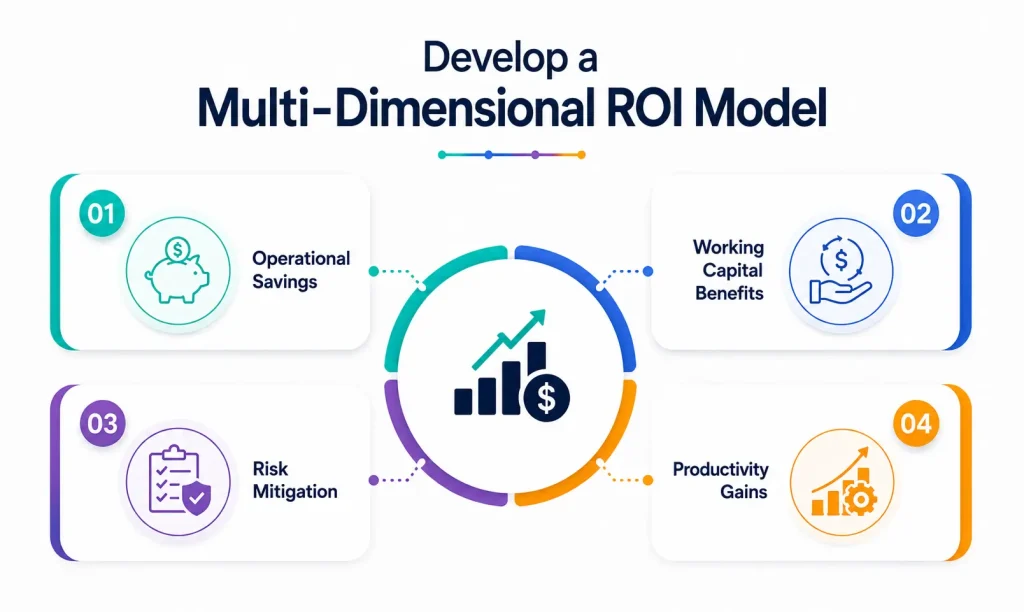
1. Operational Savings
Automation reduces repetitive activities such as invoice capture, data entry, approval routing, and exception handling. This lowers the overall cost of processing invoices while enabling AP teams to manage higher transaction volumes without increasing headcount.
2. Working Capital Benefits
Faster invoice processing improves payment timing and increases the ability to capture early-payment discounts. At the same time, enhanced visibility into outstanding liabilities supports more accurate cash flow forecasting and liquidity planning.
3. Risk Mitigation
Manual AP environments expose organizations to duplicate payments, policy violations, lost invoices, and incomplete audit trails. Automation reduces these risks through standardized workflows, intelligent validation, and centralized documentation.
4. Productivity Gains
Finance professionals spend less time on transactional activities and more time supporting strategic initiatives such as supplier performance management, spend analysis, and financial planning.
When combined, these value drivers present a far more compelling financial case than labor savings alone.
AP Automation ROI Benchmarks for 2026
These benchmarks show why AP automation ROI extends well beyond labor savings. Organizations that reduce invoice processing costs, increase touchless processing, and shorten approval cycles can generate measurable AP automation benefits across operating expenses, working capital, compliance, and finance productivity. The most compelling AP automation business cases use these industry benchmarks as a starting point and replace them with organization-specific metrics during ROI modelling.
| Metric | Manual AP | Automated AP | Source |
| Cost per invoice | $8–15 | $1–3 | Hypatos AP Automation ROI Benchmarks (2026) |
| Typical ROI | Manual AP provides no measurable automation ROI. | 300%+ three-year ROI for organizations achieving high touchless processing. | Hypatos AP Automation ROI Benchmarks (2026) |
| Payback period | — | 12–24 months (typical enterprise implementations) | Hypatos Enterprise Buyer’s Guide to AP Automation |
| Touchless invoice processing | 10–20% | 70–90% depending on automation maturity and AI capabilities. | Hypatos Enterprise Buyer’s Guide / Hypatos ROI Benchmarks |
| Invoice cycle time | 8–15 days | 2–4 hours for straight-through invoices; typically 2–3 days overall. | Hypatos AP Automation ROI Benchmarks / Ardent Partners AP Benchmark Report |
| Invoice exception rate | 18–20% | Significantly reduced through AI validation and automated exception handling. | Ardent Partners State of ePayables Benchmarks |
These benchmarks show why AP automation ROI extends well beyond labor savings. Organizations that reduce invoice processing costs, increase touchless processing, and shorten approval cycles can generate measurable AP automation benefits across operating expenses, working capital, compliance, and finance productivity. The most compelling AP automation business cases use these industry benchmarks as a starting point and replace them with organization-specific metrics during ROI modeling.
Real Business Case Examples
Real-world results make an AP automation business case more credible than projected savings alone. At Auxiliobits, client engagements have demonstrated 40–60% cost reduction across automated finance processes, $200K+ in annual savings, and 2–3x faster processing across high-volume workflows. These outcomes provide practical benchmarks for finance leaders evaluating the potential ROI of AP and broader finance automation.
One client engagement with a large marketing network demonstrates the scale of these gains. By automating vendor invoice processing and other finance and operational workflows, the organization recovered 9,700+ hours annually and achieved a $218K annual cost reduction, while also reducing reconciliation errors by 97% and accelerating financial close by 62%. Read the case study →
The results extend beyond AP into broader finance operations. For a global luxury apparel manufacturer, automation delivered a 73% reduction in monthly close processing time, demonstrating how the same automation foundation can generate significant value when extended from invoice processing into financial close. Read the luxury apparel finance automation case study → Together, these examples show why a strong business case should evaluate not only invoice-level savings, but also the broader impact on processing capacity, cycle time, close efficiency, and finance team productivity.
Anticipate the Questions Every Buying Committee Will Ask
Finance transformation initiatives rarely receive approval from a single stakeholder. CFOs, controllers, CIOs, procurement leaders, and finance operations managers all evaluate investments through different lenses.
A strong AP automation business case proactively addresses the questions each stakeholder is likely to raise.
| Stakeholder | Primary Evaluation Criteria |
| CFO | ROI, payback period, working capital improvement |
| Controller | Financial controls, compliance, audit readiness |
| CIO | ERP integration, security, scalability |
| Procurement | Supplier experience, payment efficiency |
| AP Manager | User adoption, productivity, workflow improvements |
Addressing these priorities upfront reduces internal objections and accelerates executive alignment.
Evaluate Total Cost of Ownership, Not Just Software Pricing
Executive teams increasingly evaluate automation investments based on Total Cost of Ownership (TCO) rather than licensing costs alone.
An effective AP automation business case should include a realistic assessment of:
- Software licensing
- Implementation services
- ERP integration
- User training and change management
- Ongoing platform support
- Future scalability requirements
Equally important is demonstrating how these costs compare with projected financial benefits over a three-to-five-year period. A transparent TCO analysis builds confidence in the investment and reduces concerns about hidden implementation expenses.
Differentiate Vendors Based on Long-Term Value
Selecting an AP automation platform should extend beyond feature comparisons. Organizations should evaluate vendors based on their ability to support long-term finance transformation.
Key evaluation criteria include:
- AI-driven invoice capture and validation
- Intelligent exception handling
- Native ERP and finance system integrations
- Advanced analytics and executive dashboards
- Security, compliance, and audit capabilities
- Scalability across multiple entities and geographies
- Low-code or configurable workflow capabilities
- Proven implementation methodology and post-deployment support
Choosing a partner with deep finance transformation expertise helps ensure the projected benefits outlined in the AP automation business case translate into measurable business outcomes. Organizations should also evaluate how a provider’s broader AI automation services can support automation beyond AP, including intelligent workflows, process orchestration, and other finance and business operations. For a broader understanding of these capabilities, see What Are AI Automation Services and Why Should You Care?.
Step-by-Step: How to Build Your AP Automation Business Case
A strong AP automation business case should connect your current operational pain points to measurable financial outcomes. Rather than relying solely on vendor estimates, start with your own AP data, apply realistic automation benchmarks, and build a financial model that shows stakeholders what the investment delivers over both the short and long term.
1. Baseline Your Current State
Start by documenting how AP operates today. Measure your cost per invoice, average invoice cycle time, touchless processing rate, exception rate, and FTE hours spent on AP activities. For a broader approach to process analysis before automation, see business automation consulting. These metrics establish the baseline against which automation benefits can be measured. If possible, also capture the cost of manual data entry, invoice exceptions, approval delays, duplicate payments, and missed early-payment discounts.
2. Define Your Automation Scope
Clearly identify which AP activities will be automated. Your scope may include invoice capture and data extraction, PO and non-PO invoice matching, approval routing, exception handling, payment processing, reconciliation, and reporting. Defining the scope prevents the business case from becoming a generic technology proposal and makes it easier to calculate the expected impact of each automation initiative.
3. Calculate Projected Savings
Translate the baseline metrics into financial outcomes and apply realistic benchmarks. Auxiliobits engagements demonstrate 40–60% reductions in manual finance work, 2–3x faster invoice processing, and $200K+ in annual savings in vendor invoice automation. One enterprise engagement recovered 9,700 hours annually and delivered $218K in annual cost reduction.
Use these figures as benchmarks—not guaranteed outcomes. Your projected savings should ultimately be based on your invoice volume, current cost per invoice, FTE capacity, exception rate, processing time, and expected automation coverage.
4. Factor in Implementation Costs
Calculate the full cost of implementation rather than looking only at software licensing. Include automation software, ERP and system integration, implementation services, process redesign, change management, employee training, testing, and ongoing support. A complete cost model gives stakeholders a more realistic view of the investment required and prevents unexpected costs from weakening the business case later.
5. Build the ROI Model
Create both 1-year and 3-year projections to show the immediate and cumulative value of automation. Your model should include the initial implementation investment, recurring technology and support costs, annual labor savings, productivity gains, error reduction, faster processing, and any additional value from improved discount capture or reduced late-payment costs.
At minimum, calculate:
ROI = (Total Benefits − Total Investment) ÷ Total Investment × 100
Also calculate the payback period so executives can see how quickly the initial investment is recovered. For broader finance automation programs, Auxiliobits reports a 73% reduction in close time for engagements that extend automation into the financial close, illustrating how the business case can expand beyond invoice processing as automation scales.
6. Address Risks and Mitigation
A credible business case should acknowledge what could go wrong. Consider risks such as ERP integration complexity, inaccurate invoice data, high exception volumes, supplier adoption, process changes, security and compliance requirements, and employee resistance. For each risk, define a mitigation plan—for example, phased implementation, exception-handling workflows, controlled testing, role-based training, and human-in-the-loop approvals for high-risk transactions.
7. Present the Business Case to Stakeholders
The final step is to tailor the business case to the person making the decision. A CFO will care about ROI, payback period, cost reduction, working capital, and scalability. For an AP manager, the key areas of focus will be cycle time, exception reduction, workload, accuracy, and team productivity. IT leaders will want to understand integration effort, security, architecture, maintenance, and ERP disruption.
The strongest business case gives each stakeholder a reason to support the investment while keeping the underlying financial model consistent. The objective is not simply to demonstrate that AP automation works—it is to show why automation makes financial sense for your specific organization, what it will cost, what it will return, and how quickly that value can be realized.
Common Mistakes That Undermine an AP Automation Business Case
Even a well-structured AP automation business case can lose credibility if the underlying assumptions are too optimistic or incomplete. Avoid these common mistakes when preparing your proposal:
- Focusing on software cost instead of total cost of ownership — Include implementation, integration, training, change management, licensing, support, and ongoing maintenance—not just the software fee.
- Not baselining current-state metrics before projecting savings — Establish your actual cost per invoice, cycle time, exception rate, touchless rate, and FTE effort before calculating ROI. Without a baseline, projected savings are difficult to validate.
- Overestimating the touchless rate in Year 1 — Use conservative assumptions rather than assuming every invoice will become touchless immediately. Auxiliobits recommends using a 60% straight-through processing assumption for Year 1 when building a credible business case.
- Ignoring change management and training costs — Supplier onboarding, AP-team retraining, and approver adoption can significantly affect implementation success and should be included in both the budget and timeline.
- Not including risk mitigation in the business case — Address ERP integration, data quality, exception handling, supplier adoption, security, and governance risks upfront, along with the actions required to mitigate them.
Transforming the Business Case into a Competitive Advantage
An effective AP automation business case is more than a budget request—it is a strategic investment proposal that aligns finance transformation with enterprise priorities. Organizations that successfully secure executive approval are those that clearly connect automation to measurable financial outcomes, operational resilience, and long-term scalability. A well-structured case should also demonstrate the broader AP automation benefits, from reducing manual effort and processing costs to improving visibility, control, and compliance across the accounts payable function.
The strongest business cases combine robust AP automation ROI analysis with a practical implementation roadmap, stakeholder alignment, and a clear vision for future-state finance operations. Rather than focusing solely on invoice processing, they position AP automation as a foundation for intelligent, data-driven finance functions capable of supporting sustainable business growth.
For organizations evaluating AP automation solutions, the next step is not simply selecting software—it is partnering with a provider that understands enterprise finance, can quantify AP automation ROI before implementation, and has the expertise to deliver measurable outcomes after deployment. By building a well-supported AP automation business case, finance leaders can move beyond operational improvements and make a compelling case for strategic transformation that earns executive confidence and accelerates investment decisions.
FAQ
1. What is the ROI of AP automation?
Typical AP automation projects deliver 200-600% first-year ROI with a 3-9 month payback period. Most clients see 40-60% cost reduction in automated processes.
2. How much does AP automation cost?
AP automation costs vary based on invoice volume, ERP complexity, and scope. Implementation typically takes 6-8 weeks. The cost is offset by $200K+ in annual savings for most mid-to-large finance teams.
3. How long does it take to see ROI from AP automation?
Most teams see positive ROI within 3-9 months of go-live. The fastest results come from automating high-volume, repetitive processes first (invoice capture, matching, approvals).
4. What metrics should I include in an AP automation business case?
Include cost per invoice, invoice cycle time, touchless rate, exception rate, FTE savings, discount capture rate, and projected ROI over 1-3 years.
5. How do I calculate cost per invoice?
Cost per invoice = (total AP team salaries + software costs + infrastructure costs) ÷ total invoices processed per year. Manual AP typically costs $8-15 per invoice; automated AP costs $1-3.