





How a $2.8B Advertising Services Company Automated Cross-Agency Workflows Post-Merger

Integrating 70+ agencies with seamless automation across finance, operations, and creative workflows — without adding headcount.

9700

Hours saved annually

$218K

Annual cost reduction

97%

Fewer manual errors

62%

Faster financial close

The Challenge

A $2.8B Network. 70+ Agencies. Zero Unified Workflow.

A major holding group in the global marketing and advertising industry completed a strategic series of acquisitions that brought over 70 independent agencies — spanning media buying, creative production, digital strategy, and performance marketing — under a single corporate umbrella. The combined entity managed $2.8B in annual billings across North America, EMEA, and APAC.

The Problem

The problem was immediate and operationally acute. Each acquired agency operated on its own financial stack, creative project management system, and client reporting cadence. Finance teams manually reconciled billing data from different ERP systems at the end of every month. Operations staff spent 40+ hours per week exporting, transforming, and re-entering timesheets, vendor invoices, and purchase orders across platforms. Creative workflows had no standardized handoff protocol, causing project delays averaging 4–6 days per campaign cycle.

Why It Mattered

SSC Inefficiency Was Blocking GBS Evolution

The organization’s long-term goal was to evolve its SSC into a Global Business Services (GBS) model — a centralized, standardized, and scalable operational engine.
But without automation:

We had acquired the right agencies, but we were running them like 70 separate companies. The back office was a spreadsheet held together with goodwill and overtime.
– Chief Technology Officer

The Solution

An Automation Layer Spanning Finance, Ops, and Creative

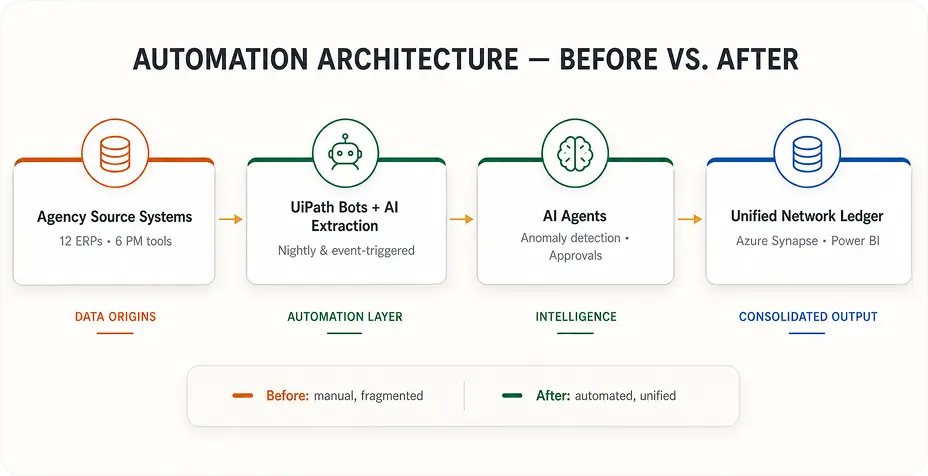
Our team deployed a phased Intelligent Process Automation (IPA) architecture that combines Agentic AI, Robotic Process Automation, AI-powered document processing, and custom integration middleware — designed to sit above the existing agency systems without forcing platform migrations. The approach preserved agency autonomy while creating unified data flows at the network level.
Technologies Deployed

Key Workflows Automated

Multi-ERP Financial Consolidation:

Robots extract, normalize, and reconcile billing data from multiple ERP systems nightly, feeding a single consolidated ledger with exception flagging for human review.

Vendor Invoice Processing:

LangGraph Multi-Agent (Gemini 2.5 Flash) extracts structured data from unstructured PDF invoices with 98.4% field accuracy; approved invoices post automatically to the relevant agency ERP (Maconomy).

Cross-Agency Timesheet Aggregation:

Unattended bots collect, validate, and route employee time logs from 6 project management platforms into the central payroll and client billing system.

Creative Brief & Asset Handoff:

An agent-driven workflow orchestration based on contextual decision-making, project milestone completion and triggers standardized handoff packets – briefs, assets, and sign-offs – to downstream production teams without manual emails.

Client Performance Reporting:

Weekly and monthly client dashboards are auto-generated, populated with live campaign data, and delivered via scheduled email — eliminating 3–5 hours of analyst time per report cycle.

Implementation

Implementation ran over 10 weeks in three phases: discovery and process mapping (weeks 1–4), bot development and integration build (weeks 5–16), and staged rollout with parallel processing validation (weeks 17–22). Change management included role-specific training for 340 operations and finance staff across 14 pilot agencies before network-wide deployment.

The Results

Measurable Impact Within the First Full Quarter

9700 hrs

Saved annually across network ops and finance teams

$218 K

Annual cost reduction in manual processing overhead

97 %

Reduction in reconciliation errors at month-end close

62 %

Faster financial close cycle (from 8 days to 3 days)

4.2 days

Reduction in average creative campaign handoff lag

100 %

Agency coverage achieved — all 70+ integrated in phase rollout

Business Outcomes

The operational uplift was immediate. Finance teams that previously spent 40+ hours monthly on manual ERP reconciliation reallocated that capacity to analysis and strategic forecasting. Operations staff across agencies reported a significant reduction in after-hours “emergency” data corrections — a chronic source of team burnout during the prior 18 months of manual integration effort.

Crucially, the automation infrastructure scaled without proportional headcount increases. The network onboarded three additional agencies during the rollout period — each absorbed into the automation layer within an average of six working days, compared to a prior manual onboarding average of 11 weeks per agency. The board’s projected synergies are now tracking ahead of schedule by an estimated 14%. 

We closed Q1 three days faster than any quarter on record. The team didn’t have to chase a single report — everything was just there. That’s not a small thing. – Chief Technology Officer
The long-term value extends beyond direct cost savings. The unified data infrastructure now enables network-level analytics — cross-agency performance benchmarking, consolidated client profitability views, and predictive resource planning — capabilities that were structurally impossible before the automation layer existed. The group is currently scoping a second phase to extend automation into new business pitching workflows and cross-agency talent allocation.

Key Takeaways

Post-merger integrations require automated financial consolidation to maintain accuracy at scale.

When disparate application systems force manual reconciliation processes, error rates compound with every additional agency added to the network. Automation is not optional at this scale — it is the architectural prerequisite for any realistic synergy realization. Waiting to solve the data problem compounds integration debt faster than most leadership teams anticipate.

Combining RPA with AI agents is the only robust path for mixed structured and unstructured workflows.

Rule-based bots alone cannot handle the variability of real-world agency operations — vendor invoices arrive in hundreds of formats, creative briefs are narrative documents, and exceptions are the norm. Layering AI document intelligence and anomaly-detection agents on top of RPA creates a system that handles both the predictable and the unpredictable without constant human intervention.

Automation enables acquisition-led growth without proportional headcount scaling

The network added three agencies mid-rollout and integrated each in under seven days — a pace categorically impossible under the prior manual model. Building the automation layer before headcount becomes the bottleneck gives leadership a genuine M&A superpower: the ability to absorb new entities rapidly, consistently, and at a fraction of the traditional integration cost.


Ready to start?

See what your finance workflows could look like when automated. Book a focused 60-minute discovery session. We’ll map your highest-impact automation opportunities and provide a preliminary ROI estimate – at no cost.