









Key Takeaways
- Digital Transformation in Finance is a strategic business initiative, not just a technology upgrade. It modernizes finance operations by combining AI, automation, cloud, and analytics to improve agility, accuracy, and decision-making.
- Intelligent technologies enable finance teams to shift from transaction processing to strategic value creation. AI, intelligent automation, advanced analytics, and Agentic AI help streamline workflows while providing real-time financial insights.
- The benefits extend well beyond cost reduction. Organizations achieve faster financial close cycles, improved compliance, better forecasting, increased productivity, and enhanced experiences for customers and suppliers.
- Successful transformation requires more than deploying new tools. Standardized processes, high-quality data, executive sponsorship, and effective change management are essential for realizing long-term business value.
- The future of finance is autonomous and AI-driven. Organizations that invest in Digital Transformation in Finance today will be better positioned to build resilient, intelligent finance operations that adapt quickly to changing business and market demands.
Finance has evolved from a back-office function into a strategic driver of business performance. Today’s finance leaders must do far more than manage transactions and ensure compliance. They are responsible for delivering real-time insights, supporting business growth, strengthening risk management, and enabling faster, data-driven decisions. Achieving these goals with legacy systems and manual processes is no longer sustainable.
This is where digital transformation in finance becomes a competitive necessity. By integrating intelligent automation, artificial intelligence, cloud technologies, advanced analytics, and modern operating models, organizations can redesign finance processes to be faster, more accurate, and scalable. The result is not simply digitized workflows, it is a finance function capable of driving enterprise-wide value.
Why Digital Transformation in Finance Is a Strategic Priority
Economic uncertainty, regulatory complexity, and increasing stakeholder expectations have fundamentally changed the role of finance. CFOs are expected to provide real-time visibility into financial performance while ensuring operational efficiency and maintaining compliance.
However, many finance teams still depend on disconnected ERP systems, spreadsheets, manual reconciliations, and email-based approvals. These fragmented processes create delays, increase operational risk, and limit the ability to generate actionable insights.
Digital transformation in finance addresses these challenges by creating connected, intelligent finance operations. Rather than automating isolated tasks, organizations redesign end-to-end workflows—from procure-to-pay and order-to-cash to record-to-report and financial planning using digital technologies that improve speed, transparency, and decision-making.
The objective is not simply to replace manual work but to create an agile finance organization that continuously adapts to changing business needs.
What Digital Transformation in Finance Really Means
Many organizations mistakenly view digital transformation as implementing a new ERP or deploying robotic process automation. While these technologies are important, true transformation extends much further.
Digital Transformation in Finance is the strategic modernization of finance operations through technology, data, automation, and process redesign. It combines people, processes, and intelligent systems to create a finance function that is proactive rather than reactive.
A digitally transformed finance organization typically demonstrates several characteristics:
- Standardized and automated financial processes
- Real-time access to financial data
- AI-driven forecasting and analytics
- Integrated systems across business functions
- Continuous compliance and risk monitoring
- Intelligent workflows that reduce manual intervention
Instead of spending valuable time collecting and validating data, finance professionals can focus on analysis, scenario planning, and strategic decision-making.
Technologies Powering Modern Finance Functions
Successful digital transformation in finance depends on multiple technologies working together rather than a single solution.
1. Artificial Intelligence and Machine Learning
AI enables finance teams to analyze large volumes of financial data, identify anomalies, improve forecasting accuracy, detect fraud, and generate predictive insights. Machine learning models continuously improve as they process new information, making financial planning more reliable over time.
2. Intelligent Process Automation
Modern automation combines robotic process automation with AI, document intelligence, workflow orchestration, and business rules. This enables organizations to automate invoice processing, reconciliations, journal entries, expense management, accounts payable, and accounts receivable with minimal human intervention.
3. Cloud Finance Platforms
Cloud-based ERP and finance applications provide scalability, continuous updates, stronger security, and easier integration across enterprise systems. They also improve collaboration by giving finance teams access to standardized data from anywhere.
4. Advanced Analytics
Traditional financial reports explain what happened. Advanced analytics helps finance leaders understand why it happened, what could happen next, and which actions they should prioritize. Interactive dashboards and predictive models improve decision-making across the organization.
5. Agentic AI
The next evolution involves AI agents capable of executing multi-step finance workflows with limited human supervision. Instead of completing isolated tasks, these intelligent agents can coordinate approvals, validate transactions, monitor exceptions, and recommend corrective actions across multiple systems.
The Business Value Beyond Cost Savings
While reducing operational costs remains an important objective, the benefits of Digital Transformation in Finance extend much further.
1. Faster Financial Close
Automated reconciliations, standardized workflows, and real-time data integration significantly reduce month-end and year-end closing cycles. Finance teams spend less time gathering information and more time analyzing business performance.
2. Improved Decision-Making
Accurate, real-time financial data enables executives to make faster and more confident decisions. Scenario modeling and predictive forecasting help organizations respond quickly to market changes and economic uncertainty.
3. Better Risk and Compliance
Digital controls, automated audit trails, and continuous monitoring reduce compliance risks while improving governance. Finance leaders gain greater visibility into transactions, policy adherence, and regulatory reporting.
4. Higher Productivity
By eliminating repetitive manual work, finance professionals can focus on higher-value activities such as financial planning, business partnering, and strategic analysis. This improves employee satisfaction while increasing organizational capacity.
5. Enhanced Customer and Supplier Experience
Automated billing, faster payment processing, and streamlined dispute resolution improve relationships with customers and suppliers. Efficient finance operations contribute directly to stronger business partnerships.
Common Challenges Organizations Face
Despite the clear benefits, many finance transformation initiatives fail to achieve their expected outcomes because organizations underestimate the complexity of change.
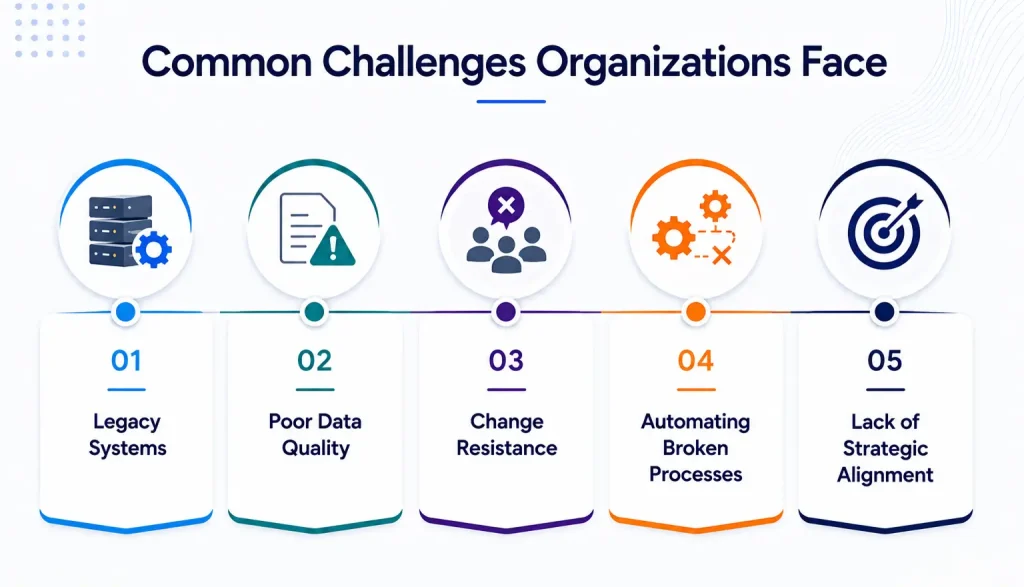
1. Legacy Systems
Older ERP environments often contain customized processes that are difficult to integrate with modern technologies. Organizations frequently struggle with fragmented applications and inconsistent data structures.
2. Poor Data Quality
AI and automation depend on reliable data. Inaccurate, duplicate, or incomplete financial information reduces the effectiveness of digital initiatives and weakens decision-making.
3. Change Resistance
Employees may perceive automation as a threat rather than an opportunity. Successful transformation requires strong communication, leadership support, and continuous training to encourage adoption.
4. Automating Broken Processes
One of the most common mistakes is automating inefficient workflows without redesigning them first. Organizations should optimize and standardize processes before introducing automation technologies.
5. Lack of Strategic Alignment
Technology investments produce limited value when they do not align with broader business objectives. Finance transformation should always support measurable outcomes such as faster reporting, improved forecasting, better compliance, or enhanced customer experience.
A Roadmap for Successful Finance Transformation
A structured approach helps organizations maximize the return on their transformation investments.
1. Assess the Current State
Evaluate existing finance processes, technology landscape, data quality, operational bottlenecks, and business objectives. Identify opportunities where automation and AI can generate measurable improvements.
2. Prioritize High-Impact Use Cases
Focus on processes that combine high transaction volumes with repetitive manual work, such as accounts payable, financial close, cash application, invoice processing, reconciliations, and financial reporting.
3. Build a Modern Data Foundation
Standardize master data, improve governance, and integrate financial information across ERP systems, business applications, and external data sources. Reliable data is the foundation of intelligent finance operations.
4. Scale Automation Strategically
Move beyond isolated automation projects toward enterprise-wide workflow orchestration. Integrate AI, automation, analytics, and governance into a unified operating model.
5. Measure Business Outcomes
Track transformation success using KPIs such as close cycle time, invoice processing cost, forecast accuracy, automation rate, compliance metrics, productivity improvements, and employee satisfaction.
The Future of Digital Transformation in Finance
Finance is entering a new era where intelligent systems do more than execute predefined rules. They understand context, coordinate actions across applications, and continuously optimize business processes.
Future finance organizations will increasingly adopt autonomous operating models powered by AI agents capable of managing complex workflows with human oversight. Routine approvals, exception handling, reporting, and financial analysis will become increasingly intelligent and proactive.
Finance professionals will spend less time processing transactions and more time shaping business strategy, evaluating investment opportunities, and guiding organizational growth.
Organizations that begin their digital transformation in finance journey today will be better positioned to respond to economic volatility, regulatory changes, and evolving customer expectations. Those that delay modernization risk falling behind competitors operating with greater speed, agility, and intelligence.
Conclusion
Digital Transformation in Finance is no longer about digitizing paper-based processes or implementing isolated automation tools. It is about creating a connected, intelligent finance function that delivers real-time insights, improves operational efficiency, strengthens governance, and enables better business decisions.
The most successful organizations approach transformation as an ongoing business strategy rather than a one-time technology project. By combining process redesign, AI, intelligent automation, cloud platforms, and data-driven decision-making, finance leaders can build resilient operations that continue to deliver value as business demands evolve.
As finance becomes increasingly autonomous, organizations that invest in intelligent, scalable operating models today will define the future of enterprise performance tomorrow.
Ready to modernize your finance operations? Auxiliobits helps enterprises accelerate digital transformation in finance through agentic process automation, intelligent enterprise automation, AI-powered finance solutions, and scalable autonomous operating models that deliver measurable business outcomes.