







As companies grow, managing finance, human resources, IT, procurement, and other support functions across multiple departments or locations can become increasingly complicated. Processes get duplicated, operational costs rise, and maintaining consistent service quality becomes harder. This is where shared services can make a difference. But how do you know when the model is right for your business? If you have ever wondered, do I need a shared services center, the answer depends on more than your company’s size. Factors such as operational complexity, transaction volumes, growth plans, and process maturity all influence whether a shared services model makes sense.
Understanding these factors can help you make a more informed decision about your operating structure without investing in a solution before your business is ready.
What Is a Shared Services Model?
A shared services model brings similar business support activities together into a centralized function that serves multiple departments, business units, or locations within an organization.
Instead of having separate teams handle the same tasks independently, a company consolidates selected activities into a shared services center. This center follows standardized processes, uses common systems, and operates under defined service expectations.
For example, a company with offices in five cities might have separate teams managing payroll, employee records, invoice processing, and vendor payments. A shared services model could bring these activities together under one operating structure while allowing local teams to focus on business-specific responsibilities.
Common functions that can be included in a shared services model are:
- Finance and accounting: Accounts payable, accounts receivable, reconciliations, expense management, and financial reporting.
- Human resources: Payroll administration, employee onboarding, benefits administration, and HR support.
- IT services: Help desk support, access management, infrastructure administration, and routine technical support.
- Procurement: Purchase order processing, vendor onboarding, and supplier data management.
- Other business operations: Data management, reporting, document processing, and selected administrative activities.
The objective is not simply to centralize everything. The goal is to identify activities that a common operating structure can deliver more consistently and efficiently.
Does Company Size Determine Whether You Need Shared Services?
Company size is an important consideration, but it is not the only factor that determines whether shared services will work.
A large organization may have the transaction volume, geographic reach, and operational complexity to justify a dedicated center. However, a smaller company with several business units, multiple locations, or rapidly growing transaction volumes may also benefit from consolidating selected processes.
Likewise, a large company with highly specialized operations and limited opportunities for standardization may find that centralization delivers fewer benefits than expected.
When considering the question, do I need a shared services center, start by examining how your business operates today rather than relying on employee count or annual revenue alone.
Consider three broad scenarios:
Small businesses: Companies with a single location, limited transaction volumes, and straightforward processes may not need a dedicated center. Shared tools, documented workflows, and a small centralized administrative team might be sufficient.
Mid-sized businesses: Organizations operating across multiple locations or business units may start experiencing duplicated work, inconsistent processes, and increasing administrative costs. Consolidating selected functions can help address these challenges.
Large enterprises: Organizations with multiple business units, countries, and complex operating structures may have stronger opportunities to establish a dedicated shared services center or develop a more advanced global business services model.
The right approach depends on whether the expected operational benefits outweigh the costs and complexity of implementing the model.
7 Signs Your Company May Be Ready for a Shared Services Center
Rather than setting a fixed employee threshold, look for operational signals that suggest your existing structure is becoming difficult to manage.
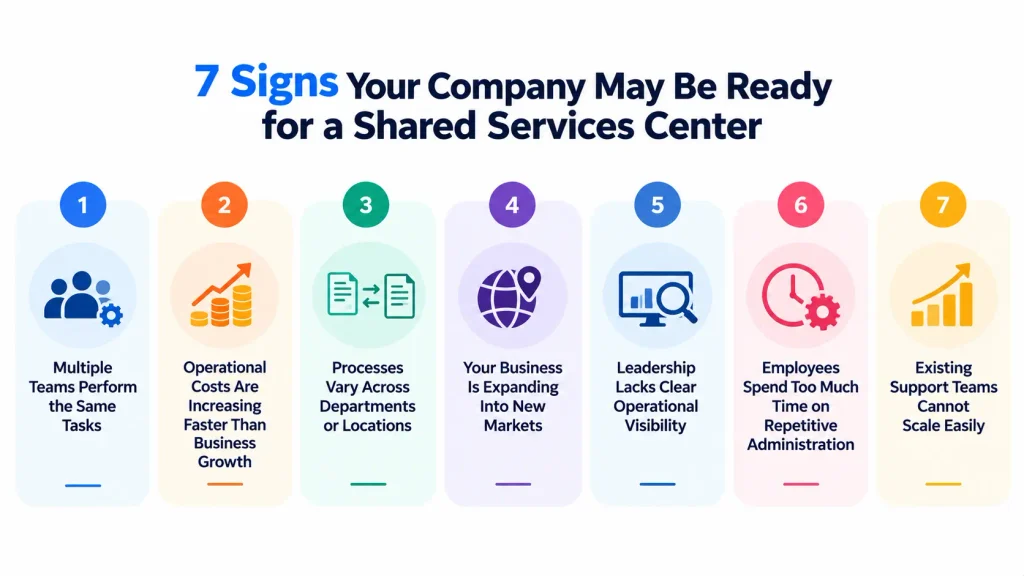
1. Multiple Teams Perform the Same Tasks
When different departments independently process invoices, maintain employee records, or prepare similar reports, the organization may be paying several times for comparable work. Duplicated activities can increase administrative effort and create inconsistent outcomes. By consolidating suitable tasks, duplication can be reduced and common standards established.
2. Operational Costs Are Increasing Faster Than Business Growth
Growing businesses naturally require additional support. However, if administrative headcount, software expenses, and processing costs rise disproportionately as the company expands, the operating model may need attention.
A shared services structure can create opportunities to pool resources, improve capacity utilization, and reduce repetitive manual work. The important step is to identify the source of rising costs before assuming that centralization will solve the problem.
3. Processes Vary Across Departments or Locations
Different teams may follow different approval workflows, use separate templates, or maintain their own reporting practices. These variations make it harder to compare performance, maintain accurate records, and establish consistent controls.
A shared services model can help standardize suitable processes while preserving local flexibility where regulatory requirements or business needs demand it.
4. Your Business Is Expanding Into New Markets
Expansion introduces additional operational demands, including new employees, suppliers, transactions, systems, and compliance requirements. Without a scalable support structure, each new location can create another layer of administrative complexity.
Shared services can provide a common operational foundation that supports growth without requiring every location to build a complete set of support functions independently.
5. Leadership Lacks Clear Operational Visibility
When information is scattered across departments and systems, leadership may struggle to understand processing costs, turnaround times, backlogs, or service quality. A shared services structure can make it easier to establish common performance indicators and consolidate reporting.
However, centralization alone does not guarantee visibility. Reliable data, appropriate systems, and clear accountability are equally important.
6. Employees Spend Too Much Time on Repetitive Administration
Highly skilled employees may spend valuable time correcting records, entering data, following up on approvals, or responding to routine requests. These activities can reduce the time available for analysis, strategic planning, customer engagement, and other higher-value work.
Consolidating repeatable activities can help clarify responsibilities and create opportunities for automation.
7. Existing Support Teams Cannot Scale Easily
If every increase in transaction volume requires additional employees in every department, the operating model may be difficult to scale efficiently. Shared services can help balance workloads across teams and locations, particularly when demand fluctuates.
The benefits depend on having enough repeatable work, appropriate technology, and the capacity to manage changing service requirements.
When Is a Shared Services Model Not the Right Choice?
Recognizing when shared services may not be suitable is just as important as identifying the benefits. A dedicated center may be unnecessary when a company has low transaction volumes, few departments, and limited duplication. The costs of establishing a separate structure, hiring specialized staff, and managing additional governance could outweigh the savings.
Centralization can also create challenges when poorly documented processes or those heavily dependent on local knowledge exist. Moving inconsistent workflows into one center does not automatically make them more efficient.
Other warning signs include:
- Limited process standardization: Departments perform similar activities in fundamentally different ways, making consolidation difficult.
- Insufficient technology infrastructure: Disconnected systems and poor data quality make centralized processing more complex.
- Strong local requirements: Certain activities require local expertise, direct customer interaction, or location-specific decision-making.
- Unclear ownership: Departments disagree about responsibilities, approvals, or accountability for service outcomes.
- Unproven business benefits: The organization has not established a credible financial or operational case for consolidation
In these situations, the better first step may be to simplify workflows, document procedures, improve data quality, or centralize a small number of suitable activities before considering a larger transformation.
How to Evaluate Whether Your Company Is Ready
If you are still asking, do I need a shared services center, use a structured assessment to understand your organization’s readiness.
Step 1: Map Your Current Processes
Identify the activities performed across finance, HR, procurement, IT, and other support functions. Document who performs each task, how frequently it occurs, which systems are involved, and how much time or effort it requires. This exercise helps reveal duplication, bottlenecks, and opportunities for standardization.
Step 2: Assess Transaction Volumes and Complexity
Estimate the number of invoices processed, employee requests handled, purchase orders created, or other transactions completed during a typical month. Look beyond total volume. Consider how much variation exists between transactions, how frequently exceptions occur, and how much manual intervention is required. Higher volumes of standardized transactions generally provide stronger opportunities for consolidation than low volumes of highly specialized work.
Step 3: Calculate the Business Case
Compare the current cost of delivering support services with the expected cost of a proposed shared services structure. Include staffing, technology, transition expenses, training, governance, facilities where relevant, and ongoing operational management. Potential benefits may include reduced duplication, improved productivity, more consistent controls, and lower processing costs. Avoid counting every potential improvement as guaranteed savings. Use realistic assumptions and account for the time needed to implement changes.
Step 4: Evaluate Technology and Process Maturity
Determine whether existing systems can support common workflows, shared data, standardized reporting, and appropriate access controls. Also assess whether processes are documented and whether performance can be measured consistently. A shared services center is easier to manage when its underlying processes and systems are sufficiently mature.
Step 5: Identify a Suitable Starting Point
You do not need to centralize every function at once. Begin with activities that are repetitive, relatively standardized, and easy to measure. Finance administration, vendor master data management, employee documentation, and routine service requests may offer opportunities, depending on the organization. A focused pilot allows the business to test assumptions, identify implementation challenges, and demonstrate results before expanding the scope.
Conclusion: Is Your Company Big Enough for Shared Services?
The decision to establish shared services should be based on operational needs, not an arbitrary company-size threshold.
If your organization is experiencing duplicated work, rising administrative costs, inconsistent processes, limited visibility, or difficulty scaling support functions, it may be time to explore a shared services model.
However, if your processes remain simple and transaction volumes are low, improving existing workflows or centralizing selected activities may be a more practical starting point.
The key is to understand your current operating model, identify opportunities for improvement, and evaluate the expected benefits against implementation costs and complexity.
Before making a decision, ask yourself one final question: do I need a shared services center, or can my current structure deliver the efficiency, consistency, and scalability my business requires?
Answering that question with operational data and a realistic assessment of your organization’s readiness will help you choose a model that supports sustainable growth without adding unnecessary complexity.