






Artificial intelligence is becoming an integral part of modern business operations, from customer support and software development to financial reporting and enterprise analytics. However, as organizations adopt AI tools, a persistent challenge remains: connecting AI models with the business systems, data, and workflows they need to deliver useful results. This is where model context protocol enterprise AI becomes an important topic for technology leaders, developers, and IT teams.
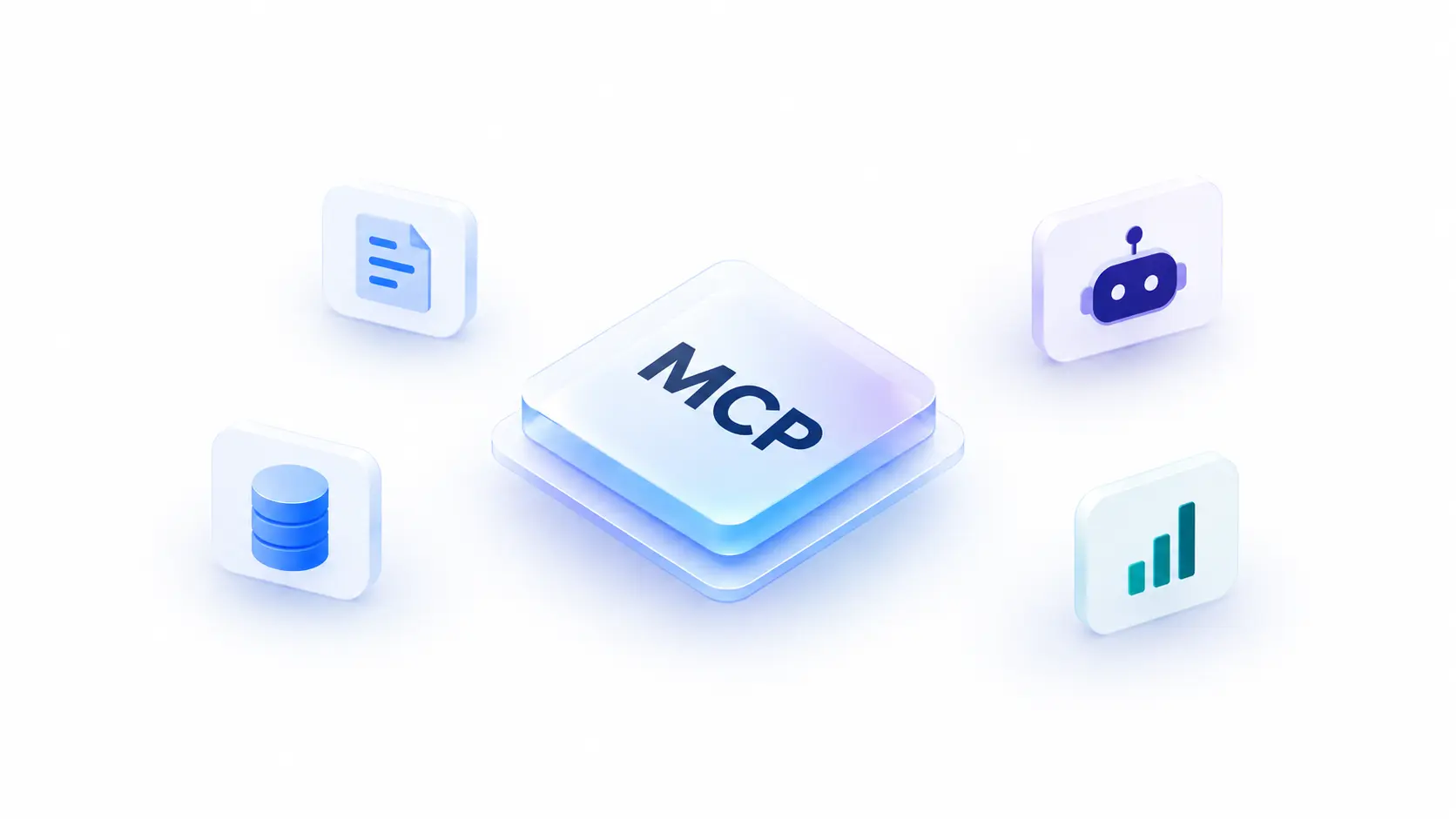
Model Context Protocol (MCP) is an open standard that helps AI applications connect with external data sources, tools, and services through a consistent communication framework. Instead of building separate integrations for every AI application and business system, organizations can use MCP to simplify how these components interact.
But what exactly is MCP, how does it work, and why are enterprise AI teams paying attention to it? Understanding these fundamentals helps businesses evaluate how connected AI systems can support more efficient, contextual, and scalable operations.
What Is Model Context Protocol (MCP)?
Model Context Protocol, commonly known as MCP, is an open protocol that standardizes communication between AI applications and external systems. It defines how applications can discover available capabilities, access contextual information, and request actions from connected services.
Consider an AI assistant that can explain financial concepts but cannot access your company’s latest financial reports. Its answers may be informative, but they cannot reflect your organization’s actual numbers unless the relevant information is provided through an integration or another supported mechanism.
MCP helps bridge this gap by establishing a common way for AI applications to interact with systems that hold relevant information or provide specific functionality.
For example, an MCP-enabled AI application could connect to authorized business systems to retrieve project updates, search internal documentation, query a database, or initiate a supported workflow. The precise capabilities depend on the MCP server, the connected application, and the permissions granted.
MCP does not replace the AI model, database, or underlying business application. Instead, it provides a standardized communication layer that helps these components work together.
Why Is MCP Important for Enterprise AI?
Enterprise environments rarely operate through a single software platform. Organizations typically rely on a combination of customer relationship management (CRM) systems, enterprise resource planning (ERP) platforms, human resources applications, collaboration tools, databases, and cloud services.
Connecting AI to these systems individually can create considerable development and maintenance work. Different applications may use different APIs, authentication mechanisms, data structures, and access rules.
A standardized integration approach can reduce some of this complexity.
The growing interest in model context protocol enterprise AI reflects a broader need to make AI systems more useful within existing business environments. Rather than operating as isolated chat interfaces, AI applications can access relevant context and interact with approved tools when needed.
This approach can support several enterprise objectives:
- Reduced integration complexity: A common protocol can minimize the need for application-specific integration logic at every connection point.
- More contextual responses: AI applications can retrieve relevant business information instead of relying exclusively on their training data or manually supplied prompts.
- Workflow automation: Connected tools can allow AI applications to perform authorized operations, not just generate recommendations.
- Greater flexibility: Organizations can develop or adopt compatible clients and servers without requiring every integration to use an entirely different communication format.
MCP does not eliminate all integration work. Systems still require compatible implementations, appropriate configuration, authentication, and governance. Its value lies in creating a reusable foundation for these connections.
How Does Model Context Protocol Work?
CP follows a client-server architecture. Its main components work together to let an AI application discover and use capabilities provided by external systems.
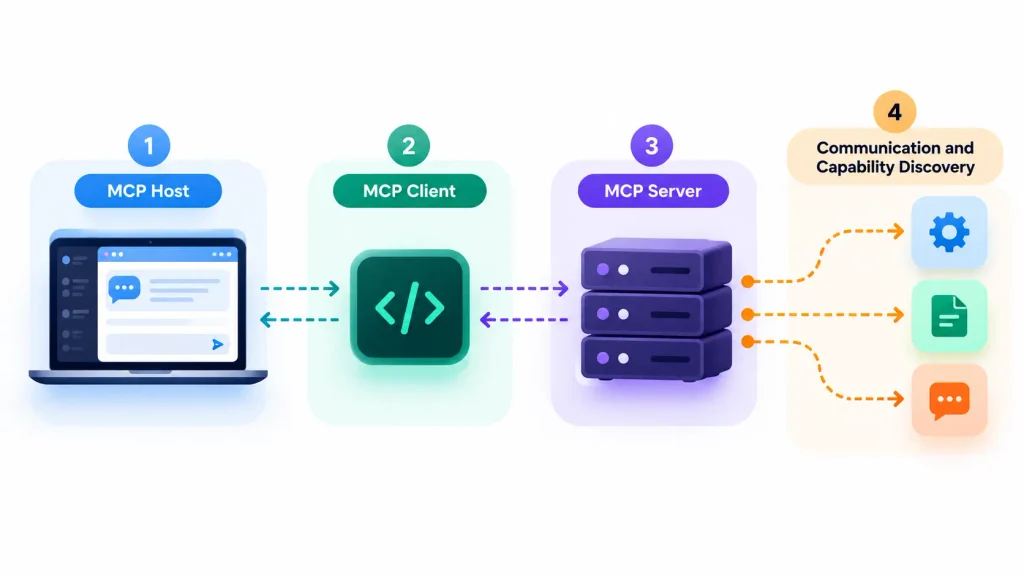
1. MCP Host
The host is the AI application that coordinates the interaction. It could be an AI assistant, a developer environment, or another application that uses a language model. The host manages the overall experience and determines how it makes connected capabilities available to the model.
2. MCP Client
The MCP client is the component within the host that communicates with an MCP server. A host can create separate clients for different servers, allowing it to connect with multiple systems. For example, an AI assistant might use one client to access internal documentation and another to interact with an authorized project management platform.
3. MCP Server
The server exposes specific capabilities from a system or service through the protocol. It serves as the connection point between the AI application and the functionality or information it provides. An MCP server might expose tools for querying records, resources containing documentation, or prompts designed for recurring tasks.
An important distinction is that an MCP server does not necessarily mean a standalone physical machine. It refers to a software component that implements the protocol and provides capabilities to an MCP client.
4. Communication and Capability Discovery
The client and server communicate through defined protocol messages. MCP uses JSON-RPC 2.0 for its core message structure and supports transports such as standard input/output (stdio) for local communication and Streamable HTTP for remote communication.
The client can discover which capabilities a server supports and request the relevant information or operations. The server processes requests according to its implementation and access controls, then returns the results.
This standardized interaction is what makes MCP useful for connecting AI applications to various services. <Link url=”https://modelcontextprotocol.io/” title=”Explore the official MCP documentation”/> for its architecture and implementation details.
The Three Core Capabilities of MCP
1. Tools: Enabling AI to Take Action
Tools allow an AI application to invoke defined functions exposed by an MCP server. These functions may retrieve information, execute calculations, query a database, or interact with an external API.
For example, a business analyst could ask an AI assistant to retrieve sales figures for a specific reporting period. If an authorized server exposes an appropriate query tool, the application can request the data and use the result to prepare an explanation.
Tools may also support actions such as creating a task or updating a record, provided the relevant functionality and permissions exist.
Because tools can affect business systems, their implementation should include input validation, access controls, appropriate approval mechanisms, and audit logging.
2. Resources: Providing Relevant Context
Resources provide information that an AI application can retrieve and use as context. Depending on the implementation, this information could include documents, database records, system metadata, or other relevant content.
Imagine an employee asking an AI assistant about the company’s expense reimbursement policy. An MCP server could expose the relevant policy document as a resource, enabling the assistant to formulate an answer based on the supplied material.
Resources help reduce dependence on manually copying information into prompts. However, the AI application’s ability to use a resource depends on how the client retrieves and supplies that content
3. Prompts: Standardizing Common Tasks
Prompts are reusable templates that help structure interactions with an AI application. They can provide predefined instructions, examples, or input formats for recurring tasks.
An enterprise team might define a prompt for summarizing project risks, preparing meeting notes, or reviewing support cases.
Rather than asking employees to construct instructions from scratch each time, a compatible application can offer consistent templates for common activities.
Together, tools, resources, and prompts allow MCP servers to provide both information and functionality through a shared protocol.
Real-World Enterprise Use Cases for MCP
The practical value of model context protocol enterprise AI becomes clearer when viewed through common business challenges.
1. Customer Support and Service Operations
Customer support teams often work across ticketing platforms, customer databases, knowledge bases, and communication tools. An MCP-enabled AI assistant could retrieve authorized customer information, search relevant support documentation, and help agents prepare responses.
Where appropriate tools and permissions exist, it could also assist with supported actions such as updating ticket details or recording follow-up tasks.
The potential benefit is less manual system switching and more context-aware assistance. Human review remains important for sensitive customer interactions and consequential decisions.
2. Finance and Reporting
Finance teams regularly gather information from accounting systems, spreadsheets, reporting platforms, and enterprise databases. Connecting these systems through compatible MCP servers could help an AI application retrieve relevant figures and explain trends.
For instance, an analyst might ask why operating expenses increased during a reporting period. The assistant could request authorized financial data, compare relevant categories, and summarize possible contributing factors.
The quality of the analysis would still depend on data accuracy, calculation methods, and the controls applied to the underlying systems.
3. Software Development
Development teams work with source code repositories, issue trackers, documentation, testing tools, and deployment systems. MCP can provide a consistent way for compatible AI applications to access selected development capabilities.
An assistant might retrieve an issue, inspect relevant documentation, or call an approved tool to run a test. This can reduce the effort required to move between systems during development.
Actions involving production environments, sensitive code, or deployments should require appropriate safeguards.
4. Human Resources and Internal Knowledge
HR teams manage policies, employee documentation, onboarding processes, and internal service requests. An AI application connected to approved resources could help employees find answers about leave policies, benefits, or onboarding requirements.
Access controls are essential because not every employee should be able to retrieve every HR record. MCP provides a communication framework, but the organization must still enforce appropriate permissions and privacy protections.
Key Benefits and Limitations of MCP
The enterprise appeal of MCP comes from interoperability, reusable integrations, and more structured access to business context. Nevertheless, adopting the protocol is not a shortcut to fully autonomous AI.
- Interoperability: Compatible applications can communicate with different services through a common protocol.
- Improved access to context: AI applications can retrieve relevant information from connected systems when needed.
- Reusable integrations: MCP implementations can reduce duplicated integration logic across supported applications.
- Workflow efficiency: AI can combine information retrieval with authorized tool execution to support multi-step tasks.
- Greater flexibility: Organizations can evolve their AI applications and integrations independently, provided compatibility is maintained.
How Can Organizations Get Started With MCP?
Businesses do not need to connect every enterprise application at once. A focused implementation helps teams understand the protocol’s value while controlling technical and security risks.
A practical starting approach includes the following steps.
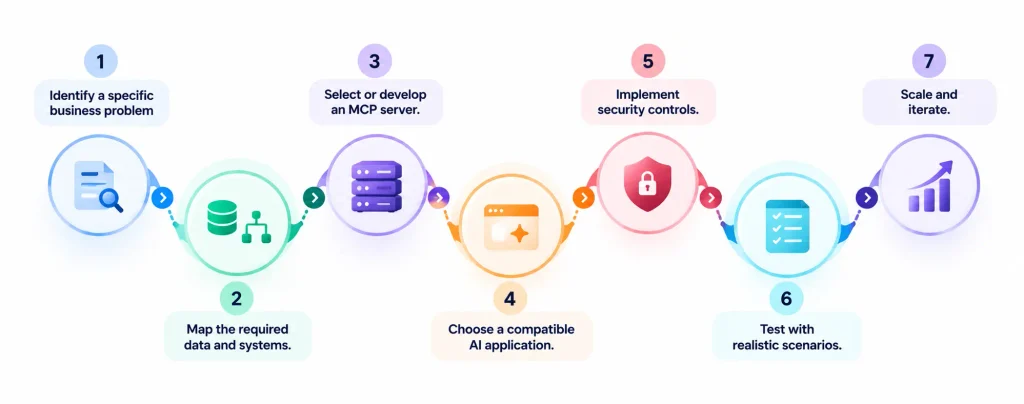
- Identify a specific business problem. Choose a task involving repeated information retrieval or system switching, such as searching internal documentation or collecting project updates.
- Map the required data and systems. Determine which applications contain the necessary information, whether suitable APIs exist, and what permissions the AI application needs.
- Select or develop an MCP server. Evaluate available implementations or build a server that exposes only the required tools, resources, and prompts.
- Choose a compatible AI application. Confirm that the application supports the relevant MCP capabilities and transport mechanism.
- Implement security controls. Configure authentication, authorization, input validation, logging, and approval requirements before allowing access to sensitive information or actions.
- Test with realistic scenarios. Assess answer accuracy, tool selection, response time, failure handling, and access restrictions. Include tests for malicious inputs and unauthorized requests.
- Measure the results. Track practical indicators such as task completion time, manual effort, error rates, and user satisfaction. Expand only when the initial implementation demonstrates measurable value.
- This incremental approach helps teams evaluate model context protocol enterprise AI in a controlled environment before introducing broader integrations.
What Is the Future of MCP in Enterprise AI?
As organizations move beyond standalone chatbots toward AI agents and connected workflows, standardized communication between AI applications and business systems becomes increasingly important.
MCP provides a foundation for this interaction by defining common patterns for capability discovery, information exchange, and tool execution. Its ecosystem can help developers build integrations that work across compatible applications instead of depending entirely on proprietary connection patterns.
Potential areas of growth include internal knowledge assistants, AI-powered analytics, developer productivity, customer service automation, and multi-step business workflows.
However, adoption will depend on more than technical compatibility. Enterprises must also consider integration maintenance, access governance, reliability, cost, and the quality of the underlying data.
Model context protocol enterprise AI should therefore be viewed as an enabling technology rather than a complete enterprise AI strategy. Its value will depend on how effectively organizations combine the protocol with sound architecture, security practices, and clearly defined business objectives.
Conclusion
Model Context Protocol is an important development in how AI applications connect with external tools, data, and services. By providing a common communication framework, it can help organizations reduce integration complexity and make AI systems more context-aware and capable of supporting practical workflows.
For enterprise teams, the main opportunity is not simply connecting more systems to AI. It is enabling AI applications to access the right information, use appropriate tools, and operate within clearly defined security boundaries.
Understanding model context protocol enterprise AI helps technology leaders evaluate where standardized integrations can improve existing processes and where additional engineering or governance is required.
The most effective starting point is a specific business challenge, a limited set of authorized capabilities, and a measurable outcome. With this foundation, organizations can assess MCP’s practical benefits and determine where connected AI can deliver meaningful improvements over time.
Looking to explore how AI integrations can improve your business operations? Contact us to discuss your enterprise AI goals and discover how the right integration strategy can help you build secure, scalable, and efficient AI workflows.