







Choosing an automation implementation partner finance teams can rely on is about more than finding someone who can build an RPA bot. Finance processes involve ERP integrations, approval controls, audit trails, reconciliations, compliance requirements, and complex business rules. The right partner needs to understand both automation technology and the way finance actually works.
A generic automation provider may be able to automate data entry. A finance-focused implementation partner should also understand accounts payable, accounts receivable, three-way matching, reconciliation, financial close, multi-entity accounting, and shared services operations.
The difference matters. The wrong partner can leave finance teams with partially working automation, unexpected integration problems, escalating costs, and months of wasted effort. The right partner should help you move from process assessment to a working automation, measurable results, and a roadmap for scaling.
This guide explains how to choose an automation partner, what questions to ask, how implementation partners differ from consultants and software vendors, what pricing models to expect, and which red flags should make you reconsider a provider.
Why Finance Teams Need a Different Kind of Implementation Partner
Most automation partner content starts with familiar phrases such as digital transformation, process optimization, intelligent automation, and operational efficiency. Those concepts matter, but finance teams have requirements that go much deeper.
A finance automation implementation has to work within the organization’s existing financial controls and systems. That can mean integrating with SAP, Oracle, NetSuite, Sage, Microsoft Dynamics, or other ERP platforms while maintaining approval workflows, audit trails, segregation of duties, and data security.
Finance also has processes that require domain knowledge. Invoice automation, for example, is not simply a matter of moving invoice information from an email into an ERP. The automation may need to validate vendor information, check purchase orders, perform three-way matching, identify exceptions, route approvals, and post transactions according to accounting rules.
The same applies to reconciliation and financial close. A partner needs to understand what constitutes a valid match, how exceptions should be handled, what supporting documentation is required, and how the process fits into the close calendar.
A generic RPA implementation partner can potentially build a bot. A finance-focused partner understands why that bot needs to behave correctly within the broader accounting process.
That distinction can become expensive. A poorly scoped implementation can consume months and tens or even hundreds of thousands of dollars before the organization realizes that the provider does not understand its finance processes, ERP environment, or control requirements.
The objective is therefore not simply to find someone who can automate. It is to find an automation implementation partner finance teams can trust to understand the process, technology, controls, and measurable business outcome together.
Implementation Partner vs. Consulting Firm vs. Software Vendor: Which Do You Need?
Before choosing an implementation partner, it helps to understand the difference between the three types of providers finance teams commonly encounter.
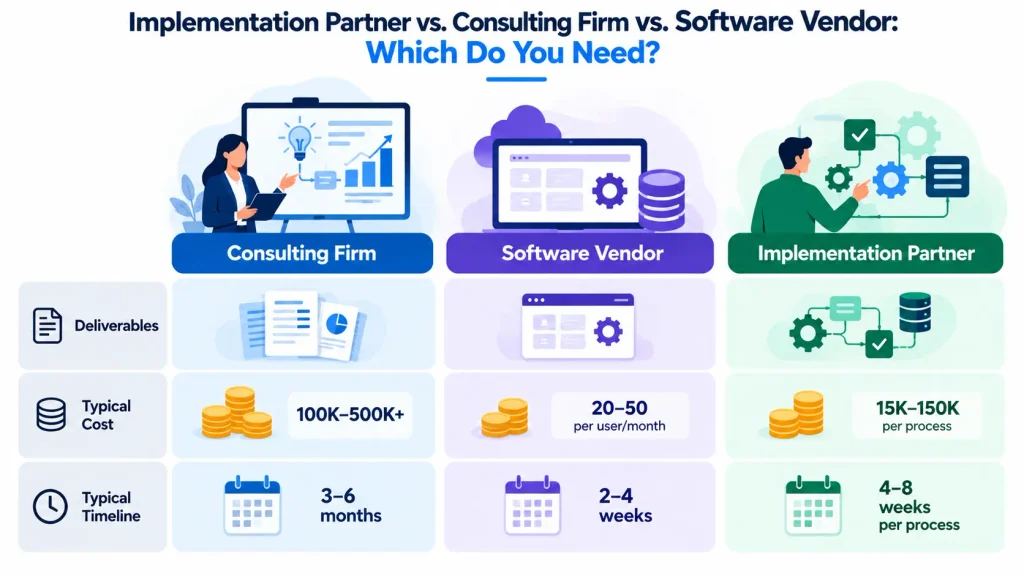
| Option | What They Do | Best For | Typical Cost | Typical Timeline |
| Consulting firm | Strategy, roadmap, operating-model design, transformation advisory | Organizations that need help determining where and how to transform | 100K–500K+ | 3–6 months for strategy |
| Software vendor | Provides a pre-built automation platform or application | Standardized processes that fit the product’s capabilities | Often 20–50/user/month, depending on product and licensing | 2–4 weeks for simpler deployments |
| Implementation partner | Designs, builds, integrates, tests, and deploys automation around specific processes and systems | Organizations that know what they want to automate but need someone to build and implement it | Approximately 15K–150K per process, depending on complexity | Often 4–8 weeks per process |
These are not necessarily competing choices. A large finance organization may use a consulting firm for transformation strategy, a software vendor for a specific technology platform, and an implementation partner to actually configure and build the automation.
For example, a finance leadership team might engage consultants for finance transformation consulting and develop a multi-year roadmap. The organization could then select an AP platform or RPA technology. An implementation partner may subsequently integrate that technology with the ERP and customize the workflow around the organization’s actual AP process.
The implementation partner is often where strategy becomes operational reality.
If your organization already knows that invoice processing, reconciliation, expense auditing, reporting, or another process needs automation, you may not need a lengthy strategy engagement before starting. You may need a provider capable of assessing the process, building a proof of concept, integrating the relevant systems, and putting the automation into production.
Likewise, having software does not automatically mean implementation is complete. A finance team may purchase an AP automation platform but still require configuration, ERP integration, workflow design, exception handling, testing, user training, and ongoing support.
The important question is therefore not simply, “Which provider is best?”
Instead, ask: What problem are we solving right now, and which type of provider is equipped to solve it?
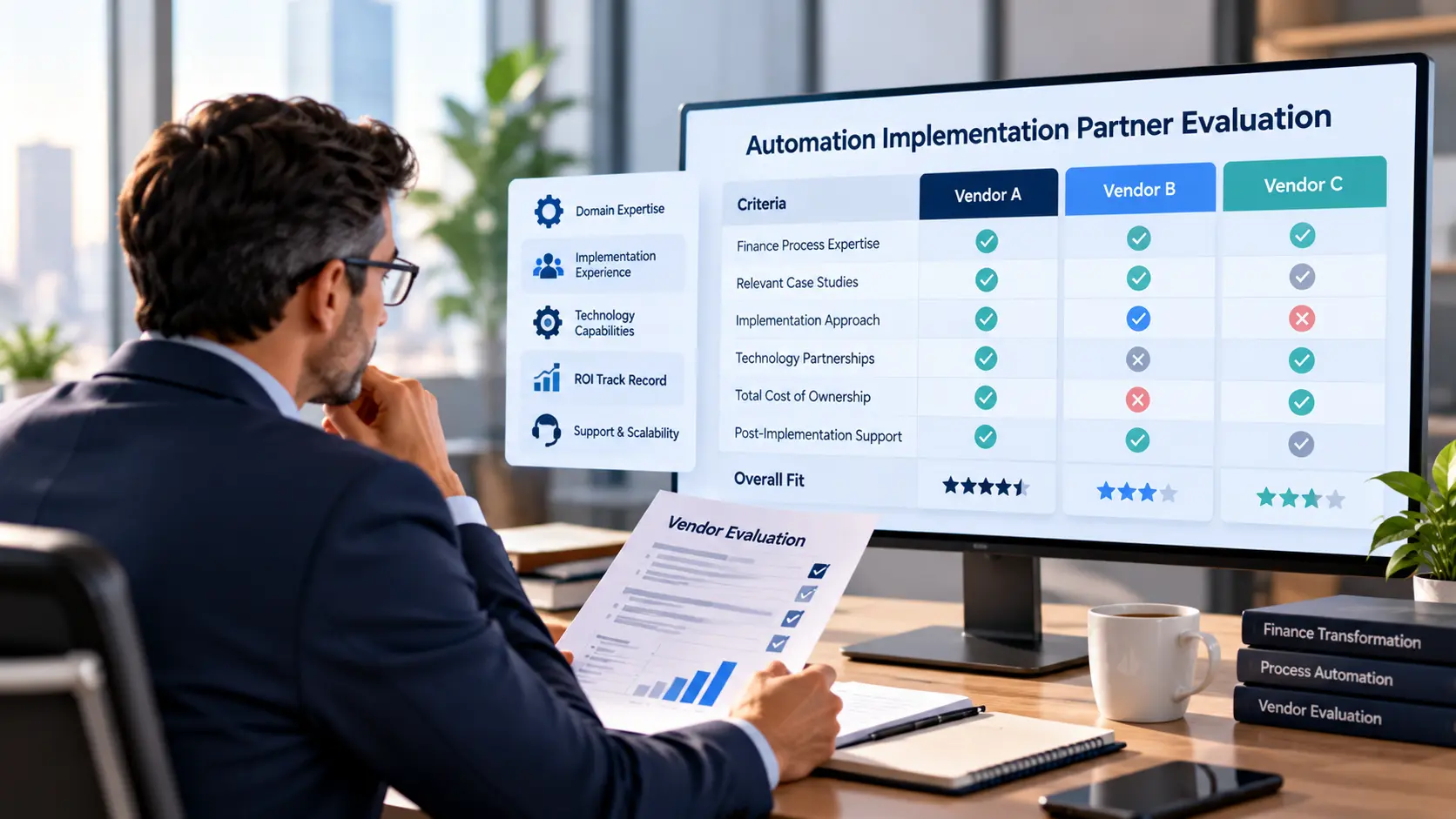
10 Criteria for Choosing a Finance Automation Implementation Partner
This is the most important part of your evaluation. The right provider should be able to demonstrate both technical implementation capability and practical finance expertise.
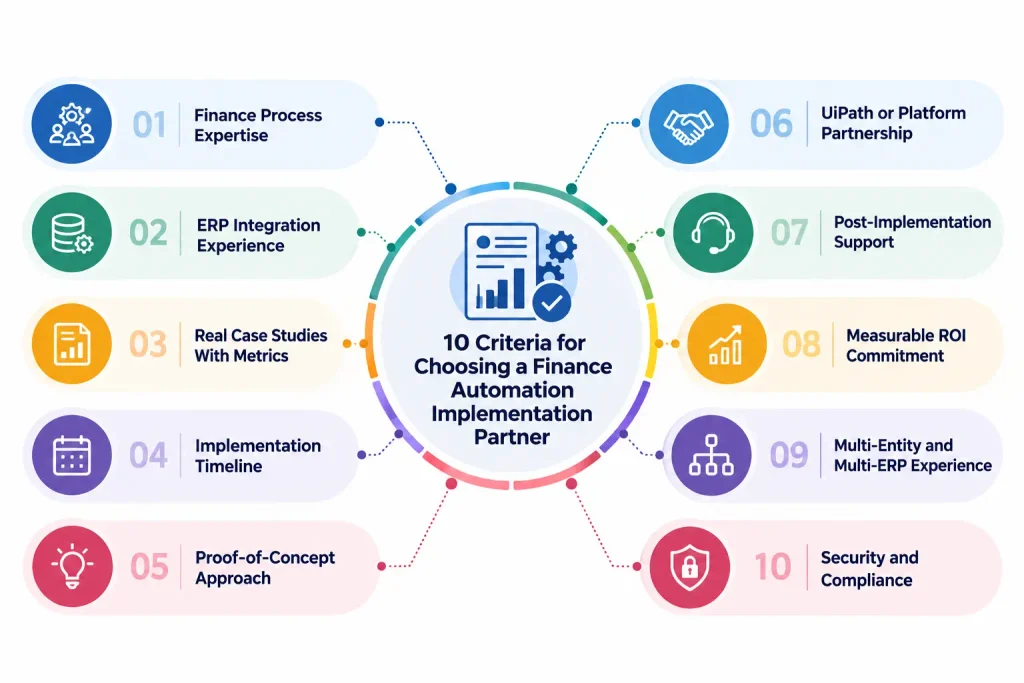
1. Finance Process Expertise
The first question is simple: Does the partner actually understand finance?
Look for experience across processes such as:
- Accounts payable
- Accounts receivable
- Invoice processing
- Three-way matching
- Reconciliation
- Financial close
- Journal processing
- Expense management
- Purchase-to-pay
- Record-to-report
- Reporting
- Shared services operations
A provider should be able to discuss the process in business terms rather than only describing bots, APIs, workflows, AI agents in finance, or AI models.
For example, ask, “Walk me through how you’d automate three-way matching in our ERP.”
A knowledgeable provider should be able to discuss purchase orders, goods receipts, invoices, matching tolerances, exceptions, approval rules, and what happens when the three records do not match.
What good looks like: The partner asks detailed questions about your current process, transaction volumes, exception rates, accounting rules, approval hierarchy, systems, and controls before proposing an automation.
Red flag: The provider immediately demonstrates a generic bot or AI tool without first understanding the finance process it is supposed to automate.
2. ERP Integration Experience
Finance automation rarely exists in isolation. The automation may need to interact with SAP, Oracle, NetSuite, Sage, Microsoft Dynamics, or multiple ERP environments. It may also need to connect with email, document repositories, procurement systems, banking platforms, expense systems, or reporting tools.
This makes ERP experience one of the most important criteria when evaluating a RPA implementation partner.
Ask: “Show me a case study where you integrated automation with our ERP.”
Do not settle for a response such as, “We can integrate with any ERP.”
Ask for evidence. Find out whether the provider has worked with the specific ERP version, modules, interfaces, security model, and workflows relevant to your environment.
What good looks like: The partner can explain previous ERP integrations, common technical constraints, authentication requirements, transaction handling, error recovery, and how automation interacts with existing finance controls.
Red flag: The provider cannot demonstrate relevant ERP experience but still provides a confident fixed timeline and price.
3. Real Case Studies With Metrics
Testimonials saying “great service” are not enough. When evaluating an automation implementation partner finance teams should look for measurable before-and-after results.
Ask: “What was the before-and-after result for processing time, error rate, manual hours, and cost?”
Useful metrics include:
- Invoice processing time
- Cost per transaction
- Manual hours
- Error rate
- Exception rate
- Reconciliation time
- Close duration
- Approval time
- FTE capacity recovered
- Annual savings
- Transaction throughput
For example, a published Auxiliobits AP automation case study reports that a large marketing network reduced invoice reconciliation from 4.2 days to under 18 hours, recovered approximately 9,700 hours annually, reduced the reported error rate from 12% to below 0.6%, and generated more than $200,000 in annual savings.
These figures are useful because they show the type of evidence you should request from any prospective partner.
What good looks like: The provider can show a case study with a defined problem, implementation approach, timeline, technology environment, and measurable outcome.
Red flag: The case study contains only phrases such as “improved efficiency,” “enhanced productivity,” or “successful digital transformation” without numbers.
4. Implementation Timeline
One of the most important questions is, “How long until we see our first automated process in production?”
A focused automation project should have a clearly defined implementation path.
For a relatively contained finance process, a 4–8 week implementation window may be realistic when requirements, data, system access, and stakeholders are available. More complex implementations involving multiple ERPs, entities, integrations, or significant process redesign may take longer.
The important thing is that the partner should explain what happens during those weeks.
A typical implementation could involve:
- Process discovery
- Current-state mapping
- Requirements definition
- Automation design
- Development
- Integration
- Testing
- User acceptance
- Deployment
- Stabilization
What good looks like: The partner gives you a milestone-based implementation plan with clear deliverables and dependencies.
Red flag: The partner proposes a six-month assessment before building anything or cannot explain when you will see a working automation.
5. Proof-of-Concept Approach
You do not necessarily need to automate your entire finance operation at once. A proof of concept can reduce implementation risk by allowing both sides to test the technology, process assumptions, integration approach, and expected results before expanding the engagement.
Ask: “Can we start with one process and scale from there?”
For example, you could begin with a high-volume AP process, demonstrate measurable improvement, and then expand into reconciliation, expense processing, reporting, or close automation.
A POC should not simply be a technology demonstration. It should use a representative process and produce evidence that the proposed approach can work in your environment.
What good looks like: The provider defines the POC scope, success criteria, timeline, data requirements, and measurable outcomes before development begins.
Red flag: The provider refuses to demonstrate its approach on a meaningful process or insists that you sign a large multi-process contract before proving the solution.
6. UiPath or Platform Partnership
If your organization has selected UiPath, Microsoft Power Automate, or another automation platform, ask about the provider’s relationship with that platform.
Ask: “What’s your partnership level with UiPath or Power Automate, and how many implementations has your team completed?”
A formal platform partnership does not automatically make a provider the right choice. However, relevant certifications, platform expertise, implementation experience, and access to vendor resources can reduce technical risk.
For organizations specifically looking for a UiPath implementation partner, evaluate platform expertise alongside finance expertise. A provider may be excellent at UiPath but have limited understanding of financial processes.
The strongest combination is technology expertise plus finance domain knowledge.
What good looks like: The team can demonstrate relevant platform certifications, implementation experience, reusable components, governance practices, and finance-specific use cases.
Red flag: The provider treats the platform itself as the solution and cannot explain how it will fit your finance process.
7. Post-Implementation Support
Go-live is not the end of automation. Once an automation enters production, someone needs to monitor it, handle exceptions, maintain integrations, respond to application changes, and investigate failures.
Ask: “What’s included in ongoing support, and what costs extra?”
Clarify:
- Support hours
- Response times
- Monitoring
- Incident management
- Bot maintenance
- ERP changes
- Process changes
- Enhancement requests
- Reporting
- Performance reviews
- Disaster recovery
This is especially important for finance processes because failures can affect invoices, payments, reconciliations, reporting, and close activities.
What good looks like: The provider has a documented support model with defined responsibilities, response times, escalation procedures, and pricing.
Red flag: The provider focuses entirely on implementation and does not clearly explain what happens after go-live.
8. Measurable ROI Commitment
Automation should create measurable business value. Before implementation begins, establish a baseline.
For example:
- Current invoice processing time: 4 days
- Current manual effort: 800 hours/month
- Current error rate: 10%
- Current cost per invoice: $X
Then define the target state.
Ask: “What metrics will we use to measure success, and what happens if the expected outcomes are not achieved?”
Be careful with providers that promise unrealistic savings before understanding the process. A credible partner should explain what drives the expected ROI and which factors are outside its control. Your ROI calculation can include labor savings, capacity recovery, faster processing, reduced errors, reduced overtime, improved compliance, and avoided future hiring. For a deeper financial justification, use your AP automation business case and establish a baseline before selecting a vendor.
What good looks like: The partner defines measurable KPIs before development and reports actual performance after implementation.
Red flag: The provider promises a percentage of savings without explaining the baseline, calculation method, assumptions, or measurement period.
9. Multi-Entity and Multi-ERP Experience
Finance becomes considerably more complicated when automation needs to operate across multiple legal entities, regions, business units, or ERP platforms.
Ask: “Have you implemented automation across multiple entities with different ERPs?”
This matters particularly for global organizations and shared services centers.
The provider may need to account for:
- Different chart-of-account structures
- Different approval workflows
- Different tax requirements
- Different currencies
- Different ERP configurations
- Different business rules
- Regional compliance requirements
- Different invoice formats
The objective is not always to create one identical workflow for every entity. Instead, the partner should understand where standardization makes sense and where local variations are necessary.
What good looks like: The provider has experience designing reusable automation frameworks while accommodating legitimate entity-level differences.
Red flag: The provider assumes one workflow can simply be copied across every entity without analyzing local requirements.
10. Security and Compliance
Finance automation handles sensitive information, including invoices, vendor data, employee expenses, banking information, financial records, and potentially personally identifiable information.
Ask: “How do you handle audit trails, access controls, and data security?”
Your evaluation should cover:
- Role-based access
- Authentication
- Credential management
- Data encryption
- Audit trails
- Logging
- Segregation of duties
- Exception handling
- Data retention
- Environment separation
- Change management
- Regulatory requirements
Automation should strengthen controls rather than create a new source of risk. A good provider should be able to explain exactly who can access the automation, what actions are logged, how credentials are protected, and how changes are approved.
What good looks like: Security and compliance requirements are included during solution design rather than added at the end of implementation.
Red flag: Security is treated as an IT issue that can be addressed after the automation is already built.
What a Good Implementation Partner Actually Does
A good automation implementation partner does more than build bots or configure software. The right partner takes responsibility for understanding your finance process, designing the automation around it, implementing the solution, and measuring whether it delivers the expected business value. If your organization is still defining its broader transformation strategy, finance transformation consulting & automation consulting and advisory can help establish the right priorities before implementation begins.
1. Starts With a Process Assessment
The engagement should begin with an assessment—not a sales pitch. The partner should understand transaction volumes, manual steps, exceptions, systems, approval rules, and current performance before recommending automation.
For example, if accounts payable is the starting point, the assessment should identify invoice volumes, manual touchpoints, approval delays, exception rates, and ERP dependencies. This information helps determine whether the organization needs AP automation implementation services and where the biggest opportunities exist.
2. Maps the Current-State Workflow
Before building anything, the implementation team should document how the process works today. This helps identify unnecessary steps, bottlenecks, repetitive tasks, and opportunities for automation.
The partner should also evaluate the technology already available. If you are comparing platforms or considering replacing an existing solution, reviewing the best AP automation software can help you understand which capabilities may be available out of the box and where custom implementation may still be required.
3. Builds a Proof of Concept
A capable partner should be willing to demonstrate the proposed solution. A POC can typically be developed within 2–4 weeks, depending on process complexity, giving finance teams evidence that the approach works before committing to a larger rollout.
4. Implements the Automation
Once the concept is validated, implementation can move into development, integration, testing, and deployment. A focused finance process can often be implemented within 4–8 weeks, although complex ERP environments or multi-entity workflows may require additional time.
The implementation partner should also have experience with the technology platform being used. For organizations adopting UiPath, for example, working with an experienced UiPath implementation partner can help with platform configuration, integrations, deployment, and ongoing automation management.
5. Provides Training and Documentation
Implementation should include user training, process documentation, technical documentation, and clear instructions for handling exceptions. This ensures the finance team can operate and understand the solution after go-live.
Documentation is particularly important when automation affects approval workflows, accounting controls, or shared services operations. For organizations scaling automation across a finance or GBS function, a structured shared services automation implementation approach can help maintain consistency across processes and entities.
6. Provides Ongoing Support
Automation needs monitoring and maintenance after deployment. ERP changes, application updates, process changes, and unexpected exceptions can all affect automation performance. Ongoing support helps keep processes running reliably.
7. Measures ROI
Finally, a good partner tracks measurable outcomes such as processing time, manual hours, error rates, transaction costs, and capacity recovered.
Before implementation, organizations should establish a baseline and define how success will be measured. A detailed AP automation business case can help quantify the expected financial impact, while ongoing automation ROI measurement can demonstrate whether the automation is delivering the expected results.
For another example of measurable finance automation outcomes, see the expense automation case study.
The key takeaway is simple: a good implementation partner should not just deliver automation. It should help you prove, implement, measure, and continuously improve the business outcome.
Pricing Models: What to Expect
Finance automation pricing varies significantly based on process complexity, transaction volume, number of systems, integration requirements, security requirements, and the level of customization required.
Several pricing models are common.
1. Fixed Price Per Process
A provider may quote a defined fee for automating a specific process such as AP, reconciliation, or expense processing. A typical range for a relatively contained process may be approximately 15,000–50,000, although complex implementations can cost considerably more. The benefit is predictability. The key is making sure the scope clearly defines what is included.
2. Monthly Support Retainer
After implementation, organizations may pay a monthly support fee. A typical range could be approximately 2,000–10,000 per month, depending on the number of automations, support requirements, monitoring, and service levels.
3. Automation-as-a-Service
With Automation-as-a-Service, the provider manages automation on an ongoing basis for a recurring monthly fee. Depending on scope, a program may cost approximately 5,000–20,000 per month.
This can be useful when the organization wants automation capability without building a large internal team.
The important comparison is not simply the price. A consulting strategy engagement may cost 100,000–500,000 or more without delivering a working automation. An implementation engagement should be evaluated based on the working processes delivered, measurable savings, capacity recovered, and long-term scalability.
For organizations considering a managed model, explore automation-as-a-service to understand how ongoing automation delivery and support can be structured.
Red Flags: When to Walk Away
Knowing what to look for is only half of how to choose an automation partner. You also need to know what should make you pause.
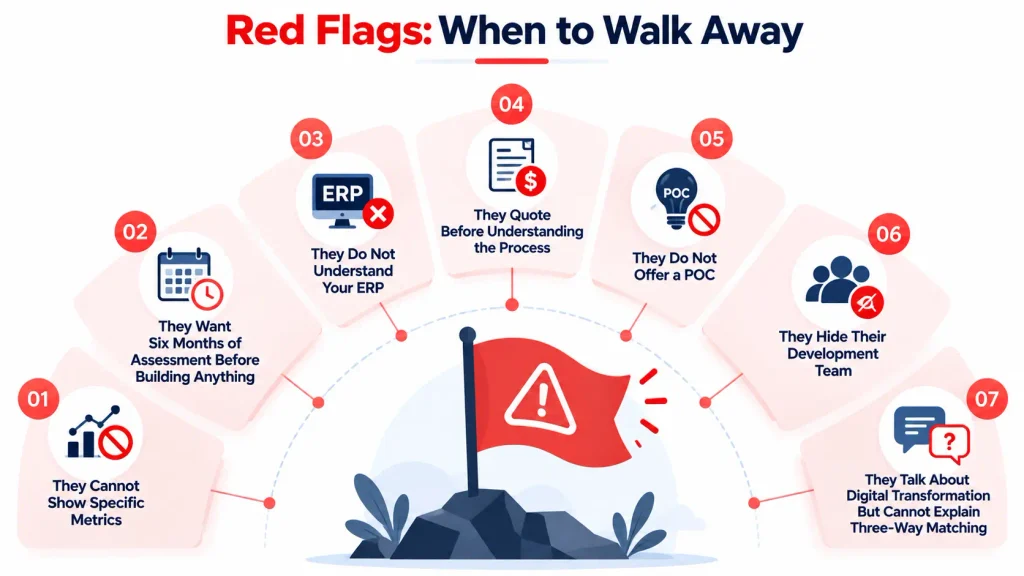
1. They Cannot Show Specific Metrics
If every case study says “improved efficiency” but none provides processing time, cost, hours, error rates, or other measurable outcomes, ask why.
2. They Want Six Months of Assessment Before Building Anything
Discovery is valuable. Endless discovery is not. A good assessment should lead to a decision about what to automate and how to prove it.
3. They Do Not Understand Your ERP
If your provider has never worked with your ERP but gives you an extremely confident implementation timeline, investigate further.
4. They Quote Before Understanding the Process
A serious provider should ask about transaction volumes, workflows, exceptions, integrations, users, entities, and business rules before providing a detailed estimate.
5. They Do Not Offer a POC
A proof of concept is not mandatory for every project, but for an unfamiliar provider or technically complex process, the ability to demonstrate the approach can significantly reduce risk.
6. They Hide Their Development Team
If you outsource all development and the provider cannot introduce you to the people actually building and supporting the automation, ask how accountability will work.
7. They Talk About Digital Transformation But Cannot Explain Three-Way Matching
This is perhaps the clearest finance-specific warning sign. You are not buying a presentation about transformation. You are buying a working solution for a finance process. Your implementation partner should be able to discuss the actual business rules behind that process.
Ready to Find the Right Implementation Partner?
Choosing an automation implementation partner should start with your process, not a vendor’s technology demo.
Before signing an implementation contract, understand where your finance team is spending time, where errors occur, how much work is manual, which systems are involved, and what measurable improvement would justify the investment.
Start with an AP efficiency assessment to assess your current AP process. The assessment is designed to take approximately three minutes and provide an immediate view of potential improvement opportunities.
If AP is only the beginning, you can then build a broader roadmap covering reconciliation, reporting, close, P2P, AR, and agentic process automation across shared services automation.
Or book a discovery call to discuss your automation roadmap, current finance processes, ERP environment, and potential implementation priorities.
The goal is simple: start with one measurable process, prove the value, and scale what works.