








Key Takeaways
- Automation success does not automatically translate into scalability. Once demand outpaces the architecture supporting the first 10–15 automations, integration, ownership, and governance debt can cause delivery costs and timelines to rise.
- Integration debt is one of the biggest barriers to enterprise automation scaling. Point-to-point connections multiply as more systems are introduced, making reusable integration layers critical for reducing the marginal cost of new automations.
- Most enterprises plateau at the Coordinated Stage. A formal CoE and basic standards may exist, but fragmented integrations and inconsistent governance prevent the program from progressing to a platform-based model.
- Scaling requires infrastructure, not just more automation tools. Funding reusable integrations, giving the CoE architectural decision rights, and establishing automation lifecycle management create the foundation for sustainable growth.
- The goal is to make every new automation easier to deploy than the last. Mature enterprise automation scaling shifts the focus from individual process ROI to portfolio-level outcomes such as reuse, deployment speed, coverage, reliability, and risk reduction.
There is a predictable moment in almost every enterprise automation program: the first 10–15 automations work. Business teams see measurable time savings, leaders approve more use cases, and demand starts accelerating.
Then something changes. The next 50 automations take longer to build than the first 15. Integration work becomes a bottleneck. Different teams build similar connections to the same systems. The Center of Excellence (CoE) spends more time reviewing exceptions than enabling new use cases. Security and audit questions appear late in the delivery cycle.
This is often interpreted as an automation problem. It isn’t. It is a scaling architecture problem.
Enterprise automation scaling is not simply about deploying more bots, workflows, or AI agents. It requires an operating model that allows automation to compound rather than accumulate technical debt.
The key question changes from “What should we automate next?” to “What foundation will make the next 50 automations faster, safer, and cheaper to deploy?”
This article explains how to identify that transition point, measure your automation maturity, and determine what needs to change before scaling further.
Why Automation Programs Plateau After the Pilot Phase
Early automation programs can succeed with relatively simple architecture. One department identifies a repetitive process. A developer builds an automation. The business owner validates it. The automation goes live.
At this stage, point-to-point integrations and decentralized ownership may not create visible problems.
The economics change as the program grows. Multiple departments begin connecting to the same ERP, CRM, HR platform, document repository, or financial system. Different developers create overlapping integrations. Monitoring becomes fragmented. Nobody has a complete inventory of what is running or who owns it.
Three forms of structural debt typically emerge:
- Integration debt— every new automation creates another connection to maintain.
- Ownership debt— responsibility for approvals, monitoring, maintenance, and retirement becomes unclear.
- Governance debt— access controls, audit trails, security reviews, and compliance requirements are addressed reactively rather than by design.
These problems compound. Adding more developers may increase delivery capacity temporarily, but it does not eliminate the underlying architectural constraints. In fact, it can worsen them by increasing the number of components and patterns that need to be maintained.
The Integration Debt Behind Rising Automation Costs
One of the clearest indicators that an automation program is not scaling efficiently is an increase in the cost and time required to deploy each new automation. The reason is often integration complexity.
With point-to-point architecture, the potential number of connections between systems can be represented approximately as:
Connections = n(n−1)/2
where n represents the number of systems involved.
Consider the difference:
| Systems | Potential point-to-point connections |
| 4 | 6 |
| 8 | 28 |
| 12 | 66 |
| 20 | 190 |
The exact number of production connections will vary by architecture, but the underlying principle remains: integration complexity grows faster than the number of systems.
Now consider an automation that connects a CRM to an ERP.
If that integration is built specifically for one workflow, the next automation may build it again. A third automation may require another variation. Over time, the organization owns multiple versions of essentially the same connection.
That creates maintenance costs, security exposure, testing requirements, and failure points.
This is why the traditional prioritization rule, “automate the highest-ROI process next,” becomes incomplete at scale.
After the pilot phase, organizations should also ask: How much reusable infrastructure will this automation create?
A shared CRM-to-ERP integration used across 20 workflows can create more strategic value than a single high-ROI automation that introduces another isolated connection.
That is the foundation of effective enterprise automation scaling.
The Four Stages of Enterprise Automation Scaling
Automation maturity is better understood as a progression than as a checklist. The architecture, governance, and operating model required at each stage are different.
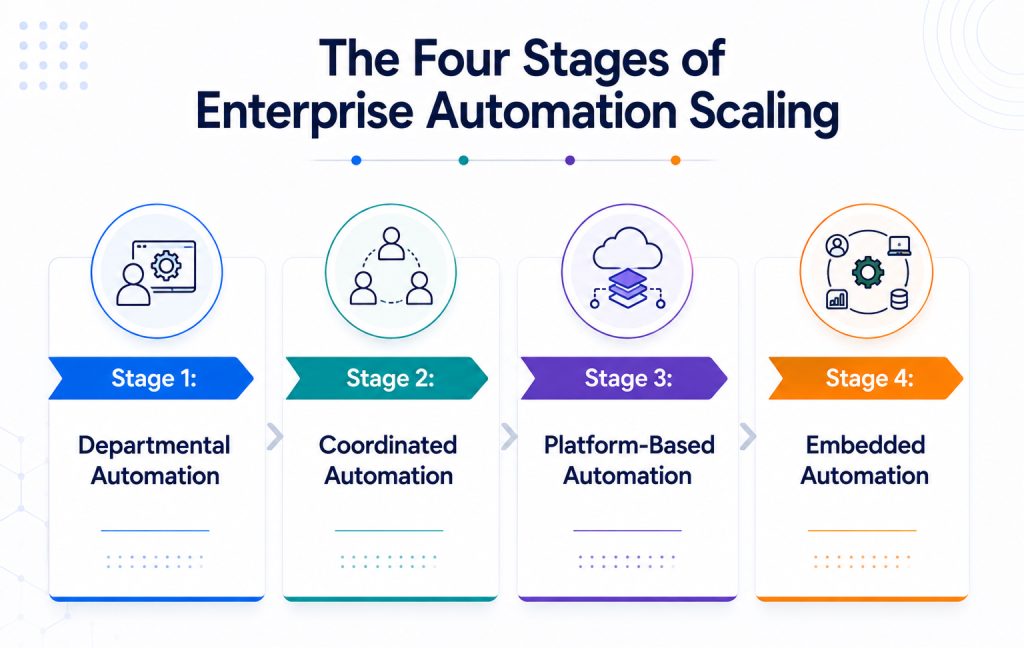
Stage 1: Departmental Automation
Automation is primarily owned by individual business teams. Processes are selected based on local priorities, and success is usually measured in hours saved or manual steps eliminated.
Typical characteristics include:
- Independent automation development
- Limited reuse of components
- Point-to-point integrations
- Process-level ROI measurement
- Minimal centralized governance
Typical scale: 1–15 automations
At this stage, speed matters most. However, organizations should establish basic standards early enough to prevent every successful pilot from becoming a future maintenance problem.
Stage 2: Coordinated Automation
The organization begins treating automation as an enterprise capability rather than a collection of individual projects. A shared integration layer allows new automations to reuse existing connections and components. Monitoring, access controls, logging, and governance are incorporated into the platform architecture.
Typical scale: 50–200+ automations
The objective is no longer simply to increase automation volume. It is to reduce the marginal cost and time of each additional automation. That is the real measure of scalable automation.
Stage 4: Embedded Automation
At the most mature stage, automation becomes part of how processes are designed. Business teams consider automation during process redesign rather than identifying it after a process has already been established.
The CoE shifts from being a development bottleneck to an enterprise enablement function. Business units request capabilities through standardized intake processes instead of creating disconnected shadow automations.
Measurement also moves from individual automation. ROI to portfolio-level outcomes, including:
- Percentage of eligible processes automated
- Average time to deploy
- Reuse of integrations and components
- Automation reliability
- Risk reduction
- Cost per automation
- Business adoption
The program becomes capable of compounding.
A Practical Enterprise Automation Scaling Assessment
Before selecting another automation platform or adding development capacity, score your current operating model.
| Assessment area | 0 points | 1 point | 2 points |
| New integrations | Built point-to-point each time | Some reusable patterns | Shared integration layer |
| Approval | Builder decides | CoE review is inconsistent | CoE approval is enforced |
| Automation inventory | No central inventory | Partial/manual inventory | Complete inventory with ownership and status |
| ROI measurement | Hours saved per process | Department-level reporting | Portfolio-level business outcomes |
| System changes | Break/fix response | Some monitoring | Automated monitoring and change management |
How to Interpret Your Score
0–3 points: Stage 1 — Departmental
Your immediate priority should be standardization. Establish reusable integration patterns and basic ownership before significantly increasing automation volume.
4–6 points: Stage 2 — Coordinated
You are likely at the enterprise automation scaling plateau. Prioritize the integration foundation before simply adding more use cases or development resources.
7–8 points: Stage 3 — Platform
Your foundation is becoming scalable. The next priority is strengthening governance, observability, reuse, and portfolio-level measurement.
9–10 points: Stage 4 — Embedded
Architecture is unlikely to be your primary constraint. Focus on enterprise intake, process redesign, adoption, and prioritization.
Three Changes That Actually Enable Scale
The organizations that successfully move beyond the plateau tend to make three structural changes.
1. Fund Integration as Infrastructure
Integration should not depend entirely on individual process owners. A process owner has little incentive to fund a reusable connector that may benefit ten other automations later. Treating the integration layer as shared enterprise infrastructure solves this funding problem.
The question becomes: What reusable capability should we build once instead of rebuilding it across every automation?
2. Give the CoE Decision Rights
A CoE that reviews automations only after development is complete is primarily a quality-control function. At scale, the CoE needs influence before development begins.
For example, an automation request touching a system that already has five existing integrations should trigger an architectural review before another connection is created.
The objective is not to slow delivery. The goal is to prevent five teams from solving the same integration problem in five different ways.
3. Retire Automations Deliberately
Scaling is not the same as continuously adding automations. Some automations will become redundant. Others will support processes that have been redesigned. Some will have been built before enterprise standards existed.
A mature program therefore needs a lifecycle:
Discover → Prioritize → Build → Monitor → Optimize → Retire
Without retirement, the automation portfolio becomes another source of technical debt.
What Enterprise Automation Scaling Should Look Like
The goal of enterprise automation scaling is not to maximize the number of automations deployed but to create an environment where each successful automation makes the next one easier to deliver.
That requires a shift in thinking:
From: individual automation projects
To: reusable automation capabilities
From: hours saved per automation
To: portfolio-level business outcomes
From: reactive governance
To: governance by design
From: point-to-point integrations
To: reusable integration services
From: automation deployment
To: automation lifecycle management
If your program has 15, 20, or even 50 successful automations but every new use case requires another custom integration, another security review, and another maintenance process, you are not yet scaling.
You are accumulating.
The most important decision at this stage may therefore not be which process to automate next. It may be deciding which integration, governance, ownership, and reuse capabilities need to exist before the next 50 automations arrive.
That is the difference between an automation program that grows linearly and one that compounds.
The Bottom Line
Enterprise automation scaling begins when automation stops being a collection of successful pilots and becomes an engineered enterprise capability.
If your program is sitting in Stage 2, resist the temptation to solve the plateau by simply buying another tool or adding more developers. First map your current integration footprint, identify duplicated connections, clarify ownership, and establish the reusable foundation that future automations can share.
The objective is simple: Make automation cheaper, faster, and safer to scale with every new use case, not more expensive.