









Key Takeaways
- Accuracy alone doesn’t measure automation. STP rate shows how much work IDP actually eliminates.
- Exceptions determine ROI. The cost and handling time of exceptions are critical to the IDP business case.
- Test real documents, not vendor benchmarks. Your edge cases reveal production performance.
- Measure improvement over time. A strong IDP system should reduce recurring exceptions through feedback.
- The goal is controlled automation. Human expertise should focus on exceptions, not routine document processing.
A lending operations director once told us her team had selected an intelligent document processing vendor almost entirely on the strength of one number: 97% extraction accuracy. The number was real. It had been verified against the vendor’s benchmark dataset, and it looked compelling in the procurement presentation.
Eight months later, underwriters were still manually reviewing nearly half of every document batch. The problem wasn’t that the technology was inaccurate. The problem was that the organization had optimized for the wrong metric.
This is one of the quieter failure modes of intelligent document processing in finance. Financial institutions often evaluate the metric that vendors are best at demonstrating, rather than the metric that determines whether automation will actually change the economics of an operation. Accuracy makes an impressive headline. But if a significant share of documents still requires human intervention, the business case quickly starts to weaken.
For finance leaders evaluating IDP platforms, the more important question isn’t, “How accurately can the system extract data?” It is, “How much work can the system complete without human intervention, and what happens when it cannot?”
That distinction changes how organizations should evaluate vendors, structure proofs of concept, calculate ROI, and design their operating model around document automation.
The Metric Everyone Optimizes For (and Why It’s the Wrong One)
Accuracy sounds like the obvious metric to measure. If an IDP platform can extract information with 97% accuracy, shouldn’t that mean 97% of the work is automated?
Not necessarily.
Extraction accuracy is typically measured at the field level. A system may correctly identify 97 out of 100 individual fields while still sending a substantial percentage of documents to manual review. One uncertain or incorrectly extracted field can be enough to pull an otherwise successfully processed document into an exception queue.
Consider a loan application containing income statements, bank statements, tax documents, and identification records. If 19 out of 20 fields are extracted correctly but one critical income field falls below the confidence threshold, the document may still require an underwriter’s attention.
The result is a system with excellent accuracy statistics but limited operational automation.
This is why straight-through processing (STP) rate is often a more meaningful business metric. STP measures the percentage of documents that move through the required workflow without human intervention.
A platform with 95% field-level accuracy and an 80% STP rate can create substantially more value than one reporting 98% accuracy but achieving only 55% STP. The difference isn’t academic. It determines how much manual capacity remains tied up in document processing after implementation.
For finance operations, the cost of automation isn’t determined by how accurately the system handles successful documents. It is determined by how much work remains afterward.
The Real Lever: Exception Economics
This leads to a more useful way of evaluating intelligent document processing in finance: exception economics.
Every document automation deployment will produce exceptions. Documents arrive with poor-quality scans, unfamiliar layouts, handwritten information, missing fields, inconsistent formats, or data that falls outside expected patterns. That isn’t necessarily a failure of the technology. In a well-designed IDP environment, the system should recognize when confidence is low and route the document for appropriate review.
The real question is what happens to that exception tail.
Does the platform identify the exact field that requires attention, or does it leave a reviewer to search through the entire document? Can exceptions be prioritized according to risk and business impact? Does the system capture reviewer corrections and use them to improve future processing? Most importantly, how long does it take a human to resolve an exception?
These questions reveal far more about operational ROI than another percentage point of extraction accuracy.
A document that takes 20 seconds to review because the system highlights the uncertain field and presents the relevant source information is fundamentally different from a document that forces an employee to start the investigation from scratch. Multiply that difference across thousands or millions of documents, and exception handling becomes a significant operating cost.
The value of IDP, therefore, isn’t determined only by the documents it processes successfully. It is determined by how cheaply, safely, and intelligently it handles the documents it cannot process automatically.
Where Exception Economics Matter Across Finance
The exception-economics lens becomes particularly important when evaluating IDP across different financial workflows.
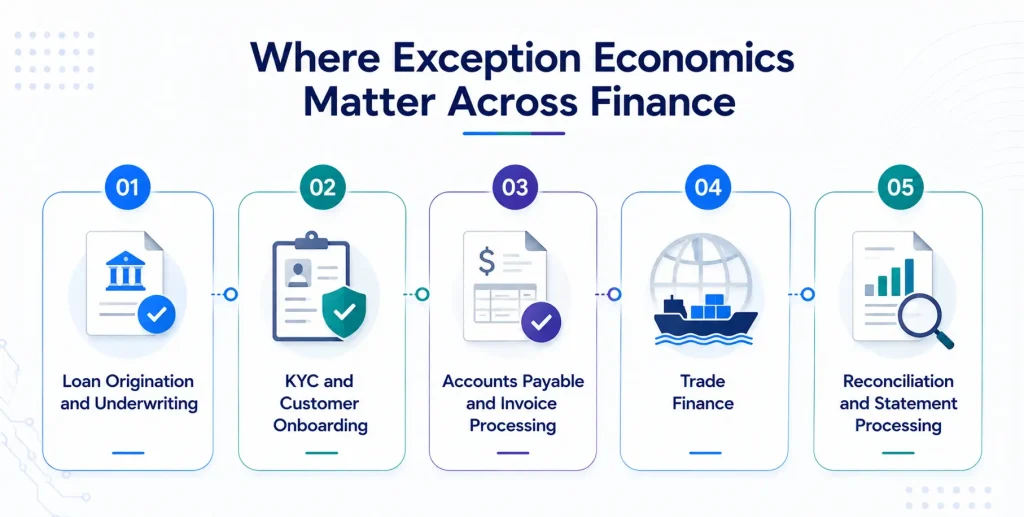
1. Loan Origination and Underwriting
Loan operations process highly variable documentation, including bank statements, tax returns, income verification, identification documents, and employment records. The documents that create the most difficulty are often the ones that matter most: self-employed income statements, non-standard compensation structures, unfamiliar financial institutions, and poor-quality statements.
A vendor benchmark built primarily around clean, standardized documents can therefore make a platform appear more capable than it will be in production. The better test is whether the system can identify uncertainty, surface the relevant information, and give underwriters enough context to resolve exceptions quickly.
2. KYC and Customer Onboarding
KYC workflows introduce another layer of complexity because exceptions can carry compliance implications. Expired identification, inconsistent names, missing information, and discrepancies between submitted documents and customer records require more than extraction. They require controlled identification and escalation.
An intelligent system should make these discrepancies visible rather than simply passing incomplete information downstream. The objective isn’t to remove human judgment from the process. It is to reserve human judgment for cases that genuinely require it.
3. Accounts Payable and Invoice Processing
Accounts payable is often an attractive starting point for IDP because invoice formats vary widely while the required output is relatively structured. The question isn’t simply whether the platform can read an invoice. It is whether invoices can move from receipt through validation, matching, approval, and posting without human intervention.
This makes STP particularly useful for establishing the financial impact of an IDP deployment. Organizations can directly connect automation performance with processing costs, cycle times, exception volumes, and finance team capacity.
4. Trade Finance
Trade finance provides an even stronger case for exception-focused evaluation. Letters of credit, bills of lading, invoices, certificates, and related documents often need to be checked against contractual requirements. The workflow is fundamentally concerned with identifying discrepancies.
A platform that extracts fields accurately but cannot effectively surface contractual mismatches has solved only part of the problem. When evaluating IDP for trade finance, organizations should therefore examine discrepancy detection, exception routing, and reviewer workflows alongside extraction performance.
5. Reconciliation and Statement Processing
Reconciliation workloads become particularly challenging during month-end and period-end close, when document volumes increase while review capacity remains constrained. Even a relatively small exception rate can create a substantial queue.
Here, a platform that progressively reduces recurring exceptions can deliver more value than one with marginally higher extraction accuracy. The ability to learn from corrections and reduce repeat exceptions directly affects the operational burden on finance teams.
IDP vs. OCR vs. RPA: What Actually Changes?
The distinction becomes clearer when intelligent document processing is compared with traditional automation technologies.
| Capability | Traditional OCR | Rule-Based RPA | Intelligent Document Processing |
| Handles varied document layouts | Limited | Limited | Yes |
Understands document context | No | No | Yes |
| Identifies low-confidence extraction | Limited | No | Yes |
| Supports exception routing | Limited | Rule dependent | Yes |
| Learns from corrections | No | No | Yes, with feedback mechanisms |
| Primary failure mode | Manual rework | Broken automation | Routed human review |
The important difference isn’t simply that IDP can process more document types. It is that intelligent document processing can be designed to recognize uncertainty and incorporate human judgment into the workflow.
That distinction matters in finance because a system that fails visibly and routes an exception to the right reviewer can be safer than one that confidently passes incorrect information into a downstream process.
In other words, the objective isn’t perfect automation. It is controlled automation.
A Practical Framework for Evaluating IDP
If your organization is running a proof of concept, don’t rely exclusively on a vendor’s benchmark dataset. Build the evaluation around your own documents and measure the complete workflow.
1. Test your worst documents. Include poor-quality scans, unfamiliar layouts, handwritten fields, unusual formats, and documents that historically create manual work. Your best documents will show how the platform performs under ideal conditions. Your worst documents will show what implementation will actually cost.
2. Measure STP rate. Ask vendors to report the percentage of documents that required zero human intervention. Don’t stop at field-level accuracy. Your scorecard should capture both extraction quality and document-level automation.
3. Measure exception handling time. Time how long reviewers need to resolve an exception, including locating the document, identifying the problematic field, validating the information, and recording the correction. This gives you a much more realistic view of operational savings.
4. Measure improvement over time. Run the same document categories again after corrections have been incorporated. If the exception rate remains unchanged, investigate whether the platform has meaningful feedback and learning mechanisms. A successful implementation should improve the process over time rather than simply automate today’s workload.
5. Test failure visibility. Ask exactly what happens when the system is uncertain or wrong. Where does the document go? Who sees it? What information is displayed? Can reviewers see the source document alongside the extracted value? How are corrections captured? The answers will tell you considerably more about operational risk than another decimal point in an accuracy score.
Put the Framework Against Your Own Documents
Every IDP vendor can show you an impressive accuracy number. Far fewer can tell you precisely what happens to the documents that don’t meet it — how those exceptions are surfaced, how expensive they are to resolve, how they are prioritized, and whether that cost declines over time.
Before selecting a platform, evaluate your actual document mix. Establish your baseline STP rate. Measure the cost of exception handling. Identify which exceptions require human judgment and which can be safely automated.
The goal isn’t to eliminate people from the process. It is to ensure that people spend their time on the documents that genuinely require their expertise while the system handles everything else.
That is the real promise of intelligent document processing in finance: not simply reading documents faster, but fundamentally changing how financial operations work.