









Key Takeaways
- A scalable finance automation strategy starts with architecture, not individual tools or bots.
- The finance automation maturity curve shows how organizations move from fragmented tasks to orchestrated and autonomous operations.
- Five architectural layers—data, orchestration, processing, governance, and exception management—form the foundation for sustainable automation.
- Build, buy, and hybrid approaches each have different trade-offs, making architectural fit more important than simply choosing the most feature-rich platform.
- Future-ready finance automation requires modular technology, strong governance, clear ownership, and intelligent exception handling from the beginning.
If your finance team has already answered the question, “Should we automate finance operations?”, the next question is considerably harder: What automation architecture will actually scale?
Automating AP, AR, close, reconciliation, reporting, or treasury in isolation is relatively straightforward. The challenge begins when those automations multiply. A bot here, an AI tool there, and a point-to-point integration somewhere else suddenly give finance more automation but less visibility into how work moves across the function.
That is where automation architecture for finance becomes critical.
A durable architecture does more than connect systems. It creates a foundation for orchestrating processes, governing automated decisions, managing exceptions, and introducing new technologies without rebuilding the stack every time.
For controllers, VPs of finance, and finance transformation leaders evaluating platforms, vendors, or internal development, the objective should not be to find the tool with the longest feature list. It should be to determine whether the underlying architecture can support the next stage of automation.
The Finance Automation Maturity Curve
Before selecting an architecture, determine where your finance organization actually sits today. Automation maturity typically develops across four stages
Stage 1: Fragmented
Automation exists at the task level. A bot extracts ERP data, a macro handles reconciliations, and another application manages close activities.
Each solution may work well independently, but there is no shared control plane, data model, or audit trail. The result is oft
Stage 2: Connected
Systems can exchange data through APIs and point-to-point integrations, but workflows still depend heavily on people.
When an exception occurs, someone determines what happens next, moves information between systems, and follows up with the appropriate team. The technology is connected, but the process is not truly orchestrated.
Stage 3: Orchestrated
A workflow layer coordinates activities across applications, systems, and people.
Tasks are sequenced automatically. Exceptions follow defined escalation paths. Automated actions are logged, and finance leaders have greater visibility into process status.
For many organizations, Stage 3 represents the most practical target for near-term transformation. It delivers meaningful automation without requiring finance to eliminate human judgment.
Stage 4: Autonomous With Oversight
AI-assisted decisioning takes on increasingly complex work, including classification, matching, anomaly detection, prioritization, and recommendations.
Humans remain involved where judgment, materiality, risk, or ambiguity requires review.
Few finance organizations operate at this level across the entire function today. However, architecture decisions made at earlier stages determine whether reaching this stage later is straightforward or requires another transformation project.
A useful diagnostic is simple: Can you trace an automated financial output back to its source data, processing logic, and approval history within minutes?
If the answer is no, your organization may be less mature than its automation inventory suggests.
The Five Layers of Finance Automation Architecture
A scalable finance automation architecture is built around five interconnected layers. The technology within each layer can evolve, but the architectural responsibilities remain consistent.
1. Data and Integration Layer
This layer connects the automation environment to the systems where financial information originates and resides. That can include ERPs such as SAP, Oracle, NetSuite, and Workday, as well as banking platforms, expense systems, procurement applications, CRM platforms, data warehouses, and financial documents.
The objective is not simply to move data. It is to establish reliable, governed access to the information automation depends on.
Weak integration creates downstream problems: duplicate data, inconsistent records, manual uploads, and broken workflows.
2. Orchestration and Workflow Layer
Orchestration acts as the control plane for finance automation. It determines what happens, when it happens, which system performs the action, and when a person needs to intervene.
For example, an automated reconciliation process might retrieve transactions, match records, apply business rules, identify exceptions, route unresolved items to an accountant, and trigger approval—all without requiring someone to manually coordinate each step.
This layer is often the difference between a collection of connected tools and a genuinely automated process.
3. Processing Layer
This is where financial work gets executed. Depending on the use case, processing may involve RPA, deterministic business rules, machine learning, generative AI, or agentic systems.
The critical architectural principle is modularity.
Finance teams should avoid building an architecture where every process depends on one processing technology. A workflow designed around RPA today should not require a complete rebuild when AI becomes the better option tomorrow.
The processing layer should evolve independently from the orchestration and governance layers.
4. Governance, Controls, and Audit Layer
Automation does not remove financial controls. It changes where and how those controls operate.
Every material automated action should have sufficient information to establish:
- What happened
- When it happened
- Which data was used
- What rule, model, or logic was applied
- What system performed the action
- Who approved or reviewed it
- Why an exception was raised or cleared
This becomes particularly important for organizations operating under SOX or similar control requirements. Governance should therefore be part of the architecture from the beginning—not an audit feature added after deployment.
5. Human-in-the-Loop and Exception Layer
The objective of finance automation should not be 100% touchless processing. Some transactions will always require judgment. The question is whether those transactions are routed intelligently.
A mature exception-management layer identifies the issue, determines its priority, assigns it to the right person, and provides the context required to resolve it.
That creates a fundamentally different operating model: people spend less time finding problems and more time resolving the problems that actually require their expertise.
Build vs. Buy vs. Hybrid: Which Model Fits?
Architecture decisions should reflect both maturity and organizational capability.
| Approach | Best Fit | Primary Trade-Off |
Build In-House | Stage 2+ teams with strong engineering capabilities and highly differentiated processes | Maximum control, but significant development and maintenance requirements |
| Buy a Platform | Teams seeking a structured path from fragmented automation to orchestration | Faster deployment, but potential platform and processing-layer dependency |
| Hybrid | Stage 2–3 organizations with unique process requirements | Balances flexibility and speed, but requires clear ownership of integrations |
For many finance organizations, the hybrid model provides the strongest balance.
A platform can provide orchestration, governance, monitoring, and reusable capabilities, while internal teams retain control over business-specific integrations and process logic.
The important question is not simply “Build or buy?” It is “Which parts of the architecture should we own, and which should we consume?”
A Weighted Scorecard for Evaluating Automation
A vendor demonstration can make almost any platform look capable. A structured evaluation exposes what happens beyond the demo.
Consider scoring each option from 1–5 across the following criteria:
| Criterion | Weight | What to Test |
ERP and system compatibility | 20% | Test integration with your actual environment |
| Compliance and control mapping | 20% | Review a real audit trail against an existing control |
| Exception management | 20% | Ask how ambiguous transactions are identified and escalated |
| Cross-process scalability | 15% | Determine whether the architecture extends beyond one process |
| Data lineage and explainability | 15% | Trace an output back to source data and processing logic |
| Processing flexibility | 10% | Determine whether AI, rules, or other engines can be changed independently |
This approach shifts the conversation from “What features do you have?” to “How does this architecture behave in our environment?”
That distinction matters.
A platform that performs exceptionally well in AP but cannot extend to close, AR, or reporting may create another silo rather than solve the underlying architectural problem.
Common Architecture Pitfalls
Even well-funded automation programs can stall when the architecture is designed around short-term wins.
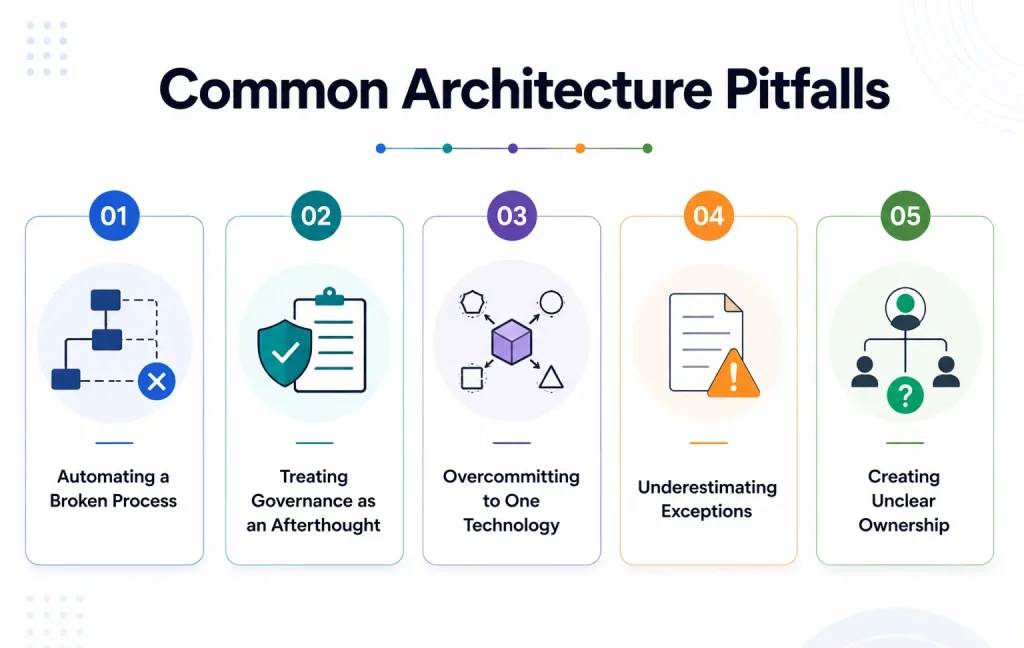
1. Automating a broken process
Technology accelerates processes—including inefficient ones. Redesign the process before embedding it into an automation framework.
2. Treating governance as an afterthought
Retrofitting controls and audit trails after deployment can be expensive and disruptive. Governance should be designed into every workflow from the start.
3. Overcommitting to one technology
An architecture built entirely around RPA may struggle when AI becomes more effective for classification, reasoning, or anomaly detection. Keep processing capabilities modular.
4. Underestimating exceptions
The 15% of transactions that require human intervention can determine whether an automated process actually succeeds. Design the exception path as carefully as the straight-through path.
5. Creating unclear ownership
Finance, IT, security, compliance, and data teams may all have a role in automation. Without one accountable owner for the architecture, decisions become fragmented, and the environment gradually returns to Stage 1.
Building for the Next Stage of Finance Automation
The strongest finance automation architecture is not necessarily the one with the most sophisticated technology.
It is the one that can evolve without forcing the organization to start over.
For a Stage 1 organization, that may mean establishing reliable integrations and centralized governance before pursuing advanced AI. For a Stage 2 organization, orchestration may be the highest-value investment. For a Stage 3 organization, modular processing and AI-assisted decisioning may be the next logical step.
The goal is not to automate everything immediately. It is to establish an architecture in which every new automation strengthens the operating model instead of adding another disconnected component.
That is the difference between automating finance processes and building an automated finance function.
If your team is evaluating platforms, internal development, or a hybrid approach, start by mapping your current maturity against the five architectural layers. Then use a weighted scorecard to evaluate each option against the capabilities that will matter not only today, but two or three stages from now.
The best automation architecture for finance is not just the one that solves today’s workflow.
It is the one that gives finance room to evolve.
Want a second opinion on where your team sits on the maturity curve? Book a 30-minute architecture assessment with our team. We’ll map your current stack against the five layers above and flag where the biggest gaps actually are.