








As Global Business Services (GBS) organisations move from AI-assisted workflows to autonomous AI-driven operations, governance is becoming a critical factor in determining how safely these systems can scale. AI agents can now execute multi-step processes, interact with enterprise applications, retrieve sensitive information, make operational decisions, and trigger downstream actions with limited human intervention. However, this autonomy introduces risks that traditional automation controls were never designed to address.
Implementing AI agent guardrails GBS governance requires more than defining access permissions or establishing approval workflows. Organisations need a structured control environment that governs agent behaviour, decision boundaries, data interactions, accountability, and operational consequences across business functions.
The challenge for GBS leaders is not simply preventing agents from making mistakes. It is ensuring that autonomous systems remain aligned with enterprise policies while delivering measurable operational value. This requires governance mechanisms that are enforceable, auditable, adaptable, and integrated into existing GBS operating models.
Moving Beyond Traditional Automation Governance
Traditional GBS governance frameworks were primarily designed around predictable processes, predefined workflows, and human accountability. Robotic Process Automation (RPA), for example, typically follows fixed rules and executes predetermined instructions. AI agents operate differently. They can interpret context, select tools, determine execution sequences, and modify their approach based on intermediate results.
This creates a governance gap. A process that was previously controlled through predefined workflow permissions may now involve an agent making several decisions before completing a task. Each decision introduces a potential control point.
For instance, an AI agent handling supplier onboarding might retrieve vendor information, validate documentation, identify missing details, update an ERP record, and initiate an approval request. Although the overall process appears similar to traditional automation, the agent exercises discretion at multiple stages.
A mature governance model must therefore distinguish between:
- Process governance: Whether the agent is authorised to execute a particular business process.
- Decision governance: Which decisions the agent can make independently.
- Execution governance: Which actions, tools, and systems the agent can access.
- Outcome governance: Whether the resulting business activity complies with organisational policies.
This distinction is particularly important when designing AI agent guardrails GBS governance for processes spanning finance, procurement, HR, customer operations, and shared technology services. Rather than treating an AI agent as just another automation tool, organisations should govern it as a delegated operational actor with clearly defined authority.
Establishing an Agent Authority Model
One of the less discussed challenges in enterprise AI adoption is determining exactly how much authority an agent should receive. Most organisations focus on what an agent can technically access. However, technical access does not necessarily define what an agent should be permitted to decide or execute.
A stronger approach is to introduce an agent authority model.
This model defines the agent’s operational boundaries through three distinct dimensions:
1. Decision authority: The decisions an agent can make without human intervention. For example, it may classify an invoice or identify a policy discrepancy but may not independently approve a high-value payment.
2. Execution authority: The actions an agent can perform within enterprise systems. An agent may be allowed to prepare a journal entry but restricted from posting it directly.
3. Financial and operational authority: The maximum value, risk exposure, or business impact associated with an agent’s independent actions.
These permissions should be assigned according to process criticality, financial exposure, regulatory requirements, and the reversibility of an action. For example, an agent correcting a non-critical supplier address may operate with limited oversight. An agent modifying bank account information should require stronger verification and independent approval.
An important design principle is that authority should be granted at the action level, not merely at the application level. This makes AI agent guardrails GBS governance more precise because an agent’s access to an ERP platform does not automatically imply permission to execute every function within it.
Context-Aware Guardrails Instead of Static Permissions
Static permissions are insufficient for autonomous agents because the same action can carry different levels of risk depending on the surrounding context.
Consider an AI agent processing employee expense claims. A routine claim within policy limits may be suitable for automated processing. However, the same agent should behave differently when it encounters unusual spending patterns, missing receipts, conflicting employee records, or repeated submissions.
This is where context-aware guardrails become valuable.
Instead of relying exclusively on predefined access rules, organisations can introduce dynamic control conditions based on:
- Transaction value and cumulative financial exposure.
- Employee, supplier, or customer risk classification.
- Data sensitivity and information classification.
- Unusual behavioural patterns or deviations from historical activity.
- Confidence in retrieved information and supporting evidence.
- Changes in the agent’s execution environment or available tools.
For example, an agent may normally process invoices below a defined threshold. However, if several invoices from the same supplier collectively exceed that threshold, the system can automatically escalate the activity. This prevents agents from exploiting gaps in individual transaction limits through repeated low-value actions.
A context-aware approach also allows organisations to adjust control intensity without unnecessarily interrupting routine operations. For GBS organisations managing thousands of transactions across multiple regions, this is a practical way to balance operational efficiency with risk management.
Controlling Agent-to-Agent Delegation and Handoffs
Multi-agent architectures introduce another governance challenge that is often overlooked: delegated authority. In these environments, one primary agent may distribute work among specialised agents. For example, a finance operations agent might delegate document extraction to one agent, compliance validation to another, and reconciliation to a third.
This architecture can enhance efficiency, but it also introduces risks such as permission inheritance, uncontrolled delegation, and accountability gaps.
A parent agent should not automatically transfer all its permissions to a subordinate agent.
Instead, every delegation should carry a restricted execution scope containing:
- The specific task being delegated.
- The permitted data sources and systems.
- The authorised actions and expected output.
- The applicable time or execution limits.
- The conditions under which the task must be escalated.
- The identity of the originating agent and accountable business owner.
Delegated agents should operate with the minimum permissions necessary to complete their assigned task.
Another important requirement is maintaining a traceable relationship between the original request and every downstream action. If a subordinate agent modifies a customer record or generates a financial recommendation, the organisation should be able to identify which parent agent initiated the activity and which business process authorised it. This is an essential component of AI agent guardrails GBS governance, particularly when organisations introduce agentic workflows across multiple service lines.
Designing Transaction-Level Auditability
Traditional audit logs generally capture who accessed a system, what transaction was performed, and when it occurred. However, these records may not provide enough information to explain the behaviour of an AI agent.
An agent may complete an action through several intermediate reasoning and tool interactions. If the final transaction is recorded without its execution context, investigators may struggle to understand why the action occurred.
GBS organisations should therefore develop transaction-level audit trails that are specifically designed for autonomous execution.
A useful audit record should capture:
- Agent identity and version.
- Business process and task identifier.
- Original instruction or authorised task specification.
- Relevant policy and permission checks.
- Data sources and enterprise tools were accessed.
- Actions were requested and executed successfully.
- Human approvals, overrides, and escalations.
- Output generated and final transaction status.
- Timestamped execution events and correlation identifiers.
Importantly, auditability should not depend on storing every internal reasoning token or unrestricted conversation history. Organisations should prioritise recording decision evidence, policy evaluations, tool calls, approvals, and execution outcomes. This distinction helps maintain audit transparency without unnecessarily exposing sensitive information or creating excessive data retention obligations.
For regulated processes, organisations should also establish evidence retention periods that are based on applicable legal, contractual, and internal audit requirements. A well-designed audit framework transforms agent activity from an opaque automated process into a traceable business event.
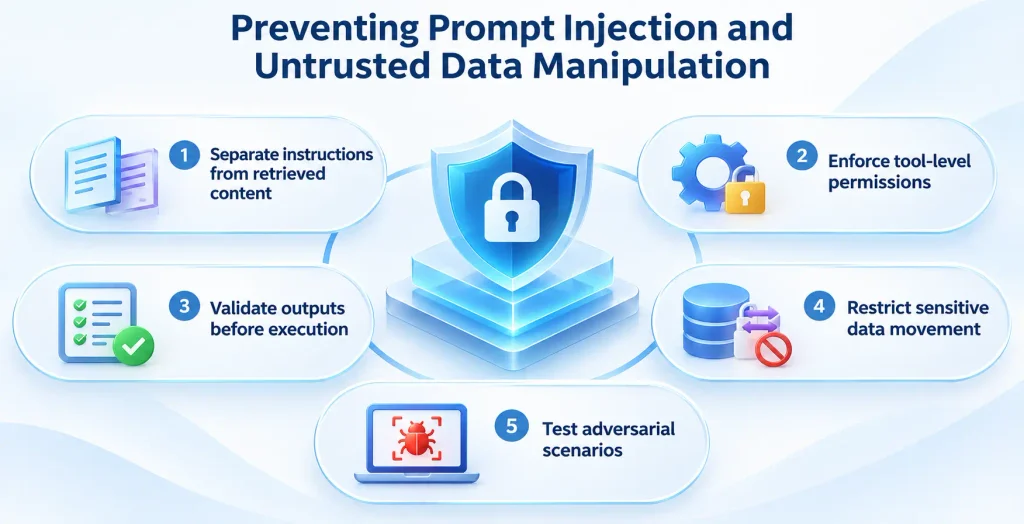
Preventing Prompt Injection and Untrusted Data Manipulation
One of the most significant security risks associated with AI agents is their ability to interpret and act on information retrieved from external or internal sources.
Unlike conventional automation, agents may process emails, PDFs, websites, supplier documents, support tickets, and knowledge repositories containing instructions that were never intended to control the agent.
A malicious document could contain embedded instructions asking an agent to reveal confidential information, ignore existing restrictions, or execute an unauthorised action. This is commonly associated with prompt injection.
The risk becomes more serious when an agent has access to enterprise tools and can perform consequential actions.
GBS organisations should implement multiple layers of protection:
1. Separate instructions from retrieved content: Documents and external information should always be treated as untrusted data rather than authoritative instructions.
2. Enforce tool-level permissions: The agent’s ability to access a tool must be controlled independently of the instructions it receives.
3. Validate outputs before execution: High-impact actions should pass through deterministic validation rules before being submitted to enterprise systems.
4. Restrict sensitive data movement: Agents should not be able to transfer confidential information between systems or external destinations without appropriate authorisation.
5. Test adversarial scenarios: Security testing should include malicious emails, manipulated documents, conflicting instructions, and indirect prompt injection attempts.
The important lesson is that an AI agent’s instructions alone cannot serve as a security boundary. Enforcement must happen outside the model through application controls, identity systems, policy engines, and enterprise security infrastructure.
Building a GBS-Wide Governance Operating Model
The final challenge is ensuring that agent governance does not remain fragmented across individual business functions. A finance team may establish its controls, while procurement and HR introduce different approval structures. Over time, these practices can create inconsistent permissions, duplicated monitoring, and unclear accountability.
A central GBS governance operating model can address this problem without removing functional ownership.
A practical structure should include:
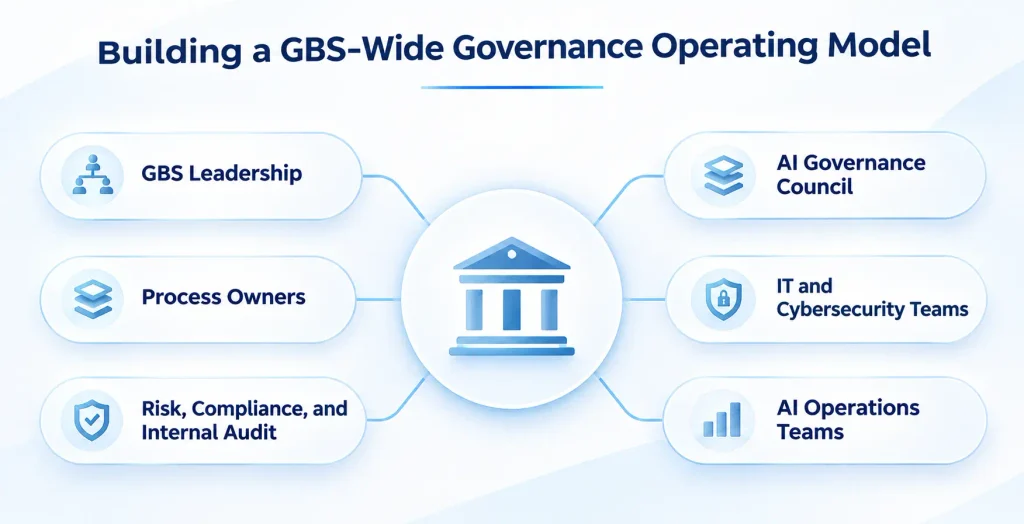
- GBS leadership: Defines enterprise priorities, risk appetite, and acceptable levels of autonomous execution.
- AI governance council: Establishes common policies, approval criteria, and oversight standards.
- Process owners: Remain accountable for business outcomes and process-level risks.
- IT and cybersecurity teams: Manage agent identities, infrastructure security, integrations, and technical enforcement.
- Risk, compliance, and internal audit: Independently evaluate control effectiveness and regulatory alignment.
- AI operations teams: Monitor agent performance, incidents, configuration changes, and lifecycle activities.
Organisations should also maintain a central agent inventory that includes ownership details, deployment status, risk classification, system access, business purpose, and approval history.
This inventory provides visibility into the overall agent ecosystem and helps identify shadow agents or duplicated capabilities operating outside established governance channels.
The objective is to create consistent enterprise-wide standards while allowing individual GBS functions to apply additional controls according to their specific operational and regulatory requirements.
Conclusion
Scaling autonomous AI across global business services requires a shift from traditional automation governance to a more sophisticated model of delegated authority, continuous oversight, and enforceable operational boundaries.
The most effective AI agent guardrails GBS governance approach combine context-aware permissions, controlled delegation, transaction-level auditability, prompt injection protection, risk-based human intervention, and lifecycle management.
For GBS leaders evaluating enterprise AI adoption, the real question is not whether agents can perform complex operational tasks. It is whether the organisation can demonstrate that every consequential agent action remains authorised, explainable, traceable, and recoverable.
Establishing these controls early helps organisations move beyond isolated AI pilots and build a sustainable foundation for enterprise-wide agentic operations. More importantly, it allows GBS teams to pursue greater autonomy without compromising accountability, security, or trust.