









Global Business Services (GBS) has evolved beyond a centralized model for reducing operational costs. Today, organizations use GBS to standardize enterprise processes, improve service delivery, accelerate automation, and create measurable business value across functions and geographies. However, achieving these outcomes depends on a critical decision: determining which processes should enter the GBS operating model and which should remain within business functions.
A structured GBS process scoping framework helps organizations evaluate processes using consistent criteria, including business value, process maturity, standardization potential, technology readiness, risk, and scalability. Rather than transferring entire functions into a shared services environment, IT leaders and enterprise architects can use this framework to identify processes that benefit most from centralized ownership, common platforms, and automation.
For organizations moving from traditional shared services to an integrated GBS model, effective process scoping establishes the foundation for sustainable transformation.
Why Process Scoping Is Critical to GBS Success
Poor process selection can undermine even a well-funded GBS transformation. Moving unsuitable activities into a centralized model may increase handoffs, create additional governance requirements, and introduce operational dependencies without delivering meaningful efficiencies.
For example, consolidating accounts payable across multiple regions may improve standardization, invoice processing, and reporting. However, transferring a highly localized regulatory activity without understanding country-specific requirements could introduce compliance risks.
The objective is not to centralize every possible activity. It is to identify where GBS can deliver better outcomes than the existing operating model.
Effective scoping helps organizations:
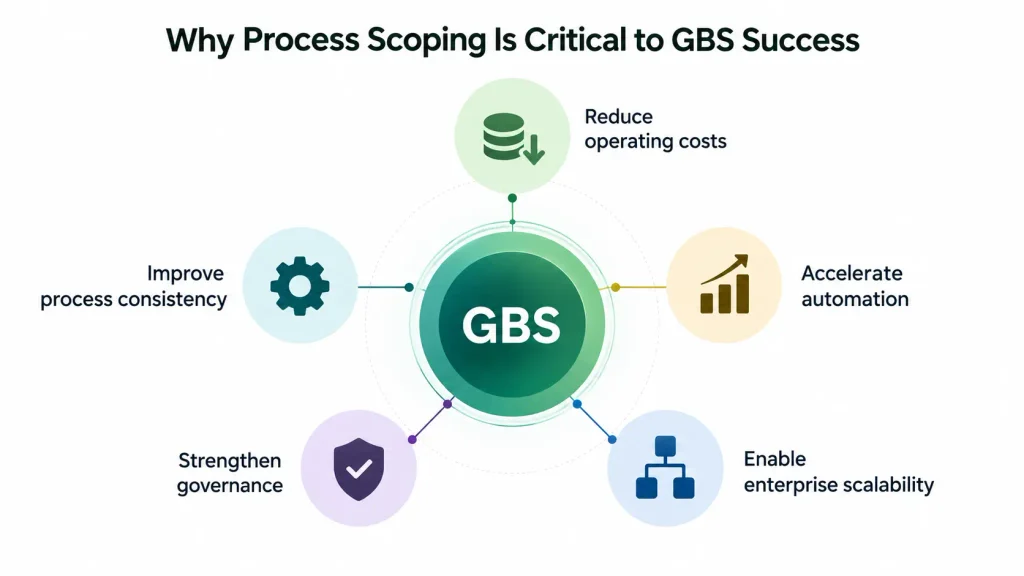
- Reduce operating costs: Consolidate repeatable activities and eliminate duplicated capabilities.
- Improve process consistency: Establish common workflows, controls, and performance standards.
- Accelerate automation: Prioritize activities suitable for workflow orchestration, robotic process automation (RPA), and AI-enabled processing.
- Strengthen governance: Clarify accountability, escalation paths, and service-level expectations.
- Enable enterprise scalability: Create reusable capabilities that support business growth, acquisitions, and geographic expansion.
A disciplined GBS process scoping framework connects these objectives to specific process-level decisions instead of relying on assumptions about which functions should be centralized.
Define the Scope at the Right Level of Granularity
One of the most common scoping mistakes is evaluating entire functions rather than individual processes or activities. Functions such as finance, HR, procurement, customer operations, and IT contain activities with different levels of complexity, risk, and business impact. Consequently, a function-wide decision can obscure opportunities for selective centralization.
Consider procurement. Supplier onboarding, purchase order administration, strategic sourcing, and supplier relationship management may sit within the same function, but they have different operating requirements.
Supplier onboarding may be standardized and centrally administered, while strategic sourcing may require close collaboration with regional stakeholders and business leaders.
A practical scoping hierarchy includes three levels:
Level 1: Function
Identify the broad business domain, such as finance or procurement.
Level 2: End-to-end process
Map the process across its lifecycle, including inputs, outputs, systems, and accountable stakeholders.
Level 3: Activity or task
Break the process into discrete activities that can be evaluated for ownership, execution, standardization, and automation.
This level of granularity enables organizations to adopt hybrid operating models. A process may have centralized execution, regional exception handling, and local business ownership rather than being transferred entirely into GBS.
Establish the Core Evaluation Criteria
A robust GBS process scoping framework should evaluate each candidate process against a consistent set of dimensions. The following criteria provide a practical starting point.
1. Business value and strategic relevance
Assess whether centralization supports enterprise priorities, including cost optimization, service quality, business growth, and operational resilience. Consider transaction volumes, current operating costs, duplication across business units, and the potential to improve customer or employee experience.
Activities that influence competitive differentiation, strategic decision-making, or direct customer relationships may require stronger business-unit involvement.
2. Process standardization potential
Determine whether the process follows common rules, workflows, data definitions, and control requirements across business units. High standardization potential generally supports centralization. However, variations should be examined before being treated as permanent constraints. Some differences reflect genuine regulatory requirements, while others result from legacy systems or inconsistent local practices.
3. Volume, repeatability, and scalability
Evaluate transaction volumes, demand variability, exception frequency, and expected growth. High-volume, repeatable processes often benefit from shared delivery teams, workflow automation, and economies of scale. Low-volume activities may still qualify when they require specialized expertise or when consolidation reduces operational risk.
4. Technology and data readiness
Examine system compatibility, integration dependencies, data quality, access controls, and automation feasibility. A process that depends on fragmented applications, unstructured inputs, or unreliable master data may require remediation before migration. Automation potential alone is insufficient if the underlying process remains unstable.
5. Risk, compliance, and control requirements
Identify regulatory obligations, segregation-of-duties requirements, data residency restrictions, confidentiality concerns, and business continuity dependencies. The decision should distinguish between activities that must remain locally accountable and activities whose execution can be centralized under appropriate controls.
6. Talent and capability availability
Assess whether GBS can access the skills required to deliver the process effectively. Consider domain expertise, language requirements, analytical capabilities, technology skills, and the availability of qualified talent across delivery locations.
These criteria should be weighted according to the organization’s strategy and risk appetite rather than treated as equally important in every situation.
Compare Centralization and Automation Options
Process scoping should not automatically equate GBS suitability with full centralization. Organizations should compare alternative delivery configurations before selecting a target state.
| Operating model | Best suited for | Key consideration |
| Centralized GBS | Standardized, repeatable, enterprise-wide activities | Requires clear service ownership and governance |
| Regional delivery | Activities with regional language, market, or regulatory requirements | Can retain some duplication across regions |
| Local business ownership | Highly specialized, sensitive, or business-critical activities | May limit economies of scale |
| Hybrid delivery | Processes requiring centralized execution and local decision-making | Needs clear handoffs and accountability |
| Automated or AI-enabled execution | Stable, rules-based or suitable knowledge-intensive tasks | Requires controls, monitoring, and exception management |
For example, an organization evaluating invoice processing might compare three options: retaining processing within individual business units, consolidating execution in GBS, or combining centralized processing with automated invoice matching.
The comparison should include implementation costs, recurring operating costs, control effectiveness, service quality, scalability, and transition complexity.
A GBS process scoping framework becomes more effective when it evaluates these alternatives against a common b
Build a Weighted Scoring Model
A weighted scoring model converts qualitative assessments into a repeatable prioritization mechanism. It helps transformation teams compare processes, explain decisions, and identify the assumptions that require further validation.
An illustrative model could use the following weights:
| Evaluation criterion | Weight |
| Business value and cost potential | 25% |
| Standardization potential | 20% |
| Volume and repeatability | 15% |
| Technology and data readiness | 15% |
| Risk and compliance suitability | 15% |
| Talent and scalability | 10% |
| Total | 100% |
Score each criterion from 1 to 5, where 1 indicates low suitability and 5 indicates high suitability. For risk, a higher score should mean that risks are manageable within the proposed GBS model, not that the process is inherently riskier.
Calculate the weighted score using:
Weighted score = Σ (Criterion score × Criterion weight)
If weights are expressed as percentages, divide the result by 100 to obtain a final score on the 1–5 scale. For instance, a process scoring 4 on business value, 5 on standardization, 4 on volume, 3 on technology readiness, 4 on risk suitability, and 4 on scalability would achieve a weighted score of 4.05 out of 5 under the illustrative model.
Organizations could initially classify processes scoring 4.0 or above as high-priority candidates, 3.0–3.99 as candidates requiring further assessment, and below 3.0 as lower-priority candidates.
These thresholds are illustrative, not industry standards. Mandatory regulatory, security, or control requirements should operate as decision gates rather than being overridden by a high aggregate score.
Validate Process Data Before Finalizing Scope
Scoring is only as reliable as the information behind it. Transformation teams should establish a process inventory containing:
- Process owner and accountable business function
- Transaction volumes and demand patterns
- Current cost per transaction and total cost to serve
- Existing applications, integrations, and data dependencies
- Cycle times, error rates, and exception volumes
- Regulatory obligations and control requirements
- Current service-level performance
- Potential automation opportunities
- Estimated transition effort and business disruption
Use enterprise resource planning (ERP) data, workflow logs, process mining, interviews, and operational reports to validate the inventory.
Where data is incomplete, document assumptions and confidence levels. A process with an attractive estimated business case but poor data quality may need a discovery phase before an investment decision.
The purpose of this step is to distinguish genuine improvement opportunities from benefits that exist only in a business case.
Convert Scoping Decisions into an Implementation Roadmap
Once candidate processes have been assessed, group them into implementation waves based on value, readiness, dependencies, and risk.
Wave 1: High-value, high-readiness processes
Prioritize standardized processes with reliable data, manageable dependencies, and measurable benefits. These processes can establish operating-model credibility and test the GBS governance structure.
Wave 2: Processes requiring remediation
Address fragmented workflows, inconsistent master data, or application dependencies before migration. Standardization should precede automation wherever process variation would otherwise undermine the solution.
Wave 3: Complex or strategically sensitive processes
Introduce these activities after the organization has established the required capabilities, controls, and stakeholder relationships. Each wave should include a defined business case, migration criteria, process ownership, service-level agreements (SLAs), key performance indicators (KPIs), and post-transition validation.
A GBS process scoping framework should therefore produce more than a list of eligible activities. It should generate a sequenced transformation roadmap with clear dependencies, accountable owners, and measurable outcomes.
Establish Governance and Continuous Review
Process suitability changes as organizations mature. New acquisitions, regulatory changes, technology modernization, and shifts in business demand can alter the economics and feasibility of centralization.
Establish a governance structure involving GBS leadership, business process owners, enterprise architecture, IT operations, cybersecurity, risk, and automation teams.
Define decision rights for approving scope, accepting exceptions, funding remediation, and authorizing migration. Maintain a decision log that records evaluation scores, assumptions, rejected alternatives, and reasons for approval or exclusion.
After migration, monitor performance using metrics such as cost per transaction, first-time-right rate, cycle time, SLA attainment, automation success rate, exception frequency, and customer or employee satisfaction.
Review these metrics against the pre-migration baseline to determine whether the expected benefits have materialized.
The GBS process scoping framework should be revisited periodically, particularly when performance deteriorates, process volumes change materially, or new automation capabilities become available.
Conclusion
Selecting the right processes for global business services requires a structured, evidence-based approach. Organizations must evaluate business value, standardization, scale, technology readiness, risk, and talent requirements at the activity level rather than moving entire functions into GBS by default.
A well-designed GBS process scoping framework enables IT leaders, automation heads, and enterprise architects to compare delivery models, prioritize investment, and build a phased transformation roadmap. Combining weighted scoring with mandatory risk gates, validated operational data, and continuous governance creates a defensible basis for decision-making.
For organizations evaluating their next stage of GBS maturity, the priority is to establish a transparent selection process that links every scoping decision to measurable business outcomes. This ensures GBS evolves from a cost-focused shared services structure into a scalable enterprise capability that supports efficiency, resilience, and long-term business value.