









India has become a strategic destination for Global Business Services (GBS) and Global Capability Centers (GCCs), offering access to skilled talent, established technology ecosystems, and competitive operating costs. However, building a center requires more than selecting an office location and recruiting employees. Organizations must account for legal incorporation, technology infrastructure, talent acquisition, compliance, governance, and ongoing operations.
Understanding the cost to set up GCC in India is essential for IT leaders, automation heads, and enterprise architects preparing a business case for executive approval. The investment varies considerably depending on team size, functional scope, location, operating model, and the level of operational independence expected from the center.
This guide breaks down the major cost components, compares different setup approaches, and explains how organizations can develop a realistic budget that supports long-term business value rather than focusing solely on initial expenditure.
What Determines GCC Setup Costs in India?
There is no universal price for establishing a GCC. A small finance operations team has different requirements from a technology center employing software engineers, cybersecurity specialists, data scientists, and enterprise architects.
The cost to set up GCC in India depends primarily on six factors:
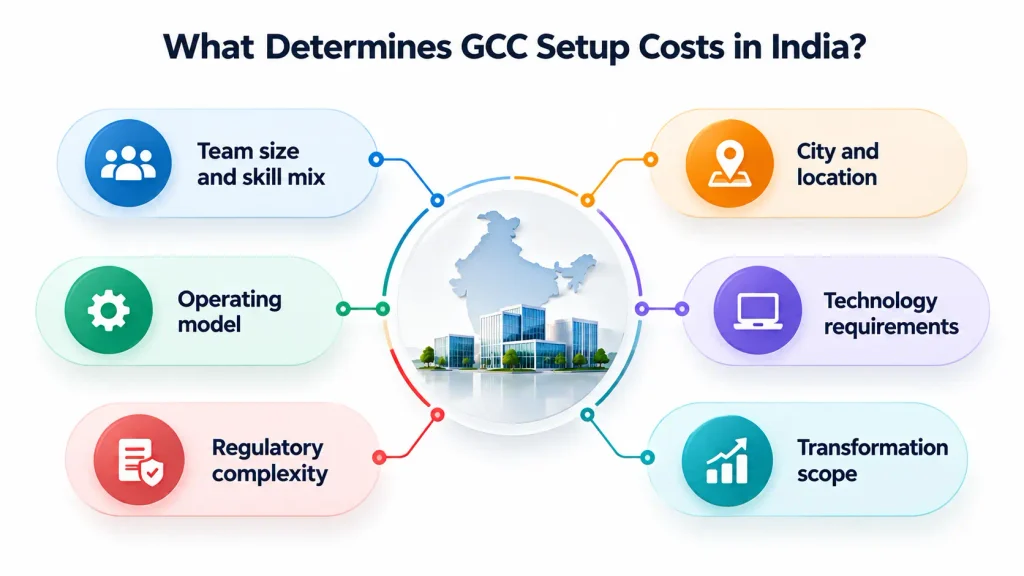
- Team size and skill mix: Headcount, seniority, specialist skills, and compensation expectations determine the largest recurring expense.
- City and location: Office rents, talent availability, competition for experienced professionals, and local infrastructure influence costs.
- Operating model: A wholly owned subsidiary requires more direct investment and operational responsibility than a managed or partner-led arrangement.
- Technology requirements: Cloud platforms, enterprise applications, cybersecurity, development environments, and data infrastructure vary by function.
- Regulatory complexity: Corporate registrations, employment obligations, tax structuring, transfer pricing, and industry-specific requirements create additional costs.
- Transformation scope: A transactional shared services center generally requires a different investment profile from an advanced engineering, analytics, or AI-focused GCC.
Before estimating expenditure, organizations should define the center’s mandate, initial headcount, target operating model, and three-year growth plan. These decisions establish the assumptions needed for a defensible financial model.
Break Down the Initial Setup Investment
The initial setup budget should distinguish one-time expenditure from recurring operating costs. Mixing these categories can make a GCC appear cheaper to establish than it will actually be to operate.
1. Legal entity and compliance
Many organizations establish an Indian private limited subsidiary to maintain direct control over hiring, operations, intellectual property, and intercompany arrangements.
Initial expenses may include incorporation, professional advisory, tax registrations, employment documentation, foreign investment reporting where applicable, and transfer pricing support.
For planning purposes, an initial legal and advisory allowance of approximately ₹3–15 lakh can serve as a preliminary estimate for a relatively straightforward setup. More complex international structures, specialized regulatory requirements, and extensive advisory engagements may increase this amount.
The cost to set up GCC in India should also account for recurring statutory audits, corporate secretarial services, tax filings, and employment compliance. These expenses continue after incorporation and should be included in the annual operating budget.
The final structure and obligations should be validated with qualified Indian legal and tax advisers.
2. Office space and physical infrastructure
Organizations typically choose between traditional leased offices, coworking facilities, and managed offices. A conventional lease may require a security deposit, interior fit-outs, workstations, meeting rooms, networking equipment, power backup, access control, and facilities management. These investments increase initial capital requirements but provide greater control over the workplace.
Managed offices reduce the need for upfront fit-out expenditure because many facilities are provided through a consolidated service arrangement. However, the recurring seat price may be higher than the equivalent bare-shell rent.
For example, a 50-seat center may need tens of lakhs of rupees for deposits and fit-outs, depending on the location, building specification, and lease terms. Deposits should be tracked separately from expenses because refundable amounts affect cash flow without necessarily becoming permanent costs.
3. Technology and cybersecurity
Technology expenditure depends heavily on the GCC’s responsibilities. A finance operations center may require ERP access, workflow tools, reporting platforms, and secure endpoints. A software engineering or AI center may additionally need developer workstations, cloud environments, testing infrastructure, data platforms, and specialized security controls.
Typical cost categories include:
- Employee laptops, peripherals, and device management.
- Identity and access management, endpoint protection, and network security.
- Cloud hosting, storage, backup, and disaster recovery.
- Enterprise software licenses and workflow platforms.
- Integration with headquarters systems and data environments.
- Monitoring, logging, vulnerability management, and incident response.
Organizations should distinguish capital expenditure from recurring software subscriptions and cloud consumption. A low initial technology budget can become expensive if organizations do not govern license usage, data transfer, or cloud workloads properly.
Understand the Largest Expense: Talent
For most GCCs, employee compensation is the largest recurring cost. The required skill mix matters more than headcount alone. A center employing experienced platform engineers, AI specialists, enterprise architects, and security professionals will have a different cost structure from one focused on standardized finance or HR operations.
The cost to set up GCC in India should therefore be calculated using role-based compensation assumptions rather than a single average salary.
The workforce budget should include:
- Base salary and variable compensation.
- Employer provident fund contributions and applicable statutory benefits.
- Gratuity provisions, insurance, and other employee benefits.
- Recruitment fees, background verification, and onboarding.
- Training, certifications, and leadership development.
- Attrition-related replacement hiring and temporary productivity losses.
Leadership hiring deserves particular attention. A capable GCC head and experienced functional leaders can improve execution, governance, stakeholder alignment, and hiring quality. Underfunding these roles may reduce initial expenditure but create larger operational problems later.
Recruitment should also be phased against the delivery roadmap. Hiring the entire planned workforce before systems, processes, and work allocation are ready can increase idle capacity and delay returns.
Compare Setup Models Before Committing
Organizations do not need to build every capability independently from day one. Comparing alternative operating models helps balance speed, control, capital investment, and long-term economics
| Setup model | Initial investment | Control | Best suited for |
| Wholly owned subsidiary | Higher | High | Strategic, long-term GCC operations |
| Employer of Record (EOR) | Lower | Moderate | Small teams and initial market testing |
| Partner-led or managed GCC | Moderate | Shared, depending on contract | Faster launches with external operational support |
| Build-Operate-Transfer (BOT) | Contract-dependent | Increases through transition | Organizations seeking phased ownership |
An EOR allows an organization to employ staff through a third-party employment structure without immediately establishing its own local entity. However, it does not automatically provide the same legal, operational, or intellectual property arrangements as a wholly owned subsidiary.
A partner-led model can reduce implementation complexity by providing recruitment, facilities, and operational support. The trade-off is the partner’s management fees and the need to define service ownership, data access, and exit arrangements.
The cost to set up GCC in India should be compared across these models using a 24–36-month total cost of ownership (TCO), not merely the initial setup quote. Include transition fees, partner margins, internal management overhead, and the cost of moving to a different model later.
Illustrative Budget for a 100-Person GCC
Consider a hypothetical technology-focused GCC in Bengaluru or Hyderabad with 100 employees and an average annual compensation assumption of ₹18 lakh per employee.
The following example illustrates how a preliminary budget can be structured. It is a planning scenario, not a market quotation.
| Cost component | Illustrative annual or initial cost |
| Employee compensation | ₹18 crore annually |
| Employer benefits and statutory costs | ₹2–3 crore annually |
| Office lease and facilities | ₹0.85–1.20 crore annually |
| Technology and cybersecurity operations | ₹0.10–0.30 crore annually |
| Recruitment and onboarding | ₹0.25–0.40 crore initially |
| Entity setup and professional advisory | ₹0.10–0.25 crore initially |
| Initial office fit-out and equipment | ₹0.35–0.60 crore initially |
Under these assumptions, annual operating expenditure could exceed ₹21 crore before additional contingency, transformation, or specialist technology investments. Initial setup expenditure would be additional, although the precise amount depends on which infrastructure costs are included in the annual facilities and technology budgets.
These figures are illustrative and should not be added mechanically without checking for overlaps. For instance, a managed-office contract may already include furniture, connectivity, and facilities services.
The cost to set up GCC in India should ultimately be modeled using actual role-based compensation, vendor quotations, lease terms, and approved technology requirements.
Account for Hidden Costs and Implementation Risks
A budget can be technically complete yet commercially unrealistic if it excludes transition and ramp-up costs.
Commonly overlooked expenses include:
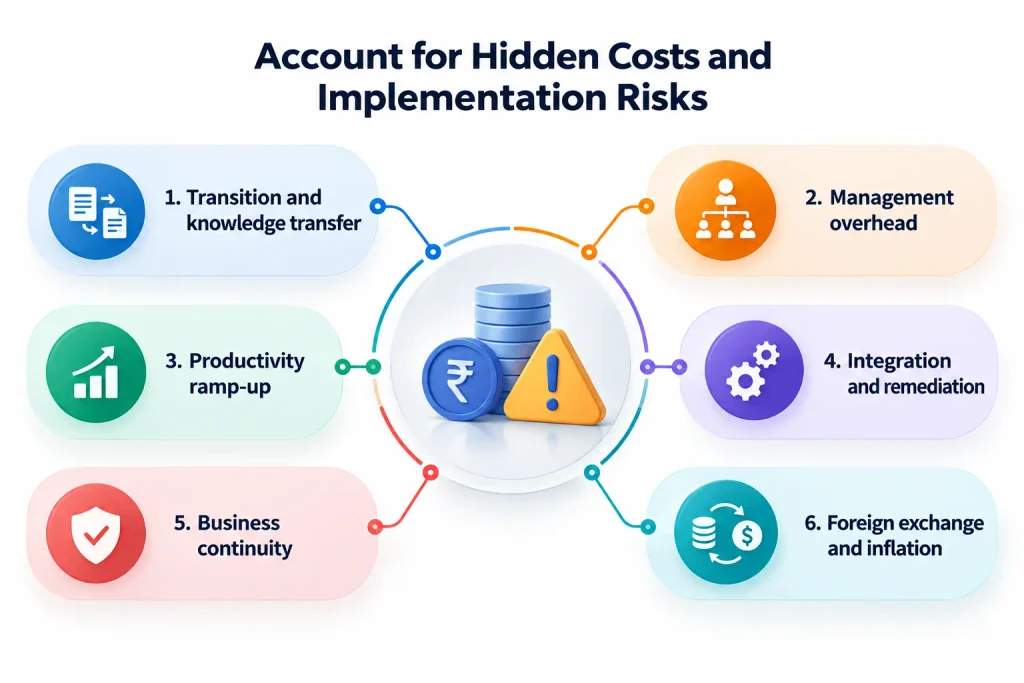
- Transition and knowledge transfer: Moving processes from headquarters or external providers requires documentation, training, shadow operations, and parallel runs.
- Management overhead: Finance, HR, legal, procurement, information security, and global leadership may need to support the new center before it reaches operational maturity.
- Productivity ramp-up: Newly hired employees may require several months to achieve expected throughput and quality levels.
- Integration and remediation: Legacy applications, poor master data, inconsistent workflows, and undocumented interfaces can increase implementation effort.
- Business continuity: Backup connectivity, disaster recovery, incident response, and resilience testing may require additional infrastructure and specialist services.
- Foreign exchange and inflation: Currency movements, compensation revisions, lease escalations, and software price changes can affect multi-year projections.
The cost to set up GCC in India should therefore include a contingency reserve based on the maturity of the business case and the uncertainty surrounding major assumptions. Organizations should document exclusions explicitly rather than hiding them inside a broad miscellaneous category.
A Practical Approach to Controlling GCC Costs
A disciplined implementation approach helps organizations manage investment without compromising operational quality.
First, define the GCC’s mandate and identify the capabilities that must remain under direct ownership. Next, select the location and operating model using a consistent comparison of cost, talent, control, and scalability.
Establish a phased workforce plan, validate technology and compliance requirements, and obtain comparable vendor quotations. Use stage gates to release funding as hiring, infrastructure, governance, and operational readiness milestones are achieved.
Track actual expenditure against the approved business case monthly. Review cost per employee, cost per transaction where applicable, hiring efficiency, service-level attainment, utilization, and automation outcomes.
This approach makes the cost to set up GCC in India a controlled investment decision rather than a one-time facilities or recruitment exercise.
Conclusion
The investment required to establish a GBS or GCC in India depends on the center’s scale, talent strategy, location, technology requirements, and operating model. While legal incorporation and initial infrastructure create visible setup expenses, workforce compensation, facilities, technology, and governance drive the longer-term financial commitment.
For IT leaders and enterprise architects, the priority is to build a transparent, multi-year business case that distinguishes one-time expenditure from recurring operating costs and connects investment to measurable outcomes.
A well-structured cost model, combined with phased implementation and strong governance, helps organizations establish a GCC that is financially sustainable, operationally resilient, and capable of delivering value beyond cost savings.