









As businesses expand across countries, managing finance, human resources, procurement, IT, and other corporate functions becomes increasingly complex. Different systems, disconnected teams, inconsistent processes, and rising operational costs can make it difficult for organizations to maintain efficiency and visibility. This is where Global Business Services (GBS) can make a significant difference.
This CFO guide to GBS explores how organizations can use the GBS model to simplify operations, improve financial visibility, standardize processes, and support strategic decision-making. Rather than treating shared services as separate departments focused primarily on cost reduction, GBS brings multiple business functions together under an integrated operating model.
For Chief Financial Officers (CFOs), understanding GBS is particularly important because financial leaders are responsible for balancing operational efficiency, financial control, business performance, and long-term growth. Understanding how GBS works can help CFOs identify opportunities to improve the way their organizations operate and deliver value.
What Is Global Business Services (GBS)?
Global Business Services is an integrated operating model that brings together support functions such as finance, human resources, procurement, IT, and other administrative services to improve how an organization delivers internal business services.
Traditionally, many multinational organizations operated these functions independently across different countries and business units. Each location might have its own finance team, procurement procedures, reporting systems, and technology platforms. While this structure can provide local flexibility, it often creates duplicated work, inconsistent processes, and limited enterprise-wide visibility.
GBS addresses these challenges by coordinating services across business functions, geographical locations, and technology platforms.
For example, a multinational company might consolidate accounts payable, employee support, vendor management, and financial reporting processes under a common GBS structure. Instead of every regional office maintaining entirely separate workflows, the organization can establish standardized processes, shared technology, and consistent performance measures.
The goal is not simply to centralize work. It is to create an operating model that improves service quality, efficiency, accountability, and business outcomes.
For CFOs, the CFO guide to GBS begins with recognizing that GBS can connect operational activities with broader financial and strategic objectives.
How Is GBS Different From Shared Services?
GBS and shared services are closely related, but they are not exactly the same.
Shared services typically consolidate similar activities into a centralized team or service center. For example, an organization might establish a shared finance center to process invoices, reconcile accounts, and support financial reporting across multiple business units.
GBS generally takes a broader, more integrated approach. It can combine multiple functions, align processes across regions, and coordinate service delivery through common governance, technology, and performance management.
The following comparison explains the difference.
| Area | Traditional Shared Services | Global Business Services |
| Scope | Often focused on one function | Integrates multiple functions |
| Operations | Consolidates selected activities | Coordinates end-to-end processes |
| Technology | May use separate systems | Encourages integrated platforms |
| Governance | Often function-specific | More enterprise-wide |
| Performance | Focuses on service efficiency | Balances cost, quality, and business value |
| Strategic role | Primarily operational support | Can contribute to transformation and growth |
Not every GBS organization operates in the same way. Some retain significant functional separation, while others integrate services more extensively. The defining principle is the coordinated delivery of business services rather than centralization alone.
Why Should CFOs Understand GBS?
CFOs increasingly need to look beyond traditional financial reporting and cost control. They must help organizations improve productivity, manage uncertainty, strengthen controls, and allocate resources effectively.
GBS can support these responsibilities in several ways.
1. Improving Cost Transparency
One challenge in large organizations is understanding the true cost of delivering internal services. Different business units may use different accounting methods, staffing structures, and service providers, making comparisons difficult.
A well-designed GBS model can introduce consistent cost allocation methods, standardized reporting, and common service measures.
This allows finance leaders to examine questions such as:
- How much does it cost to process an invoice?
- Which regions have the highest transaction-processing costs?
- Where are similar activities being performed more than once?
- Which processes would benefit from automation or redesign?
A practical CFO guide to GBS should emphasize that visibility is the first step toward meaningful cost improvement. Organizations need reliable baseline data before they can evaluate savings or measure progress.
2. Strengthening Financial Control and Compliance
Operating across multiple markets exposes organizations to different tax requirements, regulatory expectations, accounting standards, and internal control risks.
GBS can help establish common procedures for activities such as reconciliations, transaction approvals, documentation, and financial reporting.
Standardization makes it easier to define responsibilities, monitor exceptions, and identify control weaknesses across locations.
For example, a company may introduce consistent approval workflows for vendor payments across its international operations. This can reduce process variations and improve oversight while allowing specific local requirements to be addressed.
However, centralization does not automatically guarantee compliance. Organizations still need appropriate controls, local expertise, clear accountability, and regular monitoring.
3. Increasing Operational Efficiency
Repetitive manual tasks can consume significant employee time and delay business decisions. Examples include invoice processing, expense verification, data entry, account reconciliation, and routine reporting.
GBS provides an opportunity to review these activities across the organization and identify where processes can be simplified, standardized, or automated.
For CFOs, the objective is not merely to process more transactions with fewer resources. It is to improve productivity while maintaining accuracy, service quality, and appropriate controls.
4. Supporting Better Business Decisions
Finance teams often struggle to provide timely insights when information is scattered across multiple systems and reporting structures.
An integrated GBS model can improve access to consistent operational and financial data. This can help leadership understand spending patterns, service performance, process bottlenecks, and emerging risks.
With better information, CFOs can make more informed decisions about resource allocation, operating models, technology investments, and business priorities.
Key Components of a Successful GBS Model
A successful GBS organization requires more than a centralized service center. It depends on a combination of governance, process design, technology, people, and performance management.
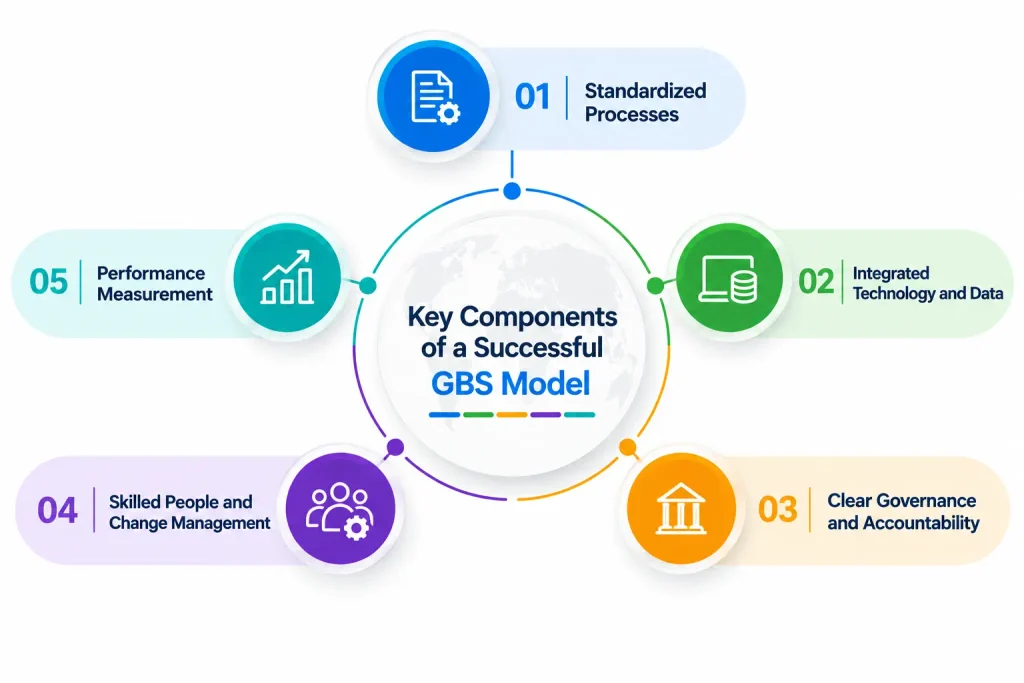
1. Standardized Processes
Organizations should identify processes that can follow a common approach across departments and locations.
Standardization reduces unnecessary variation, simplifies training, and creates a stronger foundation for automation. However, processes should retain flexibility where local laws, customer needs, or business requirements demand it.
2. Integrated Technology and Data
GBS often relies on enterprise resource planning (ERP) systems, workflow platforms, automation tools, analytics, and shared data environments.
These technologies can reduce manual intervention and improve visibility across functions. Nevertheless, technology integration should follow a clear process strategy. Automating a poorly designed process may simply make inefficiencies happen faster.
3. Clear Governance and Accountability
Organizations need to define who owns each process, who makes decisions, how exceptions are handled, and how service performance is evaluated. Without clear governance, GBS teams may experience conflicting priorities between central leadership and local business units.
A structured governance model helps balance global consistency with regional requirements.
4. Skilled People and Change Management
Employees need the right combination of process knowledge, analytical skills, technology expertise, and business understanding.
Moving to GBS may also change job responsibilities, reporting relationships, and established ways of working. Communicating the reasons for change and providing appropriate training can improve adoption and reduce resistance.
5. Performance Measurement
GBS teams should track metrics that reflect both operational efficiency and the value delivered to internal stakeholders. These measures can include processing costs, turnaround times, accuracy, compliance, employee satisfaction, and service-level performance.
The CFO guide to GBS approach is to evaluate these indicators together instead of relying on cost reduction as the only measure of success.
How Does GBS Use Automation and Artificial Intelligence?
Automation and artificial intelligence (AI) are becoming increasingly relevant to GBS operations. They can help organizations manage high transaction volumes, reduce repetitive work, and make information easier to analyze.
For example, robotic process automation (RPA) can perform rule-based activities such as transferring data between systems, validating information, and processing routine transactions.
AI-enabled tools can support invoice data extraction, document classification, anomaly detection, and the identification of unusual transaction patterns. Generative AI may also assist with summarizing reports, answering routine employee queries, and retrieving information from approved knowledge sources.
For CFOs, these capabilities create opportunities to improve productivity and provide faster access to business insights.
However, organizations should evaluate automation opportunities carefully. Data quality, information security, access controls, model accuracy, and regulatory requirements must remain priorities.
Automation should also be assessed against measurable outcomes, including reduced manual effort, improved accuracy, shorter processing times, and lower exception rates. The objective is to use technology where it produces meaningful and sustainable improvements.
Common Challenges in GBS Implementation
Although GBS offers several potential benefits, implementation can be complex. Recognizing the common challenges helps organizations prepare realistic transformation plans.
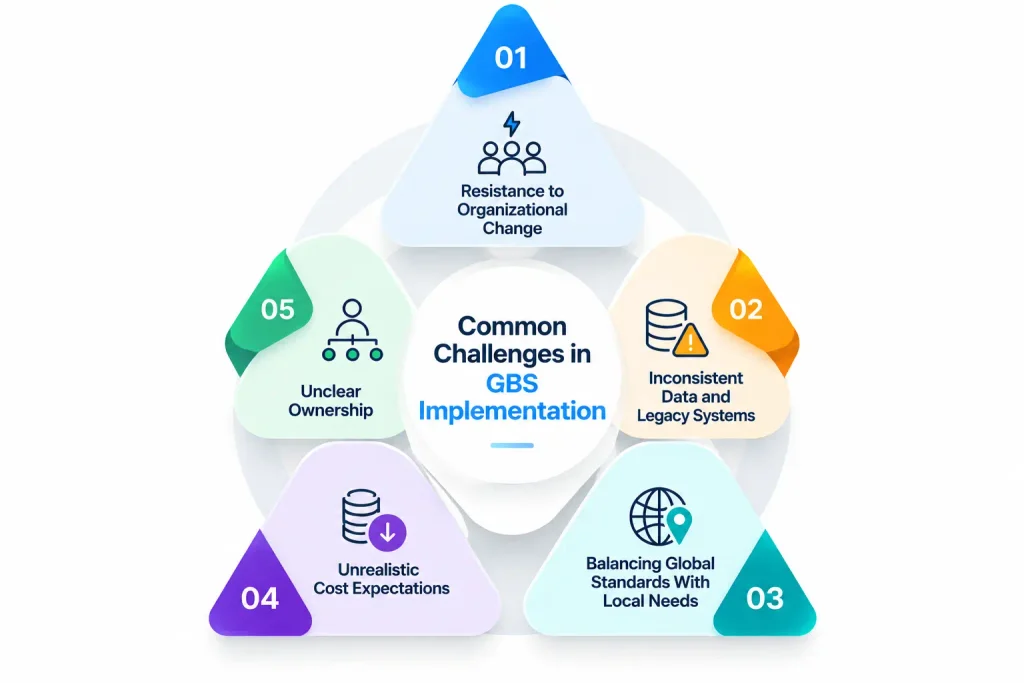
1. Resistance to Organizational Change
Employees and regional leaders may worry about losing control, changing responsibilities, or receiving lower-quality services. Early communication, stakeholder involvement, and clear service expectations can help address these concerns.
2. Inconsistent Data and Legacy Systems
Different business units may use incompatible platforms, inconsistent data definitions, or outdated technology. These issues can limit integration and undermine reporting accuracy.
Organizations should assess their existing systems and data quality before attempting large-scale consolidation.
3. Balancing Global Standards With Local Needs
A process that works well in one country may not satisfy another country’s legal or operational requirements. GBS leaders must distinguish between activities that need standardization and those that need local adaptation.
4. Unrealistic Cost Expectations
GBS is sometimes viewed primarily as a cost-cutting initiative. This can lead to aggressive targets that overlook implementation expenses, employee training, service quality, and long-term capability development.
A more balanced approach considers total cost, productivity, control effectiveness, stakeholder satisfaction, and business impact.
5. Unclear Ownership
If responsibilities are not clearly assigned, service issues can move between departments without resolution. Defining process owners, escalation routes, and decision rights is essential for accountability.
Conclusion
Global Business Services represents an opportunity for organizations to rethink how finance and other corporate functions work together. By integrating service delivery, standardizing processes, improving data visibility, and using technology strategically, businesses can create a more consistent and efficient operating environment.
For CFOs, the value of GBS extends beyond reducing administrative costs. It can support stronger financial controls, more reliable reporting, better resource allocation, and improved decision-making.
This CFO guide to GBS highlights an important principle: successful transformation begins with understanding the organization’s existing challenges and defining measurable business outcomes. The right approach depends on the company’s size, operating complexity, technology landscape, and strategic priorities.
Rather than treating GBS as a one-time restructuring exercise, CFOs can view it as an ongoing capability for improving operational performance and supporting sustainable growth.