





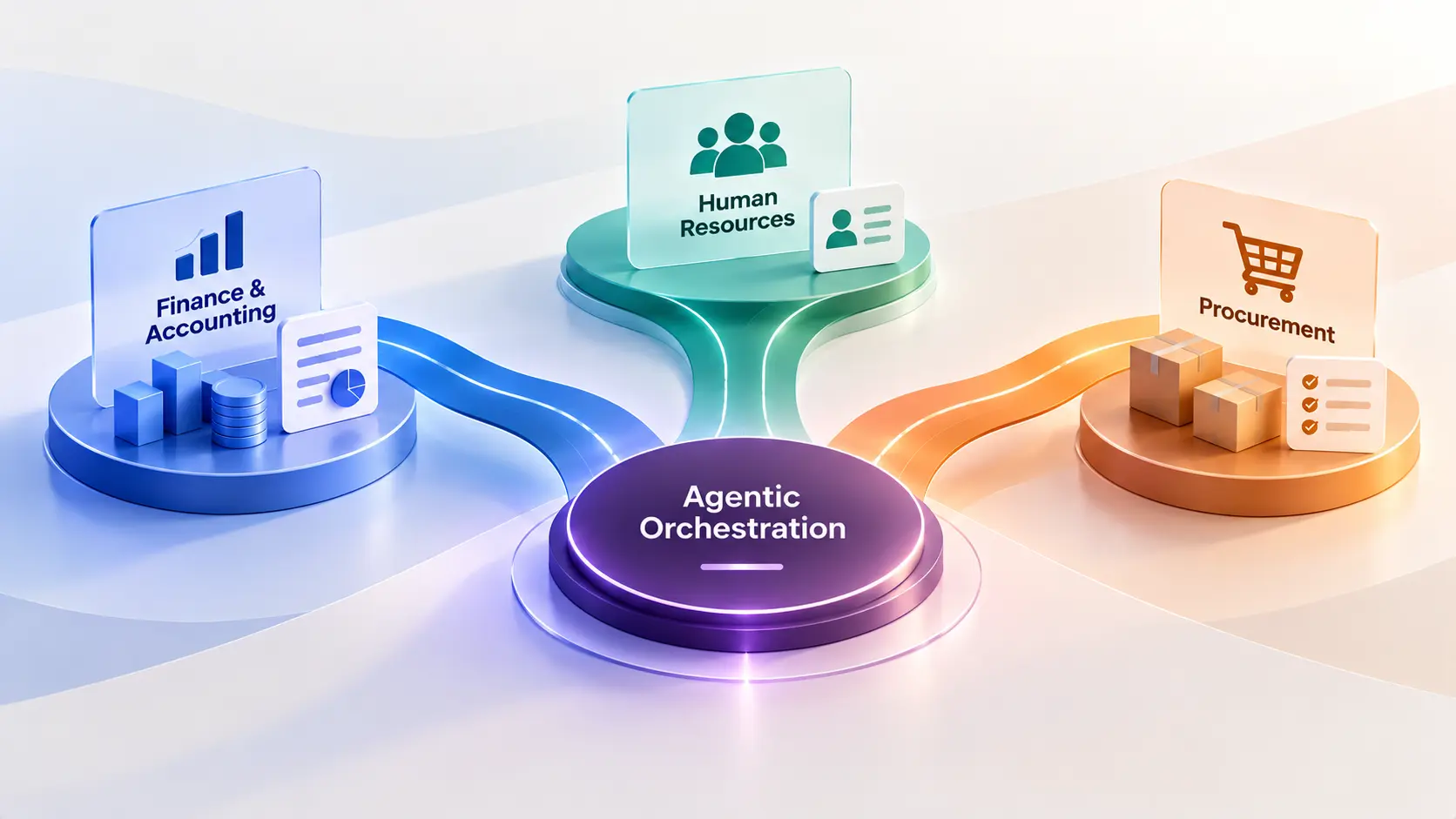


Global Business Services (GBS) organizations are designed to bring business functions together, improve operational efficiency, and create more consistent services across an enterprise. Yet even when Finance & Accounting (F&A), Human Resources (HR), and Procurement operate under one GBS structure, their workflows often remain disconnected. Finance waits for purchase order information, HR follows up on employee documentation, and procurement chases approvals from multiple stakeholders.
This is where agentic orchestration multi-tower GBS becomes an important concept. Rather than automating isolated tasks within individual departments, it focuses on coordinating AI agents, workflows, enterprise systems, and human decisions across multiple service towers. The goal is to help work move between functions with better context, fewer unnecessary handoffs, and clearer accountability.
To understand what this approach could look like in practice, it helps to explore how connected AI agents could support everyday business operations without removing the controls that enterprise processes require.
What Is Agentic Orchestration in a Multi-Tower GBS?
Traditional automation usually targets a defined task. A bot might extract invoice data, update an employee record, or send a purchase requisition for approval. Each automation can deliver value, but the broader process may still depend on employees coordinating the next step.
Agentic orchestration takes a wider view. AI agents can interpret information, identify the next appropriate action, use approved tools, and coordinate with other agents or workflows to move a business outcome forward. An orchestration layer helps manage dependencies, task assignments, shared context, and escalation when a decision requires human involvement.
In an agentic orchestration multi-tower GBS model, this coordination extends beyond a single function. An agent working on an invoice exception might need information from Procurement, while an employee onboarding workflow could depend on HR, IT, and Finance.
The important distinction is that orchestration does not simply mean deploying more AI agents. It means coordinating their work around an end-to-end business process, with defined permissions, reliable information exchange, and clear decision boundaries.
Why Multi-Tower GBS Needs a Different Approach
Many GBS organizations have already invested in workflow platforms, robotic process automation (RPA), enterprise resource planning (ERP) systems, and service management tools. These technologies remain valuable, especially for repetitive tasks with stable rules.
However, cross-functional processes often involve information that is incomplete, inconsistent, or spread across several systems. A workflow can be technically automated and still require significant manual intervention because one department does not have the context needed by another.
Consider a supplier invoice that does not match its purchase order. Finance identifies the discrepancy, procurement contacts the supplier or checks the order, and the business owner may need to confirm whether the goods or services were received. Each team handles part of the issue, but the overall resolution depends on coordination.
An agentic orchestration multi-tower GBS approach could help coordinate these activities. One agent could classify the invoice exception, another could retrieve approved purchase order and receipt information, and a workflow could route unresolved questions to the appropriate owner. Finance would retain control over the final accounting treatment wherever required.
This approach shifts the focus from automating individual tasks to coordinating the work needed to resolve an operational issue.
What Agentic Orchestration Looks Like Across Three Towers
1. Finance & Accounting: From Invoice Exceptions to Resolution
F&A processes generate many opportunities for cross-functional coordination. Accounts payable, reconciliations, expense management, and financial close activities frequently depend on information held outside Finance.
Imagine an invoice arriving with a price that differs from the purchase order. Instead of immediately sending the case to a finance analyst, an orchestrated process could begin by identifying the discrepancy and gathering relevant records.
- Invoice analysis agent: Extracts invoice details and identifies the type of mismatch.
- Procurement coordination agent: Retrieves purchase order terms and checks available supplier information.
- Receipt validation workflow: Checks whether goods or services have been recorded as received.
- Exception management workflow: Routes the case to the appropriate person if the records remain inconsistent.
The agents would not automatically approve every invoice. They would operate within approved rules, distinguish routine cases from uncertain ones, and provide evidence for human review when necessary.
This is one practical example of agentic orchestration multi-tower GBS. Finance receives a more complete exception case, while procurement is engaged based on a specific business need rather than through repeated, unstructured email exchanges.
The potential benefit is not simply faster invoice processing. It is a more coordinated resolution process with clearer ownership and less time spent gathering information.
2. Human Resources: Connecting Employee Onboarding Across Functions
Employee onboarding is often treated as an HR responsibility, but successful onboarding depends on several teams. HR manages employee records and documentation, IT provisions equipment and system access, and Finance may need payroll details, cost centre assignments, or other approved information.
When these activities are managed separately, a new employee may complete the HR paperwork but still lack system access or have an incomplete payroll setup.
An orchestrated onboarding workflow could coordinate the process from the moment an offer is accepted.
- HR agent: Checks required onboarding documents and identifies missing information.
- IT workflow or agent: Initiates approved equipment and access requests after receiving the necessary authorization.
- Finance coordination agent: Checks whether required payroll or cost centre information has been submitted.
- Orchestration layer: Tracks dependencies, monitors completion, and flags tasks that are delayed or blocked.
For example, if payroll setup requires a missing bank detail, the process could notify the employee through an approved channel and track the outstanding requirement. If system access depends on managerial approval, the workflow would route the request to the appropriate approver instead of attempting to bypass the control.
Here, agentic orchestration multi-tower GBS connects tasks around a shared outcome: ensuring that an employee is ready to begin work. HR remains accountable for its responsibilities, while other functions receive the information and requests needed to complete theirs.
3. Procurement: Connecting Supplier Onboarding With Finance
Supplier onboarding is another process that crosses functional boundaries. Procurement collects supplier information, Finance validates payment-related details, and compliance teams may review tax documents, certifications, or risk information.
The process can become complicated when suppliers submit documents in different formats or provide inconsistent information across forms.
An agentic approach could coordinate document collection, validation, and review. One agent could classify submitted documents, another could compare supplier details across approved systems, and a workflow could identify missing evidence or route higher-risk cases for review.
Finance could then receive validated supplier payment information through an authorized process, reducing the need to repeatedly request documents already collected elsewhere.
The orchestration layer would track which checks are complete, which remain outstanding, and who is responsible for the next action. Sensitive changes, such as modifications to bank details, would still require the organization’s prescribed verification and approval controls.
In this scenario, agentic orchestration multi-tower GBS helps procurement and finance work from a more consistent supplier record without assuming that every validation can be delegated to an AI agent.
How the Three Towers Work Together
The real opportunity becomes clearer when we view these towers as connected parts of a larger operating model. Consider a supplier providing services to a company. Procurement manages the supplier relationship and purchase order. Finance processes the invoice and payment. HR may become involved if the purchase relates to workforce services, contractor onboarding, or employee-related expenditure.
A change in one tower can create work in another. A new supplier may require a purchase order, a valid supplier record, and payment configuration. In addition, contractor engagements may also require identity checks, system access, and cost allocation.
A coordinated model can help manage these dependencies by sharing relevant context, initiating approved tasks, and tracking progress across functions.
In a mature agentic orchestration multi-tower GBS environment, the process would not rely solely on employees noticing an email and manually forwarding it to another department. Instead, the system could identify the dependency, initiate the next approved step, and make the current status visible to the relevant teams.
This does not mean every tower needs its own autonomous agent. Some activities may be better handled by existing workflows, APIs, business rules, or RPA bots. Orchestration determines how these components work together to complete the broader process.
Agentic Orchestration vs. Traditional Automation
Understanding the distinction between task automation and orchestration helps organizations avoid treating agentic AI as a replacement for every existing automation.
Traditional RPA is well suited to repetitive, predictable actions. For example, a bot can transfer validated invoice fields into an ERP system or update a record according to a fixed rule. Workflow tools can route approvals, enforce sequences, and maintain task status.
Agentic systems add capabilities for interpreting less structured information, selecting among approved tools, and coordinating work when the next step depends on context. Orchestration connects those capabilities with existing enterprise processes.
For a deeper look at the architectural differences, read Agentic Process Automation vs Traditional RPA: A Tech Stack Perspective.
The choice is not necessarily between traditional automation and agentic AI. A practical architecture may combine both. An agent could interpret an exception and decide which approved workflow to initiate, while an RPA bot executes a stable legacy-system task. Business rules can validate the result, and a human can approve actions that exceed the agent’s authority.
This hybrid approach allows organizations to build on existing investments rather than redesigning every process at once.
What Needs to Be in Place for Successful Orchestration?
Cross-tower coordination introduces challenges that organizations need to address before expanding autonomy.
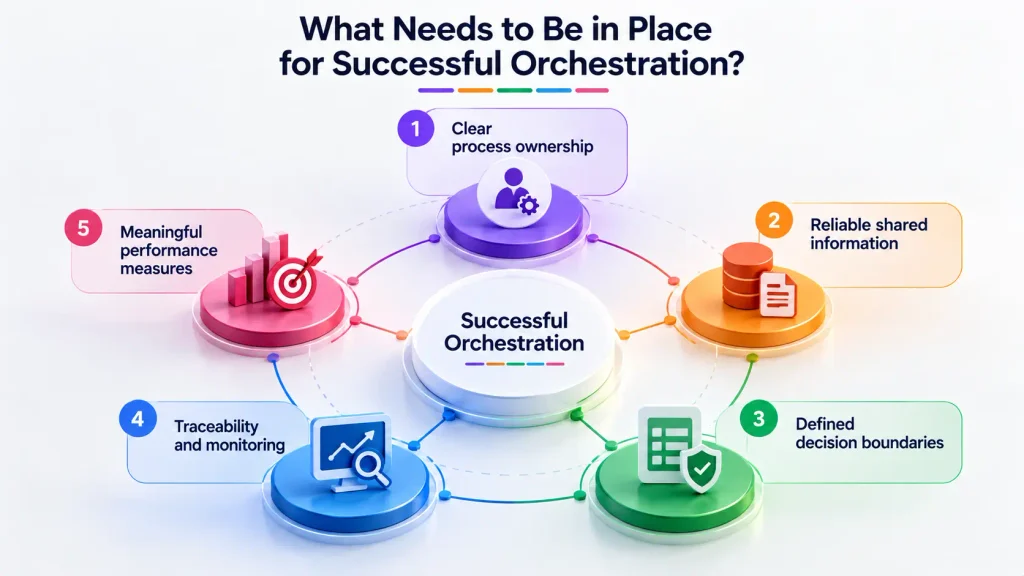
- Clear process ownership: Every cross-functional workflow needs a defined owner. Teams should understand who is accountable for the overall outcome, who owns each task, and who resolves disputes between process requirements.
- Reliable shared information: Agents cannot coordinate effectively if supplier records, employee data, purchase orders, and financial information are inconsistent. Organizations need clear data ownership, appropriate access permissions, and reliable connections between systems.
- Defined decision boundaries: Not every decision should be autonomous. Routine actions may be eligible for automated execution, while financial approvals, sensitive employee decisions, supplier bank changes, and policy exceptions may require human review.
- Traceability and monitoring: Organizations need records of the information used, actions taken, workflow transitions, approvals, and escalations. Monitoring should make it possible to identify failures, investigate unexpected outcomes, and improve controls.
- Meaningful performance measures: Success should be measured across the complete process, not only by the number of tasks automated. Useful measures include end-to-end cycle time, manual handoffs, exception resolution time, rework, policy compliance, and the percentage of cases resolved without unnecessary escalation.
These foundations help ensure that agentic orchestration multitower GBS delivers operational improvements without creating a new layer of complexity that is difficult to govern.
How Should GBS Leaders Get Started?
A multi-tower orchestration initiative does not need to begin with a large transformation program. A focused pilot can reveal where cross-functional coordination creates the greatest friction.
Start by selecting a process that crosses at least two towers, such as invoice exception resolution between Finance and Procurement or employee onboarding between HR, IT, and Finance. Map the current workflow, identify repeated handoffs, document the systems involved, and establish a baseline for cycle time and rework.
Next, distinguish between tasks that require deterministic automation and those that involve interpreting information or coordinating decisions. Define which actions agents may perform, what evidence they must collect, and when they must escalate.
Finally, test the process against realistic scenarios, including missing information, conflicting records, unavailable systems, and policy exceptions. Measure the results before extending the approach to additional workflows or towers.
The objective is to demonstrate that better coordination can improve the end-to-end process—not simply to prove that an AI agent can complete an isolated task.
Conclusion
The future of multi-tower GBS is not just about deploying more automation within finance, HR, or procurement. It is about connecting work across these functions so that information, decisions, and responsibilities move together toward a shared business outcome.
Agentic orchestration provides one way to achieve this by coordinating AI agents, existing automation, enterprise systems, and human oversight. When applied thoughtfully, agentic orchestration multitower GBS can help reduce fragmented handoffs, improve exception management, and make cross-functional processes easier to monitor.
The opportunity is not to remove people from every decision or to make every workflow fully autonomous. It is to ensure that routine work progresses efficiently, complex cases reach the right experts, and important decisions remain accountable.
For GBS leaders, the most useful starting point is a real operational problem that spans multiple towers. By improving one connected process, measuring its outcomes, and establishing clear governance, organizations can build a practical foundation for broader orchestration over time.