








Global Business Services (GBS) organizations are entering a new phase of enterprise transformation. While traditional automation focused on reducing manual effort within individual processes, Agentic AI introduces a fundamentally different opportunity: coordinating intelligent systems that can reason, make decisions, execute tasks, and collaborate across multiple business functions. This shift requires organizations to rethink the agentic AI GBS business case beyond isolated productivity improvements and evaluate its potential at an enterprise-wide level.
For years, organizations have justified automation investments through metrics such as hours saved, reduced processing costs, faster turnaround times, and fewer manual interventions. These metrics remain relevant, but they do not fully capture the value of agentic AI.
When evaluated at GBS scale, the business case becomes broader. It encompasses operating model redesign, cross-functional productivity, improved service delivery, workforce capacity, decision-making efficiency, risk management, and the ability to scale operations without proportionally increasing costs.
The real question is no longer how much time an AI agent can save in one process. It is how multiple AI agents can transform the way an entire GBS organization operates.
Moving Beyond Single-Process ROI to Enterprise-Wide Value
Traditional automation business cases are generally built around individual processes. For example, an organization might introduce automation into invoice processing and calculate the return based on reduced manual effort, fewer errors, and faster invoice approvals.
Although this approach provides a measurable return, it creates a limited view of automation’s overall potential.
Agentic AI operates differently. Instead of automating a single repetitive activity, AI agents can coordinate multiple tasks across connected workflows. They can retrieve information, interpret business requirements, interact with enterprise applications, initiate actions, and escalate exceptions when human intervention is required.
Consider an employee onboarding process. It typically involves several departments and activities:
- HR collects employee information and verifies documentation.
- IT creates system accounts and assigns access permissions.
- Finance initiates payroll and benefits-related activities.
- Procurement or administration arranges equipment and workplace resources.
- Compliance teams complete necessary checks.
Automating each activity independently may improve individual process efficiency. However, an agentic AI-enabled workflow can coordinate these activities through a connected operating structure.
This changes the financial evaluation. Instead of calculating savings separately for HR, IT, finance, and administration, organizations can assess the combined impact of reducing delays, eliminating repeated data entry, improving coordination, and accelerating employee readiness.
The agentic AI GBS business case therefore needs to capture value across the complete workflow rather than treating every department as an independent automation opportunity.
Why Process-Level Savings Underestimate the Actual Opportunity
One of the biggest limitations of traditional ROI models is that they focus heavily on direct labor savings. For example, suppose an organization automates a process that requires 10,000 employee hours annually. When automation cuts the workload by 40%, it frees up 4,000 hours of capacity as an immediate benefit.
However, those 4,000 hours do not automatically translate into financial savings.
Employees may still be required to manage exceptions, review outputs, handle complex cases, and perform activities that automation cannot independently complete. The organization may also retain the same workforce while redirecting employees toward higher-value responsibilities.
This distinction is particularly important when evaluating agentic AI.
A more comprehensive business case should distinguish between:
Hard savings: Actual reductions in operating expenditure, such as reduced outsourcing costs, lower temporary staffing requirements, or avoided hiring.
Capacity release: Employee hours made available for more valuable activities without necessarily reducing headcount.
Cost avoidance: Future expenses that the organization does not need to incur because existing teams can handle higher transaction volumes.
Productivity improvement: Better output per employee through reduced administrative work, faster information retrieval, and improved task coordination.
Business value: Improvements in service quality, decision-making, customer experience, and operational responsiveness.
For GBS leaders, separating these value categories prevents unrealistic ROI projections and creates a more credible investment case. It also helps finance teams understand which benefits will appear directly in the income statement and which will contribute to long-term organizational performance.
Modeling Cross-Functional Value Instead of Isolated Automation Benefits
The most significant opportunity from agentic AI often emerges when multiple processes connect. GBS organizations frequently manage interdependent activities across finance, HR, procurement, customer operations, supply chain, and IT. These functions share information, depend on common systems, and frequently encounter delays because of fragmented workflows.
An individual automation solution may improve one department’s performance without addressing the underlying dependencies. Agentic AI creates an opportunity to model value across these interconnected operations.
For example, consider the procure-to-pay cycle. An AI-enabled operating model could support several activities:
- Identifying purchase requirements.
- Checking purchase orders against procurement policies.
- Matching invoices with purchase orders and delivery records.
- Identifying discrepancies and requesting missing information.
- Routing exceptions to the appropriate employees.
- Preparing payment recommendations for authorized approval.
Instead of measuring the ROI of invoice matching alone, organizations can evaluate improvements across the entire procure-to-pay lifecycle. This includes reduced invoice exceptions, fewer supplier follow-ups, faster approvals, improved compliance, and better working capital visibility. The agentic AI GBS business case becomes considerably stronger when organizations evaluate these interconnected benefits together.
However, organizations must avoid double-counting savings. If faster invoice processing also reduces supplier follow-ups, the same labor hours should not be counted as two separate financial benefits. A robust model should identify the primary value driver for each benefit and establish clear ownership across functions.
Understanding the New Cost Structure of Agentic AI
A common mistake when evaluating AI investments is comparing the cost of an AI agent with the salary of an employee performing a particular task. This comparison is incomplete because agentic AI introduces a different cost structure.
While AI agents can reduce certain operational expenses, deploying them at enterprise scale requires investment across multiple areas. These typically include:
- Technology infrastructure: Cloud resources, model access, enterprise platforms, integration tools, and computing requirements.
- AI orchestration: Systems responsible for coordinating agents, managing workflows, assigning tasks, and maintaining execution consistency.
- Data management: Data integration, cleansing, governance, accessibility, and quality management.
- Security and compliance: Identity management, access controls, audit trails, monitoring, and regulatory safeguards.
- Human oversight: Employees responsible for reviewing sensitive decisions, resolving exceptions, approving transactions, and monitoring agent performance.
- Change management: Employee training, process redesign, operating model adjustments, and adoption initiatives.
Organizations should also account for ongoing costs associated with model usage, maintenance, testing, monitoring, and continuous improvement. The important consideration is not whether agentic AI is cheaper than human labor for every individual task. It is whether the complete AI-enabled operating model delivers a better economic outcome over time.
This is why a scalable financial model must consider total cost of ownership rather than implementation costs alone.
Redesigning Workforce Productivity and Capacity Planning
Agentic AI introduces a major change in how GBS organizations should evaluate workforce productivity. Traditional productivity models often measure employee output through transaction volumes, average handling time, processing speed, and cost per transaction.
These measures remain useful, but they become less sufficient when AI agents perform significant portions of operational workflows. Employees increasingly shift from executing repetitive tasks to supervising AI systems, managing exceptions, validating outcomes, and handling complex decisions.
For example, a finance professional who previously spent several hours collecting information, reconciling records, and preparing reports may now focus more on investigating unusual transactions and providing financial insights.
This changes the nature of workforce capacity.
Instead of asking how many employees can be replaced through automation, GBS leaders should evaluate:
- How much employee capacity can be released?
- Which activities require human judgment?
- Can existing teams handle higher transaction volumes?
- How much additional hiring can be avoided?
- Which roles need reskilling or redesigned responsibilities?
- How can released capacity support strategic business priorities?
The agentic AI GBS business case should connect productivity improvements with workforce transformation. A realistic model should also account for the time required to redesign roles, train employees, establish supervision responsibilities, and achieve consistent adoption. Without these considerations, projected productivity gains may look impressive on paper but remain difficult to realize in practice.
Measuring Business Outcomes Beyond Cost Reduction
Cost reduction is an important investment driver, but it should not be the only measure of success. Agentic AI can influence several operational outcomes that traditional automation models often overlook.
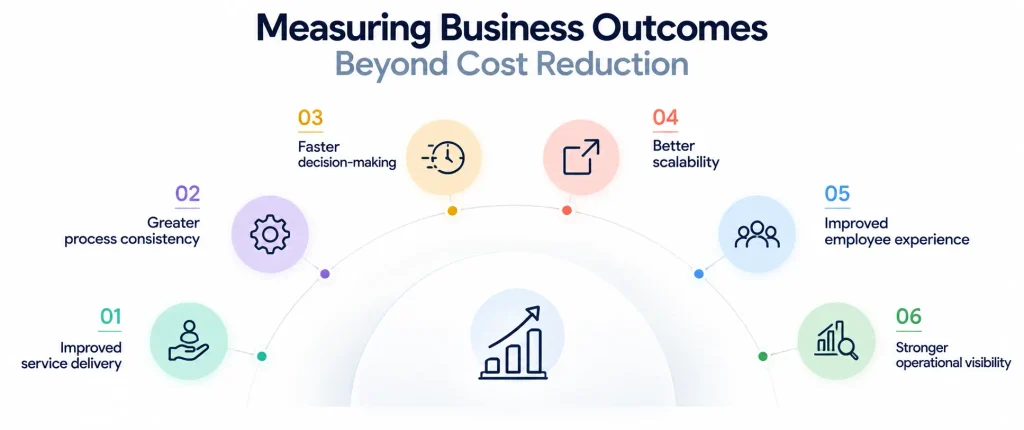
- Improved service delivery: AI agents can coordinate tasks across departments, reducing delays caused by manual handoffs and disconnected workflows.
- Greater process consistency: Standardized execution and policy-based controls can reduce variation in routine activities.
- Faster decision-making: AI agents can gather relevant information, analyze available data, and prepare recommendations for human decision-makers.
- Better scalability: Organizations can potentially manage increasing transaction volumes without expanding operational capacity at the same rate.
- Improved employee experience: Reducing repetitive administrative work allows employees to focus on problem-solving and higher-value responsibilities.
- Stronger operational visibility: Centralized monitoring can help leaders identify bottlenecks, recurring exceptions, and process inefficiencies.
These benefits should be translated into measurable indicators. For example, organizations can monitor end-to-end cycle time, first-time-right processing, exception rates, service-level agreement performance, cost per transaction, and employee capacity utilization. The objective is to establish a clear connection between AI deployment and business performance rather than relying on generic productivity claims.
Managing Risk, Governance, and Human Oversight at Scale
An enterprise-wide business case cannot ignore the risks associated with autonomous AI systems. As AI agents gain the ability to execute tasks and interact with business applications, organizations must establish clear boundaries around their authority.
A system that can independently retrieve information may present a relatively low operational risk. However, an agent authorized to approve payments, modify employee records, or change supplier information requires significantly stronger controls.
A scalable governance framework should include:
- Role-based access and identity management for AI agents.
- Defined permissions and transaction limits.
- Human approval for sensitive or high-impact decisions.
- Audit trails covering agent actions and decisions.
- Continuous monitoring for errors and unexpected behavior.
- Data privacy and regulatory compliance controls.
- Escalation mechanisms for ambiguous or exceptional situations.
Organizations should also evaluate the potential financial impact of incorrect decisions, unauthorized actions, system failures, and data exposure. Risk management should not be treated as an additional expense disconnected from ROI. It is part of the investment required to operate agentic AI reliably.
A mature agentic AI GBS business case therefore evaluates both the value created through autonomous execution and the cost of maintaining appropriate governance. This approach helps organizations move from experimentation toward responsible enterprise adoption.
Building a Scalable Business Case: A Practical Evaluation Framework
To evaluate agentic AI at a GBS scale, organizations need a structured framework that connects business priorities, operational opportunities, technology investments, and measurable financial outcomes.
A practical approach can be divided into five stages.
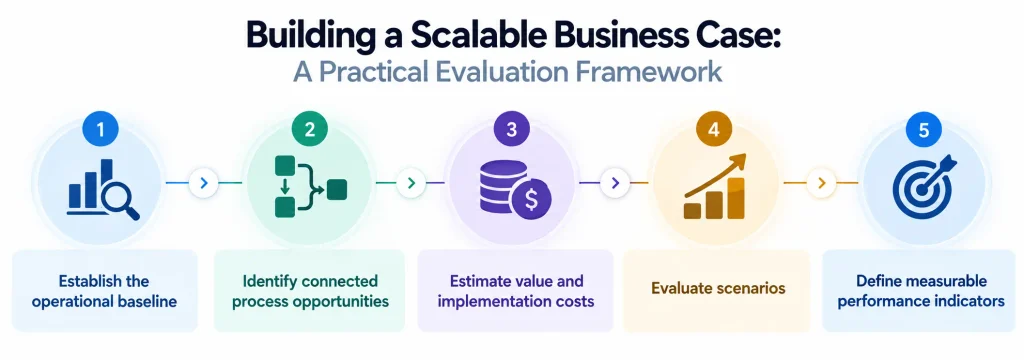
Stage 1: Establish the operational baseline: Document current transaction volumes, workforce requirements, processing costs, cycle times, exception rates, and service-level performance. This baseline provides a reference point for measuring improvements.
Stage 2: Identify connected process opportunities: Evaluate workflows that span multiple functions rather than selecting isolated tasks based only on automation potential. Prioritize processes with high transaction volumes, repetitive coordination requirements, significant manual intervention, and measurable business impact.
Stage 3: Estimate value and implementation costs: Calculate potential labor capacity release, cost avoidance, operational improvements, and quality benefits. Include technology, integration, governance, infrastructure, and change management expenses.
Stage 4: Evaluate scenarios: Develop conservative, expected, and ambitious scenarios based on different levels of adoption, automation coverage, exception rates, and implementation timelines. For example, an organization should not assume that every task within a selected workflow can be executed autonomously from day one.
Stage 5: Define measurable performance indicators: Establish clear KPIs and assign ownership to business stakeholders. Track realized financial savings separately from capacity release and non-financial improvements. This framework makes the investment evaluation more transparent and helps leadership understand how value will be generated, measured, and sustained.
What GBS Leaders Should Prioritize Before Investing
Before approving large-scale investments, GBS leaders should ask several important questions:
- Are we evaluating the complete business process or only individual tasks?
- Have we identified where multiple functions can benefit from coordinated AI execution?
- Are projected savings financially realizable, or do they represent theoretical capacity release?
- Have we included the complete cost of technology, integration, governance, and ongoing operations?
- Can our existing data and enterprise systems support reliable agent execution?
- Have we established appropriate human oversight and accountability?
- Do we have a clear roadmap for scaling beyond initial pilots?
- Can we measure business outcomes consistently across different functions?
These questions help distinguish a technology-led investment proposal from a true business case for enterprise transformation. They also create a stronger foundation for discussions between GBS leadership, finance, IT, procurement, and business stakeholders.
Conclusion
The business case for agentic AI changes significantly when organizations move from evaluating individual automation opportunities to modeling transformation at a GBS scale. The value is no longer limited to reducing manual effort in one department. It comes from connecting workflows, coordinating activities across functions, improving decision-making, releasing employee capacity, and creating more scalable operating models.
For organizations evaluating the agentic AI GBS business case, the priority should be to move beyond isolated ROI calculations and develop an enterprise-wide view of costs, benefits, risks, and long-term operational outcomes. This requires more than deploying intelligent agents. It requires rethinking process ownership, workforce responsibilities, governance structures, technology integration, and performance measurement.
GBS organizations that approach this transformation strategically will be better positioned to turn agentic AI from a collection of promising pilot projects into a sustainable source of enterprise value.