








Exception handling has traditionally been one of the most resource-intensive activities within Global Business Services (GBS). Whether it involves mismatched invoices, incomplete purchase orders, payroll discrepancies, vendor onboarding issues, or failed transactions, exceptions frequently require employees to investigate multiple systems, gather information, identify root causes, and coordinate corrective actions.
Traditional automation can identify predefined exceptions and route them according to established rules. However, it often struggles when an issue requires contextual understanding, multi-step investigation, or decisions based on information scattered across enterprise applications.
This is where AI agent exception handling GBS becomes relevant. AI agents introduce a more intelligent approach by combining data retrieval, reasoning, decision-making, workflow orchestration, and controlled execution within a single operational framework.
But what actually happens inside an AI agent when an exception occurs?
Understanding its technical architecture is essential for GBS leaders evaluating agentic AI solutions. Rather than viewing an AI agent as a chatbot or another automation tool, organizations need to understand its individual components, how they interact, and how decisions move from detection to resolution.
Understanding the Architecture of an AI Agent
An AI agent designed for GBS exception handling is a system that receives an operational objective, gathers relevant information, evaluates possible actions, and executes approved steps within defined boundaries.
Unlike traditional rule-based automation, which follows a predetermined sequence, an AI agent can adapt its investigation based on the information it discovers.
A typical architecture consists of six interconnected components:
- Input and event detection: Identifies an exception from an enterprise application or workflow.
- Context and data retrieval: Collects relevant records, policies, documents, and transaction history.
- Reasoning engine: Interprets the exception, identifies potential causes, and determines the next action.
- Tool and system integration: Connects the agent with ERP, finance, procurement, HR, and other enterprise applications.
- Execution and orchestration: Coordinates corrective actions, approvals, and follow-up activities.
- Governance and monitoring: Tracks decisions, permissions, outcomes, and human interventions.
These components work together to transform exception handling from a fragmented manual activity into a structured, intelligent workflow.
The AI agent exception handling GBS architecture should not be considered a single AI model. It is better understood as a coordinated system combining language models, enterprise data, business rules, APIs, workflow engines, and governance mechanisms.
Step One: Exception Detection and Event Ingestion
The process begins when an exception is detected.
An exception can originate from several sources, including:
- ERP transaction failures.
- Invoice and purchase order mismatches.
- Failed payment processing.
- Vendor master data discrepancies.
- Missing employee information.
- Service-level agreement breaches.
- Incomplete documentation.
- Compliance-related alerts.
For example, consider an invoice processing workflow in which an invoice amount does not match the corresponding purchase order. A traditional system may flag the mismatch and place the invoice in an exception queue. An AI agent-enabled workflow can go further by receiving the exception event and initiating an investigation.
Technically, this event can enter the agent architecture through an API, webhook, message queue, event bus, or workflow trigger.
The incoming event should contain structured information such as:
- Transaction ID.
- Supplier or employee ID.
- Exception category.
- Timestamp.
- Transaction amount.
- Source application.
- Error code or exception description.
- Reference document identifiers.
The system then validates the incoming payload and assigns a unique case identifier. This step is important because the agent needs a reliable starting point. Poorly structured events, duplicate notifications, or incomplete identifiers can lead to incorrect investigations.
A well-designed AI agent exception handling GBS workflow therefore begins with event validation, normalization, and classification rather than immediately sending raw information to a language model.
Step Two: Context Retrieval and Enterprise Data Access
An exception rarely contains enough information to determine its root cause. An invoice mismatch, for instance, could result from incorrect pricing, partial delivery, outdated purchase order information, tax differences, duplicate billing, or a simple data-entry error.
The agent must therefore retrieve additional context before deciding what to do. This is where enterprise integration becomes critical.
Depending on the exception type, the agent may retrieve information from:
- ERP systems such as SAP or Oracle.
- Procurement and supplier management platforms.
- Accounts payable applications.
- Contract management repositories.
- Document management systems.
- Internal knowledge bases.
- Historical transaction records.
- Business policy documents.
Technically, this can involve API calls, database queries, enterprise search, and retrieval-augmented generation (RAG). RAG allows an AI agent to retrieve relevant information from approved knowledge sources and provide that information as context to the language model.
For example, if an invoice exceeds the purchase order amount, the agent might retrieve the original purchase order, goods receipt, supplier contract, invoice document, and applicable tolerance policy.
The retrieved information is then organized into a structured context package. Importantly, access must be permission-aware. The agent should retrieve only the information it is authorized to access, with sensitive data protected through appropriate controls.
The AI agent exception handling GBS model becomes more reliable when the agent has access to accurate, current, and relevant enterprise information instead of relying exclusively on the information contained in the initial exception alert.
Step Three: The Reasoning Engine and Decision Logic
The reasoning engine is responsible for interpreting the retrieved information and determining what should happen next. This is one of the most important differences between traditional automation and agentic AI. A conventional automation workflow may follow a fixed instruction: if the invoice amount differs from the purchase order amount, send the invoice to an employee.
An AI agent can investigate why the amounts differ before deciding whether the issue requires clarification, correction, escalation, or approval.
A reasoning process may involve the following activities:
Exception classification: Determine whether the issue relates to pricing, quantity, tax, documentation, duplication, or another category.
Root-cause investigation: Compare transaction records, supporting documents, historical patterns, and applicable business policies.
Policy evaluation: Check whether the discrepancy falls within an approved tolerance or requires additional authorization.
Action selection: Determine the appropriate next step based on the available evidence.
Confidence assessment: Evaluate whether the retrieved information supports a reliable recommendation.
For example, suppose an invoice amount exceeds the purchase order by 2%. The agent retrieves the procurement policy and identifies an approved tolerance threshold of 3% for the relevant transaction category. It also confirms that the goods receipt matches the invoiced quantity.
Based on these findings, the agent can recommend that the invoice proceed through the applicable approval process. However, it should not automatically approve payment simply because the discrepancy falls within the tolerance. The actual authority to approve must remain governed by the organization’s financial controls.
A robust AI agent exception handling GBS implementation combines probabilistic reasoning from the language model with deterministic business rules, validation checks, and authorization policies. This hybrid approach helps reduce the risk of unsupported decisions.
Step Four: Tool Calling and Enterprise System Integration
An AI agent becomes operationally useful when it can interact with enterprise systems rather than simply generate recommendations. Tool calling allows the agent to invoke specific functions or services to retrieve information and perform permitted actions.
For example, an accounts payable agent may have access to tools that allow it to:
- Retrieve invoice details.
- Check purchase order status.
- Verify goods receipt records.
- Access supplier information.
- Create an exception case.
- Request missing documentation.
- Update an authorized workflow status.
- Route a case for human approval.
Each tool should have a clearly defined purpose, input schema, output format, and permission boundary.
A typical interaction might look like this:
- The agent identifies an invoice discrepancy.
- It calls the purchase order retrieval API.
- The application returns the purchase order details.
- The agent calls the goods receipt verification service.
- The service confirms the received quantity.
- The agent retrieves the applicable procurement policy.
- It evaluates the discrepancy against the policy.
- It creates a recommendation and routes the case for the required approval.
This is fundamentally different from allowing an AI model to directly modify enterprise databases. The model should request actions through controlled tools, while the connected applications enforce authentication, authorization, business rules, and transaction validation.
For organizations implementing the AI agent exception handling GBS architecture, this separation between reasoning and execution is essential for operational safety and auditability.
Step Five: Workflow Orchestration and Exception Resolution
Once the agent has investigated the issue and selected an appropriate action, the workflow orchestration layer coordinates execution. This layer determines which tasks must happen, in what sequence, and which activities require human participation.
Consider a vendor onboarding exception involving incomplete tax documentation.
The agent may:
- Identify the missing document.
- Check the vendor onboarding requirements.
- Retrieve the supplier’s existing records.
- Generate a request for the missing information.
- Send the request through an approved communication channel.
- Update the case status.
- Monitor for the required response.
- Resume processing when the document becomes available.
If the submitted document fails validation, the agent can reopen the investigation or escalate the case. This creates a more adaptive workflow than a traditional automation sequence that simply stops when a predefined condition fails.
For complex cases, multiple specialized agents may participate. For example, one agent can retrieve procurement information, another can validate documentation, and a coordinating agent can manage the overall case.
However, multi-agent architecture is not automatically necessary. For many GBS use cases, a single agent supported by well-designed tools and workflow orchestration is simpler, easier to govern, and more cost-effective.
The AI agent exception handling GBS approach should therefore prioritize the simplest architecture that can reliably resolve the target exception category.
Step Six: Human-in-the-Loop Controls and Escalation
Not every exception should be resolved autonomously. GBS operations frequently involve financial approvals, regulatory obligations, sensitive employee information, and supplier relationships. These activities require accountability and clearly defined decision-making authority.
Human-in-the-loop controls ensure that AI agents operate within approved boundaries. Organizations can establish different levels of autonomy depending on the risk and complexity of an exception.
| Exception category | Recommended handling |
| Low-risk, predefined issue | Automated resolution within approved rules |
| Moderate-risk discrepancy | AI recommendation with employee review |
| High-value financial exception | Mandatory authorized approval |
| Compliance-related issue | Escalation to the compliance team |
| Ambiguous or unsupported case | Human investigation |
The agent should also provide an explanation of its recommendation, including the information retrieved, applicable policy, validation results, and proposed action. This allows employees to review decisions without repeating the entire investigation.
A mature AI agent exception handling GBS architecture should also support approval workflows, escalation thresholds, override mechanisms, and clear accountability for actions performed by both humans and AI agents.
Step Seven: Monitoring, Audit Trails, and Continuous Learning
Deploying an AI agent is not the end of the implementation process. Its performance must be monitored continuously. Organizations need visibility into how agents behave, which decisions they make, how often they require human intervention, and whether their actions produce the intended outcomes.
Important monitoring metrics include:
- Exception detection accuracy.
- Root-cause identification accuracy.
- Automated resolution rate.
- Human escalation rate.
- Average exception resolution time.
- Incorrect action or recommendation rate.
- Policy compliance rate.
- Cost per resolved exception.
Audit trails are equally important.
Every significant action should generate a record containing the case identifier, input data references, retrieved information, model and policy versions, tool calls, validation results, approvals, and final outcome.
Sensitive information should be protected through appropriate retention and access policies. Organizations should also evaluate recurring errors and feedback from employees to improve retrieval quality, business rules, prompts, and workflow design.
This does not necessarily mean continuously training the underlying language model. In many implementations, organizations can achieve improvements by using better data, updated policies, revised instructions, improved tools, and more reliable validation mechanisms.
The AI agent exception handling GBS framework should treat observability and auditability as core architectural requirements rather than features added after deployment.
What Does a Practical Implementation Look Like?
Consider a GBS finance operation handling 10,000 invoices every month. A portion of these invoices enter exception queues because of mismatched amounts, missing purchase orders, incomplete documentation, or supplier information discrepancies.
A conventional process may require employees to open multiple applications, compare records, contact suppliers, and manually update case statuses.
An AI agent-enabled architecture can introduce a more structured investigation and resolution process.
| Workflow component | AI agent responsibility |
| Detection | Identify invoice exceptions |
| Context retrieval | Collect invoice, PO, GRN, and supplier records |
| Reasoning | Investigate discrepancies and identify possible causes |
| Validation | Apply approved policies and tolerance rules |
| Execution | Initiate permitted workflow actions |
| Human oversight | Route sensitive cases for approval |
| Monitoring | Track resolution time, accuracy, and outcomes |
The business impact should be measured against the existing operational baseline.
For example, organizations can compare average resolution time, employee handling effort, exception backlog, first-time-right processing, and cost per resolved case before and after implementation.
They should also measure how frequently employees need to correct agent recommendations. The AI agent exception handling GBS model should demonstrate improvements in both operational efficiency and resolution quality, rather than focusing exclusively on the percentage of cases processed without human involvement.
Key Technical Considerations Before Scaling
A successful pilot does not automatically translate into an enterprise-ready deployment. Before scaling AI agents across GBS operations, organizations should evaluate several architectural requirements.
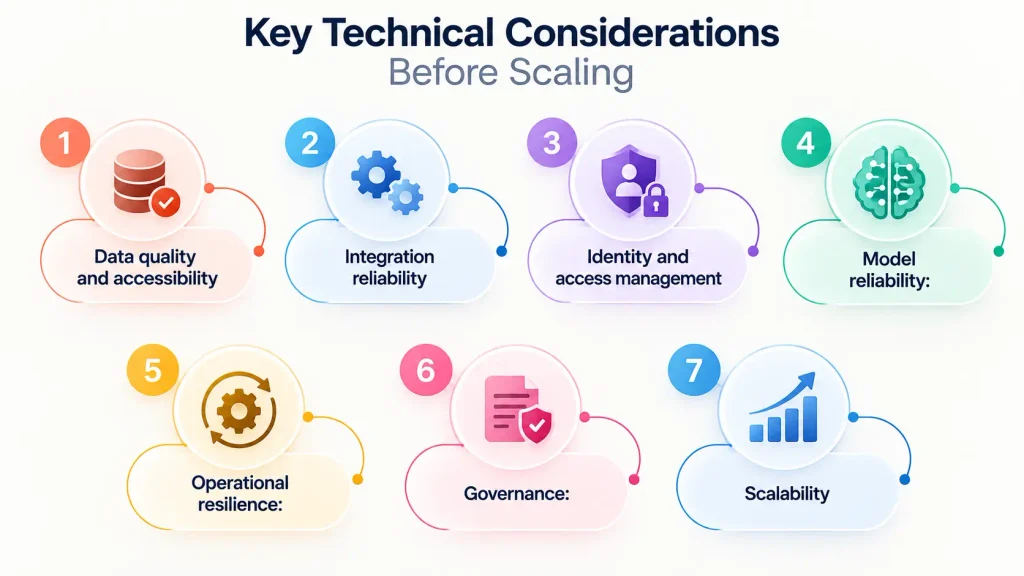
- Data quality and accessibility: Agents need reliable access to structured transaction records and relevant unstructured documents.
- Integration reliability: APIs and enterprise connectors must support secure, consistent communication with business applications.
- Identity and access management: Every agent should operate with clearly defined permissions and restricted access.
- Model reliability: Organizations should test reasoning accuracy, retrieval relevance, hallucination risks, and performance across different exception categories.
- Operational resilience: The architecture should handle API failures, duplicate events, timeouts, and incomplete responses through retries and controlled recovery mechanisms.
- Governance: Business owners must define accountability, escalation requirements, approval authority, and acceptable autonomy levels.
- Scalability: Infrastructure and orchestration systems should support increasing exception volumes without compromising response times or control requirements.
A scalable AI agent exception handling GBS deployment also needs clear ownership across IT, finance, operations, risk, and compliance teams. Without this cross-functional accountability, even technically successful solutions can struggle to achieve sustained adoption.
Conclusion
The anatomy of an AI agent for GBS exception handling involves much more than connecting a language model to an enterprise application. It requires a coordinated architecture combining event detection, contextual data retrieval, reasoning, tool integration, workflow orchestration, human oversight, and continuous monitoring.
Each component plays a distinct role in ensuring that exceptions are investigated accurately, actions are executed within approved boundaries, and outcomes remain measurable.
For GBS organizations evaluating agentic AI, the priority should be to identify exception categories where intelligent investigation can meaningfully reduce manual effort and improve resolution quality.
A well-designed AI agent exception handling GBS solution should not aim to remove human involvement from every decision. Instead, it should enable employees to spend less time gathering information and coordinating routine activities while retaining control over complex, sensitive, and high-impact decisions.
That is what makes an AI agent operationally valuable: not simply its ability to process exceptions, but its ability to make the entire exception management process more intelligent, consistent, transparent, and scalable.