








Agentic AI is changing how Global Business Services (GBS) organizations manage enterprise workflows. Unlike traditional automation, which follows predefined instructions, AI agents can interpret context, evaluate information, plan actions, and execute multi-step tasks across business applications. However, giving agents the ability to act autonomously introduces an important question: how much decision-making authority should they actually have?
Establishing agentic AI decision boundaries GBS is becoming essential for organizations that want to adopt autonomous workflows without compromising financial controls, regulatory compliance, or operational accountability.
The objective is not to make every business process fully autonomous. It is to identify decisions that agents can safely handle, decisions that require human approval, and situations where autonomous execution should not be permitted.
For GBS leaders, the challenge is designing an operating model where AI agents improve speed and efficiency while remaining within clearly defined business, technical, and governance boundaries.
Why Decision Boundaries Matter in Agentic GBS
GBS environments manage interconnected processes across Finance, HR, Procurement, IT, and other enterprise functions. These processes involve different levels of operational risk, financial exposure, data sensitivity, and regulatory responsibility.
Consider an AI agent processing supplier invoices. It can extract invoice information, validate purchase orders, identify discrepancies, and prepare transactions for posting. These activities are largely rule-driven and can be automated with appropriate validation. However, approving an unusually large payment, changing supplier banking information, or overriding a financial control involves significantly greater risk.
The distinction is important because an AI agent capable of executing an action does not automatically have the authority to make that decision.
A well-designed agentic AI decision boundaries GBS framework separates three responsibilities:
- Execution: Tasks that agents can complete independently within predefined permissions.
- Decision support: Activities where agents analyze information and recommend actions, but humans retain decision authority.
- Restricted decisions: High-risk activities that require designated human authorization or must remain outside autonomous execution.
Without these boundaries, organizations risk creating workflows where agents make decisions beyond their intended responsibilities.
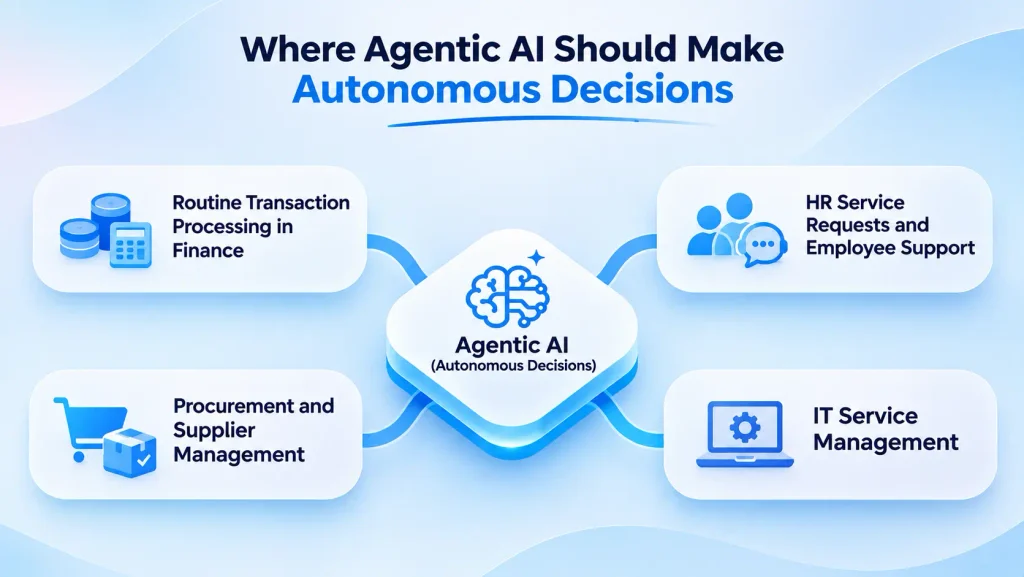
Where Agentic AI Should Make Autonomous Decisions
The strongest initial opportunities are processes involving high transaction volumes, repetitive decisions, structured business rules, and clearly measurable outcomes.
1. Routine Transaction Processing in Finance
Finance operations offer several opportunities for controlled autonomous execution. AI agents can process invoices, validate purchase orders, compare invoice details against goods receipts, identify duplicate transactions, and update workflow statuses.
For example, when an invoice matches the purchase order and goods receipt within predefined tolerances, an agent can complete validation and prepare the transaction for posting.
Similarly, agents can support cash application by matching incoming payments with outstanding receivables using customer references, invoice numbers, and transaction information.
Suitable autonomous decisions include:
- Matching invoices against purchase orders.
- Identifying duplicate invoices.
- Classifying financial transactions.
- Applying predefined reconciliation rules.
- Routing standard exceptions.
- Updating transaction statuses.
These activities are suitable because the decision criteria can be defined, tested, and monitored. However, autonomous processing should not automatically extend to high-value payment authorization or financial adjustments outside approved thresholds.
2. HR Service Requests and Employee Support
HR shared services handle large volumes of employee queries and administrative requests. AI agents can interpret employee requests, retrieve relevant policy information, identify the appropriate workflow, and execute approved administrative actions.
For instance, an employee requesting a leave balance update can receive an automated response based on verified HR system information.
Agents can also initiate onboarding workflows, generate task lists, coordinate documentation requests, and update employee service case statuses.
Suitable autonomous decisions include:
- Classifying employee queries.
- Retrieving approved HR policy information.
- Routing service requests.
- Initiating onboarding tasks.
- Updating routine case statuses.
- Sending standard notifications.
Sensitive employee matters, disciplinary decisions, compensation changes, and employment termination decisions should remain under authorized human control.
3. Procurement and Supplier Management
Procurement workflows involve multiple systems, approvals, and supplier interactions, making them suitable for coordinated agent-based automation. An AI agent can validate supplier documentation, check vendor information against approved records, identify missing onboarding requirements, and initiate purchase order workflows.
For recurring purchases within established policies, agents can also prepare procurement requests and route them through predefined approval hierarchies.
Suitable autonomous decisions include:
- Checking supplier documentation completeness.
- Identifying duplicate supplier records.
- Validating purchase requisition information.
- Routing purchase orders.
- Monitoring supplier onboarding progress.
- Flagging contract and compliance exceptions.
However, supplier selection involving strategic considerations, contract negotiations, and changes to sensitive banking information should require appropriate human authorization.
4. IT Service Management
IT shared services provide another strong opportunity for autonomous agent execution. Agents can classify incoming service desk tickets, retrieve relevant troubleshooting procedures, reset eligible access credentials through approved identity systems, and execute predefined remediation workflows.
For example, when an employee reports a routine software access issue, an agent can verify eligibility, check access policies, and initiate an authorized provisioning workflow. More complex incidents involving infrastructure outages, security threats, or privileged access should trigger escalation. The key is to distinguish routine service execution from decisions that could affect enterprise security or system availability.
Where Agentic AI Should NOT Make Autonomous Decisions
Not every business decision should be delegated to an AI agent. Certain activities require human judgment, accountability, regulatory interpretation, or authorization that automated reasoning cannot replace.
1. High-Value Financial Approvals
AI agents can analyze payment requests, validate supporting documentation, identify unusual transactions, and recommend approval decisions. However, final authorization for high-value payments, unusual financial adjustments, and transactions exceeding delegated authority should remain with designated finance personnel.
This distinction helps organizations maintain segregation of duties and prevent an agent from independently initiating and authorizing the same financial transaction.
2. Sensitive Employee Decisions
HR decisions involving promotions, compensation changes, disciplinary action, employee termination, and sensitive grievances can have significant personal and legal consequences. AI agents may organize information, retrieve relevant policies, and provide decision support. However, final decisions should remain with authorized HR professionals.
3. Regulatory and Compliance Exceptions
Agents can identify missing documentation, flag policy violations, compare transactions against compliance rules, and prepare audit evidence. They should not independently override compliance restrictions or approve exceptions that require formal regulatory or management authorization.
4. Privileged Access and Security Changes
Identity and access management requires strict control over who can access enterprise applications and sensitive information. Agents may process standard access requests when identity, role, and approval conditions are verified. However, explicit authorization and appropriate verification should be required for granting privileged administrative access, modifying security policies, or disabling critical security controls.
5. Strategic Business Decisions
Decisions involving organizational restructuring, major supplier relationships, financial strategy, workforce planning, and significant business commitments require broader organizational context. AI agents can provide analysis, model scenarios, and surface recommendations, but strategic accountability must remain with business leaders.
The principle behind agentic AI decision boundaries GBS is straightforward: delegate execution where rules are clear, retain human authority where consequences are significant, and restrict autonomy where decisions could compromise enterprise controls.
Building a Decision-Boundary Framework for GBS
Organizations evaluating agentic AI should establish a consistent framework before deploying autonomous agents across business functions.
A practical approach is to classify decisions into four autonomy levels.
Level 1: Fully Assisted
The agent gathers information, summarizes relevant context, and recommends possible actions. A human performs the actual task. Example: Preparing an analysis of an invoice discrepancy for an AP specialist.
Level 2: Human-Approved Execution
The agent prepares an action and submits it for approval before execution. Example: Preparing a payment batch that requires finance manager authorization.
Level 3: Controlled Autonomous Execution
The agent executes predefined actions independently when all validation conditions and authorization requirements are satisfied. Example: Processing invoices that match approved purchase orders within established tolerances.
Level 4: Restricted Autonomy
The agent is prohibited from executing specific actions independently. It may identify risks, gather evidence, and escalate the issue to an authorized human. Example: Changing supplier banking information or overriding a critical financial control.
These levels should be assigned at the individual decision or action level rather than giving an entire business process a single autonomy rating.
This makes agentic AI decision boundaries GBS more practical because different activities within the same workflow can operate under different authorization requirements.
Technical Controls Required for Safe Agent Autonomy
Defining autonomy levels is only the starting point. Organizations also need technical controls that enforce these boundaries during execution.
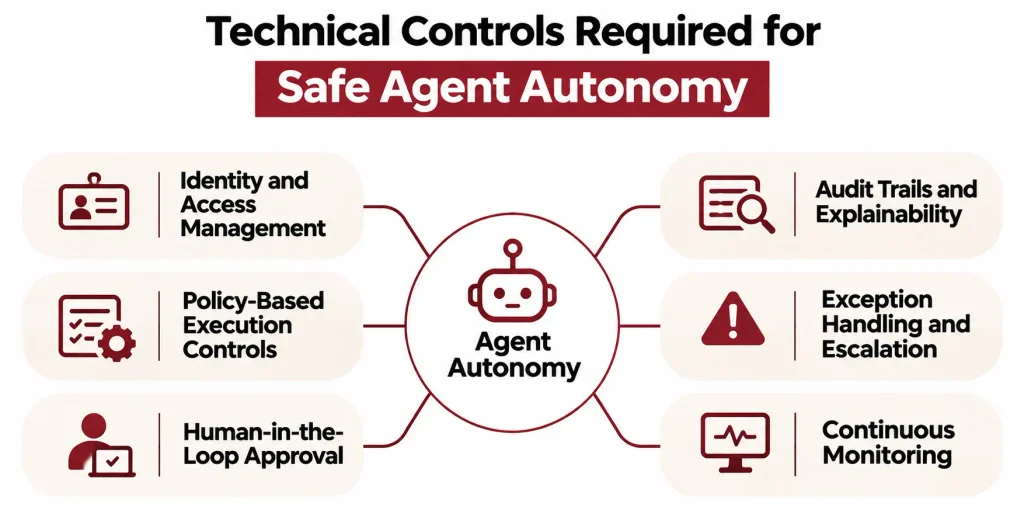
1. Identity and Access Management: Every agent should operate with a verifiable identity, scoped permissions, and least-privilege access. Agents should only access the enterprise applications and data required for their assigned responsibilities.
2. Policy-Based Execution Controls: Business rules should determine which actions an agent can execute, under what conditions, and within which transaction limits. These controls should be enforced independently of the agent’s reasoning.
3. Human-in-the-Loop Approval: Approval mechanisms should be integrated into workflows for high-risk or sensitive actions. The system must verify that the required authorization has been received before proceeding.
4. Audit Trails and Explainability: Organizations should maintain records of inputs, retrieved information, decisions, tool calls, approvals, and executed actions. This creates traceability for operational reviews and audits.
5. Exception Handling and Escalation: When information is incomplete, confidence is insufficient, or business rules conflict, agents should pause execution and escalate the case rather than inventing an answer or taking an unauthorized action.
6. Continuous Monitoring: Agent performance should be evaluated through execution accuracy, exception rates, unauthorized action attempts, escalation frequency, processing time, and business outcomes.
A mature agentic AI decision boundaries GBS architecture also separates the AI reasoning layer from the authorization layer. Even if an agent recommends an action, an independent control mechanism must verify whether that action is permitted.
How to Evaluate Agentic AI Solutions for GBS
When comparing agentic AI platforms and implementation approaches, technology leaders should look beyond the number of available agents or the sophistication of their language models.
The evaluation should focus on how effectively the solution controls autonomous execution in real enterprise environments.
Key evaluation criteria include:
- Workflow orchestration: Can agents coordinate multi-step processes across ERP, HRMS, procurement, and IT systems?
- Permission management: Can access rights and execution permissions be defined separately for each agent?
- Approval integration: Can the solution enforce existing enterprise approval hierarchies?
- Context management: Can agents access relevant business information while respecting data boundaries?
- Exception handling: Can agents recognize uncertainty and escalate appropriately?
- Auditability: Can every important decision and action be traced?
- Scalability: Can the architecture support multiple entities, applications, and business functions?
Frameworks such as LangGraph, CrewAI, and Microsoft AutoGen can support different multi-agent orchestration patterns. However, framework selection should follow architecture and governance requirements rather than precede them.
For enterprise GBS environments, a hybrid architecture combining AI agents, deterministic automation, API integrations, and human approval workflows is often more appropriate than relying entirely on autonomous AI execution.
How Auxiliobits Can Help
Moving from traditional automation to agentic AI requires more than deploying AI agents. Organizations need to understand their existing processes, identify suitable autonomy levels, integrate enterprise systems, and establish controls around execution.
Auxiliobits helps enterprises modernize operations through RPA, intelligent automation, AI-powered workflows, intelligent document processing, and enterprise system integration.
For GBS organizations, this can involve identifying high-value automation opportunities, automating repetitive finance, HR, procurement, and IT activities, integrating agents with existing enterprise applications, and designing workflows that combine autonomous execution with human approvals.
A process-first implementation approach helps organizations determine which activities can be automated safely, which require human intervention, and which should remain restricted. The goal is to introduce autonomy where it creates measurable business value without weakening enterprise governance.
Conclusion
The future of GBS will not depend on making every business process fully autonomous. It will depend on identifying where AI agents can execute work independently and where human judgment must remain central.
Organizations that establish clear autonomy levels, enforce permission boundaries, integrate approval mechanisms, and continuously monitor agent behavior will be better positioned to scale agentic AI responsibly.
Ultimately, agentic AI decision boundaries GBS should be treated as an architectural and governance requirement, not an afterthought. The most effective enterprise deployments will combine intelligent decision-making with controlled execution, transparent accountability, and human oversight.