






Global Business Services (GBS) organizations increasingly operate across multiple legal entities, business units, geographies, and enterprise applications. While ERP platforms manage financial transactions, email handles business communication, and approval systems govern decision-making, these environments often operate in disconnected silos. This creates integration challenges, manual dependencies, delayed approvals, and limited operational visibility.
This is where multi-agent ERP orchestration GBS becomes an important architectural approach. Instead of relying on isolated automation scripts or a single AI assistant, organizations can deploy specialized AI agents that coordinate activities across ERP platforms, email systems, workflow engines, and enterprise approval applications.
The objective is not simply to automate individual tasks. It is to create an interconnected operational ecosystem where agents can interpret business context, exchange information, execute authorized actions, and coordinate complex workflows across multiple entities while maintaining governance and human oversight.
Why Traditional Integration and Automation Fall Short in Multi-Entity GBS
Most enterprise environments rely on a combination of ERP systems, robotic process automation (RPA), APIs, email platforms, and approval workflows. Although these technologies support business operations, they frequently lack the coordination required for complex, cross-system processes.
Consider an accounts payable workflow involving three legal entities. An invoice arrives through email, its details are extracted, vendor information is validated in an ERP, and the transaction is routed through an approval system. Once approved, the invoice is posted and prepared for payment.
In a traditional setup, each activity may be managed by a separate automation workflow. If vendor details are inconsistent, an approval is delayed, or the ERP rejects a transaction, the process may require manual intervention.
These challenges become more significant when multiple entities operate different ERP instances, approval hierarchies, currencies, and compliance requirements.
Common limitations include:
- Fragmented integrations: ERP, email, and approval applications exchange information through disconnected interfaces.
- Limited contextual understanding: Traditional bots execute predefined instructions but struggle with changing business conditions.
- Complex exception handling: Unstructured emails, missing documents, and mismatched records frequently require human intervention.
- Entity-specific governance: Approval thresholds, access permissions, and financial controls vary across legal entities.
- Limited process visibility: Operations teams often lack a unified view of transactions moving across applications.
A coordinated agent architecture addresses these limitations by introducing intelligent orchestration across existing enterprise systems.
What Is Multi-Agent ERP Orchestration in GBS?
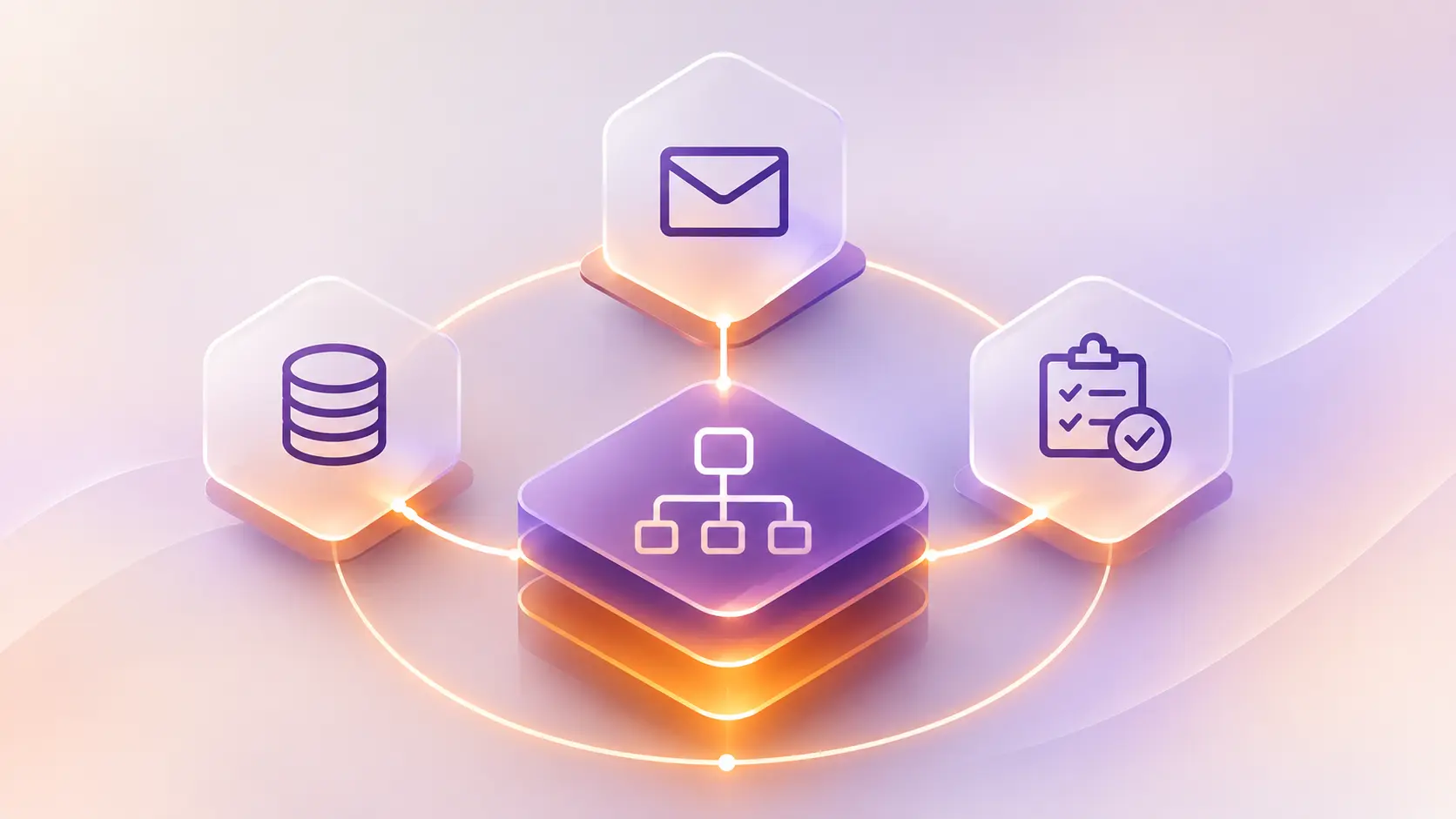
Multi-agent ERP orchestration GBS refers to an architecture in which multiple specialized AI agents collaborate to execute and coordinate business processes across ERP platforms, communication systems, and enterprise approval applications.
Rather than assigning every responsibility to one AI model, organizations distribute tasks among agents with clearly defined responsibilities.
For example:
- Email Intelligence Agent: Monitors designated email inboxes, identifies incoming business requests, extracts relevant information, classifies documents, and initiates appropriate workflows.
- ERP Interaction Agent: Retrieves vendor records, validates financial information, checks purchase orders, and interacts with ERP systems through authorized APIs or integration services.
- Approval Coordination Agent: Identifies the appropriate approval hierarchy, checks authorization requirements, routes requests, and monitors approval status.
- Validation and Exception Agent: Detects discrepancies, identifies missing information, evaluates business rules, and determines whether an exception requires human intervention.
- Monitoring and Reporting Agent: Tracks workflow progress, identifies bottlenecks, maintains operational visibility, and generates process-level reports.
These agents operate within a coordinated framework rather than functioning as independent automation tools. The orchestration layer manages task delegation, execution sequences, communication, state management, and exception escalation.
Reference Architecture: Connecting ERP, Email, and Approval Systems
A scalable architecture for multi-agent ERP orchestration GBS requires more than connecting several AI agents. It needs a structured integration and control layer that ensures agents interact with enterprise applications reliably and securely. For a more profound understanding of the technologies powering these architectures, explore our guide to the Tech Stack Behind Agentic AI, covering the frameworks, APIs, and enterprise ecosystems that enable intelligent agent orchestration.
A typical reference architecture consists of five layers.
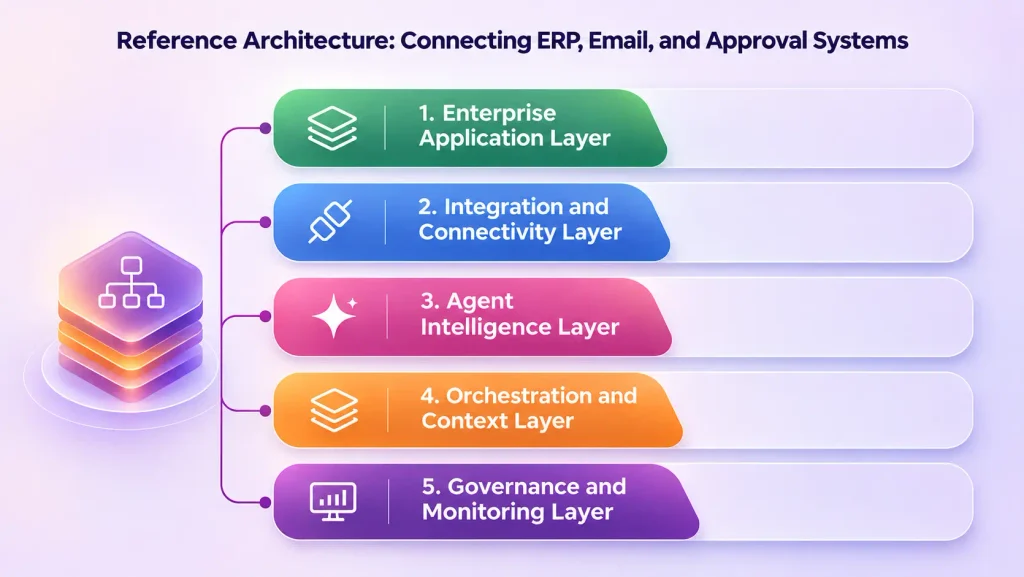
1. Enterprise Application Layer
This layer contains the systems where business activities originate and are completed.
Typical components include:
- ERP platforms such as SAP, Oracle, and Microsoft Dynamics.
- Email applications such as Microsoft Outlook and Gmail.
- Approval and workflow management systems.
- Document management platforms.
- Procurement and vendor management applications.
The architecture should support existing enterprise environments without requiring organizations to replace their core applications.
2. Integration and Connectivity Layer
The integration layer provides secure communication between agents and enterprise applications. It can include REST APIs, webhooks, middleware, SFTP connections, event-driven messaging, and application connectors.
For legacy systems without suitable APIs, RPA can provide controlled UI-based interaction.
A key architectural consideration is ensuring that agents do not directly bypass enterprise application controls. All interactions should pass through approved integration services, authentication mechanisms, and validation processes.
3. Agent Intelligence Layer
This is where specialized agents perform their assigned responsibilities. Each agent receives a defined objective, relevant business context, permitted tools, and execution boundaries.
For example, an ERP agent may retrieve vendor information but should not automatically modify vendor banking details without the required verification and authorization.
This separation of responsibilities improves maintainability, accountability, and control.
4. Orchestration and Context Layer
The orchestration layer coordinates the entire workflow. It determines which agent should execute the next task, manages dependencies, maintains workflow state, and handles failures.
Frameworks such as LangGraph, CrewAI, and Microsoft AutoGen can support multi-agent coordination through different orchestration approaches. For enterprise workflows, the architecture should also maintain persistent transaction context, execution history, and recovery information. This is particularly important when workflows span multiple entities and take several hours or days to complete.
5. Governance and Monitoring Layer
The governance layer establishes the controls required for enterprise deployment.
Important capabilities include:
- Role-based and attribute-based access control.
- Agent identity and authentication.
- Approval thresholds and authorization policies.
- Audit trails and transaction logging.
- Data encryption and privacy controls.
- Human-in-the-loop decision mechanisms.
- Monitoring, evaluation, and performance reporting.
Together, these layers provide the foundation for reliable multi-agent ERP orchestration in GBS across complex enterprise environments.
How Agents Coordinate Across ERP, Email, and Approval Workflows
Consider an invoice-processing scenario involving two subsidiaries operating separate ERP instances. An invoice arrives through a shared email channel. The email intelligence agent identifies the document, extracts invoice details, and determines the relevant legal entity using vendor information and predefined business rules.
The ERP interaction agent then retrieves the corresponding purchase order and goods receipt information from the appropriate ERP instance. If the records match, the approval coordination agent determines the applicable approval hierarchy based on the entity, transaction value, and authorization matrix. The approval request is submitted through the organization’s existing workflow application. Once approval is received, the ERP agent posts the invoice using an authorized transaction interface. The monitoring agent records the transaction status and updates the workflow.
If the invoice contains a mismatch, the validation agent identifies the discrepancy and requests clarification through the appropriate communication channel. This illustrates how multi-agent ERP orchestration GBS can coordinate an entire business process rather than simply automate individual steps. The critical advantage is contextual coordination. Each agent understands its assigned responsibility while the orchestration layer maintains visibility across the complete transaction lifecycle.
Choosing the Right Orchestration Approach
Not every enterprise workflow requires the same architecture. Organizations evaluating multi-agent ERP orchestration GBS should compare orchestration approaches based on workflow complexity, integration requirements, governance, and scalability.
Sequential orchestration works well when tasks follow a predictable sequence. For example, email extraction, ERP validation, approval routing, and invoice posting.
Parallel orchestration is useful when multiple independent checks can happen simultaneously. Vendor validation, purchase order verification, and duplicate invoice detection can run concurrently.
Hierarchical orchestration introduces a supervisor agent that delegates work to specialized agents and monitors their execution. This is useful for complex processes involving multiple entities and business functions.
Event-driven orchestration initiates agent workflows when specific events occur, such as a new invoice arriving, an approval being completed, or an ERP transaction failing.
For enterprise GBS environments, a hybrid approach is often practical. Sequential execution can manage controlled financial transactions, parallel execution can accelerate independent validations, and event-driven mechanisms can handle workflow changes.
The architecture should also distinguish between deterministic workflow execution and AI-driven reasoning. Business-critical activities should remain governed by explicit policies rather than unrestricted agent decisions.
Key Technical Considerations Before Enterprise Deployment
Implementing multi-agent ERP orchestration GBS requires careful attention to several technical considerations.
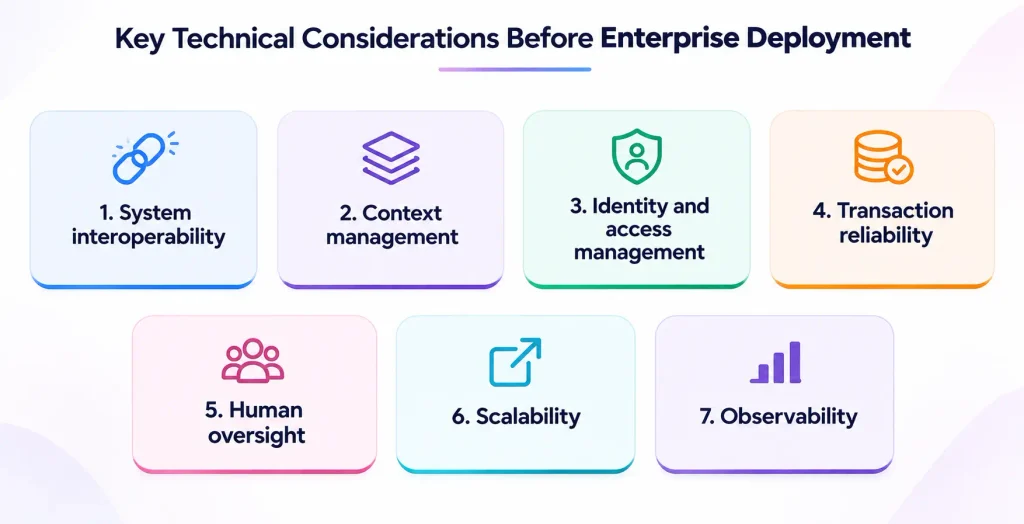
- System interoperability: Different entities may use different ERP versions, APIs, data structures, and authentication methods. Integration services should normalize information and provide consistent interfaces.
- Context management: Agents need access to relevant transaction history, entity-specific policies, and workflow status without exposing unnecessary sensitive information.
- Identity and access management: Each agent should operate with a verifiable identity and least-privilege permissions. Shared credentials and unrestricted system access should be avoided.
- Transaction reliability: Duplicate execution, partial failures, and inconsistent updates must be addressed through idempotency controls, retry policies, transaction tracking, and reconciliation mechanisms.
- Human oversight: High-risk decisions, financial master data changes, unusual payments, and policy exceptions should require appropriate human authorization.
- Scalability: The architecture should support additional entities, applications, agents, and transaction volumes without creating unnecessary integration complexity.
- Observability: Organizations need centralized logs, execution traces, agent performance metrics, and exception monitoring to understand how workflows behave in production.
- These controls help ensure multi-agent ERP orchestration GBS remains reliable as organizations expand automation across their shared services operations.
How Auxiliobits Can Help
Building an enterprise agent ecosystem requires more than deploying AI models. Organizations need process understanding, integration expertise, automation architecture, and governance that align with their existing technology environment. Auxiliobits helps enterprises modernize business operations through intelligent automation, RPA, AI-powered workflows, and enterprise system integration.
Its approach focuses on identifying process dependencies, understanding existing application environments, and designing automation solutions around actual business requirements.
For multi-entity GBS organizations, this can include integrating ERP applications, automating email-driven processes, coordinating approval workflows, implementing intelligent document processing, and introducing AI-powered exception management.
By combining traditional automation with emerging agentic AI capabilities, organizations can move beyond isolated bots toward coordinated enterprise workflows.
The objective is to improve operational efficiency while preserving the controls, accountability, and visibility required in enterprise environments.
Conclusion
Multi-entity GBS operations require more than isolated automation scripts and disconnected application integrations. They need an architecture capable of coordinating information, decisions, and actions across enterprise systems.
Multi-agent ERP orchestration GBS provides a pathway toward this model by connecting specialized AI agents with ERP platforms, email applications, and approval systems through a governed orchestration framework.
The most effective implementations will combine AI reasoning with deterministic workflows, secure integrations, human oversight, and measurable business objectives.
For IT leaders and automation architects, the opportunity is not simply to deploy more AI agents. It is to build an intelligent enterprise ecosystem in which agents collaborate reliably, execute authorized tasks, and support shared services operations across multiple entities.