









transaction-processing units into strategic operating models that help enterprises standardize financial operations, improve control effectiveness, and scale without proportionally increasing costs. As organizations expand across geographies, business units, currencies, and regulatory environments, fragmented finance functions create duplicated work, inconsistent data, and limited visibility into enterprise-wide performance.
The challenge is no longer simply deciding which activities to centralize. It is determining how finance processes, technology, governance, and accountability should work together across the organization.
A well-designed model connects individual finance processes with enterprise-level objectives, creating a coordinated operating structure that supports efficiency, compliance, and decision-making. Understanding its scope, organizational structure, and scaling mechanisms is essential for businesses seeking sustainable improvements rather than isolated process optimization.
What Are Finance Shared Services?
Finance shared services are an operating model in which financial activities previously performed independently by different departments, business units, or regional entities are consolidated into a centralized or coordinated service organization. Instead of every business unit maintaining separate teams for accounts payable, accounts receivable, general ledger activities, reconciliations, and reporting, the organization establishes common processes, service standards, systems, and governance mechanisms.
However, centralization alone does not define maturity. A centralized team that still operates through disconnected spreadsheets, inconsistent approval structures, and manual handoffs may simply concentrate inefficiencies in one location. The more advanced model combines process ownership, standardized execution, integrated technology, and measurable service outcomes.
For example, a multinational enterprise may operate regional finance teams across 15 countries. Rather than maintaining independent transaction-processing teams in every country, it can consolidate repeatable activities into regional or global service centers while retaining local expertise for statutory reporting, tax interpretation, and jurisdiction-specific requirements.
This creates a distinction between where work is performed, who owns the process, and who remains accountable for the financial outcome. These responsibilities do not always sit within the same team.
Scope: Which Activities Belong in the Model?
The scope of finance shared services should be determined by transaction characteristics, control requirements, decision complexity, and the degree of standardization possible across entities.
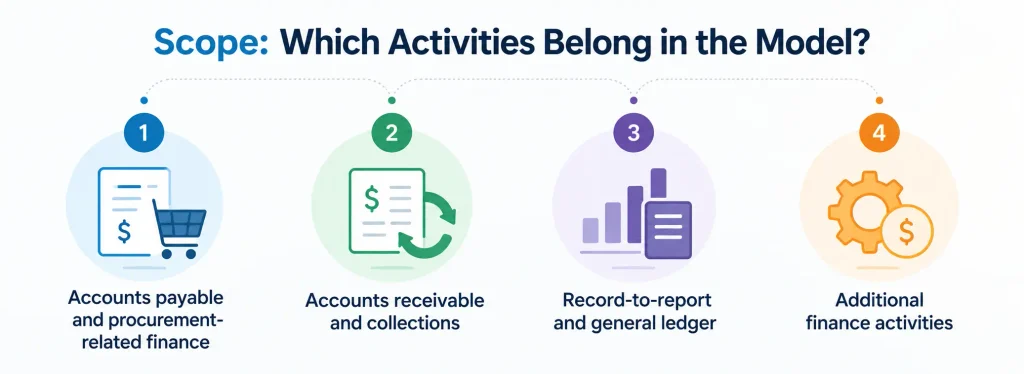
1. Accounts payable and procurement-related finance
Accounts payable typically includes invoice capture, purchase-order matching, exception handling, payment preparation, supplier query management, and vendor statement reconciliation.
The important design consideration is not simply centralizing invoice processing. It is separating standardized activities from decisions that require commercial judgment, procurement intervention, or local regulatory knowledge.
For example, a three-way matching exception involving a purchase order, goods receipt, and supplier invoice may require different escalation paths depending on whether the discrepancy concerns quantity, price, tax, or contractual terms.
2. Accounts receivable and collections
Accounts receivable activities may include customer billing support, payment allocation, collections administration, deductions management, dispute coordination, and receivables reporting.
These activities are closely connected to cash flow, customer experience, and working-capital performance. A shared services organization should therefore measure more than the volume of invoices processed or collection calls completed.
Useful measures include unapplied cash, overdue receivables, dispute resolution time, collection effectiveness, and days sales outstanding (DSO).
3. Record-to-report and general ledger
Record-to-report activities include journal processing, intercompany accounting, balance-sheet reconciliations, close support, accrual management, and financial reporting preparation.
Centralization creates opportunities to standardize accounting calendars, journal templates, reconciliation policies, and close dependencies across entities.
Nevertheless, activities involving accounting judgments, material estimates, consolidation policy, or financial statement approval may require retained finance leadership or controllership oversight.
4. Additional finance activities
Depending on organizational maturity, the scope may extend to fixed-asset accounting, expense management, master-data administration, cash application, treasury operations support, tax data preparation, and management reporting.
The scope should not be defined solely by whether an activity is repetitive. A more useful assessment considers transaction volume, process variability, control sensitivity, system dependencies, and the consequences of an error.
High-volume, rules-based activities are often strong candidates for centralization. Highly judgmental activities may benefit more from standardized policies and shared expertise than from complete transfer into a service center.
Structure: Designing the Operating Model
An effective structure separates service delivery from process governance without creating unnecessary organizational layers.
A common model contains three interconnected components.
1. Global process ownership
Global process owners define how finance processes should operate across the enterprise. They establish standard workflows, control requirements, performance definitions, exception policies, and improvement priorities.
For instance, a global accounts payable process owner may define invoice-matching rules and escalation thresholds, while regional teams manage legally necessary variations.
Process ownership should include authority to enforce standards across business units. Without that authority, global process owners may find themselves in advisory roles, with local preferences overriding their recommendations.
2. Shared services delivery
The delivery organization executes standardized activities through global, regional, or country-level service centers.
A global delivery model works well when processes, systems, language requirements, and regulatory conditions are sufficiently consistent. Regional centers may be more appropriate when time zones, local languages, data residency, or statutory obligations materially affect execution.
A hybrid model is often the most practical arrangement: global standards, regional execution, and local support for activities that cannot be fully standardized.
3. Retained finance and business partnering
Retained finance teams preserve accountability for financial policy, business decisions, statutory obligations, material accounting judgments, and strategic analysis. Finance business partners focus on forecasting, profitability, investment decisions, and operational performance rather than routine transaction processing.
The boundary between retained finance and shared services must be explicit. Otherwise, organizations experience duplicated reviews, unclear approval rights, and recurring disputes over who owns exceptions.
A responsibility matrix should identify the process executor, control owner, decision authority, escalation recipient, and final accountable role for each critical activity.
Scale: Moving from a Local Center to an Enterprise Model
Scaling is not simply increasing the number of transactions processed by a service center. It requires the organization to absorb new entities, acquisitions, currencies, systems, and regulatory requirements without creating a corresponding increase in operational complexity.
Three delivery models are common:
- Global center: A single center manages standardized activities across multiple countries.
- Regional centers: Teams operate across geographic clusters, balancing global consistency with regional requirements.
- Federated model: Local or regional teams retain more autonomy while following common enterprise policies and reporting standards.
The right model depends on process similarity, transaction volumes, language requirements, regulatory constraints, technology architecture, and business continuity requirements.
Research from ScottMadden and APQC illustrates the complexity of this decision. Their 2024 benchmarking research found that 83% of surveyed shared services organizations served more than one country, while 88% operated more than one finance shared services center. These findings demonstrate that scale frequently involves coordinating multiple locations rather than simply consolidating everything into one building.
Designing for acquisitions and new entities
Acquisitions expose weaknesses in poorly designed operating models. Newly acquired businesses may use different charts of accounts, ERP platforms, vendor identifiers, customer masters, and close calendars.
A scalable model needs a repeatable onboarding framework covering:
- Process and control assessment.
- Master-data mapping and cleansing.
- Chart-of-accounts and organizational mapping.
- ERP integration and workflow configuration.
- Migration of open transactions and balances.
- Control validation and reconciliation.
- Service-level baselining and operational handover.
A frequently overlooked issue is the difference between technical integration and semantic integration. Two systems may exchange financial data successfully while assigning different meanings to customer categories, payment statuses, cost centers, or reconciliation exceptions.
Without common definitions, enterprise reporting becomes inconsistent even when system integrations appear technically sound.
Managing capacity without proportional headcount growth
A mature service center should forecast workload using transaction drivers rather than revenue or headcount alone.
For example, accounts payable demand may depend on invoice volume, the percentage of invoices requiring manual intervention, supplier diversity, and exception complexity. Month-end workload may also differ significantly from the average daily workload.
A useful capacity model is:

The model should account for seasonality, training, leave, quality reviews, and non-processing responsibilities. Otherwise, theoretical capacity will overstate actual delivery capability.
Technology and Automation: The Architecture Behind Scale
Technology enables standardization, but automation applied to fragmented processes can amplify inconsistency rather than eliminate it.
An enterprise architecture typically combines several layers:
- ERP and financial systems: Maintain accounting records, transactions, master data, and financial postings.
- Workflow and case management: Route approvals, exceptions, disputes, and escalations.
- Integration and data platforms: Connect systems, validate data, and maintain consistent identifiers.
- Automation: Execute rules-based activities and reduce repetitive manual work.
- Analytics and process intelligence: Identify bottlenecks, control failures, rework, and opportunities for improvement.
Robotic process automation can handle structured, repetitive tasks, while intelligent document processing can extract invoice information from varied formats. AI-assisted systems may classify exceptions, summarize supporting evidence, or recommend next actions.
However, financial automation requires clear boundaries. An automated recommendation should not automatically become an approved payment, journal entry, or accounting judgment without the required authorization and controls.
Design controls into automated workflows
Automation should preserve segregation of duties, approval thresholds, access restrictions, audit trails, and evidence retention. Important technical controls include idempotency, duplicate detection, exception queues, reconciliation between source and destination systems, and recovery procedures.
Idempotency is particularly important in financial integrations: if a payment or journal submission is retried after a timeout, the system should prevent the same business transaction from being posted twice.
Organizations should also distinguish between successful task execution and successful financial outcomes. A bot may report that a file was processed even though records were rejected downstream or the resulting balances do not reconcile.
The appropriate success criteria are therefore end-to-end completion, data integrity, control compliance, and reduced manual effort—not automation volume alone.
Governance, SLAs, and Performance Measurement
Governance determines whether the operating model delivers consistent outcomes across locations. It should define decision rights, performance expectations, escalation procedures, process ownership, and accountability for financial risks.
Service-level agreements (SLAs) are useful, but transaction-processing speed alone is an inadequate measure of success. A team can meet its invoice-processing SLA while creating downstream payment errors or increasing reconciliation backlogs.
A balanced scorecard should include:
| Dimension | Example metrics |
| Cost | Cost per invoice, cost per journal, total cost to serve |
| Productivity | Transactions per FTE, automated processing rate |
| Quality | First-pass yield, error rate, rework percentage |
| Speed | Cycle time, close duration, exception-resolution time |
| Working capital | DSO, overdue receivables, unapplied cash |
| Controls | Control failures, overdue reconciliations, audit findings |
| Service | Query-resolution time, internal customer satisfaction |
The definitions behind these metrics matter as much as the metrics themselves. For instance, straight-through processing should measure transactions completed without manual intervention, not merely transactions initiated by automation.
Organizations should also distinguish between leading and lagging indicators. Exception backlog, unresolved master-data defects, and overdue control activities can signal future problems. Month-end errors and missed payment deadlines reveal problems that have already materialized.
The governance framework should connect these indicators to corrective actions, named owners, and escalation thresholds. Otherwise, performance reporting becomes descriptive rather than operationally useful.
Reconciliation as an Enterprise-Wide Control
Reconciliation is often treated as an accounting task performed at month-end. In a scaled operating model, it is better understood as a control mechanism connecting transaction processing, subledgers, bank activity, and the general ledger.
Consider a multinational company processing payments through multiple banks, payment providers, ERP systems, and currencies. Even if each system reports successful transactions, timing differences, duplicate records, missing references, and inconsistent identifiers can create discrepancies between operational records and accounting balances.
An effective reconciliation architecture should establish:
- Data completeness: Confirm that all expected records have arrived from source systems.
- Matching logic: Apply deterministic rules using transaction references, amounts, dates, currencies, and other reliable attributes.
- Exception classification: Separate timing differences, missing transactions, duplicates, and genuine financial discrepancies.
- Ownership and aging: Assign unresolved items to accountable teams with defined resolution deadlines.
- Evidence and auditability: Preserve source records, matching decisions, approvals, adjustments, and resolution history.
- Balance integrity: Validate that reconciled totals agree with the relevant subledger, bank statement, or general ledger balance.
One important distinction is between matching and reconciliation. Matching associates individual records across systems; reconciliation establishes whether the relevant populations and balances agree and whether differences are adequately explained.
Centralizing reconciliation without addressing upstream data quality can create a large, persistent exception queue. The better approach combines common matching standards, automated evidence collection, risk-based review, and feedback loops that address recurring root causes.
Implementation: A Practical Roadmap
A successful transformation should follow a controlled sequence rather than transferring every process into a central team simultaneously.
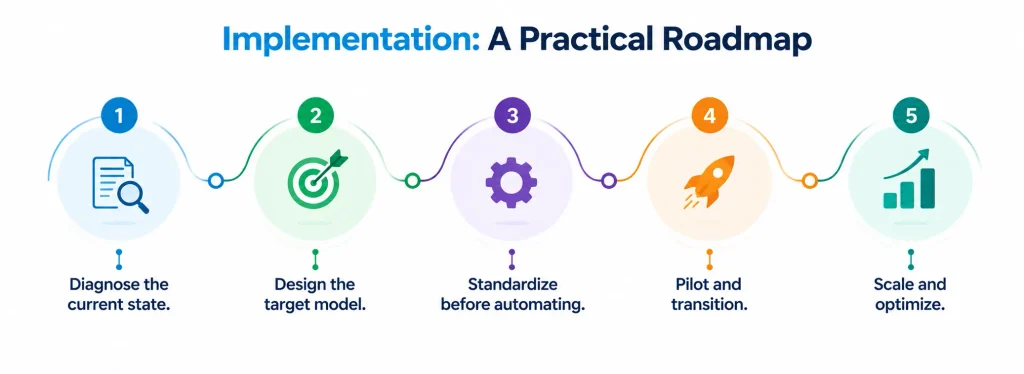
Phase 1: Diagnose the current state. Map processes, systems, transaction volumes, staffing, controls, service performance, and local variations. Establish a baseline for cost, quality, cycle time, and risk.
Phase 2: Design the target model. Determine which activities should be centralized, which require local execution, and which responsibilities remain with finance leadership. Define global process ownership, decision rights, technology requirements, and performance measures.
Phase 3: Standardize before automating. Remove unnecessary process variations, clarify policies, clean master data, and document exception handling. Automation should follow a stable process design.
Phase 4: Pilot and transition. Move a defined process, entity, or region first. Validate controls, test transaction completeness, establish service levels, and confirm that the receiving team can manage exceptions independently.
Phase 5: Scale and optimize. Expand to additional entities using repeatable onboarding templates. Review performance against baseline measures, address root causes, and prioritize automation based on measurable business value.
Change management is critical throughout. Employees need clear role definitions, training, escalation channels, and an understanding of how responsibilities will change. Process documentation should reflect how work is actually performed, including exceptions, rather than only describing the intended workflow.
Common Mistakes That Limit Value
Several design mistakes repeatedly undermine enterprise-wide performance:
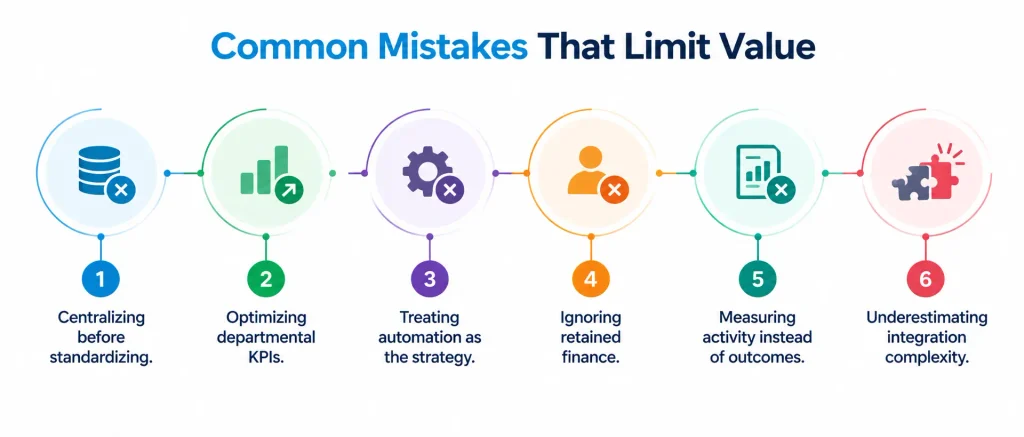
- Centralizing before standardizing: Different regional practices are transferred into the same center without removing unnecessary variation.
- Optimizing departmental KPIs: Teams improve local productivity while increasing delays, errors, or costs elsewhere in the process.
- Treating automation as the strategy: Bots are introduced before process ownership, data quality, and exception handling are established.
- Ignoring retained finance: Unclear boundaries create duplicated reviews and unresolved accountability.
- Measuring activity instead of outcomes: Transaction counts improve, but cash flow, close quality, and control effectiveness do not.
- Underestimating integration complexity: New entities are onboarded without reconciling data definitions, system interfaces, and accounting structures.
The underlying lesson is that operational scale depends on consistent processes, reliable data, clear accountability, and effective governance—not centralization alone.
Conclusion
Finance shared services provide an enterprise framework for coordinating financial operations across business units, systems, and geographies. Their effectiveness depends on defining the right scope, separating execution from governance, standardizing processes, and building an architecture that can absorb growth without multiplying complexity.
The most mature organizations go beyond transaction consolidation. They connect end-to-end process ownership, automation, reconciliation, performance measurement, and retained finance into one coherent operating model. For example, order-to-cash automation can help streamline receivables processes, improve visibility, and strengthen operational efficiency.
For finance leaders, the objective is not simply to process more transactions at a lower cost. It is to create a finance organization that delivers reliable financial data, stronger controls, predictable service, and the capacity to support business growth.