








Most finance teams have invested heavily in automating accounts payable, but the other side of the ledger—order-to-cash (O2C), often remains dependent on emails, spreadsheets, manual data entry, follow-ups, and exception handling. Order to cash automation changes that by connecting the entire customer revenue cycle into a more intelligent, streamlined workflow.
The order-to-cash process starts when a customer places an order and continues through credit approval, fulfillment, invoicing, collections, payment, and cash application. When these activities operate across disconnected systems and manual handoffs, delays can affect customer experience, working capital, and finance productivity.
O2C automation uses technologies such as artificial intelligence (AI), robotic process automation (RPA), intelligent document processing (IDP), machine learning, and workflow orchestration to automate repetitive activities while routing exceptions to the right people.
This guide explains the O2C process step by step, what can be automated, the technologies and platforms involved, potential ROI, implementation considerations, and how finance teams can begin building an automated order-to-cash operation.
What is O2C automation?
O2C, or order-to-cash, is the end-to-end business process that begins when a customer places an order and ends when the business receives and applies the customer’s payment.
The process typically includes order capture, credit checks, order fulfillment, invoicing, collections, dispute management, payment processing, and cash application. Each step depends on accurate information flowing between systems such as ERP platforms, CRM applications, order management systems, banking platforms, and customer portals.
O2C automation applies technologies such as AI, RPA, machine learning, IDP, and workflow orchestration to reduce manual intervention across these activities.
Instead of employees manually entering customer orders, checking credit limits, creating invoices, sending collection emails, matching payments, and updating ERP records, automated workflows can perform many of these tasks based on predefined rules and intelligent decision-making.
For example, an automated workflow can capture an order received through email, extract the relevant information, validate it against customer and product records, initiate a credit check, and route an exception for human approval if the order exceeds the customer’s credit limit.
Similarly, when a customer payment arrives, AI-powered cash application can identify the customer, match the payment against outstanding invoices, and automatically post the transaction when confidence levels meet defined thresholds.
The goal is not simply to eliminate manual work. A well-designed O2C automation strategy improves the speed, consistency, visibility, and control of the entire order-to-cash process.
The key business outcomes can include:
- Faster order processing
- Shorter invoice-to-payment cycles
- Lower Days Sales Outstanding (DSO)
- Higher straight-through processing rates
- Fewer manual errors
- Better cash visibility
- Faster dispute resolution
- Improved customer experience
- Greater finance team capacity
In other words, automated order to cash connects activities that are often managed as separate finance and operational tasks into one coordinated process.
The O2C process step by step
The O2C process can look different across industries, but the core workflow generally follows six major stages.
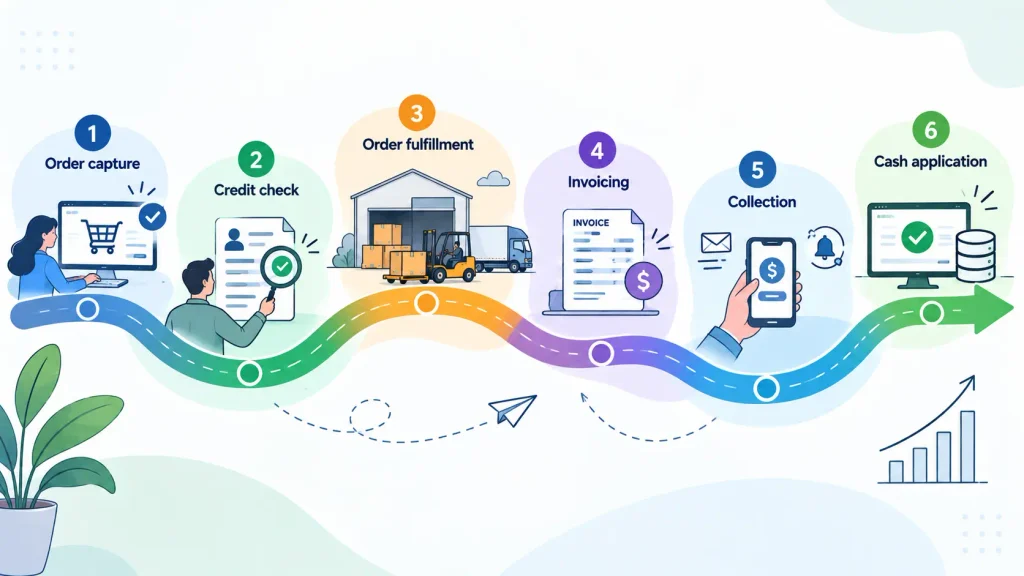
1. Order capture
The process begins when a customer submits an order. Orders may arrive through electronic data interchange (EDI), customer portals, e-commerce platforms, email, sales representatives, or other channels.
In a manual environment, employees may read emails, download attachments, enter order information into an ERP, validate customer details, and check product or pricing information.
With automation, orders can be captured directly from connected systems. IDP and AI can extract information from unstructured documents and emails, while integrations can transfer structured data from EDI, portals, CRM platforms, and e-commerce systems.
Automation can therefore reduce repetitive order entry and help identify missing or inconsistent information before the order moves forward.
2. Credit check
Once an order is captured, the business may need to confirm that the customer meets its credit requirements. Traditionally, credit teams may review customer balances, credit limits, payment history, outstanding invoices, and risk information manually.
An automated workflow can retrieve relevant customer information, compare the order against the approved credit limit, and automatically approve orders that meet predefined rules. Orders that exceed thresholds or contain unusual conditions can be routed to a credit analyst for review.
This creates a useful balance: automation handles predictable decisions while people focus on exceptions and higher-risk cases.
3. Order fulfillment
After approval, the order moves into fulfillment. For product-based businesses, this can involve inventory availability, picking, packing, shipping, delivery confirmation, and updating the customer.
Automation can connect the order management system with inventory, warehouse, transportation, and ERP systems. Status updates can be triggered automatically, reducing the need for employees to manually check multiple systems.
This is also important for invoicing because fulfillment confirmation can become the trigger for generating an invoice.
4. Invoicing
Once the order has been fulfilled or the appropriate billing milestone has been reached, the business generates an invoice.
Manual invoicing often requires employees to collect information from ERP, CRM, shipping, contract, or order management systems and then create and send the invoice.
Automated workflows can generate invoices based on predefined billing rules and transaction events, validate key fields, and deliver invoices through the customer’s preferred channel.
This is one area where invoice automation can significantly reduce repetitive work while accelerating the billing cycle.
Faster invoicing matters because a delayed invoice can become a delayed payment.
5. Collection
After an invoice is issued, the business needs to ensure that the customer pays according to the agreed terms.
Traditional collections can involve manually reviewing aging reports, prioritizing accounts, sending reminder emails, making calls, and tracking promises to pay.
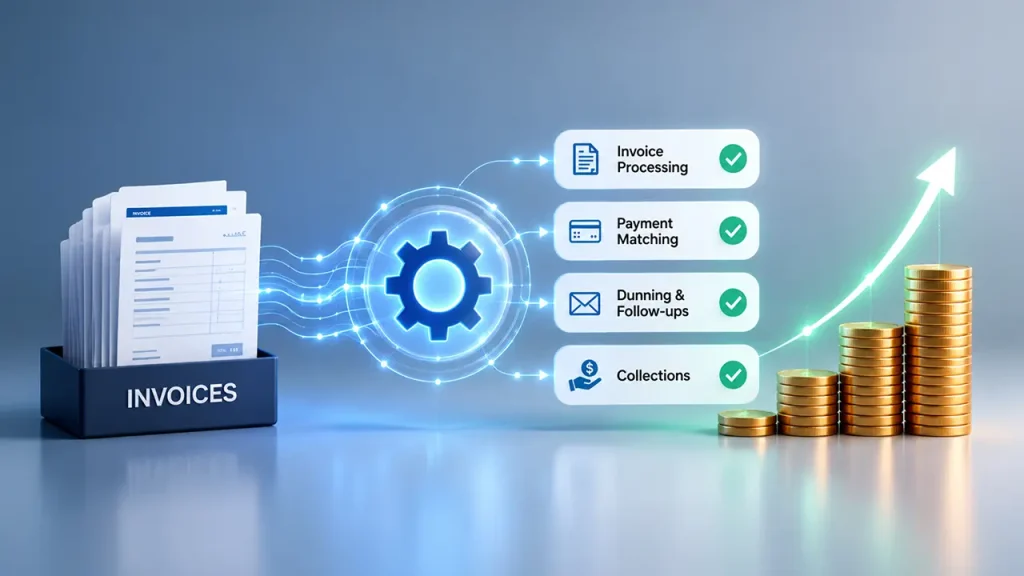
O2C automation can segment customers based on payment behavior, invoice age, value, risk, and other factors. Automated dunning sequences can send reminders at predefined intervals, while AI can help prioritize accounts that require human attention.
Collection automation should not mean sending identical messages to every customer. Effective automation combines business rules, customer context, payment history, and exception handling.
6. Cash application
The final major stage is applying received cash to outstanding customer invoices. This can be surprisingly labor-intensive. Payments may arrive with incomplete remittance information, different references, partial payments, deductions, or multiple invoices associated with a single payment.
Manual cash application requires employees to compare bank transactions with customer accounts and open invoices.
AI-powered matching can compare payment references, customer names, invoice numbers, amounts, historical behavior, and other signals to identify likely matches.
High-confidence matches can be posted automatically, while uncertain transactions are routed to finance professionals for review.
This is closely connected to reconciliation. Teams looking to automate this part of the process can also explore reconciliation automation to reduce manual matching and exception handling.
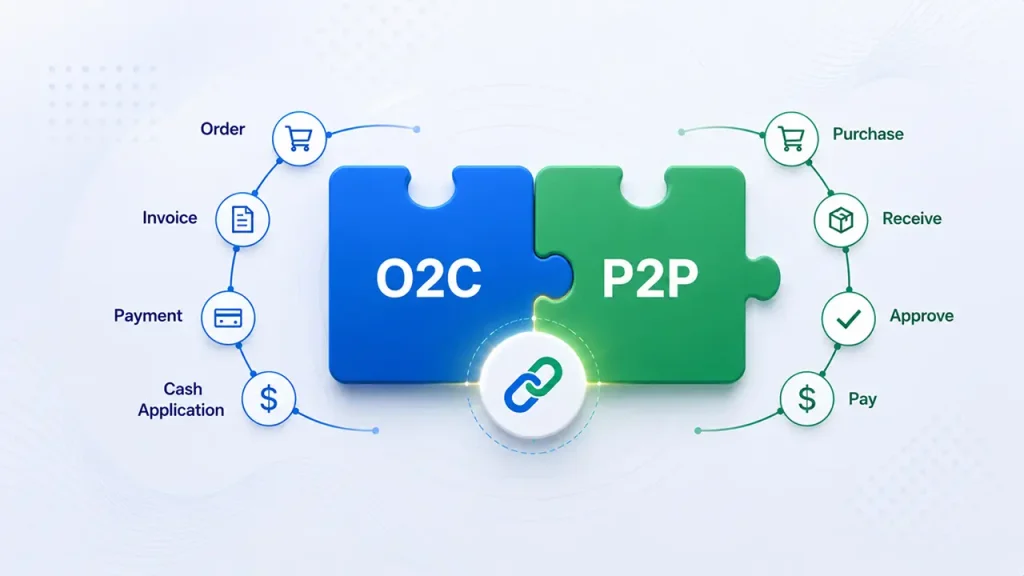
O2C and procure-to-pay (P2P) address opposite sides of the business transaction cycle. While O2C focuses on customer orders and incoming cash, P2P focuses on purchasing and outgoing payments. For comparison, see procure-to-pay automation.
What can be automated in O2C?
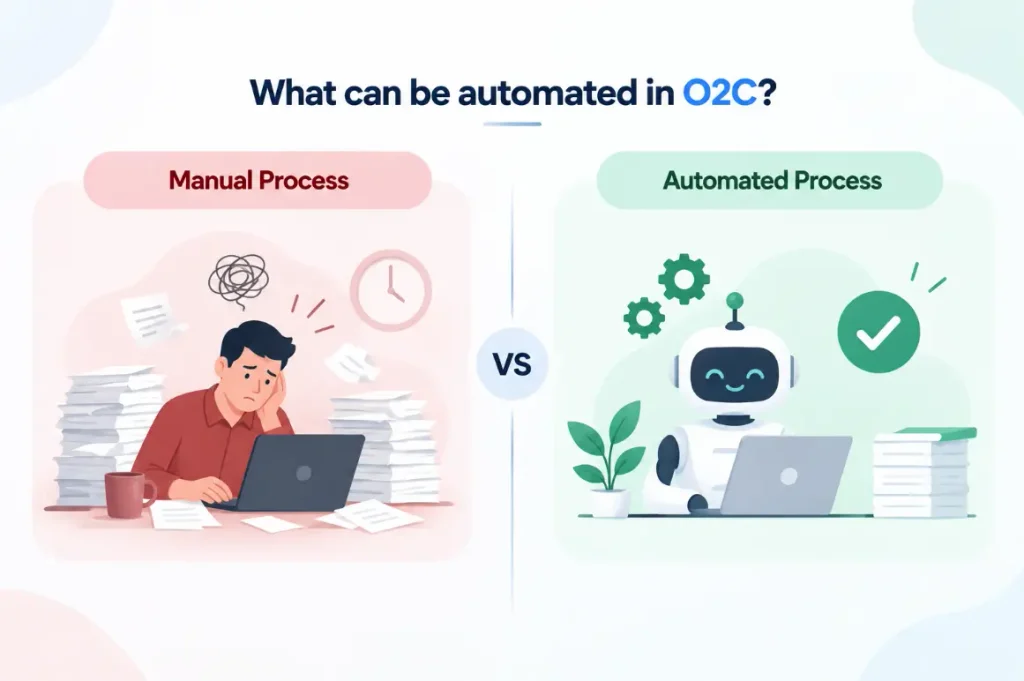
Not every O2C activity requires the same level of automation. The right approach depends on transaction volume, process complexity, data quality, exception rates, and the systems involved.
The following ranges are indicative planning benchmarks rather than guaranteed outcomes. Actual automation levels vary by organization and process design.
| O2C step | Manual process | Automated process | Indicative automation level |
| Order capture | Manual order entry from email or portal | Auto-capture from EDI, portal, email | 90–100% |
| Credit check | Manual credit review and spreadsheet tracking | Automated credit scoring and real-time limits | 80–95% |
| Invoicing | Manual invoice generation and sending | Auto-generate and send based on fulfillment | 95–100% |
| Collection | Manual dunning calls and emails | Automated dunning sequences and AI prioritization | 70–90% |
| Cash application | Manual matching of payments to invoices | AI-powered auto-matching and straight-through posting | 80–95% |
| Dispute management | Manual case handling | Automated case routing and AI-assisted resolution | 60–80% |
The highest value often comes from automating cash application, invoicing, and collections because these activities combine high transaction volumes with significant manual effort and a direct impact on cash flow. Automated cash application can match incoming payments with open invoices faster, reducing unapplied cash and reconciliation work. Invoicing automation helps eliminate delays between order fulfillment and invoice delivery, while automated collections can prioritize overdue accounts and trigger personalized reminders without requiring collectors to manage every interaction manually.
Beyond reducing labor, O2C automation can improve Days Sales Outstanding (DSO) by accelerating the movement from invoice creation to payment. AI can also identify exceptions, prioritize accounts requiring human attention, and route disputes to the right teams. The result is a more streamlined O2C process where employees spend less time on repetitive transactions and more time handling exceptions, customer relationships, and higher-value decisions.
O2C automation tools and platforms
A modern O2C automation environment typically combines multiple technologies rather than relying on a single tool.
1. AI and machine learning for cash application
AI and machine learning can analyze payment and invoice data to identify likely matches. Fuzzy matching is particularly useful when payment references do not exactly match invoice numbers.
Over time, machine learning can use historical matching patterns to improve confidence and reduce the volume of transactions requiring manual review.
2. RPA for order entry and invoicing
RPA is useful for repetitive, rule-based interactions with applications that may not have modern APIs.
For example, an RPA workflow can retrieve information from a system, enter data into an ERP, download a document, or trigger an existing transaction.
RPA is particularly valuable when organizations need to automate legacy applications without replacing the underlying systems.
3. Agentic AI for collections and disputes
Agentic AI introduces another layer of automation by enabling systems to interpret context, make decisions within defined boundaries, and take action across connected systems.
For collections, an AI agent could analyze account history, identify overdue invoices, determine the appropriate communication path, draft a personalized message, and update the relevant system.
For disputes, an agent could collect transaction records, review supporting documentation, identify the likely reason for the dispute, and route the case to the appropriate team.
Human oversight remains important for high-value, sensitive, or ambiguous decisions.
4. Workflow orchestration
Workflow orchestration connects different applications and automation technologies so that the overall O2C process operates as a coordinated workflow.
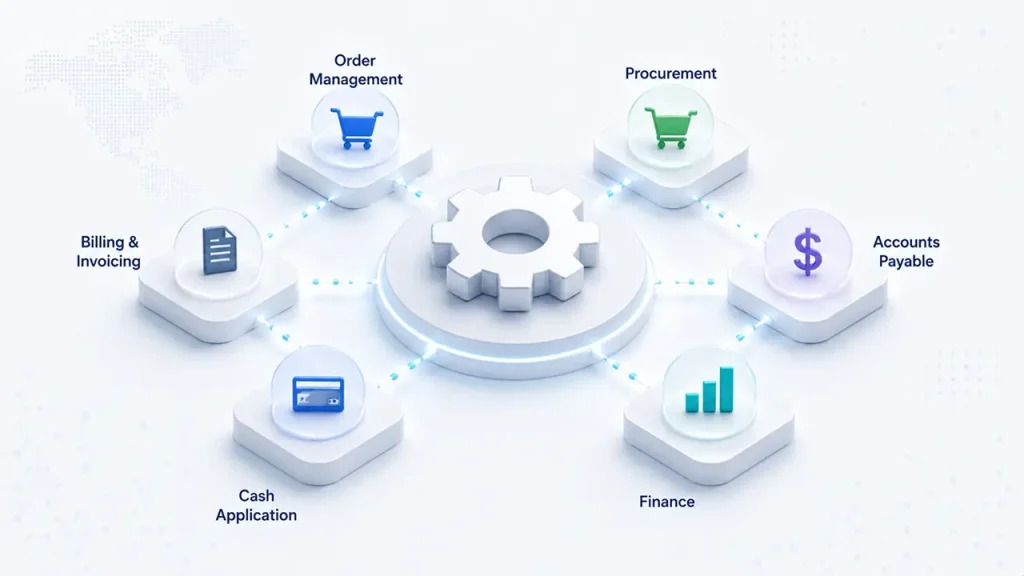
Instead of having separate automation for order entry, invoicing, collections, and cash application, orchestration can connect these activities across ERP, CRM, banking, order management, and customer systems.
This end-to-end approach is a core component of effective shared services automation.
5. Intelligent document processing
IDP extracts information from documents such as customer orders, remittance advice, proof of delivery documents, and correspondence.
This is particularly useful where customers still send information through email or PDF rather than structured digital channels.
Several platforms support different parts of the O2C automation landscape, including UiPath, HighRadius, Billtrust, Versapay, and Esker. Their capabilities, deployment options, and pricing models vary, so organizations should check directly with each vendor when evaluating costs and fit.
When selecting an O2C automation platform, look beyond individual features. ERP integration with systems such as SAP, Oracle, or NetSuite is critical for maintaining connected workflows and data consistency. Businesses should also evaluate cash application accuracy, collections AI capabilities, dispute management, scalability, exception handling, and reporting.
For organizations looking to automate finance operations beyond O2C, shared services automation can provide a broader framework for connecting and scaling automation across finance and shared-services functions.
O2C automation ROI
The business case for O2C automation goes beyond reducing finance headcount or eliminating individual manual tasks.
Industry planning benchmarks often associate well-designed O2C automation with outcomes such as:
- 5–15 days of potential DSO reduction
- Order processing reduced from days to hours
- 95%+ cash application accuracy
- 30–50% reduction in overdue accounts
These should be treated as indicative benchmarks, not guaranteed results. Actual performance depends on starting conditions, transaction volumes, customer behavior, system integration, and automation coverage.
The most important financial impact comes from working capital. If automation reduces DSO by even one day, a company can potentially release cash tied up in receivables. The financial effect becomes more significant as annual revenue increases.
Finance teams should therefore calculate automation ROI using their own baseline data, including transaction volume, labor effort, exception rates, DSO, collection performance, technology costs, and implementation costs.
Auxiliobits reports outcomes from its finance automation engagements, including a 40–60% reduction in manual finance work, $200K+ in annual savings, 9,700+ hours recovered annually, a 73% reduction in close processing time in relevant engagements, and 2–3× faster processing across high-volume finance workflows.
These results demonstrate the broader potential of finance automation, but O2C teams should build their own business case rather than assuming that another organization’s outcomes will transfer directly.
Invoice automation is another important ROI lever because accelerating invoice generation can help shorten the billing cycle and support faster collections.
Case studies
O2C automation becomes easier to understand when viewed as an operational transformation rather than a collection of individual bots.
For example, Auxiliobits has published finance automation engagements showing measurable reductions in manual work and processing time. Its shared services offering reports 40–60% reduction in manual finance work, 2–3× faster processing, 9,700+ hours recovered annually across a multi-process engagement, and a 6–8 week timeline from assessment to a working automation solution.
Its published case studies also include a large marketing network engagement that recovered 9,700 hours annually and generated more than $200K in annual savings through finance process automation.
These examples illustrate an important principle: automation value comes from redesigning the workflow around measurable outcomes, not simply replacing individual manual tasks with software.
You can explore additional Auxiliobits case studies covering finance, automation, AI, RPA, and enterprise process transformation.
Getting started with O2C automation
A successful O2C automation initiative does not need to begin with a complete transformation of every process. A focused, measurable starting point is usually more practical.
Step 1: Baseline your current O2C metrics
Start by documenting the current state.
Measure:
- Days Sales Outstanding (DSO)
- Order processing time
- Invoice processing time
- Cash application rate
- Percentage of unapplied cash
- Collection effectiveness
- Dispute resolution time
- Straight-through processing rate
- Manual hours per transaction
- Exception volume
Without a baseline, it becomes difficult to prove whether automation has created measurable value.
Step 2: Identify the highest-impact opportunity
Do not automate simply because a process is repetitive. Prioritize based on transaction volume, manual effort, business impact, error rates, and potential working-capital improvement.
Cash application and invoicing are often strong candidates because they combine high transaction volumes with measurable financial impact.
For organizations focused specifically on receivables, AR automation can also provide a focused starting point for the receivables portion of the O2C process.
Step 3: Choose technology that integrates with your ERP
Your O2C automation should work with the systems already running the business. Look for integration with your ERP, CRM, banking platforms, order management systems, and customer portals.
Replacing an ERP simply to implement automation is rarely necessary. A better approach is often to build an automation layer around the existing technology environment.
Step 4: Run a proof of concept
A focused proof of concept can typically be structured around a high-volume use case and run over approximately 4–6 weeks.
The objective is to validate:
- Data quality
- Integration feasibility
- Automation accuracy
- Exception handling
- User acceptance
- Expected ROI
A proof of concept also provides evidence for deciding whether to expand the initiative.
Step 5: Scale to the full O2C process
Once the initial automation is proven, expand into adjacent workflows.
A practical roadmap might move from: Cash application → invoicing → collections → disputes → order capture → credit management
The sequence can vary depending on the organization’s biggest bottleneck.
With the right process discovery and implementation approach, broader finance automation initiatives can move from assessment to a working solution within approximately 6–8 weeks. Auxiliobits currently describes a phased approach involving process discovery, automation build, stabilization, and scale.
Step 6: Measure and optimize
Automation is not a one-time deployment.
Continue tracking:
- DSO
- Straight-through processing
- Cash application accuracy
- Collection effectiveness
- Exception rates
- Dispute cycle time
- Order processing time
- Manual hours eliminated
Use these metrics to identify where the automated order to cash workflow is performing well and where additional rules, AI capabilities, integrations, or process changes are required.
Ready to automate your order-to-cash process?
Ready to explore order to cash automation for your finance team? A focused assessment can help identify where manual work is slowing collections, delaying cash application, or increasing the cost of O2C operations. The right starting point is usually one high-impact process, followed by measurable results and a roadmap for broader automation.
Contact Auxiliobits to discuss your O2C challenges and explore an automation roadmap for your finance team.