






Key Takeaways
- A significant percentage of invoices still require manual intervention, making exception handling one of the biggest obstacles to achieving true AP automation efficiency.
- Unmanaged exceptions increase processing costs, delay payments, impact supplier relationships, and reduce the overall return on automation investments.
- Most automation solutions successfully process standard invoices but often lack intelligent mechanisms to classify, route, and resolve exceptions effectively.
- Recurring exceptions are usually symptoms of more profound issues such as poor vendor data, procurement process gaps, pricing inconsistencies, or weak governance controls.
- Organizations that combine intelligent exception management, root-cause analysis, contextual workflows, and performance tracking consistently achieve better financial outcomes, stronger compliance, and higher automation rates.
You automated your order-to-cash cycle. The dashboards look clean. And yet, invoices still pile up, payments still delay, and your team is still firefighting the same issues every quarter. The culprit, more often than not, is exception handling — the critical gap no one planned for.
When finance leaders invest in order to cash (O2C) automation, the value proposition is clear: reduce manual effort, accelerate cash flow, eliminate processing errors, and give your AP team time for higher-value work. For the straightforward 70–80% of invoices — those that match perfectly and flow cleanly through your ERP — automation delivers just that.
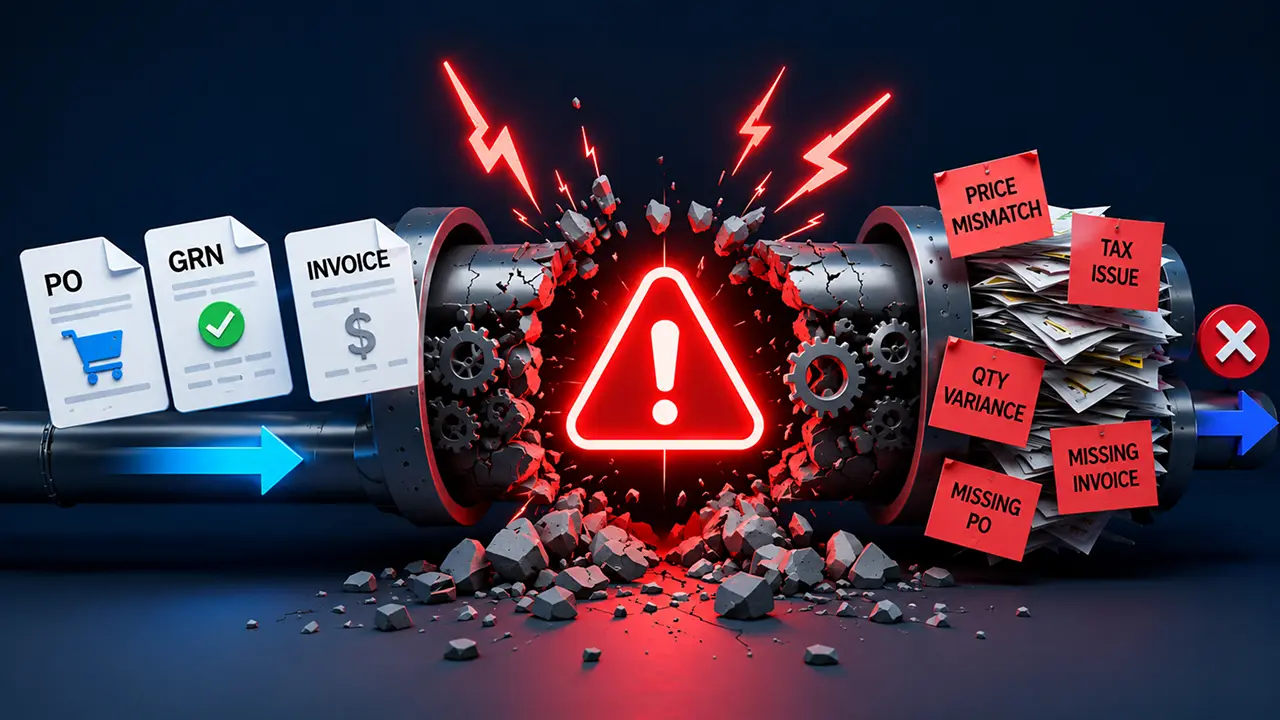
But here is where the gap opens up. The remaining 20–30% of invoices don’t match. They have pricing discrepancies, missing purchase orders, quantity variances, duplicate submissions, or vendor data errors. These are your AP exceptions — and they are the single most common reason that otherwise sophisticated O2C automation programs fail to deliver their promised ROI.
25%
of invoices require manual exception handling on average
4–6×
higher cost to process an exception vs. a clean invoice
72%
of AP teams report exceptions as their top operational bottleneck
Most automation tools are designed and sold around the clean-invoice scenario. Exception handling, by contrast, is messy, context-dependent, and often requires human judgment. That mismatch is the critical gap — and closing it is where the real value of O2C automation is won or lost.
What AP exceptions actually are — and why they multiply
An AP exception is any invoice that cannot be automatically matched, approved, and processed without human intervention. They come in several flavors, and in a growing business, the volume and complexity of exceptions tends to scale faster than the clean invoice volume does.
| Exception type | Common cause | Risk if unresolved |
| Price mismatch | Vendor invoices at a different rate than the PO | High Overpayment, audit exposure |
| Quantity variance | Invoice quantity differs from goods received | High Payment for undelivered goods |
| Missing PO | Invoice arrived without a valid purchase order reference | Medium Approval delays, maverick spend |
| Duplicate invoice | Vendor re-submits or system logs twice | High Double payment risk |
| Coding errors | Wrong GL account or cost center assigned | Medium Misallocated costs, reporting errors |
| Missing goods receipt | Three-way match fails; GR not yet recorded | Medium Payment timing disputes |
| Vendor master data issues | Wrong bank details, expired vendor records | High Payment failure or fraud exposure |
As your supplier base grows, as you expand into new geographies, or as your procurement team moves faster than your data governance can keep up, the frequency and variety of exceptions increase. What worked at 500 invoices per month becomes a significant bottleneck at 5,000.
The critical gap: where O2C automation breaks down
Order to cash automation is typically described as a continuous cycle — from customer order, through fulfillment, invoicing, and payment receipt. On the AP side, automation tools handle invoice capture, PO matching, and payment scheduling. The workflow looks elegant in a process diagram.
The critical gap is not in the automation itself; it is in what happens after the automation says “no.” When an invoice fails matching, most systems create a queue and stop. There is no intelligent routing, no context surfaced to the reviewer, no workflow to resolve the underlying cause, and no learning loop to prevent recurrence. The exception handling process is essentially still manual — just with a different entry point.
This gap manifests in three specific failure modes that AP teams experience repeatedly:
1. Exceptions are treated as individual events, not systemic signals
When an invoice arrives with a price mismatch, the AP team resolves it manually and moves on. The same mismatch recurs with the same vendor next month and the month after. Without exception, analytics return to the procurement and vendor management process, but the root cause remains unaddressed. Automation creates efficiency for clean invoices while institutionalising the manual cost of recurring exceptions.
2. Routing logic doesn’t adapt to exception type or business context
Not all exceptions require the same resolution path. A $200 quantity variance on a low-risk vendor might need a single approver sign-off. A $40,000 price discrepancy on a critical supplier contract might need procurement, finance, and a contract review. Generic exception queues treat both identically, creating unnecessary escalations for simple cases and under-scrutiny for complex ones. This slows cycle times and increases risk simultaneously.
3. Exception resolution is disconnected from downstream O2C metrics
How quickly and accurately exceptions are resolved directly affects days payable outstanding (DPO), early payment discount capture, and vendor relationship health. But in most organisations, AP operations teams treat exception handling as an operational issue rather than a strategic O2C metric. The connection between exception volume, resolution time, and cash flow impact remains invisible — until it surfaces in a quarterly financial review.
“We thought we had automated our AP process. What we had actually automated was the easy part. The exceptions — the part that carries the most financial risk — were still entirely manual. We just had better software to show us how big the backlog was.”
— AP Director, mid-market manufacturing firm
The hidden costs of unmanaged AP exceptions
Finance leaders often underestimate the true cost of exception handling because teams, time, and systems distribute it across their operations. The direct cost — the staff hours spent resolving each exception — is only part of the picture.
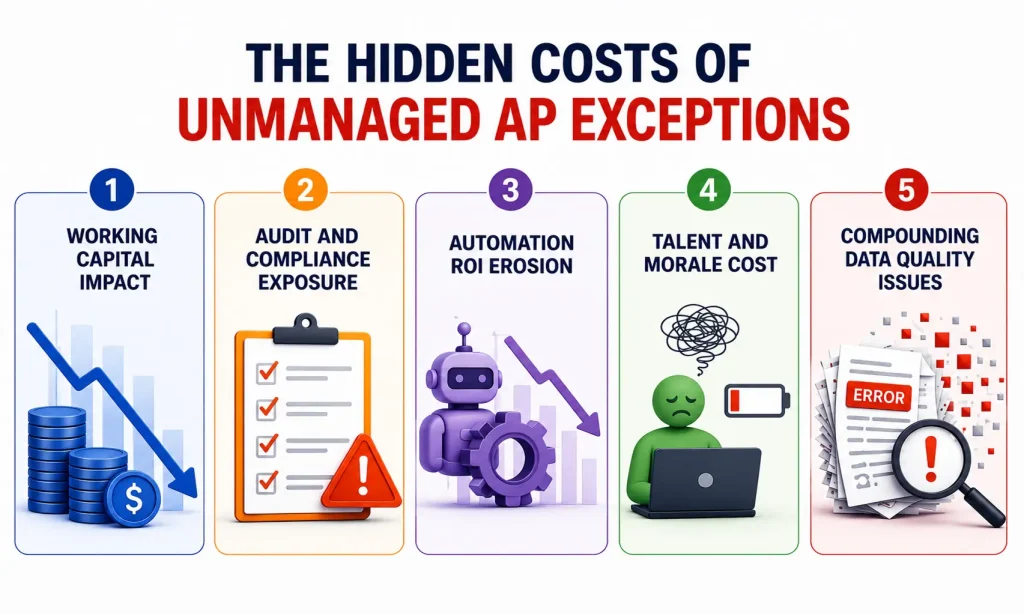
1. Working capital impact
Unresolved exceptions delay payment. Delayed payments mean suppliers may tighten terms, withdraw early payment discounts, or deprioritise your orders. In a supply chain where reliability matters, AP exception backlogs are a hidden risk to vendor relationships and supply continuity.
2. Audit and compliance exposure
Manually resolved exceptions often lack consistent documentation. When auditors review your AP process, inconsistently documented exceptions create uncertainty about controls and can trigger more profound scrutiny. Organisations with high exception volumes and poor resolution records incur disproportionately high audit costs.
3. Automation ROI erosion
If 25% of your invoices require manual handling, your effective automation rate is much lower than the technology adoption rate suggests. AP leaders often cite 85% automation as a target; the reality, when exceptions are factored in, is often closer to 60–65%. The gap is eating your projected savings.
4. Talent and morale cost
Experienced AP professionals who spend their days manually resolving exceptions — chasing buyers for approvals, emailing vendors about discrepancies — are not doing the analytical work that retains them or adds strategic value. Exception overload is a documented driver of finance team attrition.
5. Compounding data quality issues
Every manually resolved exception that isn’t fed back into your vendor master or procurement data creates a condition for the same exception to recur. Without a closed feedback loop, your exception rate doesn’t decline over time — it grows with transaction volume.
What a mature exception management framework looks like
Closing the critical gap in order to cash automation requires treating exception handling not as a residual manual process but as a structured sub-system within your broader AP automation programme. Mature organisations address this challenge across four dimensions:
1. Intelligent exception classification
Rather than routing all exceptions to a single queue, mature systems classify exceptions by type, value, vendor risk tier, and resolution complexity. This allows genuinely simple cases to be resolved with minimal touchpoints — sometimes automatically, with human confirmation — while complex cases get appropriate escalation paths. Machine learning models trained on historical resolution data can dramatically improve classification accuracy over time.
2. Contextual resolution workflows
When a reviewer picks up an exception, they should see not just the invoice but also the relevant PO, the goods receipt, the vendor’s payment history, the contract terms, and any prior exceptions from the same vendor. Surfacing this context at the point of review reduces resolution time and improves decision quality. This is where integrations between your AP automation platform, ERP, and contract management system become critical.
3. Root cause analytics and feedback loops
Exception data, aggregated over time, is a goldmine for process improvement. Which vendors generate the most exceptions? Which buyers raise POs with the most discrepancies? Which product categories have the most frequent pricing variances? Answering these questions allows procurement, AP, and finance leadership to address root causes — renegotiating vendor terms, improving PO processes, correcting vendor master data — rather than endlessly resolving the same exceptions downstream.
4. Exception SLAs tied to O2C metrics
Mature AP teams set and track exception resolution SLAs linked to their broader O2C outcomes: DPO targets, discount capture rates, and vendor payment terms. This makes exception management a measurable, managed process — not an invisible cost absorbed by the team. It also surfaces exceptions as a finance leadership conversation, not just an operational one.
Benchmark: Leading AP teams resolve 80%+ of exceptions within 48 hours, maintain exception rates below 15% of invoice volume, and document root cause analytics for at least 70% of recurring exception types. If your organisation is significantly above these thresholds, exception handling is likely the primary constraint on your O2C automation ROI.
Evaluating your current state: five questions to ask
Before investing in additional automation tooling, it is worth assessing how much of your existing O2C automation value you are losing to unmanaged exceptions. These five questions will help frame that conversation internally:
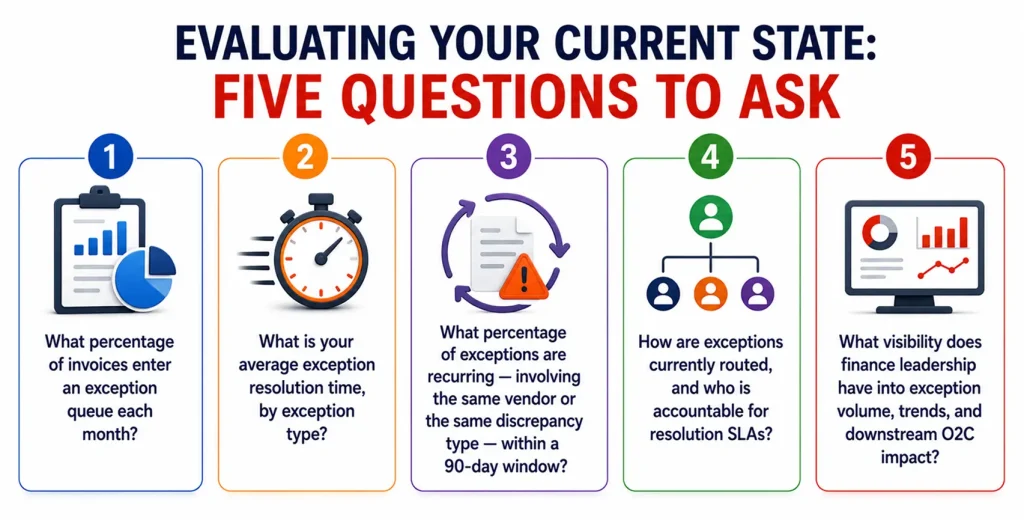
- What percentage of invoices enter an exception queue each month? If you don’t know this number precisely, that itself is a signal — exception volume should be a core AP operations metric.
- What is your average exception resolution time, by exception type? Aggregate resolution time masks the difference between simple approvals and complex investigations. Breaking the data down by type reveals where the real delays are.
- What percentage of exceptions are recurring — involving the same vendor or the same discrepancy type — within a 90-day window? High recurrence rates indicate a root-cause problem that automation alone will not solve.
- How are exceptions currently routed, and who is accountable for resolution SLAs? If routing is ad hoc and accountability is diffuse, you have a process design problem, not just a technology gap.
- What visibility does finance leadership have into exception volume, trends, and downstream O2C impact? If exceptions are only visible in AP operations reporting, the strategic cost remains invisible to those who can authorise the resources to address it.
Order to cash automation creates real, measurable value — but only when the full invoice lifecycle is addressed, including the exceptions that automation cannot handle alone. The critical gap between your automation platform’s capability and your actual straight-through processing rate is where working capital, vendor relationships, and team capacity are quietly eroded.
Organisations that treat exception handling as a structured, managed, analytics-driven process — rather than a residual manual task — consistently outperform on the metrics that matter most in O2C: DPO, discount capture, processing cost per invoice, and audit readiness. Closing this gap is not a technology purchase; it is a process design decision that the right technology enables.
Ready to assess your exception handling maturity?
Explore how leading finance teams are closing the critical gap in their O2C automation programmes.