









Key Takeaways
- Security should be built into your finance automation strategy from the start, not treated as a final procurement or compliance checkpoint.
- Compliance claims need evidence. Finance teams should verify SOC 2 documentation, access controls, audit logs, data policies, and other security controls before selecting a platform.
- Automation can make auditability stronger by creating a continuous record of transactions, approvals, exceptions, and final outcomes as work happens.
- Segregation of duties is stronger when enforced by the system, rather than relying solely on employee awareness, policies, and manual reviews.
- The right platform should reduce compliance exposure, not simply add automation. The goal is to make finance operations more controlled, measurable, and auditable while moving confidently from evaluation to deployment.
You’ve done the demos. You’ve compared vendors. Your finance automation strategy is largely finalized except for one question that keeps stalling the deal: Can we trust this platform with our financial data?
For finance leaders, that question is rarely a formality. Finance automation touches invoices, payment information, vendor records, employee data, banking details, approvals, and audit evidence. The more processes you automate, the greater the importance of knowing exactly how that data is protected, who can access it, and how every financial decision is documented.
That is why security and compliance can become the final bottleneck between vendor evaluation and deployment.
The teams that move through this stage fastest aren’t necessarily the ones asking fewer questions. They’re the ones asking the right questions early, validating the answers with evidence, and treating security as part of the finance automation strategy rather than as a procurement checkbox.
Why Security Is the Real Bottleneck in Finance Automation Strategy
Most finance leaders don’t need convincing that automation can improve efficiency. They already understand the business case: fewer manual tasks, faster processing, better visibility, fewer errors, and more scalable operations.
The harder question is who should be trusted to execute those processes.
A modern finance automation strategy may involve systems processing thousands of invoices, routing approvals, reconciling transactions, managing vendor information, and generating records that auditors rely on. That creates a different risk profile from simply introducing another productivity tool.
A security incident can expose sensitive financial information. Poor access controls can allow unauthorized approvals. Weak audit trails can make it difficult to reconstruct what happened during a transaction. And poorly designed workflows can create segregation-of-duties conflicts that only surface during an audit.
For CFOs, the consequences extend beyond the technology itself. A security failure or compliance issue can affect financial reporting, regulatory obligations, customer trust, and credibility with the board.
The answer isn’t to avoid automation. It’s to make security, governance, and compliance architectural requirements of the finance automation strategy from the beginning.
What a Compliance-Ready Finance Automation Strategy Requires
Before signing with an automation provider, finance, IT, security, and compliance teams should agree on a minimum control baseline.
The platform should be able to provide documented evidence, not verbal assurances, for requirements such as:
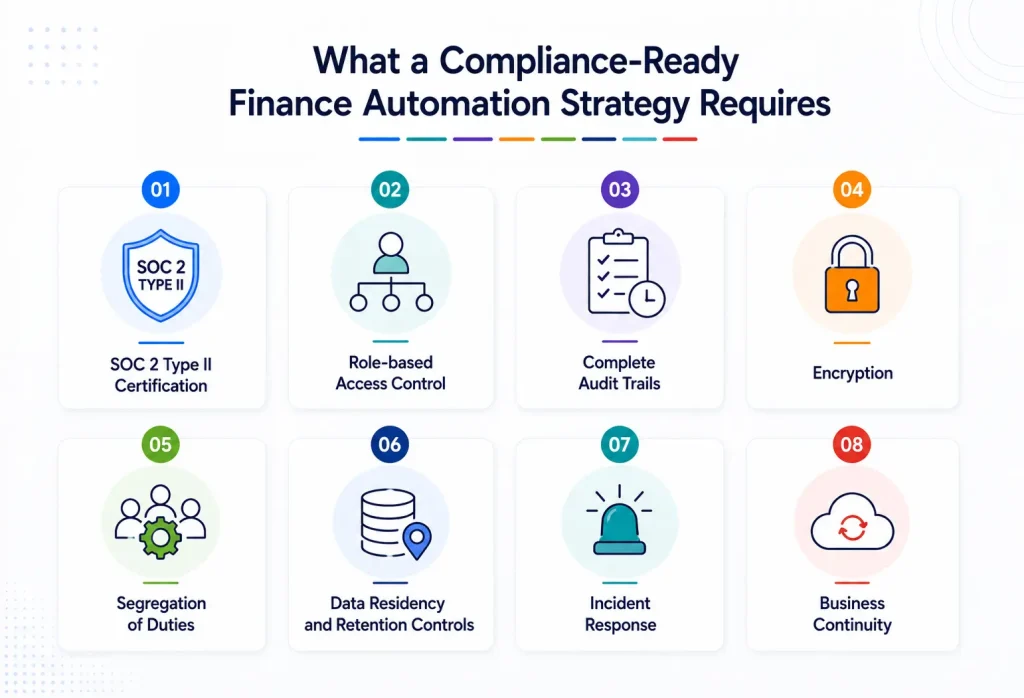
- SOC 2 Type II certification: Independent assessment of controls covering security and other relevant trust criteria.
- Role-based access control: Permissions should be assigned according to job responsibilities, with granular controls over sensitive financial actions.
- Complete audit trails: Approvals, edits, exceptions, overrides, and other material actions should be logged with timestamps and identifiable users or system actors.
- Encryption: Financial information should be protected both in transit and at rest using current industry-standard encryption.
- Segregation of duties: The system should prevent incompatible responsibilities from being assigned to the same user or workflow.
- Data residency and retention controls: Organizations operating across jurisdictions should understand where data is stored, how long it is retained, and how it is deleted.
- Incident response: Vendors should have documented processes for identifying, containing, investigating, and communicating security incidents.
- Business continuity: Disaster recovery and resilience controls should protect critical finance processes from prolonged disruption.
The important distinction is between having a policy and having a control that the software actually enforces.
For example, a vendor may say that your organization has segregation-of-duties policies. That doesn’t necessarily mean the platform prevents a user from creating and approving the same transaction.
In a mature finance automation strategy, embed critical controls into the workflow wherever possible.
Don’t Just Ask for Compliance, Ask for Evidence
One of the easiest ways to improve vendor evaluation is to stop asking broad questions such as, “Is your platform secure?”
Instead, ask for evidence.
Request the relevant SOC 2 documentation. Ask how access permissions are configured. Request a walkthrough of the audit log. Ask what happens when a user attempts an unauthorized approval. Understand the vendor’s data deletion process when the contract ends.
This approach changes the conversation from marketing claims to demonstrable controls.
A useful test is simple: Could your internal audit or security team independently verify the vendor’s answer?
If the answer is no, the control may not be mature enough for a finance-critical deployment.
The Audit Trail Matters More Than Most Teams Realize
Auditability is one of the strongest reasons to make controls part of your finance automation strategy.
In a manual process, reconstructing a transaction can require searching through emails, spreadsheets, approval messages, ERP records, and shared folders. Even when the process was compliant, proving that compliance can take significant effort.
A well-designed automation platform can create a continuous record of what happened:
- A transaction entered the workflow.
- The system validated required information.
- The transaction was routed to the appropriate approver.
- The approver reviewed and authorized it.
- Any exception or override was recorded.
- The transaction moved to the next stage.
- The final outcome was captured in the audit history.
That creates an important shift.
Instead of asking employees to remember and document compliance, the system generates evidence as work happens.
This doesn’t eliminate the need for human oversight. It makes that oversight more consistent and easier to verify.
Segregation of Duties Should Be Enforced, Not Remembered
Segregation of duties is another area where automation can materially strengthen a finance automation strategy.
Consider a procure-to-pay process. Depending on your control framework, the person creating a vendor shouldn’t necessarily be the same person approving a payment. Similarly, the person initiating a transaction may need to be separated from the person authorizing it.
In a spreadsheet-driven environment, these controls can depend heavily on employee awareness and managerial review.
In an automated environment, the workflow itself can enforce the rule.
If a user attempts an action that conflicts with their assigned responsibilities, the system can block the transaction or route it to an authorized individual.
That difference matters because policy describes what should happen; system controls determine what can happen.
For high-volume finance operations, that distinction can significantly reduce control failures caused by human error, turnover, or inconsistent process execution.
A Practical Comparison
When evaluating options, finance leaders should look beyond feature counts and compare the control environment each approach creates.
| Requirement | Manual / Spreadsheet Process | Generic Automation Tool | Compliance-Oriented Finance Automation |
| Access controls | Often manually managed | Configurable | Granular, role-based controls |
| Audit trail | Distributed across systems | Basic activity logs | Centralized transaction-level history |
| Segregation of duties | Policy-driven | May be configurable | Embedded in workflow logic |
| Data protection | Depends on underlying tools | Standard platform controls | Designed around financial-data requirements |
| Exception handling | Email/manual escalation | Rule-based in many cases | Controlled, documented workflow |
| Audit preparation | Manual evidence gathering | Partial automation | Self-service evidence and reporting |
| Compliance visibility | Periodic reviews | Moderate | Continuous workflow-level visibility |
The objective isn’t simply to select the platform with the most security features. It’s to determine whether the platform reduces your overall compliance exposure.
From Security Review to Deployment
The final question isn’t whether finance automation introduces risk. Every technology investment introduces some risk.
The question is whether your chosen platform gives you sufficient controls, visibility, and evidence to manage that risk responsibly.
The strongest finance automation strategy doesn’t treat compliance as an obstacle to automation. It uses automation to make compliance more consistent, measurable, and auditable.
When approvals are enforced by workflow, access is governed centrally, transactions leave a complete digital trail, and compliance evidence is generated as work happens, security becomes part of the operating model—not a separate layer sitting on top of it.
If your automation initiative is currently stuck in security or compliance review, the next step shouldn’t be another generic product demo.
Ask to see the access controls, audit trail, exception workflow, security documentation, and compliance reporting using scenarios that reflect your actual finance operations.
That’s how you move the conversation from “Can we trust this platform?” to a much more useful question: “Can we demonstrate that this platform controls financial processes better than the way we’re managing them today?”
And when the answer is backed by evidence, your finance automation strategy can finally move from evaluation to execution.