









Key Takeaways
- AI agents move exception handling beyond rule-based automation by combining contextual reasoning, decision-making, and execution across finance workflows.
- The biggest opportunity is reducing unnecessary manual investigation, allowing finance teams to focus human judgment on complex, high-risk exceptions rather than routine cases.
- High-volume, repeatable exceptions are the strongest starting point, including invoice mismatches, reconciliation issues, duplicate-payment alerts, policy exceptions, and journal-entry reviews.
- AI exception handling should operate within defined controls, using confidence thresholds, audit trails, human escalation, and governance to maintain finance oversight.
- Successful implementations start small and scale based on evidence, with teams establishing baseline metrics, validating AI performance against real exception data, and expanding autonomy as results justify it.
If you’re evaluating AI exception handling finance solutions, you’re probably past the basic question of whether AI belongs in finance operations. You already know what an exception queue looks like: invoices that don’t match purchase orders, duplicate-payment alerts, failed reconciliations, missing documentation, unusual journal entries, and transactions that fall outside policy.
The harder questions are more practical:
How much of that work can AI actually resolve? What controls do you need? How does an AI agent compare with rules engines and RPA? And how do you know whether the ROI will hold up after implementation?
Those are the questions that matter when you’re moving from exploration to investment.
This guide explains what AI agents can realistically do in finance exception management, where traditional automation is insufficient, what to measure, and what to verify before choosing a platform.
The Real Cost of Exception Handling in Finance
Every finance organization has exceptions. The difference is how much human effort goes into resolving them. An invoice may fail a three-way match because the quantity differs from the purchase order. A bank reconciliation may contain an unexplained variance. A payment may trigger a duplicate-risk rule. A journal entry may lack supporting documentation.
None of these tasks is particularly complex in isolation. The problem is volume.
Consider a finance operation processing 50,000 transactions per month. If even 3–8% require investigation, that’s approximately 1,500–4,000 exceptions entering the queue every month.
At 12–20 minutes of analyst time per exception—including investigation, checking source documents, communicating with stakeholders, documenting the resolution, and obtaining approval—the workload can quickly reach hundreds of analyst-hours every month.
And labor is only part of the cost.
A persistent exception backlog can contribute to:
- Longer month-end and quarter-end close cycles
- Delayed payments and supplier disputes
- Inconsistent application of finance policies
- Higher audit and compliance exposure
- Analyst burnout and turnover
- More management time spent reviewing operational issues
- Difficulty scaling transaction volumes without adding staff
This is why exception management deserves to be treated as an operating-model problem rather than simply a staffing proble
Why Traditional Automation Stops Short
Most finance organizations have already automated some portion of exception management. The challenge is that traditional automation is designed for predictable conditions.
1. Rule engines
Rules engines are effective when the exception logic is clearly defined.
For example: If invoice amount differs from purchase order amount by more than 5%, flag the invoice.
The limitation appears when exceptions become more nuanced. New patterns require new rules. Business policies change. Vendors submit different document formats. Exceptions interact with one another.
Over time, the organization can end up maintaining hundreds or thousands of rules that still don’t cover every real-world scenario.
2. RPA
RPA improves efficiency when the process follows a predictable sequence of clicks and fields. But exception resolution rarely stays predictable.
An analyst may need to read an invoice, inspect an email, compare historical transactions, check ERP records, interpret a policy, and decide whether the discrepancy is legitimate.
A bot can automate individual steps. It doesn’t inherently understand the context connecting them.
3. AI agents
AI agents introduce a different operating model. Instead of simply executing a predefined workflow, an agent can gather information from multiple sources, interpret documents and messages, evaluate the exception against policies and historical patterns, recommend or execute an action, document what happened, and escalate cases that exceed its confidence or authority.
That distinction matters.
Rules automate predefined decisions. RPA automates predefined actions. AI agents can orchestrate context, reasoning, and action.
AI Exception Handling Finance: What an Agent Actually Does
The strongest use cases aren’t about replacing every human decision. They’re about removing the repetitive investigation that surrounds those decisions.
A typical AI-powered exception workflow can look like this:
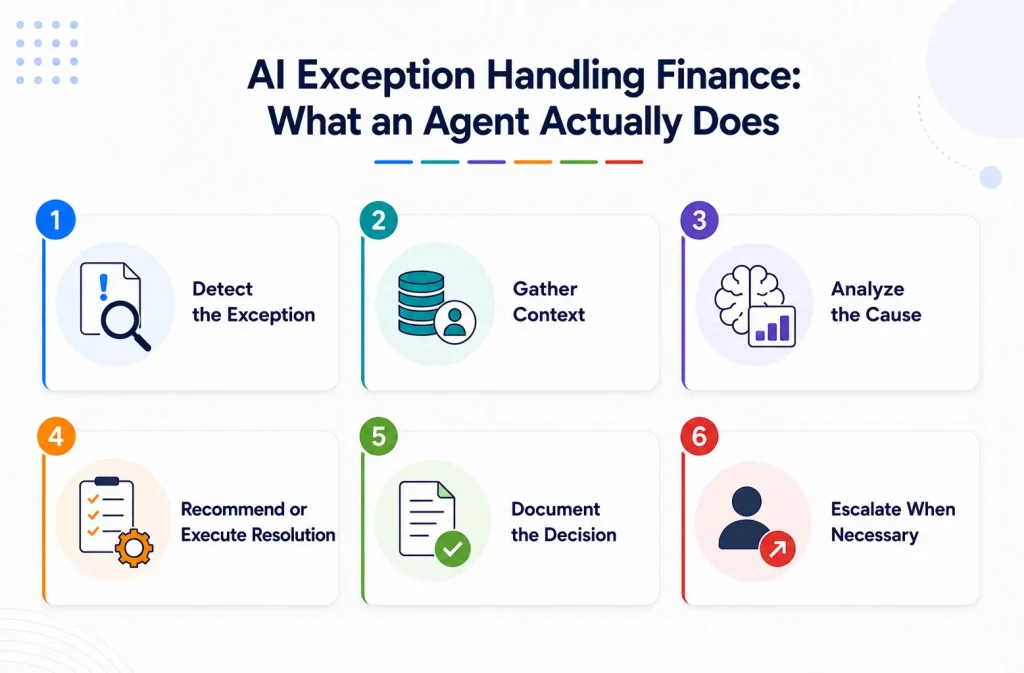
1. Detect the exception
The agent receives an exception from the ERP, AP platform, reconciliation system, payment workflow, or another finance application.
2. Gather context
It retrieves the relevant transaction, invoice, purchase order, receipt, vendor information, previous transactions, emails, and applicable policies.
3. Analyze the cause
Rather than simply identifying that a transaction failed a rule, the agent determines why it failed and whether the discrepancy appears legitimate.
4. Recommend or execute resolution
Depending on the organization’s controls, the agent can correct data, request missing information, route the transaction for approval, update a workflow, or recommend the appropriate resolution.
5. Document the decision
The system records the evidence considered, action taken, and reason for the outcome.
6. Escalate when necessary
Low-confidence or high-risk cases are routed to the appropriate finance professional instead of being forced through automation.
This creates a critical principle for enterprise finance: The goal isn’t zero human involvement. The goal is zero unnecessary human involvement.
AI Agents vs. Rules Engines vs. RPA
| Capability | Rules Engine | RPA | AI Agents |
| Handles predefined exceptions | Yes | Yes | Yes |
| Handles unfamiliar patterns | Limited | No | Yes |
| Understands PDFs and emails | Limited | Limited | Yes |
| Uses historical context | Limited | No | Yes |
| Adapts to changing scenarios | Low | Low | Higher |
| Executes actions across systems | Limited | Yes | Yes |
| Provides decision context | Limited | Limited | Yes |
| Confidence-based escalation | Limited | Limited | Yes |
| Maintenance as exceptions evolve | High | High | Lower |
| Human-in-the-loop workflows | Yes | Yes | Yes |
The important point isn’t that AI agents make every legacy technology obsolete.
Rules engines remain valuable for deterministic controls. RPA remains useful for stable, repetitive interactions. AI agents become particularly valuable where exceptions require interpretation and contextual judgment.
In mature finance environments, the best architecture may combine all three.
Where AI Exception Handling Creates the Most Value
Not every exception should be automated on day one. The best starting points tend to have three characteristics: high volume, repeatable investigation patterns, and clearly defined resolution policies.
1. Invoice and AP exceptions
AI can investigate price, quantity, tax, vendor, and purchase-order mismatches by comparing information across invoices, POs, receipts, ERP records, and correspondence
2. Reconciliation exceptions
Agents can investigate unmatched transactions, identify likely causes, retrieve supporting records, and prepare reconciliation explanations.
3. Duplicate-payment exceptions
Instead of simply flagging potential duplicates, an agent can compare vendor, amount, invoice number, date, purchase order, payment history, and supporting documentation to determine whether the transaction warrants escalation.
4. Policy exceptions
AI can assess transactions against defined finance policies and identify the supporting evidence needed for approval or escalation.
5. Journal-entry exceptions
Agents can validate supporting documentation, compare entries against established patterns, identify missing information, and route unusual entries to the appropriate reviewer.
These use cases share a common characteristic: the system must understand context rather than simply match a condition.
What Results Should Finance Leaders Expect?
The right question isn’t, “How much automation does the vendor promise?”
It’s: How much manual effort can we safely remove while maintaining or improving control?
Potential outcomes from a well-designed AI exception management program include:
| Metric | Potential Impact |
| Manual exception backlog | Significant reduction |
| Resolution time | Minutes instead of lengthy investigations |
| Close cycle | Faster exception clearance |
| Analyst productivity | More time for high-value work |
| Processing capacity | Higher volumes without proportional headcount |
| Auditability | More consistent documentation |
| Escalation quality | More targeted human intervention |
Treat these as business-case hypotheses rather than guaranteed benchmarks. Actual performance depends on transaction volume, exception complexity, data quality, ERP integration, policies, and the degree of autonomy permitted.
The strongest vendors should be willing to validate their claims against your own historical exception data.
The Bottom Line
Finance exception management has traditionally relied on a combination of rules, RPA, spreadsheets, and human analysts. Those tools remain useful, but they struggle when exceptions require context, interpretation, and judgment.
AI exception handling finance changes the equation by allowing an agent to investigate an exception, understand the surrounding context, determine the appropriate next step, execute approved actions, document the outcome, and escalate genuine edge cases.
The opportunity isn’t to eliminate finance professionals from the process.
It’s to stop spending their time on work software can safely handle.
The organizations most likely to achieve meaningful ROI won’t be the ones that automate everything immediately. They’ll start with a high-volume exception category, establish measurable baseline metrics, define governance boundaries, validate the agent against real historical transactions, and expand autonomy only when the results justify it.
That is the practical path from an exception queue managed by people to an exception operation managed by intelligent agents.