







Key takeways
- Businesses need an efficient and robust technique to manage tax compliance workload and meet the reporting obligations and deadlines.
- Intelligent automation bots can independently perform tasks like interpreting data, making decisions, taking action, and learning.
- The RPA software can be integrated easily with manual systems to optimize manual, repeatable, time-consuming processes.
- Deploying automation bots for tax compliance and reporting facilitates accurate tax calculations and timely filing of taxes.
Corporate tax compliance and reporting is a mandatory requirements for organizations across the globe. Every country has its set of tax rules that establish an accurate tax base. The tax credits and deductions depend on a myriad of factors. These aspects make tax compliance and reporting complex. The complexities are further enhanced by the fact that the rule sets for tax determination are not constant. The rule set gets updated and modified with time.
This is one of the reasons that many organizations outsource the tax compliance and reporting function to external agencies. This increases the expenses of the organization.
A tax compliance and reporting function entails:
- Set up and operation of accounting, payroll, and tax processes based on in-depth industry knowledge.
- A robust framework that facilitates timely compliance and risk management. Besides, it should offer complete visibility into accounts coupled with quality enhancements.
What businesses need is an efficient means to manage tax compliance workload and meet the reporting obligations and deadlines. This is where technology has a vital role to play.
Emerging technologies like RPA(Robotic Process Automation) and Artificial Intelligence(AI) can streamline the tax compliance and reporting function of any organization.
Intelligent automation bots can independently perform tasks like interpreting data, making decisions, taking action, and learning. Automation software can be integrated easily with manual systems to optimize manual, repeatable, time-consuming processes.
One of the most important factors for tax compliance and reporting is data management. Large volumes of data need to be gathered and analyzed. Legacy tax compliance systems had data gathering processes that extracted data from transactions that had already taken place. This data provides valuable insights to the tax departments. However, the tax departments also need foresight or data that conveys what lies ahead.
Data collection and reconciliation in disparate financial systems and processes are manual and time-consuming.
Traditional tax compliance systems entailed manual data analysis and computing using elaborate spreadsheets. This approach posed problems such as inadequate collaboration, errors in calculations, delays in processes, and more.
The technology addresses most of these issues. For instance, data analytics and predictive analysis using Artificial Intelligence provide both insights and foresight. Automation streamlines a host of processes in the tax compliance and reporting function.
Role of Automation in Tax Compliance and Reporting
Tax compliance and reporting is a complex function that cannot be fully automated. The process works best with man-machine collaboration.
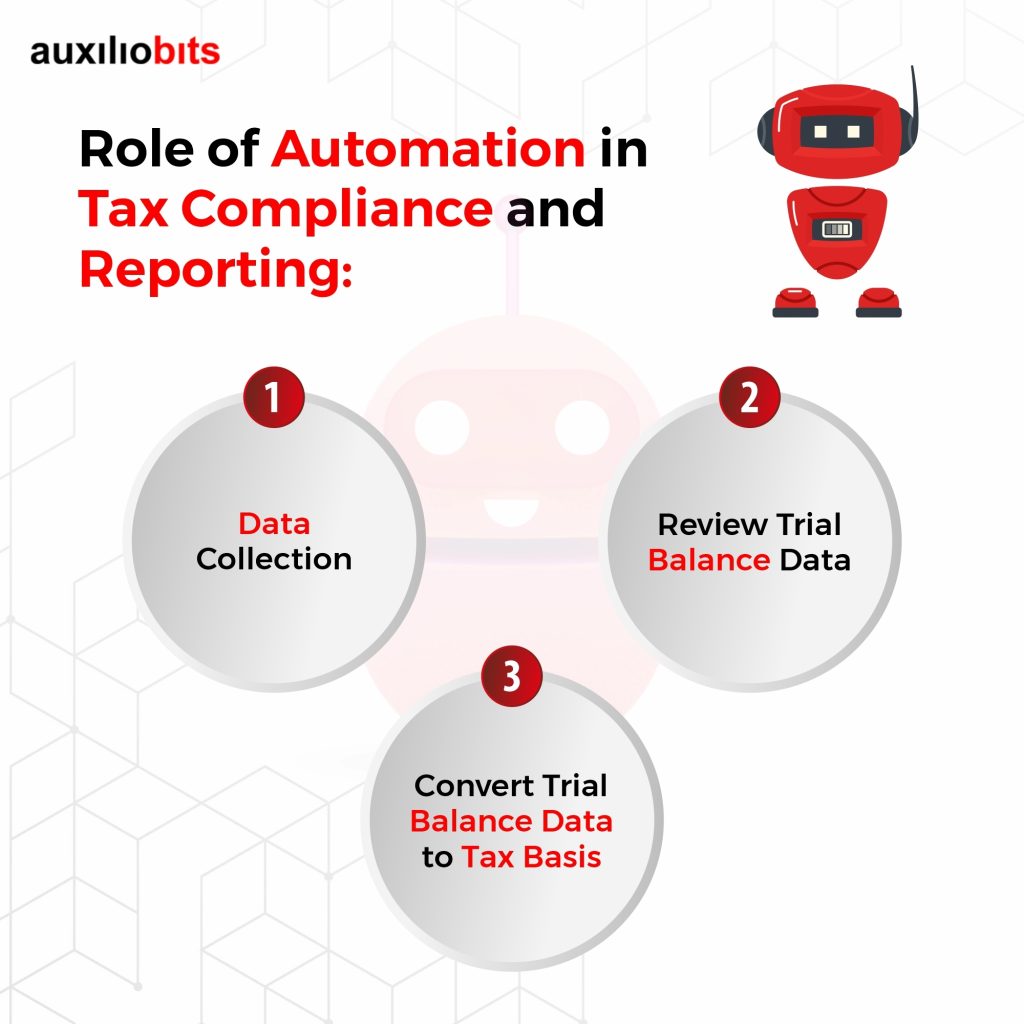
Below is the overview of the stages that the tax compliance function goes through with details of the processes that can be automated
Data Collection
Manual data collection increases execution time, vulnerability to errors, and resource requirements.
Data is gathered by exporting trial balance details from the ERP system for preparing tax returns, fixed asset sub-ledger, and company-specific data. All these data collection processes can be automated using bots.
Based on these data points, the tax filing status of all entities is updated.
Review Trial Balance Data
Tax calculation is based on the trial balance data. In the manual process, tax professionals need to download large volumes of data and process it.
Tasks such as reviewing accounts to ensure consistency with the previous year, mapping book basis accounts to tax basis account numbers, and reconciling intracompany transactions are automated.
Convert Trial Balance Data to Tax Basis
Tax professionals use checklists and follow a rule-based process to collect data and documents to prepare the tax return. These tasks can be automated by RPA bots.
Lorem ipsum dolor sit amet, consectetur adipiscing elit. Ut elit tellus, luctus nec ullamcorper mattis, pulvinar dapibus leo.
RPA bots automate processes such as:
- Calculating the tax differences.
- Applying tax differences to trial balance.
- Evaluating alternatives for the tax treatment of discrete tax transactions.
- Computing state tax adjustments.
- Reviewing tax return workbooks.
Prepare Tax Returns
Preparing tax returns entails:
- Assigning tax basis accounts to relevant tax form lines.
- Filling out tax returns based on the tax return workbook.
- Filling out other tax return details in the information fields.
- Reviewing tax returns and payments.
Of these, filing out tax returns based on the tax return workbook and filing out other tax return details in the information fields can be automated. Automated data entry eliminates multiple logging into the tax software and replication. Bots also complete the tasks and notify the relevant stakeholders.
Tax Accounting
Tax accounting processes like booking current tax accounting entries, calculation of deferred taxes, and booking deferred tax entries can be streamlined by RPA.
Prepare Tax Audit Strategy
The process goes through the following steps:
- The audit inquiries are reviewed on an ad-hoc basis to develop an audit response strategy.
- Relevant data is gathered to respond to the audit query.
- The audit process is closed by addressing the issues in the inquiry.
Preparation of tax audit strategy is usually not automated but executed by experts.
Most of the tasks that require accuracy can be automated. Automation not only improves accuracy but also speeds up the process. Besides these, there are several other reasons why you must consider automating tax compliance and reporting.
Reasons to Automate Tax Compliance and Reporting
- It minimizes costs.
- It is 3 to 5 times faster than manual processing.
- Minimizes errors and the related costs of correcting these errors.
- Automation offers scalable solutions.
- Automation software facilitates agility thereby making the system respond to the changes in business processes.
- Enhances efficiency.
- Minimizes rework by providing a better quality of output.
- Automation streamlines data, document, and workflow management.
Deploying automation bots for tax compliance and reporting facilitates accurate tax calculations and timely filing of taxes. Tax compliance software does not impact only the tax department but requires interdepartmental digitization to function. Hence, any organization considering automation of tax compliance and reporting must have a well-planned strategy.
How can an Organization Implement RPA in Tax Compliance and Reporting?
- The first step is to identify all the rule-based processes that can be automated.
- Evaluate if other functions in the organization have deployed RPA.
- Tax compliance is a cross-functional process. You will need to develop a roadmap for implementing RPA across functions like HR, Finance, IT, Supply Chain, etc.
- Identify vendors that provide Intelligent automation solutions based on concurrence by all relevant departments.
- Implement automation.
If the complexity of implementing automation overwhelms you, connect with the professional team at Auxiliobits. We provide seamless automation integration to your existing systems.
What Auxiliobits can do for your Organization?
- We automate your existing systems tailored to the specific needs of your business.
- Our software solutions accelerate the process of tax computations and reconciliation.
- Our bots automate processes and minimize manual effort.
- We help businesses enhance the efficacy of data collection, manipulation, and accrual adjustments.
- We provide automation solutions that increase visibility into accounts thereby improving the accuracy.
- Out automation bots reduce the time spent by the staff on mundane processes relieving them for tasks that require human skills.
- We provide an enterprise-level tax platform that functions as an integrated tax ecosystem.
- We provide software that supports related processes such as accounting, payroll, and tax requirements.
Final Words
Intelligent automation can support end-to-end tax administration and compliance. Bots verify compliance requirements, perform quality checks, and notify the tax professionals in case of any discrepancy. Automation bots offer a seamless tax processing solution that keeps track of all resources. Automation enables tax professionals to access real-time data to prepare reports for decision-making. Businesses can leverage automation tools alongside the intelligence of humans to transform tax functions.
Connect with the Auxiliobits Automation Team for Custom Tax compliance and reporting solutions.
Watch this space for more about the processes that Auxiliobits can automate for your business!





