








Key Takeaways
- Automation should follow process readiness, not technology trends. Finance teams should prioritise processes that are repetitive, stable, high-volume, and measurable.
- Manual effort is a strategic signal. When finance professionals spend too much time on data entry, reconciliations, spreadsheets, approvals, and routine tasks, automation can redirect capacity toward higher-value analysis.
- Not every finance process should be automated. Poorly defined workflows, unreliable data, frequent rule changes, low transaction volumes, and judgement-heavy activities may require redesign or human oversight first.
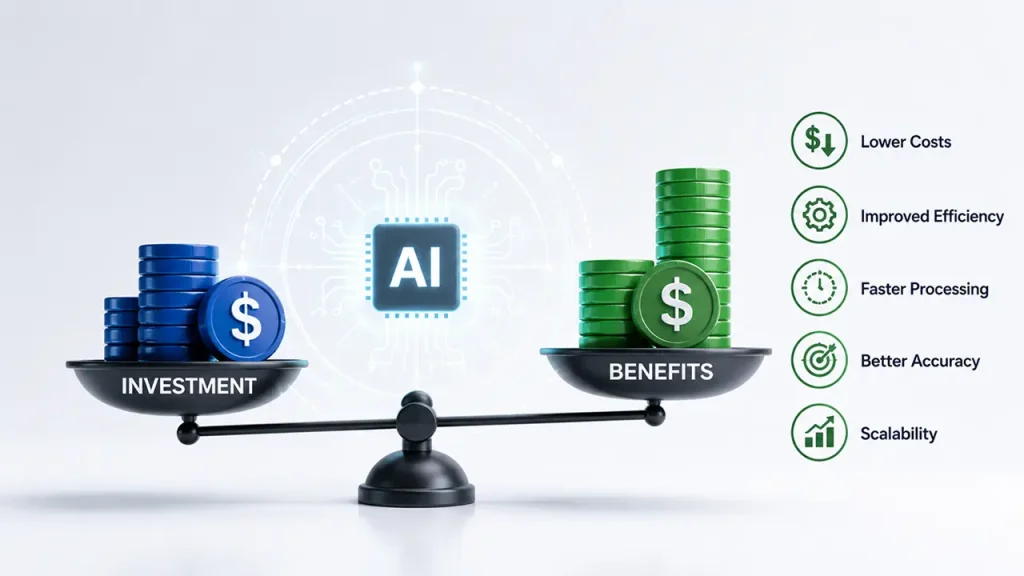
- Build the business case around measurable value. Beyond headcount savings, finance automation can improve cycle times, accuracy, controls, scalability, working capital, and employee productivity.
- The future is moving from task automation to autonomous finance. Finance leaders should increasingly evaluate how entire end-to-end processes can operate with minimal manual intervention while keeping people involved in exceptions and strategic decisions.
Finance automation is no longer a question of whether finance teams should automate. The more strategic question is when to automate finance—and, more importantly, which processes are ready for automation and which still require human judgement.
For CFOs and finance leaders, timing matters. Automating a poorly designed process can simply make inefficiency faster. Automating a stable, repetitive, high-volume process, however, can reduce operating costs, improve control, accelerate reporting, and give finance professionals more capacity for analysis and decision-making.
The right approach is therefore not to automate everything at once. It is to identify processes where automation can create measurable business value while maintaining appropriate levels of human oversight.
What Does Finance Process Automation Really Mean?
Finance process automation uses technologies such as workflow automation, artificial intelligence, machine learning, intelligent document processing, and robotic process automation to execute repetitive finance activities with limited manual intervention.
Common candidates include:
- ccounts payable invoice processing
- Accounts receivable reconciliation
- Expense management
- Financial reporting
- Journal entry preparation
- Cash application
- Account reconciliation
- Collections workflows
- Month-end close activities
- Financial data validation
However, automation does not mean removing people from finance processes entirely. The most effective operating models automate predictable execution while allowing finance professionals to handle exceptions, judgement-intensive decisions, controls, and strategic analysis.
This distinction is critical when deciding when to automate finance.
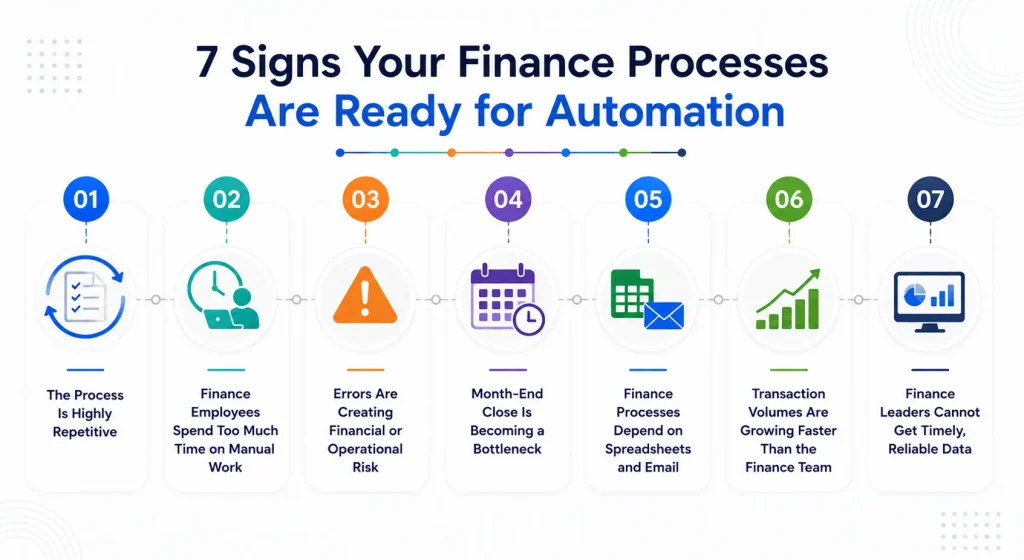
7 Signs Your Finance Processes Are Ready for Automation
There is no universal automation trigger. Instead, finance leaders should look for recurring operational signals that indicate a process has become inefficient, costly, or difficult to scale manually.
1. The Process Is Highly Repetitive
Repetition is one of the clearest indicators of automation potential. If employees repeatedly enter the same information, validate similar transactions, reconcile identical data sets, or follow the same approval sequence, the process may be suitable for automation.
For example, invoice processing often involves receiving an invoice, extracting information, validating supplier details, matching purchase orders, routing approvals, and updating the ERP.
When these steps occur thousands of times each month, manual execution becomes difficult to justify.
Automation signal: High transaction volume + predictable rules + repetitive execution.
2. Finance Employees Spend Too Much Time on Manual Work
Finance automation should not be measured only by transaction volume. Time is equally important. If highly skilled finance professionals are spending significant portions of their working week copying data between systems, preparing spreadsheets, chasing approvals, or resolving routine discrepancies, the organisation is losing valuable analytical capacity.
The question becomes: Is finance talent being used to process information or interpret it?
When routine administration consistently consumes time that could be spent on forecasting, scenario planning, risk analysis, and business partnering, automation becomes strategically relevant.
3. Errors Are Creating Financial or Operational Risk
Manual processes introduce opportunities for errors. A misplaced decimal, incorrect account code, duplicate invoice, missed reconciliation item, or spreadsheet formula error can create downstream consequences for reporting, compliance, cash flow, or management decisions.
Automation can introduce standardised workflows, validation rules, audit trails, and exception handling. This is particularly valuable for processes where accuracy is more important than speed alone.
Automation signal: Repeated manual errors + costly corrections + material financial impact.
4. Month-End Close Is Becoming a Bottleneck
The month-end close is a strong indicator of finance process maturity. When teams rely heavily on spreadsheets, email follow-ups, manual reconciliations, and disconnected systems, closing the books can become a race against the clock.
A delayed close does more than frustrate finance teams. It delays management reporting and reduces the time available to analyse business performance.
Automation can help finance teams streamline activities such as:
- Account reconciliation
- Transaction matching
- Journal preparation
- Close task management
- Data validation
- Variance identification
- Reporting workflows
The goal is not simply to “close faster”. It is to create a more predictable and controlled close process.
5. Finance Processes Depend on Spreadsheets and Email
Spreadsheets remain useful finance tools, but they become problematic when they function as the infrastructure connecting multiple systems and people. A process that requires employees to download information from an ERP, copy it into spreadsheets, email it for review, make manual changes, and upload the final version creates unnecessary operational risk.
This is often a sign that workflow orchestration or system integration should be considered.
When finance processes depend on manual handoffs between systems, automation can create a more connected operating model.
6. Transaction Volumes Are Growing Faster Than the Finance Team
Growth exposes inefficient processes. A finance team that can comfortably process 2,000 invoices manually may struggle when volumes reach 10,000. Hiring additional employees can provide short-term capacity, but it does not necessarily address the underlying process design.
Automation allows finance organisations to increase transaction capacity without increasing headcount at the same rate.
This is particularly important for growing organisations, shared service centres, and businesses that manage multiple entities, geographies, currencies, or ERP environments.
7. Finance Leaders Cannot Get Timely, Reliable Data
Automation is not only about reducing manual work. It can also improve the availability and consistency of financial information. If finance leaders spend significant time consolidating data before they can analyse it, the organisation may be operating with a reporting lag.
Automated data flows, validation, reconciliation, and reporting can shorten the distance between a financial event and actionable insight.
That makes automation a potential enabler of more responsive decision-making.
When Should You Not Automate a Finance Process?
Knowing when to automate finance also means knowing when not to automate.
A process may not be ready if:
- The underlying workflow is poorly defined.
- Business rules change frequently.
- Transaction volumes are too low to justify the investment.
- Exceptions significantly outnumber standard cases.
- The process requires complex human judgement.
- Data quality is unreliable.
- The process is likely to be redesigned soon.
- Automation would add complexity without measurable value.
A fundamental principle applies:
Do not automate a broken process before understanding why it is broken.
If an approval process has unnecessary steps, automation may simply make those unnecessary steps execute faster. Finance leaders should first simplify and standardise the workflow, and then automate it where appropriate.
A Practical Framework for Deciding When to Automate Finance
Finance leaders can evaluate automation candidates using five dimensions:
| Evaluation factor | Questions to ask |
| Volume | How many transactions occur each month? |
| Repetition | Are the steps consistent and rule-based? |
| Effort | How many employee hours are consumed? |
| Risk | What is the cost of errors or delays? |
| Value | What measurable business outcome could automation deliver? |
The strongest candidates typically score highly across several dimensions.
For example, a high-volume invoice process involving repetitive data entry, frequent errors, lengthy approval cycles, and substantial employee effort would generally present a stronger automation opportunity than a low-volume process requiring significant professional judgement.
Start With Processes, Not Technology
One of the most common mistakes organisations make is selecting automation technology before identifying the business problem.
A more effective approach starts with process discovery.
Finance leaders should map the current workflow and identify:
- Where data enters the process
- How many manual handoffs occur
- Which systems are involved
- Where approvals create delays
- Where errors typically occur
- How exceptions are handled
- How much employee time is consumed
- What controls are currently in place
Only then should technology decisions be made. Depending on the process, the solution could involve workflow automation, RPA, AI, intelligent document processing, API-based integration, or a combination of technologies.
How to Build an Automation Business Case
The best business cases for finance automation go beyond headcount reduction.
A broader value model should consider: Automation value = productivity gains + error reduction + faster cycle times + improved controls + working-capital impact + scalability
For example, automating accounts receivable reconciliation could potentially reduce manual matching effort while also improving exception visibility and accelerating the resolution of outstanding items.
Similarly, automating accounts payable can create value through faster invoice processing, improved approval visibility, fewer duplicate payments, and stronger auditability.
Finance leaders should establish baseline metrics before implementation to measure improvements objectively.
Useful KPIs include:
- Cost per transaction
- Processing time
- Error rate
- Exception rate
- Straight-through processing rate
- Days to close
- Invoice approval cycle time
- Reconciliation completion time
- Employee hours spent on manual activities
The Strategic Shift: From Finance Automation to Autonomous Finance
The next stage of finance transformation goes beyond automating individual tasks.
Instead of asking, “Which task can we automate?”, finance leaders increasingly need to ask: “Which end-to-end finance process can operate with minimal manual intervention?”
This moves the organisation from isolated automation toward connected, intelligent workflows.
For example, an automated accounts payable process could progress from invoice capture to validation, purchase-order matching, exception identification, approval routing, ERP posting, payment scheduling, and reporting—with human intervention primarily reserved for exceptions and judgement-based decisions.
This is where AI and intelligent automation can change the operating model rather than simply digitising existing tasks.
The Bottom Line
The right time to automate finance processes is not determined by a specific transaction volume or technology trend. It is determined by the combination of repetition, scale, manual effort, risk, process stability, and measurable business value.
The most successful finance organisations do not automate everything. They prioritise processes where automation can create a meaningful improvement in cost, control, speed, scalability, and employee productivity.
For CFOs, the question is therefore not simply when to automate finance. It is, ‘Which finance processes should be automated now, which should be redesigned first, and which should remain human-led?’
Answering that question creates a more disciplined path toward finance transformation—one where automation is not implemented for its own sake but used deliberately to build a faster, more controlled, data-driven finance function.