







Global Business Services (GBS) organisations are moving beyond isolated AI pilots towards enterprise-wide intelligent operations. As AI agents begin managing interconnected workflows across finance, HR, procurement, IT, and other business functions, leaders face an important strategic decision: should they develop these capabilities internally or work with an experienced technology partner? The build vs partner agentic automation GBS scale decision becomes significantly more complex when the objective is to transform an entire function rather than automate individual tasks. It affects technology ownership, integration, governance, operating costs, talent requirements, and long-term business agility. Understanding these implications is essential for selecting an approach that delivers sustainable value.
Why the Build vs Partner Decision Changes at GBS Scale
Building a single AI agent for invoice processing or employee query resolution is fundamentally different from deploying an interconnected agent ecosystem across an entire GBS organisation.
At the individual use-case level, organisations can experiment with available AI models, develop custom workflows, and integrate agents with a limited number of applications. However, enterprise-wide implementation introduces additional dependencies, including shared data infrastructure, multi-agent orchestration, security frameworks, cross-functional process ownership, and continuous monitoring.
For example, an organisation implementing agentic automation across finance might initially develop an invoice-processing agent internally. As adoption expands, the same ecosystem may need to coordinate with procurement for purchase order validation, compliance for policy checks, and treasury for payment processing.
This introduces several considerations:
- Architecture ownership: Who designs, maintains, and upgrades the underlying agent infrastructure?
- Integration complexity: Who connects agents with existing ERP, CRM, HRMS, and ITSM platforms?
- Governance: Who establishes permissions, approval thresholds, auditability, and risk controls?
- Operational responsibility: Who monitors agent performance, handles exceptions, and manages production incidents?
- Scalability: Can the solution support additional processes, business units, and geographical locations?
The build vs partner agentic automation GBS scale decision must therefore consider the entire service delivery ecosystem rather than the development cost of an individual agent.
Building Agentic Automation In-House: Capabilities and Challenges
An internal development approach gives organisations greater control over their AI architecture, development priorities, intellectual property, and operational processes.
GBS organisations with mature technology teams, established automation centres of excellence, and strong data engineering capabilities may find this approach attractive.
1. Advantages of Building Internally
Greater customisation: Internal teams can design agents around proprietary workflows, organisation-specific policies, and complex business requirements. This is particularly useful when standard commercial solutions cannot accommodate specialised operational processes.
Control over intellectual property: Organisations retain greater ownership of custom-developed agents, workflow logic, integrations, and domain-specific configurations, subject to the licensing terms of the underlying models and third-party components.
Closer alignment with business operations: Internal developers work directly with process owners and functional experts. This can improve the alignment of agent behaviour with actual operational requirements.
Long-term technical independence: Developing internal capabilities can reduce dependence on individual service providers and help organisations build their own AI engineering and operations expertise.
2. Challenges of Building Internally
However, internal development introduces responsibilities that extend well beyond initial implementation. Organisations must recruit and retain AI engineers, solution architects, integration specialists, data scientists, security professionals, and AgentOps specialists.
They must also establish infrastructure for model evaluation, prompt and workflow versioning, observability, testing, deployment, and incident management.
The hidden costs can become significant as the number of agents increases.
For instance, maintaining five agents operating across three enterprise applications is considerably simpler than managing dozens of agents interacting with multiple platforms and exchanging information across business functions.
The organisation must also manage model upgrades, changing APIs, security vulnerabilities, knowledge-base maintenance, and performance degradation.
Therefore, building internally makes the most sense when agentic capabilities are strategically differentiating, the organisation possesses the necessary technical maturity, and it can sustain the development and operational investment.
Partnering for Agentic Automation: What Organisations Gain
Working with an experienced technology partner allows GBS organisations to access specialised expertise, established implementation frameworks, integration capabilities, and operational support without developing every capability independently.
A partner may provide the underlying agent platform, custom agent development, orchestration architecture, enterprise integration, governance implementation, or managed operations.
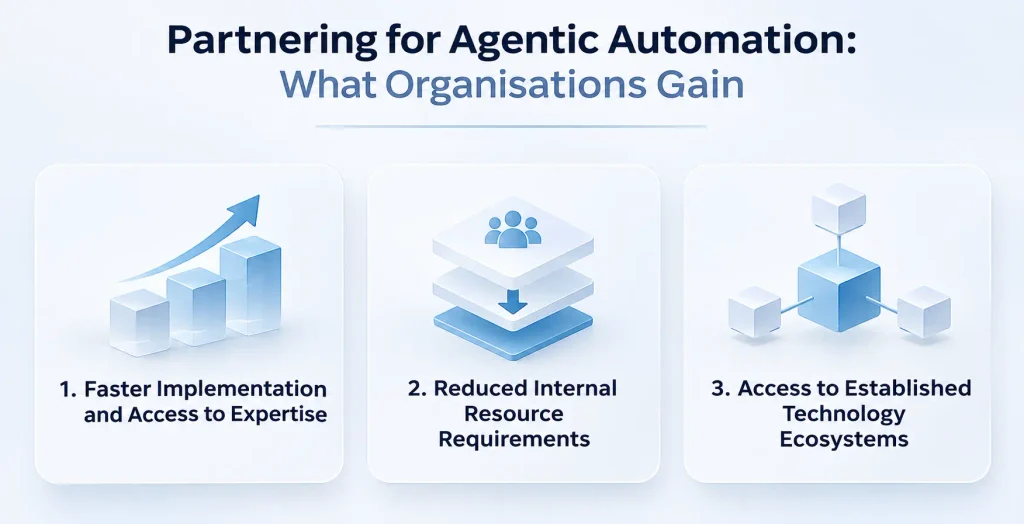
1. Faster Implementation and Access to Expertise
Partners often bring pre-existing frameworks, reusable components, technical accelerators, and experience from multiple enterprise environments. This can reduce the time required to establish foundational capabilities and move from experimentation towards production deployment.
For example, an organisation implementing agentic procurement operations may work with a partner to configure supplier verification agents, integrate procurement applications, establish approval workflows, and implement monitoring mechanisms.
Instead of developing every component from scratch, internal teams can focus on business requirements, process validation, and operational adoption.
2. Reduced Internal Resource Requirements
Partnering can reduce the immediate requirement to recruit a complete AI engineering and operations team.
Organisations can access specialised capabilities when needed, including multi-agent architecture, model optimisation, API integration, security engineering, and continuous monitoring.
However, such arrangements do not eliminate the need for internal ownership. GBS leaders must still maintain accountability for business outcomes, policies, process performance, and risk acceptance.
3. Access to Established Technology Ecosystems
Technology partners may provide access to established platforms, enterprise AI infrastructure, orchestration frameworks, and integration tools. This can help organisations avoid building commodity capabilities that already exist in the market.
However, vendor evaluation remains critical. Organisations must assess platform interoperability, data portability, licensing restrictions, security standards, customisation flexibility, and exit provisions.
The build vs partner agentic automation GBS scale evaluation should establish whether external expertise genuinely accelerates transformation or simply introduces another layer of technology dependency.
Build vs Partner: A Technical and Operational Comparison
The right decision requires evaluating both approaches against the requirements of enterprise-wide implementation.
| Evaluation criteria | Build internally | Partner externally |
| Initial investment | Higher engineering investment | Depends on engagement and licensing |
| Customisation | Greater direct control | Depends on partner capabilities |
| Implementation speed | Depends on internal maturity | Potentially faster with reusable frameworks |
| Technical expertise | Must be developed internally | Access to external specialists |
| IP ownership | Greater ownership of custom components | Defined by contractual agreements |
| Integration | Internal teams manage integration | Partner can provide integration expertise |
| Governance | Designed and managed internally | Can be jointly implemented |
| Maintenance | Internal operational responsibility | May be included in managed services |
| Scalability | Depends on internal infrastructure | Depends on partner capacity and architecture |
| Vendor dependency | Lower platform dependency if independently designed | Potentially higher without portability provisions |
Neither approach automatically delivers better results.
An organisation with mature engineering capabilities may achieve greater long-term flexibility through internal development. Another organisation with limited AI expertise may reach production faster through a specialist partner.
The build vs partner agentic automation GBS scale decision should ultimately be based on strategic importance, operational readiness, financial implications, and the level of control the organisation needs to retain.
What Changes When Agentic Automation Covers an Entire GBS Function?
The most significant difference emerges when organisations move from individual agent deployments to function-wide transformation.
At this stage, the technology decision becomes an operating-model decision.
1. Architecture and Multi-Agent Orchestration
Enterprise-wide agentic automation requires a common architecture that supports specialised agents, workflow orchestration, enterprise integrations, shared knowledge, and governance. Organisations must determine which components should remain internally controlled and which can be sourced from external providers.
For example, an organisation might retain ownership of its enterprise orchestration strategy while using a partner for specialised agent development and integration. This creates a more flexible architecture without requiring internal teams to develop every technical component.
2. Enterprise Integration and Data Management
Function-wide deployment requires agents to interact with multiple systems and access information across business processes. Finance agents may need procurement records, HR agents may require identity management integration, and IT agents may interact with service management platforms.
Consequently, integration standards, API management, data quality, access controls, and knowledge management become shared enterprise responsibilities. A partner can accelerate implementation, but the organisation must retain control over data ownership, access policies, and enterprise architecture decisions.
3. Governance and Risk Management
The expansion of agent autonomy increases the importance of consistent governance. Organisations need defined agent identities, role-based permissions, transaction limits, approval thresholds, audit trails, and escalation mechanisms.
A common governance framework should apply across all agents, regardless of whether they are internally developed or externally supplied.
The NIST AI Risk Management Framework provides a useful foundation for identifying and managing AI-related risks.
For a deeper understanding, organisations can also explore Guardrails for AI Agents Operating Inside a Formal GBS Governance Structure.
4. Workforce and Operational Ownership
Function-wide implementation also changes workforce requirements. Internal teams increasingly focus on process ownership, agent supervision, exception management, performance evaluation, and continuous improvement.
When partnering, organisations must clearly define which responsibilities remain internal and which are transferred to the service provider.
The build vs partner agentic automation GBS scale decision must therefore include a workforce and operating-model assessment, not just a technology comparison.
The Hybrid Approach: Combining Internal Ownership with External Expertise
For many GBS organisations, the most practical approach is neither completely internal development nor complete external dependency.
A hybrid model combines internal ownership of strategic capabilities with external expertise for specialised implementation and operational requirements.
For example, an organisation may:
- Retain ownership of business processes, enterprise data, and AI governance.
- Develop proprietary agents for highly specialised workflows.
- Partner with technology providers for orchestration platforms and infrastructure.
- Use external specialists for complex ERP and application integrations.
- Maintain internal teams for agent monitoring, exception management, and business performance.
This model allows organisations to protect strategic capabilities while benefiting from external experience and reusable technology.
The build vs partner agentic automation GBS scale strategy should recognise that different components of the same agent ecosystem may require different sourcing decisions.
For instance, governance might remain internally controlled, while model infrastructure and selected agent capabilities are sourced externally. This component-level approach provides greater flexibility than making a single sourcing decision for the entire programme.
How to Evaluate the Right Approach: A Practical Decision Framework
Before committing to an implementation model, GBS leaders should evaluate their requirements across five dimensions.
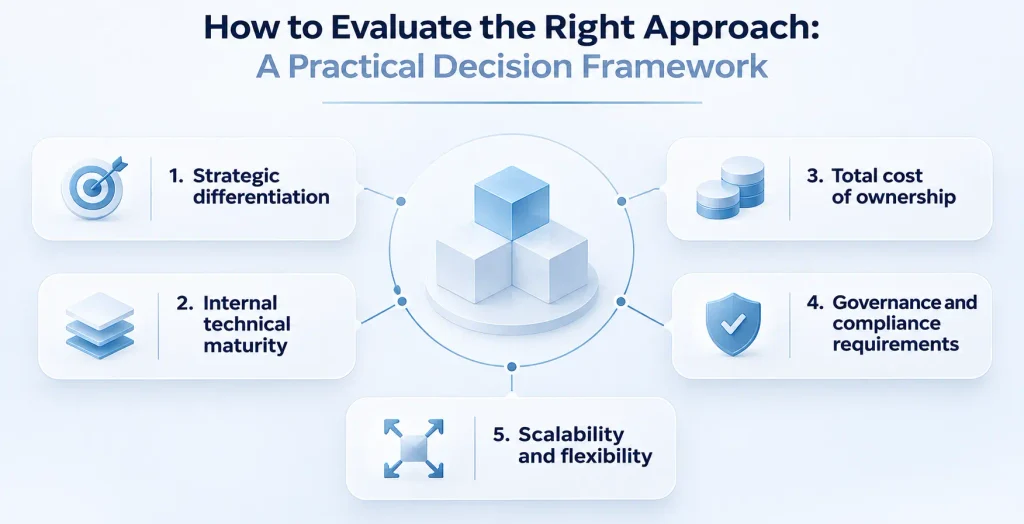
1. Strategic differentiation: Determine whether the process creates a competitive advantage. Highly specialised workflows may justify internal development, while standardised processes may benefit from established partner solutions.
2. Internal technical maturity: Assess whether the organisation has sufficient AI engineering, integration, security, and operational capabilities to build and maintain agents independently.
3. Total cost of ownership: Compare development, licensing, infrastructure, integration, monitoring, maintenance, training, and future upgrade costs. Avoid evaluating decisions solely through initial implementation expenditure.
4. Governance and compliance requirements: Identify data sensitivity, regulatory obligations, audit requirements, and the degree of control required over agent decisions.
5. Scalability and flexibility: Evaluate whether the proposed architecture can accommodate additional agents, business functions, applications, and geographical locations without substantial redesign.
A structured assessment of these dimensions makes the build vs partner agentic automation GBS scale decision more objective and helps stakeholders justify investments through measurable business requirements.
Implementation Roadmap: From Sourcing Decision to Enterprise Deployment
Once the sourcing strategy is established, organisations should follow a phased implementation approach.
Phase 1: Assess and prioritise. Identify high-value GBS processes, evaluate automation maturity, document dependencies, and establish measurable business objectives.
Phase 2: Define the sourcing model. Decide which capabilities should be built internally, obtained through partners, or delivered through a hybrid arrangement.
Phase 3: Establish the architecture. Define agent orchestration, integration standards, identity management, knowledge infrastructure, security controls, and monitoring requirements.
Phase 4: Run controlled pilots. Deploy agents in selected workflows and evaluate task completion, exception rates, decision quality, integration reliability, and human intervention requirements.
Phase 5: Scale and optimise. Expand validated solutions across additional processes, establish operational ownership, and continuously improve agent performance.
The build vs partner agentic automation GBS scale approach should also include contractual provisions covering intellectual property, data ownership, service levels, security responsibilities, performance benchmarks, and exit arrangements.
Organisations should measure success through realised cost savings, process cycle time, SLA performance, error reduction, agent reliability, and total cost of ownership.
Making the Right Long-Term Decision
The future of agentic automation in GBS will not be defined by how many AI agents an organisation deploys. It will depend on how effectively those agents integrate with business processes, enterprise systems, human teams, and governance structures.
Building internally offers greater control and opportunities for differentiation, but requires sustained investment in technology, talent, and operational capabilities. Partnering can accelerate implementation and provide specialised expertise, but requires careful management of dependencies, contracts, and intellectual property.
For most organisations, a hybrid strategy offers a practical balance between the two.
Ultimately, the build vs partner agentic automation GBS scale decision should be treated as a long-term enterprise capability strategy rather than a one-time technology procurement exercise. Organisations that establish clear ownership, scalable architecture, robust governance, and measurable business outcomes will be better positioned to move from isolated AI deployments to coordinated, function-wide agentic operations.