









Global Business Services (GBS) organisations are moving beyond traditional automation to intelligent, autonomous systems that can manage complex business workflows. From finance and procurement to HR, customer operations, and IT support, AI agents are becoming an important part of enterprise transformation. However, deploying an AI agent successfully requires more than integrating a large language model (LLM) into an existing workflow. It requires an architecture that enables the agent to understand context, make decisions, retain relevant information, and interact with enterprise systems.
This is where AI agent reasoning memory tools GBS architecture become essential. These three capabilities form the foundation of an effective enterprise AI agent. Reasoning enables decision-making, memory maintains operational context, and tools connect the agent to business applications and data sources.
For GBS leaders evaluating AI agent deployments, understanding how these components work together is critical to achieving reliable automation, operational efficiency, and measurable business outcomes.
Understanding the Three Core Capabilities of an Enterprise AI Agent
An enterprise AI agent operates through a continuous cycle of perception, reasoning, action, and evaluation. Unlike conventional rule-based automation, which follows predefined instructions, an AI agent can interpret requests, determine appropriate actions, interact with systems, and adjust its approach based on results.
Three architectural capabilities make this possible:
- Reasoning: Enables the agent to interpret instructions, break down complex tasks, evaluate alternatives, and determine the next appropriate action.
- Memory: Allows the agent to retain relevant information, retrieve historical context, and maintain continuity across interactions and workflows.
- Tools: Provide access to enterprise applications, APIs, databases, and other systems required to execute business operations.
Together, these capabilities create an intelligent execution layer that can operate across interconnected GBS processes.
Reasoning: Enabling Intelligent Decision-Making
Reasoning is the capability that allows an AI agent to move beyond generating responses and perform structured problem-solving. In GBS environments, reasoning is particularly important because business processes frequently involve multiple systems, policies, dependencies, and exceptions.
An AI agent must understand the objective, identify relevant information, evaluate possible actions, and determine whether the task can be completed independently or requires human intervention.
1. Task Decomposition and Planning
Enterprise workflows rarely consist of a single action. Consider an accounts payable process in which an agent receives an invoice and must verify its details before initiating payment.
The agent may need to:
- Extract invoice information, including vendor details, invoice numbers, and payment amounts.
- Retrieve the corresponding purchase order from the procurement system.
- Compare invoice details against purchase order records.
- Check goods receipt information.
- Identify discrepancies or missing documentation.
- Route exceptions for approval or initiate the next authorised workflow step.
Reasoning enables the agent to decompose this complex objective into smaller, manageable tasks and determine the appropriate execution sequence. This capability is central to AI agent reasoning memory tools GBS implementations because enterprise processes require contextual decisions rather than simple, isolated actions.
2. Contextual Decision-Making
GBS processes operate under different business rules, regional regulations, approval hierarchies, and service-level agreements (SLAs). An agent must account for these variables before taking action.
For example, an employee expense claim may comply with the general reimbursement policy but exceed the approval threshold for a particular business unit. A reasoning-enabled agent can identify the exception, retrieve the applicable policy, and route the claim to the authorised approver. This makes contextual reasoning particularly valuable in finance, HR, procurement, and compliance operations.
3. Exception Handling and Human Oversight
Not every enterprise scenario can be resolved autonomously. AI agents must recognise uncertainty, conflicting information, missing records, and policy exceptions. A well-designed reasoning architecture should support confidence thresholds, validation checks, escalation rules, and human approval mechanisms.
For high-impact activities such as financial transactions, employee record changes, and vendor master updates, human-in-the-loop controls help maintain accountability and prevent unauthorised actions.
Memory: Maintaining Context Across Enterprise Workflows
An AI agent without memory operates with limited continuity. It may understand an individual request but struggle to maintain relevant context across multiple interactions or extended workflows. Memory addresses this limitation by allowing agents to retain, organise, and retrieve information when required.
For GBS organisations managing high transaction volumes and recurring business processes, memory improves consistency and reduces the need for repetitive information gathering.
1. Short-Term and Long-Term Memory
Enterprise AI agents generally require different memory mechanisms depending on the information they need to retain.
Short-term memory: Maintains information within an active interaction or workflow. It may include the current task, intermediate results, previous actions, and relevant conversation history.
Long-term memory: Stores information that may be useful across future interactions. Examples include recurring user preferences, approved workflow configurations, frequently referenced business context, and relevant historical information.
The distinction matters because not every piece of information should be retained indefinitely. Enterprise memory must be designed around relevance, retention requirements, access permissions, and data governance policies.
2. Episodic, Semantic, and Procedural Memory
A more advanced memory architecture can distinguish information according to its purpose.
- Episodic memory: Records previous interactions, events, and workflow experiences. For example, an agent may retrieve how a similar procurement exception was resolved previously.
- Semantic memory: Stores structured knowledge, business definitions, organisational policies, and domain-specific information.
- Procedural memory: Retains information about how particular tasks should be performed, including established workflows and execution procedures.
These memory types can work together to provide agents with more relevant context. For instance, when processing a vendor onboarding request, an agent can retrieve the vendor’s previous interaction history, access the organisation’s onboarding policy, and follow the established verification procedure.
3. Retrieval-Augmented Generation and Enterprise Memory
Retrieval-Augmented Generation (RAG) is an important approach for connecting AI agents with enterprise knowledge. Rather than relying exclusively on information encoded within an LLM during training, RAG retrieves relevant information from external knowledge sources and provides it as context for generation.
A typical RAG architecture involves:
- Ingesting enterprise documents, policies, knowledge articles, and other approved data sources.
- Splitting content into manageable chunks.
- Generating embeddings and storing them in a vector database or compatible retrieval system.
- Converting incoming queries into searchable representations.
- Retrieving relevant information using semantic or hybrid search.
- Supplying retrieved context to the LLM for response generation.
For GBS operations, this can help agents retrieve updated finance policies, HR guidelines, procurement documentation, and process instructions. However, memory and RAG are not interchangeable. RAG primarily retrieves relevant external knowledge, while agent memory can also maintain interaction history, workflow state, and learned operational context.
An effective AI agent reasoning memory tools GBS architecture should define how these information sources interact, how updates are managed, and how access controls are enforced.
Tools: Connecting AI Agents to Enterprise Systems
Reasoning and memory allow an agent to understand what needs to happen. Tools enable it to perform the required actions. Without tool integration, an AI agent may recommend approving an invoice, updating an employee record, or creating a purchase requisition, but it cannot independently execute these operations.
Tools connect agents to enterprise applications and operational infrastructure.
1. API and Enterprise Application Integration
Tool calling enables an AI agent to invoke external functions through defined interfaces. For example, an agent handling an employee query may need to:
- Retrieve employee information from an HRMS.
- Check available leave balances.
- Access the organisation’s leave policy.
- Submit a leave request through an approved API.
- Retrieve the submission status.
The LLM determines which tool is appropriate and provides the required arguments. The integration layer validates the request, executes the function, and returns the result to the agent. Common enterprise integrations include ERP platforms, CRM systems, HRMS applications, ITSM platforms, procurement systems, document repositories, and internal databases.
2. Tool Selection and Execution
An agent may have access to dozens of tools, but selecting the correct one requires careful orchestration.
A well-designed tool interface should provide:
- Clear function descriptions.
- Strict input and output schemas.
- Authentication and authorisation controls.
- Parameter validation.
- Error handling and retry mechanisms.
- Execution logging and auditability.
For example, an agent should distinguish between a tool that retrieves an invoice status and another that initiates a payment workflow. Both may operate within the same financial system, but their permissions and business consequences are different. This separation is fundamental to safe enterprise automation.
3. Multi-System Orchestration
GBS workflows frequently span several enterprise applications. A procurement request, for instance, may involve a procurement platform, ERP system, vendor database, approval workflow, and financial reporting application.
Tool orchestration enables an agent to coordinate actions across these systems while maintaining the correct execution sequence. However, multi-system execution introduces challenges involving API failures, inconsistent records, duplicate transactions, and partial workflow completion.
To address these issues, enterprise deployments should incorporate transaction controls, idempotency mechanisms, workflow state tracking, and compensating actions where appropriate.
How Reasoning, Memory, and Tools Work Together
These three capabilities should not be treated as independent features. Their real value emerges when they operate as an integrated architecture.
Consider a GBS finance agent responsible for resolving an invoice discrepancy.
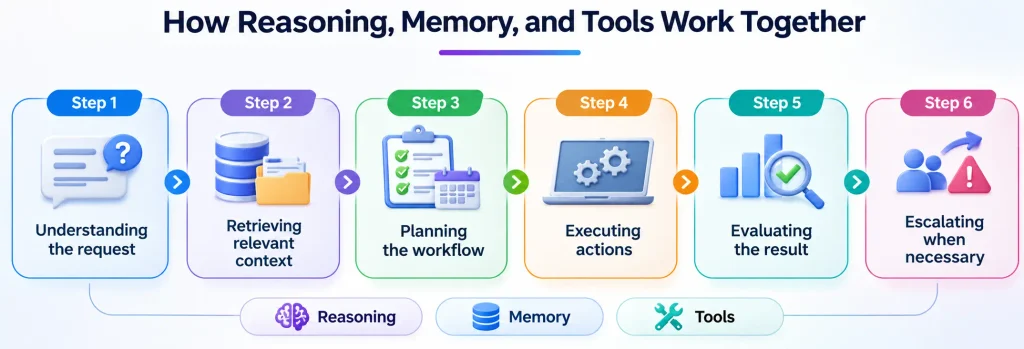
Step 1: Understanding the request
The agent receives an invoice query and uses reasoning to identify the required outcome.
Step 2: Retrieving relevant context
It accesses memory and enterprise knowledge sources to retrieve vendor history, previous exceptions, purchase order details, and applicable financial policies.
Step 3: Planning the workflow
The reasoning component evaluates the retrieved information and determines which verification steps are required.
Step 4: Executing actions
The agent uses tools to retrieve ERP records, compare invoice information, and update the relevant workflow status.
Step 5: Evaluating the result
It examines the tool responses, checks whether the discrepancy has been resolved, and determines the next action.
Step 6: Escalating when necessary
If the information is incomplete or the transaction requires additional approval, the agent routes the case to the appropriate human reviewer.
This integrated approach illustrates how AI agent reasoning memory tools GBS capabilities can support end-to-end process execution rather than isolated task automation.
Technical Considerations for GBS AI Agent Deployment
Building an intelligent agent is only one part of enterprise implementation. GBS organisations must also evaluate the architecture, security controls, scalability, and operational governance required for production deployment.
The following considerations are particularly important.
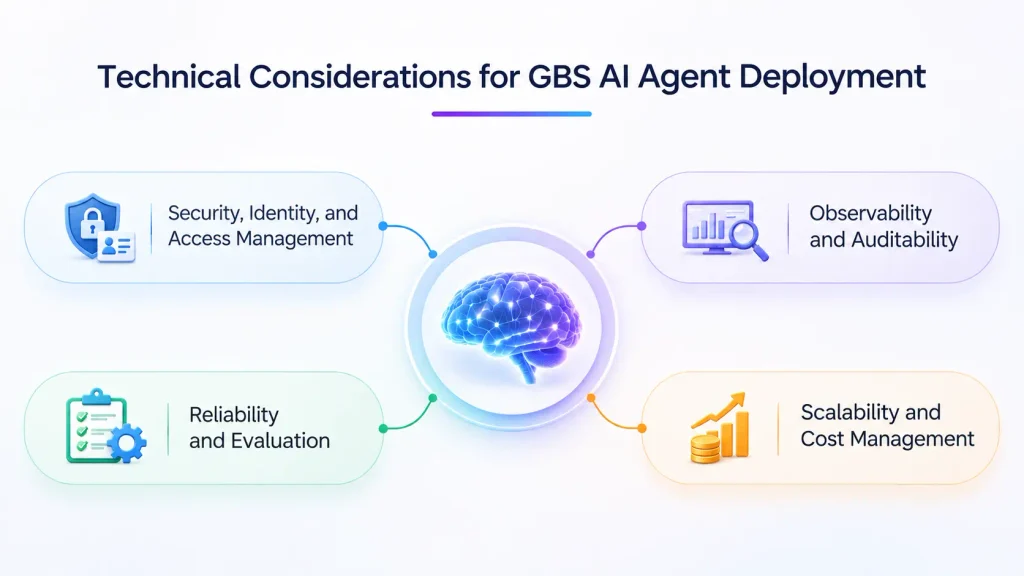
1. Security, Identity, and Access Management
Agents must operate under clearly defined identities and permissions. Role-based access control (RBAC), attribute-based access control (ABAC), and least-privilege principles can help restrict access to authorised resources.
Sensitive operations should require additional validation or human approval. Organisations must also ensure that retrieved information respects user-level permissions and data boundaries.
2. Observability and Auditability
Enterprise agents should provide visibility into their decision-making process and execution history.
Important observability components include:
- Tool invocation logs and execution outcomes.
- Workflow traces and state transitions.
- Token consumption and latency metrics.
- Error rates and escalation frequency.
- Policy violations and access-denied events.
- Human approval and intervention records.
These metrics help technical teams identify failures, optimise performance, and demonstrate operational accountability.
3. Reliability and Evaluation
AI agents can produce inconsistent outputs, select inappropriate tools, or fail when external systems return unexpected results. GBS organisations should establish evaluation frameworks that test reasoning accuracy, retrieval relevance, tool selection, execution reliability, and policy compliance.
Testing should include normal scenarios, edge cases, adversarial inputs, and failure conditions. Production monitoring should complement pre-deployment evaluation rather than replace it.
4. Scalability and Cost Management
Enterprise deployments must account for concurrent requests, model inference costs, retrieval infrastructure, API usage, and workflow execution overhead. Techniques such as model routing, caching, context optimisation, asynchronous execution, and task-specific model selection can help improve efficiency.
A scalable architecture should also support workload isolation, system-level rate limits, and graceful degradation when dependent services become unavailable.
Evaluating an AI Agent Architecture for GBS
Before selecting or expanding an AI agent deployment, GBS leaders should assess whether the underlying architecture supports enterprise requirements.
A practical evaluation framework includes:
| Evaluation Area | What to Assess |
| Reasoning | Task decomposition, planning, decision accuracy, and exception handling |
| Memory | Context retention, retrieval quality, knowledge freshness, and data governance |
| Tools | API coverage, integration flexibility, permissions, and execution reliability |
| Security | Identity management, access controls, encryption, and audit trails |
| Governance | Human oversight, policy enforcement, and accountability |
| Performance | Latency, scalability, reliability, and operating costs |
Organisations should also evaluate how easily they can monitor, update, test, and reuse agents across different business functions. A technically capable agent is not necessarily an enterprise-ready agent. Production readiness depends on the complete operating model, including integration architecture, security, governance, and ongoing performance management.
Conclusion
The successful deployment of AI agents in global business services requires a strong foundation built around reasoning, memory, and tools. Reasoning enables agents to interpret complex objectives and make contextual decisions. Memory provides continuity by retaining and retrieving relevant information. Tools connect these capabilities to enterprise applications, allowing agents to execute real business operations.
For GBS organisations, the opportunity lies in bringing these capabilities together within a secure, observable, and scalable architecture. The AI agent reasoning memory tools GBS framework provides a useful foundation for evaluating whether an agent can move beyond conversational assistance and deliver dependable operational outcomes.
As enterprises progress toward more autonomous workflows, decision-makers should prioritise agents that demonstrate measurable accuracy, controlled execution, strong governance, and seamless enterprise integration. These are the capabilities that will determine whether AI agent deployments become isolated automation experiments or sustainable components of the GBS operating model.