








Key Takeaways
- Automation success depends on governance, not just technology. The biggest risks in finance automation stem from poor process design, weak governance, and inadequate organizational readiness—not from the automation platform itself.
- Automation risk management should be embedded throughout the project lifecycle. Assessing readiness, designing secure workflows, validating implementations, and continuously monitoring performance are essential for long-term success.
- AI introduces new governance challenges for finance leaders. As organizations adopt intelligent and Agentic AI, they must establish controls for explainability, accountability, compliance, and human oversight.
- Effective risk management requires a holistic approach. Organizations should address operational, data, AI, compliance, cybersecurity, and change management risks together rather than treating them as separate initiatives.
- Future-ready finance organizations treat risk as a strategic enabler. Enterprises that integrate automation risk management into their finance transformation programs are better positioned to achieve scalable automation, stronger compliance, and sustainable business value.
Finance automation has entered a new phase. Organizations are no longer automating isolated tasks such as invoice capture or payment approvals; they are redesigning entire finance operating models around intelligent workflows, AI-driven decision-making, and autonomous process execution.
From accounts payable and cash application to financial close and compliance reporting, automation is reshaping how finance functions operate. According to multiple industry studies, enterprises continue to increase investments in intelligent automation, process mining, and AI because these technologies promise faster cycle times, lower operating costs, improved compliance, and better visibility across financial operations.
Yet, despite unprecedented investment, many automation initiatives fail to deliver their expected business value.
The challenge is rarely the technology itself.
Today’s automation platforms have become increasingly mature. They integrate with enterprise resource planning (ERP) systems, leverage artificial intelligence for document understanding, orchestrate workflows across multiple applications, and provide sophisticated analytics. Technical capabilities are no longer the primary constraint.
The real differentiator lies in automation risk management.
As finance operations become increasingly autonomous, organizations must manage risks that extend well beyond implementation. Data quality, governance, AI explainability, cybersecurity, regulatory compliance, organizational readiness, and operational resilience are now central to successful automation strategies.
Rather than asking, “How quickly can we automate?” Finance leaders are increasingly asking a different question: “How can we automate responsibly while maintaining governance, transparency, and operational control?” This shift represents one of the most significant changes in modern finance transformation.
Automation Changes the Nature of Financial Risk
Historically, finance risk management focused on human activities. Organizations designed internal controls to prevent manual errors, unauthorized approvals, fraud, duplicate payments, and inaccurate reporting. Risk frameworks evolved around people making decisions, following policies, and documenting exceptions.
Automation fundamentally changes this model.
When workflows become automated, business rules—not employees—determine how transactions move through the organization. AI models classify invoices, recommend coding, prioritize collections, and increasingly make operational decisions with minimal human intervention.
This creates a different category of enterprise risk. Instead of worrying solely about human error, organizations must evaluate whether automated decisions are accurate, explainable, compliant, and resilient to changing business conditions.
For example, an incorrectly configured approval workflow can process thousands of invoices before anyone identifies the problem. An AI model trained on incomplete historical data may consistently misclassify suppliers or expense categories. Poor integration between ERP systems can introduce financial inconsistencies that are difficult to detect during month-end close.
Automation reduces certain operational risks while simultaneously creating new ones. This is why automation risk management should not be viewed as a compliance exercise. It is an essential capability that enables organizations to scale intelligent automation without compromising governance or financial integrity.
Why Technology Is Rarely the Reason Automation Projects Underperform
When automation initiatives fail, software vendors often receive the blame. However, post-implementation reviews reveal a different picture. In many enterprise transformation programs, technology performs exactly as designed. The shortcomings emerge from decisions made before implementation begins.
Organizations frequently automate fragmented processes without addressing process inefficiencies. They migrate inconsistent data into new platforms, underestimate integration complexity, or fail to establish ownership for automated decision-making.
These issues accumulate over time. Finance teams begin creating manual workarounds, approval bottlenecks reappear, users lose confidence in automated outputs, and expected productivity improvements never materialize. This explains why organizations with similar automation technologies often achieve dramatically different business outcomes.
The difference is not platform capability; it is implementation maturity.
Successful organizations recognize automation as an operating model transformation rather than a software deployment. They invest in governance, process redesign, data quality, organizational change, and continuous optimization long before workflows become automated. In other words, they integrate automation risk management into every stage of transformation rather than treating it as a post-implementation review.
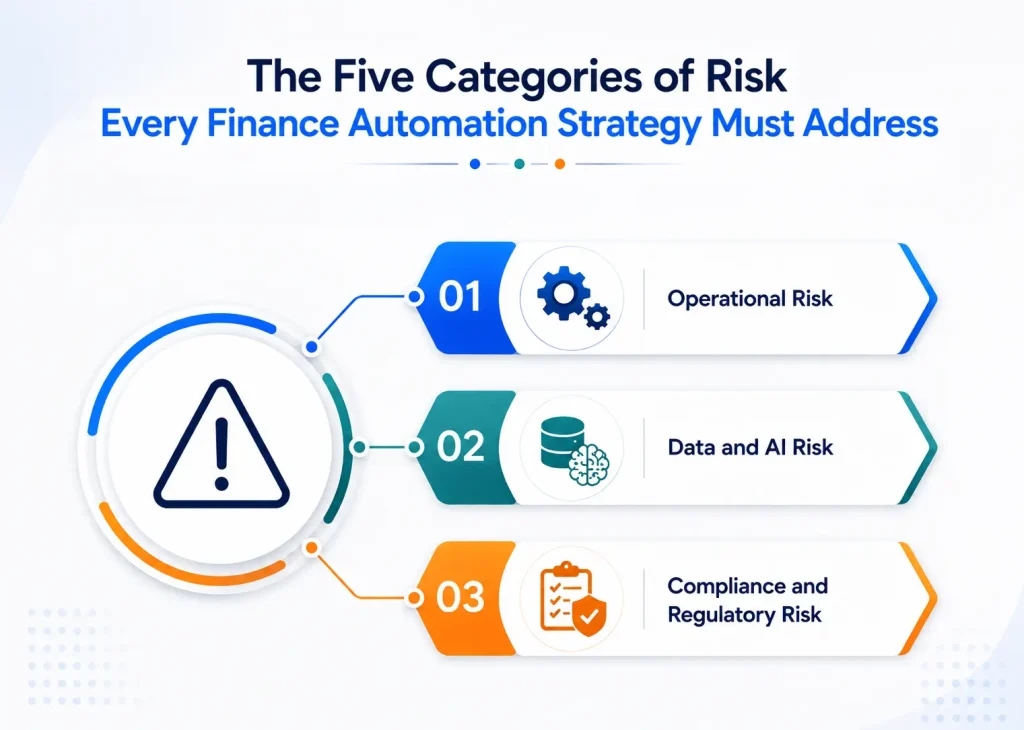
The Five Categories of Risk Every Finance Automation Strategy Must Address
While every organization has unique operational challenges, enterprise automation risks generally fall into five interconnected categories.
1. Operational Risk
Operational risk remains the most visible challenge in finance automation. Many organizations attempt to automate processes that have evolved over years of policy exceptions, regional variations, and manual interventions. Instead of simplifying complexity, automation often reinforces it.
Consider an accounts payable process where invoice approvals differ across departments, business units, and geographic regions. Automating these inconsistencies without redesigning the workflow simply digitizes inefficiency.
Operational risks commonly include:
- Inefficient process design
- Excessive workflow exceptions
- Inconsistent approval rules
- Manual overrides
- Limited process standardization
Leading organizations address these risks through process discovery and process mining before automation begins. Rather than asking, “What can we automate?” they first determine, “Which processes are mature enough to automate?” This distinction significantly improves long-term automation success.
2. Data and AI Risk
Artificial intelligence has become central to modern finance automation. Machine learning models extract invoice data, predict payment behavior, classify expenses, identify anomalies, and recommend operational actions.
However, AI performance depends entirely on data quality. Poor master data, duplicate suppliers, incomplete purchase order information, inconsistent tax records, or outdated customer information directly reduce model accuracy.
Unlike traditional software, AI systems also introduce additional governance considerations.
Organizations must understand:
- How models reach decisions
- Whether recommendations can be explained
- How model performance changes over time
- Whether bias exists within historical training data
- When human intervention should override AI recommendations
Without structured governance, AI introduces uncertainty into financial operations. Effective automation risk management therefore requires continuous monitoring of both data quality and AI performance rather than assuming models remain accurate after deployment.
3. Compliance and Regulatory Risk
Finance automation directly influences financial reporting, audit readiness, taxation, internal controls, and regulatory compliance. As organizations automate approvals and transaction processing, control environments become embedded within workflow configurations instead of manual review procedures.
A single configuration error can create compliance exposure across thousands of transactions.
Examples include:
- Violating segregation-of-duty requirements
- Missing approval thresholds
- Incorrect tax calculations
- Inadequate audit documentation
- Improper document retention
Regulatory expectations are also evolving. Auditors increasingly evaluate automated controls, AI governance practices, and digital audit trails rather than relying solely on traditional manual documentation.
Consequently, compliance teams should participate throughout automation design—not only during testing or post-implementation audits. Organizations that integrate compliance into workflow architecture build stronger operational resilience while reducing future remediation costs.
Building an Enterprise Automation Risk Management Framework
Managing automation risks requires more than a checklist of controls. It demands a governance framework that evolves alongside the organization’s automation maturity.
A practical framework consists of four interconnected stages
1. Assess Organizational Readiness
Before selecting technology, organizations should evaluate the maturity of their finance processes, data quality, governance structures, integration landscape, and workforce readiness. This assessment helps identify risks that could undermine implementation and establishes a realistic transformation roadmap.
2. Design with Governance Built In
Risk mitigation should be embedded into workflow design rather than added during testing. Approval hierarchies, segregation-of-duty controls, exception handling, audit logging, and AI oversight mechanisms should all be defined during solution architecture.
3. Validate Before Scaling
Pilot deployments provide an opportunity to test automation under real business conditions. Organizations should validate integration performance, AI accuracy, security controls, compliance requirements, and user adoption before expanding automation across business units or regions.
4. Monitor and Continuously Improve
Automation is not a one-time implementation. Business rules evolve, regulations change, AI models drift, and operational priorities shift over time. Continuous monitoring enables organizations to identify emerging risks, optimize workflows, and maintain compliance as automation scales.
This lifecycle approach transforms automation risk management from a reactive control function into a continuous capability that supports long-term operational resilience.
The Future of Automation Risk Management in the Age of Agentic AI
The next generation of finance automation will be defined by autonomous AI agents capable of planning, reasoning, and executing complex business processes with minimal human intervention.
Unlike traditional automation, which follows predefined rules, Agentic AI can dynamically evaluate situations, adapt workflows, and make context-aware decisions. This shift has the potential to transform finance operations by accelerating decision-making, improving responsiveness, and enabling higher levels of straight-through processing.
However, greater autonomy also raises new governance challenges.
Organizations will need to determine the following:
- Which financial decisions AI agents are authorized to make independently.
- When human approval remains mandatory.
- How AI-generated decisions are documented and explained.
- How model behavior is monitored and corrected over time.
- How regulatory compliance is maintained in increasingly autonomous environments.
These questions highlight an important reality: the future of finance automation is not simply about deploying more intelligent technologies—it is about establishing governance models that allow organizations to trust those technologies at scale.
For CFOs, this means expanding risk management beyond financial controls to include AI governance, model accountability, ethical decision-making, and operational resilience. Organizations that develop these capabilities early will be better positioned to adopt autonomous finance operations with confidence.
Conclusion
Finance automation has evolved from a productivity initiative into a strategic transformation of the finance operating model. While intelligent automation and AI offer significant opportunities to improve efficiency, accuracy, and scalability, they also introduce new categories of operational, regulatory, cybersecurity, and organizational risk.
Technology alone does not determine the success of automation projects. Sustainable outcomes depend on governance, high-quality data, resilient processes, effective change management, and continuous oversight.
Organizations that embed automation risk management into every stage of the automation lifecycle from process assessment and solution design to deployment and ongoing monitoring are more likely to achieve lasting business value while maintaining compliance and operational control.
As finance continues its transition toward AI-enabled and autonomous operations, managing automation risks will become a defining capability for modern finance leaders. The organizations that treat risk management as a strategic enabler, rather than a compliance obligation, will be best positioned to realize the full potential of intelligent automation.