








Key Takeaways
- AI-powered AR analytics connects user interactions with measurable business outcomes.
- Traditional analytics measure activity, while AI uncovers patterns, predicts behavior, and identifies optimization opportunities.
- Leading organizations use AR analytics to improve productivity, conversions, and customer experiences.
- A four-layer maturity framework helps businesses evolve from usage tracking to predictive analytics.
- Combining AR with AI-driven automation enables enterprises to maximize ROI and make smarter decisions.
If you’re already running AR experiences—product try-ons, field service overlays, training simulations, or retail wayfinding—you’ve probably encountered the same challenge every AR team eventually faces: you can see that people are using AR, but you can’t easily prove whether it’s delivering measurable business value.
That’s where AR analytics becomes essential. Modern AR applications generate a vast amount of spatial, behavioral, and interaction data, but collecting data alone doesn’t explain why users abandon an experience, struggle with object placement, or fail to complete a workflow. More importantly, it doesn’t reveal whether your AR investment is improving conversions, reducing operational errors, or enhancing customer engagement.
Session counts and heatmaps tell you what happened. They don’t tell you why a user abandoned a virtual try-on flow after twelve seconds, which spatial anchor is causing tracking drift, or whether your AR feature is genuinely increasing conversions instead of simply creating an engaging demonstration.
AI-powered AR analytics closes that gap. By combining machine learning with spatial interaction data, organizations can identify hidden behavioral patterns, predict user drop-offs, detect performance anomalies, and directly connect AR experiences to measurable business outcomes. From Fortune 100 manufacturers improving production quality to global retailers increasing online conversions, AI is transforming AR analytics from a reporting tool into a strategic decision-making capability.
Why AR Analytics Needs AI
Traditional analytics tools were designed for websites and mobile applications, where user interactions are limited to clicks, page views, and navigation paths. Augmented reality experiences are far more dynamic, generating spatial, behavioral, and environmental data that conventional analytics cannot fully interpret. This is where AI enhances AR analytics, transforming raw interaction data into actionable business intelligence.
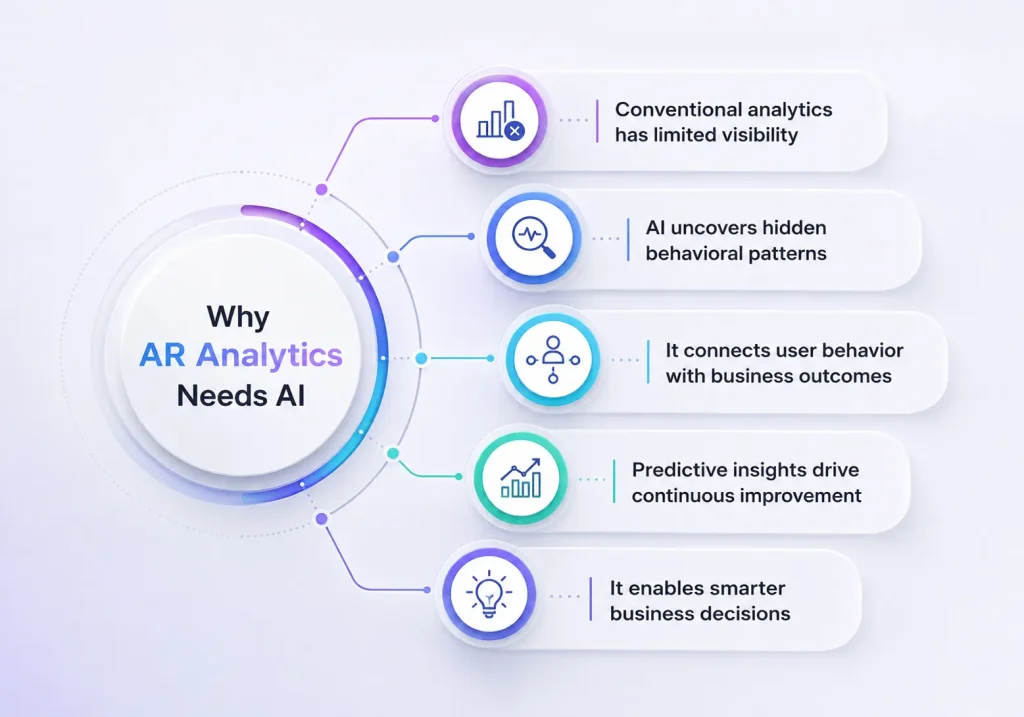
- Conventional analytics has limited visibility. Traditional dashboards can track metrics such as session duration, interaction counts, and device usage, but they rarely explain why users abandon an AR experience or where they encounter friction.
- AI uncovers hidden behavioral patterns. By analyzing spatial interactions, gesture sequences, gaze paths, and movement patterns, AI identifies trends that would be difficult to detect through manual analysis alone.
- It connects user behavior with business outcomes. AI-powered AR analytics links engagement metrics to KPIs such as conversion rates, task completion time, operational efficiency, product returns, and customer satisfaction, providing a clearer picture of ROI.
- Predictive insights drive continuous improvement. Instead of simply reporting historical data, AI can predict user drop-offs, detect anomalies, and recommend optimizations before they negatively impact performance.
- It enables smarter business decisions. As AR deployments scale across industries, AI-powered insights help organizations prioritize improvements, allocate resources effectively and continuously optimise immersive experiences based on measurable outcomes.
The Evidence: What AI-Powered AR Measurement Has Actually Delivered
The value of AR analytics is no longer theoretical. Across industries, organizations are using AI-powered analytics to measure how augmented reality impacts operational efficiency, customer engagement, and revenue. Instead of relying on usage metrics alone, leading enterprises are tracking AR experiences against measurable business outcomes such as conversion rates, task completion times, production quality, and customer satisfaction.
In manufacturing, Boeing demonstrated how AR can improve operational performance by using AR-guided instructions for wire harness assembly. The initiative reduced production time by 25% while significantly improving first-time quality and minimizing assembly errors. Rather than simply measuring headset usage, Boeing evaluated how AR influenced productivity and accuracy, providing a clear business case for expanding the technology across production workflows.
The retail industry has also seen measurable gains from AR-driven customer experiences. According to Shopify, products presented with AR or 3D visualization achieved a 94% higher conversion rate compared to traditional product images. By allowing customers to interact with products before purchasing, retailers were able to reduce uncertainty and create more confident buying decisions.
Beyond increasing sales, AR analytics also helps organizations improve customer satisfaction after the purchase. Retailers have used AR furniture visualization to help shoppers make better buying decisions, leading to larger average order values and fewer product returns. By analyzing customer interactions throughout the AR experience, businesses learn valuable information about which features encourage engagement and which areas require optimization.
These examples highlight an important shift in how organizations evaluate augmented reality initiatives. Success is no longer measured by the number of AR sessions or interaction counts alone. Instead, AR analytics enables enterprises to connect user behavior with meaningful business outcomes—whether that’s improving production efficiency, increasing conversion rates, reducing operational errors, or enhancing the overall customer experience.
The common thread across these success stories is that AI transforms AR analytics from a reporting tool into a decision-making capability. By uncovering patterns in user behavior, predicting friction points, and linking immersive experiences to business KPIs, organizations can continuously optimize their AR investments and maximize long-term return on investment.
A Framework: The Four Layers of AR Measurement Maturity
Most organizations don’t suffer from a lack of AR data—they struggle to transform that data into meaningful business intelligence. As AR deployments mature, so should the way they’re measured. While many enterprises still focus on engagement metrics such as sessions and interactions, these insights alone rarely explain whether an AR initiative is delivering measurable value.
The challenge isn’t collecting more data; it’s understanding which metrics truly matter. Organizations that successfully scale AR initiatives move beyond tracking user activity and begin measuring how immersive experiences influence operational efficiency, customer behavior, and business performance.
| Layer | What You Can Answer | What’s Typically Measured | Example |
| 1. Usage | Are people using the AR experience? | Session count, session duration, device type, feature adoption | Understanding how frequently an AR application is accessed. |
| 2. Behavior | How are users interacting with the experience? | Gesture sequences, gaze paths, dwell time, object interactions, navigation flow | Identifying where users hesitate or disengage during a virtual try-on. |
| 3. Outcome | Is AR improving business performance? | Conversion rate, task completion time, operational efficiency, error rate, product returns | Measuring whether AR reduces assembly errors or increases online sales. |
| 4. Prediction | What is likely to happen next? | Drop-off prediction, anomaly detection, user segmentation, behavioral forecasting | Predicting abandonment risks and recommending proactive optimizations before KPIs decline. |
While every organization begins at Layer 1, the greatest business value is realized at Layers 3 and 4. This is where AI-powered AR analytics distinguishes itself from conventional reporting tools. Rather than simply presenting dashboards, AI correlates user behavior with business outcomes, identifies hidden trends, predicts future performance, and recommends improvements that drive measurable ROI.
An important distinction is that AI isn’t essential for basic usage or behavioral reporting. Traditional analytics platforms and AR SDKs can capture sessions, interactions, and engagement metrics effectively. AI becomes indispensable when organizations need to understand why performance changes, forecast future outcomes, and continuously optimize AR experiences based on real business objectives. This shift from descriptive reporting to predictive intelligence is what separates modern AR analytics from traditional performance measurement.
Next Step
As augmented reality becomes an integral part of customer experiences and enterprise operations, measuring its success requires more than tracking sessions and interactions. Organizations need to understand how AR influences business outcomes such as conversion rates, operational efficiency, productivity, and customer satisfaction. That’s where AR analytics powered by AI delivers its greatest value.
By combining spatial data with intelligent analytics, businesses can move beyond descriptive reporting to uncover actionable insights, predict user behavior, and continuously optimize AR experiences. Whether you’re enhancing retail engagement, improving workforce training, or streamlining field operations, AI-powered AR analytics provides the visibility needed to maximize the return on every AR investment.
Ready to Unlock the Full Potential of AR Analytics?
At Auxiliobits, we help enterprises transform immersive technologies into measurable business outcomes through AI-driven automation and intelligent analytics. Whether you’re building your first AR solution or looking to optimize an existing deployment, our experts can help you develop a data-driven strategy that delivers lasting value.
Explore our Agentic Process Automation and Intelligent Enterprise Automation services to discover how AI can help you turn AR insights into smarter decisions, greater efficiency, and sustainable business growth.