








Key Takeaways
- Look beyond the feature list: Integration, implementation, support, scalability, and adoption often determine ROI more than the number of features a vendor offers.
- Evaluate vendors against your real environment: Test platforms using your own invoices, approval workflows, ERP setup, and business requirements—not polished demo data.
- Use a weighted scorecard: Score vendors consistently across integration, accuracy, workflows, controls, pricing, implementation, support, and compliance.
- Validate the economics at scale: Assess total cost, implementation fees, per-invoice pricing, and what happens to costs if invoice volume doubles.
- Treat implementation and support as decision criteria: A strong platform can still underperform if onboarding is slow, support is weak, or the contract provides no clear exit path.
You’ve already completed the most difficult part.
You know that accounts payable automation is worth it. You’ve calculated the hours lost to manual invoice matching, the late-payment penalties, the duplicate payments that slipped through, and the audit headaches every quarter-end. Your business case is built. Your budget is (probably) approved.
Now comes the decision that actually determines whether this investment pays off: picking the right AP automation vendor.
This is the step where even the best projects can fail to deliver. Teams pick a vendor based on a slick demo, sign a multi-year contract, and discover six months later that the tool doesn’t handle their approval hierarchy, can’t integrate with their ERP without a six-figure consulting engagement, or charges per-invoice fees that erase the ROI they modeled.
This guide is built for exactly where you are: evaluating real vendors, comparing real capabilities, and trying to avoid a costly mistake. Below is the evaluation framework, comparison criteria, and vendor scorecard we recommend using before you sign anything.
Why the Vendor Decision Matters More Than the Feature List
Most AP automation platforms now offer a similar baseline: OCR-based invoice capture, PO matching, and digital approval routing. On paper, many vendors look interchangeable. The differences that actually affect your ROI show up later — in implementation, in support responsiveness, in how the platform scales as invoice volume grows, and in how well it fits your existing finance stack.
Choosing the wrong AP automation vendor typically costs organizations in three ways:
- Sunk implementation costs when a platform requires expensive customization to match your workflows
- Extended time-to-value when onboarding drags from weeks into quarters
- Shadow processes when the tool doesn’t fit how your team actually works, so people quietly revert to email approvals and manual entry
The goal of this guide isn’t to help you find the vendor with the most features. It’s to help you find the vendor that will actually get adopted, actually integrate, and actually deliver the ROI you promised your CFO.
The 8-Point AP Automation Vendor Evaluation Framework
Use this framework to score every vendor on your shortlist consistently. We recommend scoring each category 1–5 and weighting them based on your priorities.
1. Integration Depth
Almost every AP automation vendor will claim ERP integration. The real question is what kind.
Ask specifically:
- Is the integration native and bi-directional, or a one-way data export?
- Does it sync in real time or on a batch schedule?
- Does it support your exact ERP version, or only the latest release?
- What happens to the integration during your ERP’s next major upgrade?
A vendor that can’t answer these precisely — or defers to “our implementation team will scope that” is signaling custom work and added cost later.
2. Invoice Capture Accuracy
Ask for a live demo using your invoices, not the vendor’s polished sample set. Look specifically at:
- Accuracy on non-standard formats (handwritten notes, scanned faxes, multi-currency, foreign-language invoices)
- How exceptions are routed when the OCR engine isn’t confident
- Whether accuracy improves over time (machine learning) or stays static
3. Approval Workflow Flexibility
Your approval hierarchy is probably not simple. Multi-entity structures, dollar-threshold routing, delegate approvals during PTO, and department-specific rules are common — and often underestimated during vendor demos.
Confirm the vendor can configure your actual approval matrix without professional services fees for every change.
4. Fraud Detection and Controls
Duplicate payment detection, vendor banking-detail change alerts, and three-way matching are baseline expectations in 2026, not premium add-ons. Ask vendors to walk through a specific fraud scenario and show you the control, not just describe it.
5. Scalability and Volume Pricing
Ask directly: “What happens to our cost per invoice if volume doubles next year?”
Some vendors price predictably per user or per entity. Others price per invoice, which can turn a strong first-year ROI into a much less attractive third-year cost curve as your business grows.
6. Implementation Timeline and Resourcing
Get a written implementation timeline with milestones, not a verbal estimate. Ask:
- How many hours of your team’s time does implementation require?
- Is there a dedicated implementation manager, or a shared support queue?
- What does a typical go-live delay look like, and why does it happen?
7. Support Model After Go-Live
The sales team’s responsiveness during your evaluation is not a preview of post-sale support. Ask for:
- Named support contact vs. ticketing-only support
- SLA response times by issue severity
- Whether ongoing configuration changes require a support ticket or can be self-managed
8. Security and Compliance Posture
At minimum, confirm SOC 2 Type II certification, data encryption standards, and role-based access controls. If your industry has specific compliance requirements (SOX, HIPAA, GDPR), confirm the vendor has existing customers who use the platform under those same requirements.
Vendor Comparison Scorecard
Use this table as a working document during your evaluation. Score each vendor 1–5 per category, then weight based on what matters most to your organization.
| Evaluation Criteria | Weight | Vendor A | Vendor B | Vendor C |
| ERP integration depth | High | |||
| Invoice capture accuracy | High | |||
| Approval workflow flexibility | High | |||
| Fraud & duplicate payment controls | High | |||
| Pricing model transparency | Medium | |||
| Implementation timeline | Medium | |||
| Post-sale support model | Medium | |||
| Security & compliance certifications | High | |||
| Total weighted score |
Circulate this scorecard to everyone involved in the decision — AP team leads, controllers, IT, and procurement — and have each stakeholder score independently before comparing notes. This surfaces disagreements early, before they become post-implementation friction.
The ROI Question Every Vendor Should Be Able to Answer Clearly
A serious AP automation vendor should be able to walk you through ROI math specific to your invoice volume, not just hand you a generic calculator. At minimum, ask them to model:
- Cost per invoice today (fully loaded, including labor, paper, postage, and error correction) vs. projected cost with automation
- Days Payable Outstanding (DPO) impact and any early-payment discount capture the platform enables
- Error and duplicate-payment reduction, based on data from comparable customers
- Time-to-payback on the platform’s total cost, including implementation and any ongoing per-invoice fees
If a vendor is vague on these numbers or unwilling to show comparable customer benchmarks, treat that as a signal — not a paperwork gap.
Questions to Ask During the Final Demo
By this stage, you’re not evaluating whether AP automation works in general. You’re evaluating whether this specific vendor will work for your specific environment. Bring these questions to your final demos:
- Can you show this workflow using our actual invoice templates and approval hierarchy?
- What does a failed OCR match look like in your system, end to end?
- Can you connect us with a customer in our industry, at a similar invoice volume, for a reference call?
- What is included in the base contract vs. billed as professional services?
- What’s your average implementation timeline for a company our size, and what typically causes delays?
- How do you handle multi-entity or multi-currency AP if that applies to us?
- What does your contract’s exit clause look like if the platform underperforms?
A vendor confident in their product will welcome these questions. Vague or deflective answers here are far more predictive of your post-purchase experience than anything in the sales deck.
Red Flags to Watch For
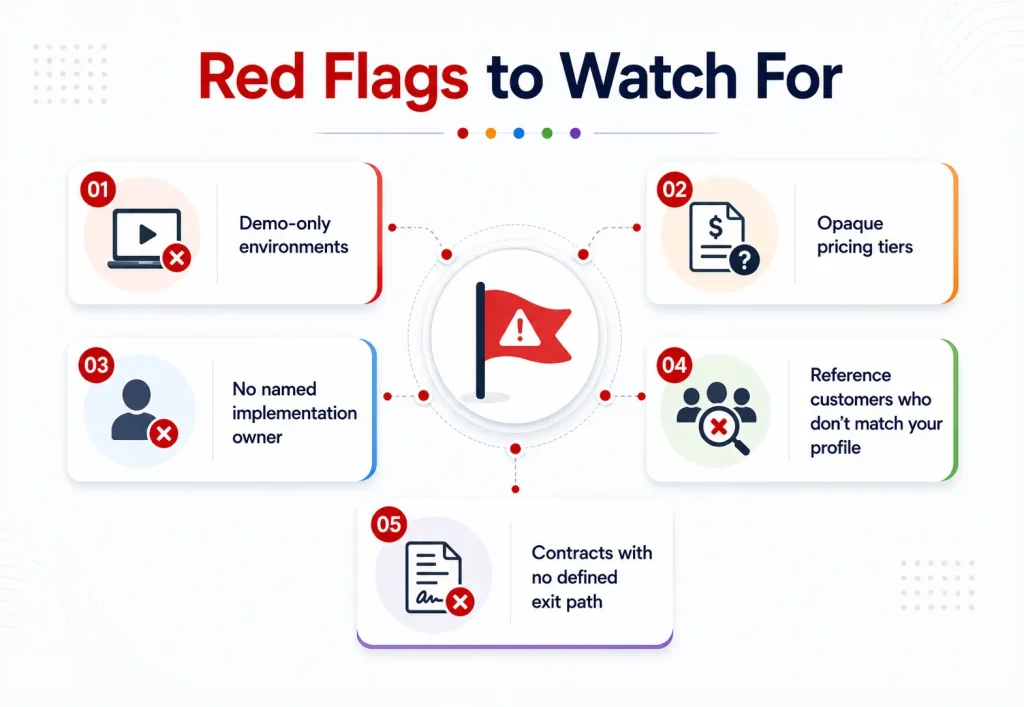
- Demo-only environments. If a vendor won’t test with your real invoices before contract signature, be cautious about what production performance will actually look like.
- Opaque pricing tiers. “Custom pricing” that can’t be roughly scoped until late in the sales cycle often signals that the vendor is holding back negotiation leverage, not genuine complexity.
- No named implementation owner. If nobody can tell you who manages your onboarding, expect your project to compete for attention with newer deals.
- Reference customers who don’t match your profile. A vendor strong with 50-person companies isn’t automatically strong at your 500-person, multi-entity scale, and vice versa.
- Contracts with no defined exit path. Multi-year lock-in with no clear off-ramp shifts risk entirely onto you if the implementation underperforms.
Your Vendor Selection Checklist
Before you sign, confirm you have:
- Completed the 8-point evaluation framework for every finalist vendor
- Tested the platform with your own invoices, not vendor samples
- Reviewed detailed, invoice-volume-specific ROI projections
- Confirmed pricing behavior at 2x your current volume
- Spoken with at least one reference customer at a similar size and industry
- Reviewed the implementation timeline and named your internal project owner
- Confirmed the post-sale support model and SLAs in writing
- Reviewed the contract’s exit terms
Making the Final Call
At this stage, the “best” AP automation vendor isn’t the one with the longest feature list — it’s the one whose integration depth, pricing model, and implementation approach match how your finance team actually operates today and how it needs to scale tomorrow.
If you’ve worked through the framework and scorecard above and still have two vendors close in score, the tiebreaker is almost always implementation and support quality because that’s what determines whether your team actually adopts the tool or quietly works around it.
Ready to see how your shortlist stacks up? Request a working demo using your invoice data, and ask for a customer reference in your industry before you sign. A vendor confident in their platform will make both easy.