








Global Business Services (GBS) organisations have spent years optimising operations through robotic process automation (RPA), intelligent automation, and centralised service delivery. However, the next phase of enterprise transformation is moving beyond automating individual tasks. It involves building intelligent systems capable of understanding objectives, making decisions, coordinating workflows, and executing actions across multiple business functions. This is where scaling agentic AI across GBS towers becomes a strategic priority.
Unlike traditional automation, which follows predefined rules and operates within limited boundaries, agentic AI introduces goal-oriented intelligence into enterprise operations. It enables organisations to move from isolated task bots to interconnected AI agents that can manage complex, end-to-end business processes. For GBS leaders, this shift represents more than a technology upgrade. It requires a fundamental rethink of operating models, process ownership, technology architecture, workforce capabilities, and governance.
From Task-Level Automation to Enterprise-Wide Intelligence
Traditional automation has primarily focused on individual activities such as invoice extraction, employee onboarding, purchase order validation, and report generation. While these solutions improve efficiency, they often operate independently, relying on predefined workflows and human intervention when exceptions arise.
Agentic AI changes this approach by introducing systems that can interpret business objectives, break them into smaller tasks, select appropriate tools, and coordinate actions to achieve the desired outcome.
For example, consider an accounts payable process. A conventional RPA bot might extract invoice information, validate predefined fields, and update an ERP system. An AI agent can go further by interpreting invoice discrepancies, retrieving supporting purchase orders, checking supplier records, communicating with relevant stakeholders, and recommending or initiating corrective actions within its authorised boundaries.
The difference becomes more significant when organisations start scaling agentic AI across GBS towers rather than deploying individual agents for isolated activities.
Instead of maintaining separate automation solutions for finance, HR, procurement, and IT, organisations can establish interconnected agent ecosystems that coordinate work across functional boundaries.
This transition introduces three important changes:
- From task execution to outcome ownership: Agents work towards defined business outcomes rather than simply completing individual instructions.
- From isolated automation to coordinated intelligence: Multiple specialised agents collaborate through shared workflows and orchestration mechanisms.
- From reactive processing to proactive operations: Agents can identify emerging issues, monitor process conditions, and initiate authorised actions before problems escalate.
The result is a shift from automation-led efficiency to intelligence-driven service delivery.
What Changes Across Individual GBS Towers?
The real value of agentic AI becomes visible when it is applied across different service towers. Each function has distinct processes, data requirements, decision boundaries, and risk considerations. Therefore, enterprise adoption requires a combination of specialised agents and shared orchestration capabilities.
1. Finance and Accounting
Finance is a strong candidate for agentic AI because it involves high-volume transactions, structured data, recurring workflows, and established approval mechanisms. Agents can support accounts payable, accounts receivable, financial reconciliation, expense management, financial close, and reporting.
For instance, an invoice-processing agent can extract information, validate entries against purchase orders, identify discrepancies, and route exceptions to the appropriate reviewer. A separate reconciliation agent can investigate mismatched transactions and gather supporting evidence.
When scaling agentic AI across GBS towers, finance agents can also coordinate with procurement agents to verify supplier information and resolve purchase-related discrepancies.
This creates an opportunity to improve straight-through processing, reduce manual intervention, and accelerate financial operations without removing necessary financial controls.
2. Human Resources
HR operations involve multiple interconnected processes, including recruitment, onboarding, payroll administration, employee queries, benefits management, and workforce reporting. Agentic AI can coordinate these activities through specialised agents.
For example, an onboarding agent can initiate documentation requests, verify submitted information, coordinate equipment provisioning with IT, and update relevant HR systems. If a document is missing, it can notify the employee and monitor the outstanding requirement.
However, decisions involving recruitment suitability, compensation, employee discipline, or sensitive personal matters should retain appropriate human oversight.
3. Procurement and Supply Chain
Procurement agents can support supplier discovery, vendor onboarding, purchase requisition validation, contract analysis, spend monitoring, and compliance checks.
Consider a purchase requisition that exceeds an established approval threshold. An agent can validate the request, retrieve relevant procurement policies, examine supplier information, and prepare an approval recommendation.
When connected to finance and supply chain systems, these agents can help organizations identify procurement bottlenecks, monitor supplier risks, and improve purchasing visibility.
4. IT and Enterprise Support
IT service management is another area where agentic AI can deliver meaningful operational improvements. Agents can classify service requests, investigate recurring incidents, retrieve troubleshooting information, recommend solutions, and execute authorised remediation actions.
For example, an IT support agent could investigate a failed application login by checking relevant system logs, identifying a possible access issue, and initiating an approved password-reset or access-request workflow.
More complex incidents can be escalated to human engineers with the investigation history and relevant evidence already assembled.
The Technology Architecture Required for Tower-Wide Agents
Deploying agents across multiple GBS functions requires more than connecting individual AI models to enterprise applications. Organisations need a scalable architecture that supports coordination, interoperability, security, and observability across all GBS functions.
A practical architecture typically includes five interconnected layers.
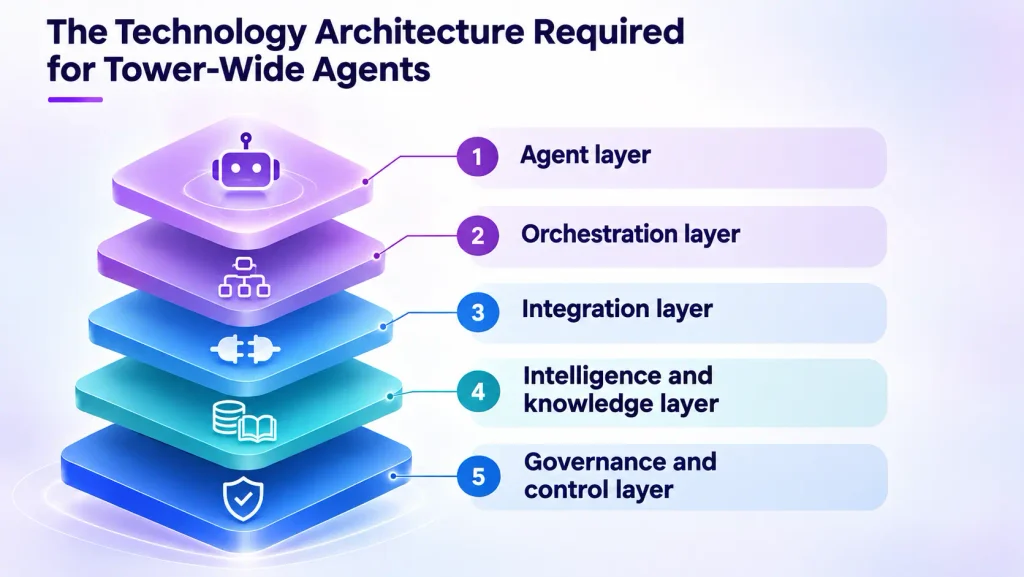
1. Agent layer: Contains specialised agents designed for specific business capabilities, such as invoice processing, employee support, supplier verification, and IT incident management.
2. Orchestration layer: Coordinates agents, distributes tasks, manages dependencies, maintains workflow states, and determines when human intervention is necessary.
3. Integration layer: Connects agents with ERP, CRM, HRMS, ITSM, procurement platforms, databases, APIs, and existing automation infrastructure.
4. Intelligence and knowledge layer: Provides access to enterprise knowledge bases, policies, business rules, retrieval-augmented generation (RAG), and contextual information.
5. Governance and control layer: Enforces identity management, access permissions, approval requirements, audit logging, policy compliance, and operational monitoring.
This layered architecture is essential for scaling agentic AI across GBS towers because it prevents every function from developing disconnected agent environments.
Organisations should also evaluate interoperability standards such as the Model Context Protocol (MCP) for connecting models with tools and data sources, and Agent2Agent (A2A) for communication between agents. These protocols can help reduce integration complexity, although they do not replace enterprise security, identity, and orchestration controls.
Data Integration and Context Sharing Become Critical
An agent is only as effective as the information it has access to. In a GBS environment, business data is frequently distributed across different applications, databases, document repositories, and regional systems.
A finance agent may require invoice information from an ERP, supplier details from a procurement platform, and approval policies from an internal knowledge repository. Without reliable access to these sources, it cannot make well-informed decisions.
Therefore, scaling agentic AI across GBS towers requires organisations to establish a consistent data foundation.
Key considerations include:
- Data standardisation: Establish consistent definitions, formats, identifiers, and business terminology across functions.
- Data accessibility: Provide secure, role-based access to relevant enterprise information through APIs and controlled integration mechanisms.
- Knowledge management: Maintain accurate, version-controlled policies, process documentation, and operational guidelines.
- Data lineage: Track where information originates, how it is transformed, and which agents use it.
- Context management: Ensure agents receive relevant workflow history, business rules, and task-specific information without exposing unnecessary data.
Organisations should also implement data-quality checks and mechanisms to detect outdated or conflicting information.
A shared data foundation does not necessarily mean creating one centralised database. It means enabling controlled access to reliable information across existing enterprise systems.
Governance, Security, and Human Oversight at Scale
One of the most significant differences between deploying a single AI agent and managing an enterprise-wide agent ecosystem is the expansion of operational risk.
An individual agent might access one application and perform a limited activity. A network of agents could interact with multiple enterprise systems, exchange information, trigger transactions, and influence decisions across several functions.
This increases the importance of governance. When scaling agentic AI across GBS towers, organisations should establish a common governance framework that covers the entire agent lifecycle.
Important controls include:
1. Identity and access management: Every agent should have a distinct identity, defined permissions, and access limited to the resources necessary for its responsibilities.
2. Role-based authorisation: Agents should operate within clearly defined authority boundaries. Access to sensitive employee records, financial transactions, and supplier information must be restricted.
3. Human-in-the-loop controls: High-impact activities, exceptions, and sensitive decisions should require appropriate human review and approval.
4. Auditability: Organisations should maintain records of agent instructions, tool calls, data access, decisions, approvals, and resulting actions.
Continuous monitoring: Agents should be evaluated for performance degradation, unexpected behaviour, policy violations, and unusual transaction patterns.
Exception management: Clearly defined escalation mechanisms should allow agents to pause workflows and transfer unresolved cases to human specialists.
The NIST AI Risk Management Framework and its Generative AI Profile provide useful guidance for identifying, assessing, and managing AI-related risks.
The objective is not to eliminate autonomy. It is to ensure that autonomy remains controlled, explainable, and aligned with business accountability.
Workforce Transformation and the New GBS Operating Model
Agentic AI will change not only how work is performed but also how GBS teams are organised. In traditional shared services, employees spend considerable time processing transactions, handling repetitive requests, validating information, and coordinating activities between departments.
With agentic AI, many of these activities can be delegated to digital agents. Human employees increasingly take responsibility for exception handling, complex decision-making, agent supervision, process optimisation, and strategic business support.
This requires new roles and capabilities, including:
- Agent supervisors: Monitor agent performance, resolve escalations, and ensure adherence to operational policies.
- AI operations specialists: Manage agent deployment, monitoring, version control, and lifecycle maintenance.
- Process architects: Redesign end-to-end workflows to accommodate agent-driven execution.
- AI governance professionals: Establish policies, assess risks, and monitor compliance.
- Business domain experts: Provide specialised knowledge and validate decisions in complex operational scenarios.
For leaders scaling agentic AI across GBS towers, workforce planning must therefore move beyond estimating the number of tasks automated. It should consider how responsibilities, skills, team structures, and service ownership will evolve.
GBS organisations will increasingly need to manage a blended workforce in which human employees and digital agents collaborate within clearly defined operating structures.
A Practical Roadmap for Scaling Agentic AI Across GBS
Enterprise-wide implementation should follow a structured approach rather than introducing agents across every function simultaneously.
A phased strategy helps organisations establish technical foundations, validate business value, and manage operational risks.
Phase 1: Assess Process Readiness
Begin by identifying processes suitable for agentic execution. Evaluate transaction volumes, process complexity, data availability, exception rates, business impact, and existing automation maturity. Prioritise processes with measurable outcomes, stable operating procedures, and manageable risk profiles.
Phase 2: Build a Cross-Functional Foundation
Establish shared integration capabilities, identity management, data access policies, orchestration infrastructure, and governance standards. This prevents individual towers from creating incompatible agent environments.
Phase 3: Launch Controlled Pilots
Start with a small number of clearly defined use cases within selected GBS towers. For example, organisations might pilot invoice exception management in finance, employee query resolution in HR, and incident classification in IT. Measure operational improvements against existing baselines before expanding deployment.
Phase 4: Introduce Cross-Tower Orchestration
Once individual agents demonstrate reliability, connect them through shared workflows. A procurement request, for example, may involve procurement, finance, compliance, and supplier management agents. At this stage, scaling agentic AI across GBS towers becomes an operating-model transformation rather than a collection of independent automation projects.
Phase 5: Optimise and Expand Continuously
Monitor agent performance, review exceptions, improve knowledge sources, update workflows, and expand into additional processes. Organisations should also establish clear procedures for agent versioning, testing, rollback, and retirement.
Measuring Business Value Beyond Automation Rates
Traditional automation programmes often measure success through hours saved, transaction volumes processed, and reductions in manual effort. These metrics remain relevant, but they are insufficient for evaluating an interconnected agent ecosystem.
A more comprehensive performance framework should include:
| Measurement area | Important KPIs |
| Operational efficiency | Cycle time, cost per transaction, throughput |
| Process quality | Error rates, first-time-right percentage, rework |
| Agent performance | Task completion rate, escalation rate, tool-call success |
| Business outcomes | SLA attainment, working capital, employee experience |
| Risk and compliance | Policy violations, unauthorised actions, audit exceptions |
| Financial performance | Total cost of ownership, realised ROI, operating savings |
Importantly, organisations should distinguish between gross productivity improvements and realised financial benefits.
For example, reducing manual processing time does not automatically translate into lower operating costs. The savings must be connected to actual changes in workforce capacity, service volumes, operating expenditure, or business performance.
When scaling agentic AI across GBS towers, leaders should also evaluate the total cost of ownership, including model usage, infrastructure, integration, security, monitoring, and ongoing maintenance. This provides a more realistic view of long-term value.
What Does the Future of Agentic GBS Look Like?
The future of GBS will be shaped by interconnected intelligence rather than isolated automation capabilities. As agent ecosystems mature, organisations will be able to coordinate workflows across finance, HR, procurement, IT, and supply chain through shared orchestration and enterprise-wide context.
GBS will gradually evolve from a centralised service delivery function into a strategic operating layer that connects business processes, enterprise data, human expertise, and autonomous digital capabilities.
However, achieving this transformation will depend on more than deploying advanced AI models. Organisations must invest in process redesign, interoperable architecture, reliable data, governance, and workforce readiness.
Ultimately, scaling agentic AI across GBS towers is not about introducing more bots or increasing the number of AI deployments. It is about building a coordinated, accountable, and continuously improving operating ecosystem that delivers measurable business outcomes.
For GBS leaders evaluating their next phase of transformation, the question is no longer simply which tasks they can automate. It is about how intelligently the entire service delivery model can operate.