









Shared services directors are facing a structural change in how enterprise operations are funded, measured, and transformed. Rising workloads, limited budgets, AI adoption, and growing demands for strategic value are converging at the same time. The most significant shared services director challenges now involve more than cost control: leaders must close productivity gaps, redesign end-to-end processes, manage new technology risks, and demonstrate measurable business outcomes.
The pressure is quantifiable. The Hackett Group’s 2026 Global Business Services research projects workload growth of 15%, compared with staffing growth of 10% and operating budget growth of 7%. The same research reports that 72% of GBS leaders are concerned about the gap between expected and actual AI benefits.
These findings point to a more profound problem. Organizations have ambitious transformation targets, but their operating models, data foundations, and governance structures are not always equipped to deliver them. Understanding this disconnect is essential to making better investment and operating decisions.
The Productivity Gap Is Becoming Structural
When workload expands faster than staffing and budgets, organizations cannot rely indefinitely on hiring, outsourcing, or incremental efficiency improvements. They must examine how much productive capacity is lost inside existing processes.
A finance team, for example, may process thousands of invoices each month but spend substantial time correcting purchase-order mismatches, chasing approvals, resolving supplier-data errors, and reconciling exceptions. Those activities consume capacity without increasing the number of invoices successfully completed.
Three mechanisms explain why capacity gets trapped:
- Rework multiplication: One upstream data error can trigger several downstream checks, corrections, and approvals.
- Queue congestion: When work arrives faster than it can be completed, waiting time and backlog age rise even if individual processing times remain stable.
- Exception concentration: A small proportion of complicated cases can consume a disproportionate share of specialist effort.
The distinction between processing speed and system throughput matters. Improving the speed of one task will not necessarily improve the number of valid transactions completed across the entire workflow.
Directors should therefore examine end-to-end cycle time, first-time-right performance, exception-handling effort, and backlog age together. These measures reveal whether the operation is genuinely becoming more productive or merely moving work between queues.
For 2026, the implication is clear: shared services director challenges must be addressed through capacity engineering and process redesign, not just annual headcount targets.
AI Investment Is Outpacing Implementation Readiness
AI has become a major response to productivity pressure, but investment does not guarantee operational value. The difficult part is integrating AI into real processes with dependable data, clear ownership, and measurable outcomes.
The Hackett Group reports that 76% of surveyed organizations achieved AI-driven improvements of at least 25% in key performance metrics. That is an encouraging signal, but it does not prove that every deployment delivers a 25% improvement or that the same results apply to every use case. The study also identifies a gap between expected and realized AI benefits.
McKinsey’s State of Organizations 2026 report highlights the implementation problem. Among respondents discussing barriers to scaling AI, 42% identified integration with existing systems, 41% cited resistance to change, and 29% identified talent shortages. Only 6% of surveyed GBS leaders reported realizing the full value of advanced technologies across multiple use cases.
These findings suggest that the limiting factor is often not access to AI tools. It is the organization’s ability to integrate them into business operations.
For example, an AI system might extract invoice data accurately, yet the process can still fail because the supplier record is inconsistent, the purchase order is missing, or the payment approval sits in another application. Model accuracy and end-to-end process success are different measures.
Directors should evaluate AI initiatives against a defined baseline, including processing cost, error rate, exception volume, cycle time, and ongoing supervision requirements. A successful pilot is only the beginning; repeatable performance at scale is the real test.
Agentic AI Changes the Control Environment
Traditional robotic process automation generally executes predefined rules and sequences. Agentic AI can potentially interpret context, select tools, and coordinate multistep actions within a defined operating boundary. This creates opportunities to automate more complex work, but it also changes how risk must be managed.
Consider an AI agent supporting accounts payable. It may retrieve invoice details, investigate discrepancies, consult purchase-order records, and prepare a resolution. If it also has permission to modify supplier information or initiate payments, a flawed decision could affect multiple connected processes.
The issue is not simply whether the model produces a correct answer. It is whether the complete workflow remains controlled when the system interprets information and takes action.
Controls for AI-enabled operations should address:
- Permission boundaries: Give agents access only to the systems and actions required for their assigned responsibilities.
- Transaction validation: Apply deterministic checks to payment amounts, account details, approval thresholds, and other critical fields.
- Human intervention: Require approval for material, irreversible, or high-risk actions.
- Execution traceability: Preserve relevant inputs, evidence, approvals, tool calls, and transaction outcomes.
- Exception containment: Set limits for retries and define escalation procedures when an action fails or produces an unexpected result.
This creates a new management responsibility: deciding which activities can be delegated to AI and which must remain subject to explicit human authorization.
For shared services director challenges, the shift toward agentic AI means governance must be designed into the workflow before autonomy is expanded, rather than added after a problem occurs.
Legacy Systems and Data Fragmentation Create Hidden Costs
Technology fragmentation is often treated as an IT problem, but its financial consequences appear throughout shared services. Different systems may store inconsistent supplier identifiers, use different definitions of the same metric, or require employees to transfer information manually between applications.
These weaknesses make automation less reliable and increase the cost of maintaining controls.
McKinsey’s 2026 research identifies legacy-system integration as the most frequently cited barrier to scaling AI, selected by 42% of respondents. Organizational resistance followed at 41%.
The important implication is that a new AI layer cannot automatically resolve inconsistencies in the systems beneath it.
Consider a procurement platform that identifies a supplier using one identifier while the finance system uses another. Even if invoice extraction is accurate, matching may fail. The resulting manual investigation can eliminate much of the expected productivity gain.
The most important technical dependencies are:
- Master data management: Establish authoritative records for suppliers, customers, employees, accounts, and organizational entities.
- Data lineage: Trace critical values from their source through transformations to final reports or transactions.
- Integration architecture: Define how systems exchange information, handle failures, and reconcile inconsistent updates.
- Data-quality controls: Measure completeness, validity, uniqueness, consistency, and timeliness.
- Exception ownership: Assign responsibility for correcting recurring data defects instead of repeatedly processing their symptoms.
Directors should quantify how much operational effort is attributable to these issues before approving major automation investments. Otherwise, technology expenditure can increase while the original causes of manual work remain intact.
This is one of the less visible shared services director challenges: determining whether a proposed technology solution addresses the root cause of inefficiency or merely adds another layer to a fragmented environment.
Traditional Performance Metrics Can Produce the Wrong Decisions
Shared services performance is frequently evaluated through cost per transaction, processing time, service-level agreement achievement, and employee productivity. These metrics are useful, but they can encourage the wrong behavior when evaluated independently.
For example, a team may reduce average processing time by prioritizing simple transactions while complex cases accumulate. The headline metric improves, but the backlog becomes older and the stakeholder experience deteriorates.
Cost per transaction can also fall because transaction volumes increased, even when total expenditure remains unchanged. Conversely, a team investing in better controls may temporarily incur higher costs while reducing expensive downstream errors.
A stronger performance framework distinguishes between activity, quality, flow, and financial outcomes.
| Metric | What it reveals | What it can miss |
| Cost per transaction | Average processing economics | Rework, transferred costs, and changes in transaction mix |
| Cycle time | Time required to complete work | Whether faster processing increases errors |
| First-time-right rate | Quality of initial processing | Complexity of transactions handled |
| Exception resolution time | Effectiveness of problem resolution | The volume and age of unresolved exceptions |
| Backlog aging | Accumulated operational pressure | Work not yet recorded in the system |
| Realized savings | Verified financial benefits | Non-financial value such as improved resilience |
Directors should combine these measures rather than optimize one in isolation. The objective is to improve the cost and reliability of producing a valid business outcome, not simply to maximize transaction volume.
What Directors Should Prioritize in 2026
The evidence points to a connected set of pressures: workload is increasing faster than resources, AI benefits remain difficult to scale, and fragmented technology and organizational structures constrain implementation.
These shared services director challenges cannot be solved through a single technology investment or another round of cost reduction. They require a sequenced transformation that addresses operating constraints before expanding automation.
A practical roadmap should begin with four decisions:
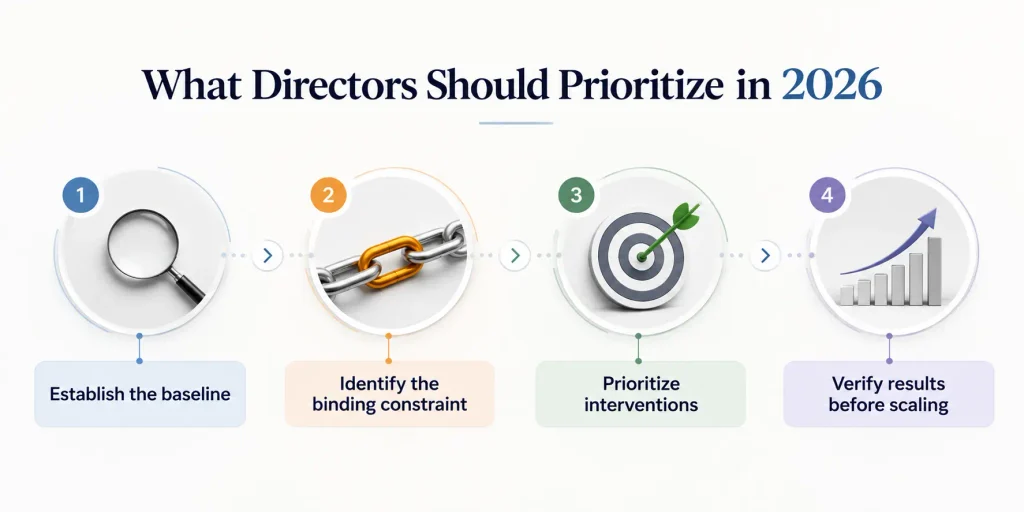
- Establish the baseline: Measure demand, end-to-end cycle time, rework, exception rates, backlog age, and fully loaded process costs.
- Identify the binding constraint: Determine whether performance is limited by capacity, data quality, system integration, decision rights, or process design.
- Prioritize interventions: Select initiatives according to measurable business value, implementation readiness, control requirements, and total cost.
- Verify results before scaling: Confirm that improvements persist under real workloads and that the projected benefits can actually be realized.
The order matters. Automating a fragmented process before addressing its underlying defects can increase technical complexity. Scaling AI before establishing permission boundaries can increase operational risk. Reporting savings before validating the financial outcome can undermine the credibility of the entire transformation program.
The New Mandate for Shared Services Leadership
In 2026, the role of a shared services director is expanding from managing service delivery toward orchestrating an integrated operating model of people, processes, data, technology, and controls.
The most consequential shared services director challenges arise when these components evolve at different speeds. Workload can outgrow capacity, AI capabilities can advance faster than governance, and financial expectations can exceed the organization’s ability to redesign processes.
The leaders best positioned to respond will focus on three outcomes: increasing effective capacity, controlling operational risk, and demonstrating verified business value.
That means measuring complete workflows instead of isolated tasks, addressing data defects before scaling automation, defining explicit boundaries for AI autonomy, and distinguishing financial savings from released capacity.
The opportunity is not simply to process existing work faster. It is to build a shared services function that can absorb changing demand, resolve exceptions more intelligently, and contribute measurable value to the wider enterprise.
Ultimately, shared services director challenges are becoming a test of operating-model design and execution discipline. Organizations that address the underlying causes of inefficiency will be better positioned to scale transformation without allowing cost, risk, and complexity to rise at the same pace.