






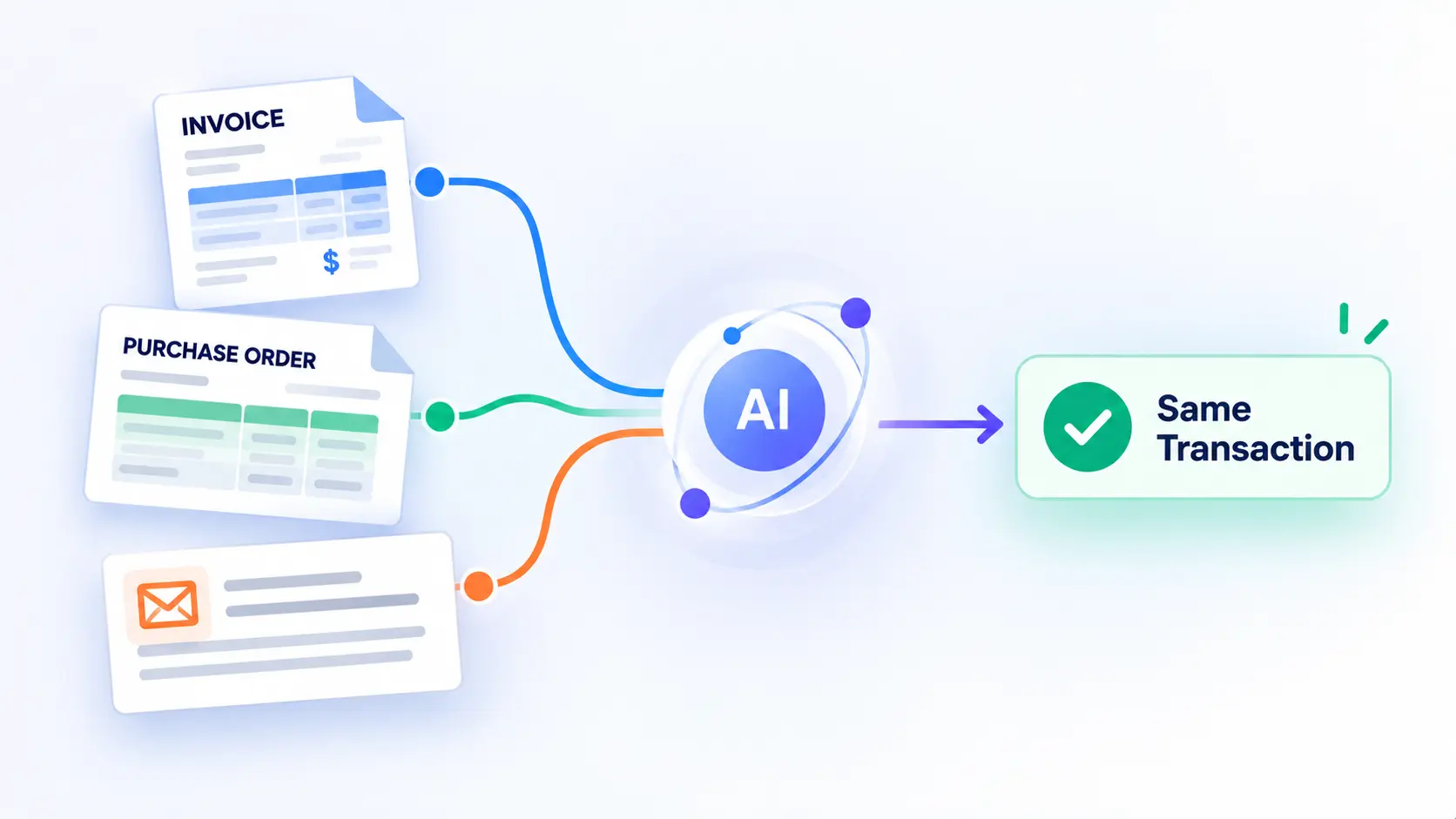


Every business transaction creates a trail of documents. An invoice arrives as a PDF, a purchase order (PO) sits in an ERP system, and an email confirms a price change or delivery update. Although these documents may look different, they often describe the same transaction.
Manually connecting them requires employees to compare identifiers, supplier details, quantities, prices, and contextual information. This process becomes difficult when documents contain inconsistent descriptions, missing references, or conflicting data. Understanding how AI agents match unstructured documents helps explain how businesses can connect these records, detect discrepancies, and improve financial accuracy through intelligent document processing.
Why Matching Business Documents Is Difficult
may use different terminology, layouts, abbreviations, and reference numbers for the same transaction.
For example:
- An invoice describes an item as an “industrial fastener kit.”
- A purchase order refers to it as an “M8 fastener assortment.”
- An email mentions “the revised order from Tuesday.”
- A goods receipt records the delivery using a shipment reference.
A human employee might recognize the relationship by reviewing all four records. Traditional automation, however, often depends on exact field matches and predefined rules.
Common challenges include:
- Inconsistent terminology: Different descriptions refer to the same product or service.
- Missing identifiers: An invoice or email does not include the original PO number.
- Unstructured layouts: Important information appears in tables, paragraphs, attachments, or scanned images.
- Conflicting information: Prices, quantities, dates, or supplier details do not agree.
- Duplicate records: The same invoice or transaction appears more than once.
- Scattered information: Relevant details are distributed across multiple systems and email conversations.
The challenge in how AI agents match unstructured documents is to interpret these differences while preserving the accuracy and accountability required for business operations.
Document Ingestion and Classification
The first step is collecting documents from the systems where business transactions originate.
An AI-enabled document processing system can receive information from:
- Email inboxes and attachments.
- Supplier portals and procurement platforms.
- Enterprise resource planning (ERP) systems.
- Shared drives and document management platforms.
- Accounts payable and accounting applications.
- Electronic data interchange (EDI) systems.
Once collected, the documents are classified according to their purpose.
For example, a classification model may identify a file as an invoice, purchase order, goods receipt, shipping notice, or supplier email.
The ingestion process also captures useful metadata, including:
- File type and document source.
- Sender and recipient information.
- Document creation or receipt timestamp.
- Email subject and conversation identifiers.
- Attachment relationships.
- Existing transaction and supplier references.
For scanned documents, optical character recognition (OCR) converts images into machine-readable text. Digital PDFs may provide embedded text directly, reducing the need for OCR.
Correct classification helps determine which information to extract and which validation rules to apply.
Extracting Information from Different Formats
After classification, document-understanding models identify relevant information from text, tables, and document layouts.
An invoice, for instance, may contain:
- Supplier name and identification number.
- Invoice number and invoice date.
- Purchase order reference.
- Product descriptions and quantities.
- Unit prices and line-item totals.
- Tax amounts and currency.
- Payment terms and final invoice amount.
A purchase order provides information about the original purchasing agreement, such as ordered quantities, approved prices, delivery dates, and product specifications.
Emails may contain additional details that are absent from formal documents, including revised prices, shipment updates, delivery delays, or approval discussions.
AI models can extract this information using natural language processing, layout-aware document models, and large language models (LLMs).
However, extraction and interpretation are different tasks. Extracting a number from a document does not establish whether it represents a subtotal, tax amount, unit price, or final total.
To understand how AI agents match unstructured documents, the system must identify the meaning of each value and preserve its source for later verification.
Normalization and Entity Resolution
Before comparing documents, the system needs to standardize information that may be expressed in different ways.
This process is known as normalization.
Examples include:
- Converting different date formats into a consistent format.
- Standardizing supplier names and business abbreviations.
- Normalizing currency codes and monetary values.
- Converting quantities into comparable units.
- Standardizing product codes and descriptions.
- Removing irrelevant formatting differences from identifiers.
For example, “Acme Limited,” “ACME Ltd.,” and “ACME LIMITED” may refer to the same supplier. Entity resolution helps determine whether these different representations identify the same real-world entity.
AI models can also compare product descriptions semantically. However, similar descriptions do not necessarily indicate identical products. Differences in size, material, specifications, or packaging may be financially significant.
A reliable normalization process must therefore preserve both standardized values and the original information.
When examining how AI agents match unstructured documents, it is important to distinguish legitimate variations from meaningful discrepancies. The system should flag uncertain cases rather than silently treating different values as equivalent.
Connecting Documents to the Same Transaction
After extracting and normalizing the information, the AI agent searches for related documents across available business systems.
It can use multiple matching signals, including:
- Purchase order and invoice numbers.
- Supplier identifiers and business names.
- Delivery and shipment references.
- Product descriptions and item codes.
- Quantities, unit prices, and total amounts.
- Transaction dates and delivery timelines.
- Email conversation history and attachment relationships.
Search technologies may include database queries, ERP APIs, keyword retrieval, and vector embeddings.
Vector embeddings represent text as numerical vectors, allowing a retrieval system to identify semantically similar descriptions even when the wording differs.
For example, an invoice may describe 120 components differently from the original PO. An email explains that the supplier split the order into two shipments. The agent can retrieve the relevant PO and email, compare their details, and evaluate whether the invoice belongs to the same transaction.
The process typically involves:
- Identifying potential matching documents.
- Retrieving related records from connected systems.
- Comparing identifiers and extracted attributes.
- Evaluating contextual relationships.
- Checking for competing candidate transactions.
- Ranking the most plausible matches.
The principle behind how AI agents match unstructured documents is to combine multiple pieces of evidence rather than rely on a single matching field.
Matching, Scoring, and Contradiction Detection
AI agents can combine deterministic rules, machine-learning models, and LLMs to evaluate document relationships.
Each technology serves a different purpose:
- Rule-based validation: Checks exact identifiers, mathematical calculations, and predefined business conditions.
- Machine-learning models: Estimate whether documents or records are likely to belong together.
- Large language models: Interpret ambiguous descriptions, summarize email context, and explain potential relationships.
- Similarity models: Compare product descriptions and identify related terminology.
- Workflow engines: Route matched records, exceptions, and approvals to the appropriate processes.
A matching engine may evaluate the following factors:
| Matching factor | What the system checks |
| Identifier agreement | Whether PO numbers and supplier references match |
| Supplier identity | Whether different supplier names refer to the same entity |
| Item similarity | Whether product descriptions and specifications correspond |
| Financial consistency | Whether quantities, prices, taxes, and totals agree |
| Temporal consistency | Whether transaction and delivery dates make sense |
| Contextual evidence | Whether emails explain revisions or shipment changes |
| Contradictions | Whether important values conflict across documents |
Not every factor carries equal weight. An exact PO reference generally provides stronger evidence than a matching invoice total, since unrelated transactions may have identical amounts.
The system should also recognize contradictions. For example, a matching PO number does not automatically justify an invoice with an unexpected currency or an unauthorized price increase.
In how AI agents match unstructured documents, confidence scoring helps separate strong matches from uncertain relationships. These scores should be calibrated against validated examples and should not be treated as guarantees of correctness.
What a Practical Technical Architecture Looks Like
A practical document-matching architecture combines several components rather than relying on one AI model to perform every task.
The main components include:
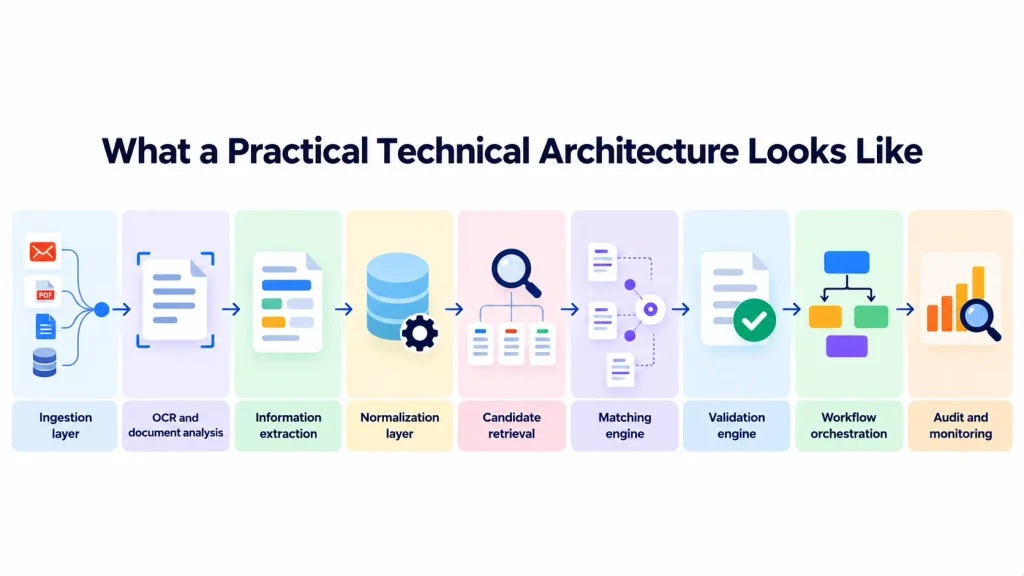
- Ingestion layer: Collects documents and metadata from business systems.
- OCR and document analysis: Converts scanned and digital documents into usable content.
- Information extraction: Identifies suppliers, identifiers, dates, amounts, and line items.
- Normalization layer: Standardizes values while preserving original data.
- Candidate retrieval: Searches for potentially related records.
- Matching engine: Evaluates identifiers, semantic similarity, contextual evidence, and contradictions.
- Validation engine: Applies arithmetic checks, tolerances, and business rules.
- Workflow orchestration: Routes matches, exceptions, and approval requests.
- Audit and monitoring: Records evidence, decisions, performance, and reviewer feedback.
This architecture uses conventional software where deterministic behavior is important and AI where contextual interpretation adds value.
For example, an LLM may interpret a supplier’s email and identify a possible connection to a purchase order. A conventional validation engine should then check the relevant values against the organization’s approved rules.
This hybrid approach makes how AI agents match unstructured documents more transparent, testable, and manageable within existing business systems.
Conclusion
An invoice, a purchase order, and an email can represent the same transaction even when their wording, formats, and identifiers differ. Establishing that relationship requires more than extracting text or comparing individual fields.
Reliable AI-based document matching combines:
- Document classification and information extraction.
- Normalization and entity resolution.
- Candidate retrieval and contextual analysis.
- Evidence-based matching and confidence scoring.
- Business-rule validation and contradiction detection.
- Human oversight, security, and auditability.
Ultimately, how AI agents match unstructured documents comes down to assembling evidence, testing relationships, identifying exceptions, and explaining decisions.
When implemented responsibly, these capabilities can reduce repetitive manual comparisons, improve document traceability, and help organizations process business transactions more accurately without sacrificing essential financial controls.