









As organizations look for ways to improve operational efficiency, reduce costs, and simplify business processes, shared services have become an important part of enterprise operating models. However, one key decision leaders face is whether to adopt multi-function shared services or a single-function shared services model.
Both approaches help organizations consolidate activities, standardize processes, and improve service delivery. The difference lies in how responsibilities are organized. A single-function model focuses on one business function, such as finance or human resources (HR), while a multi-function model brings several functions together under a coordinated shared services structure.
For CXOs, digital leaders, and transformation consultants, understanding these models is an important first step toward identifying operational gaps and exploring new ways of working. This guide explains how each model works, its advantages and limitations, and the factors organizations should consider when choosing an approach.
What Are Shared Services?
Shared services is an operating model in which an organization consolidates similar business activities into a centralized or coordinated service delivery structure. Instead of every department or business unit managing the same activities independently, specialized teams provide services to multiple parts of the enterprise.
Common shared services activities include:
- Finance and accounting
- Human resources and employee support
- Procurement and supplier management
- Information technology (IT) support
- Customer service and order management
- Data management and reporting
The objective is to reduce duplication, establish consistent processes, improve service quality, and make better use of people and technology. Organizations can organize these services in different ways. Some establish separate shared services centers for individual functions, while others bring several functions together within a broader operating model.
This decision influences reporting relationships, governance, technology requirements, performance measurement, and how easily teams collaborate across the enterprise.
What Are Single-Function Shared Services?
A single-function shared services model consolidates activities within one business function. For example, an organization may establish a finance shared services center that manages accounts payable, accounts receivable, general ledger activities, and financial reporting support.
Similarly, an HR shared services center might handle employee records, benefits administration, recruitment coordination, and routine employee inquiries.
Although these teams may support multiple business units or geographical regions, they concentrate their responsibilities within one primary function.
Pros of Single-Function Shared Services
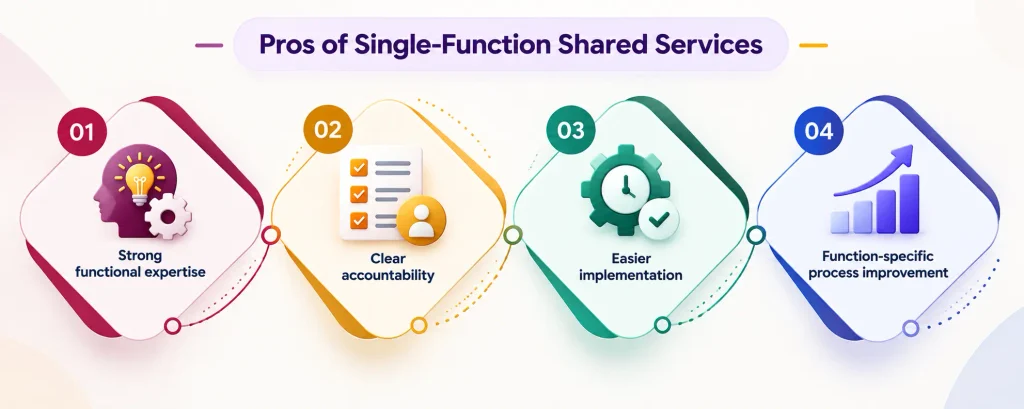
1. Strong functional expertise
Teams can develop specialized knowledge of their processes, systems, regulations, and business requirements. A finance team, for example, can focus on improving reconciliation, invoice processing, and financial controls.
2. Clear accountability
Responsibilities, reporting lines, and performance measures are generally easier to define when the team focuses on one function. Leaders can identify the owner of a particular process and the escalation point for service issues.
3. Easier implementation
Organizations can establish a single-function center without redesigning several departments simultaneously. This can make implementation more manageable, particularly when the enterprise is beginning its shared services journey.
4. Function-specific process improvement
Teams can concentrate on improving workflows within their area. Finance may focus on reducing invoice processing time, while HR may prioritize employee request resolution and data accuracy.
Cons of Single-Function Shared Services
1. Functional silos can persist
Although activities are consolidated within a function, coordination challenges may remain between departments. Finance, procurement, and IT teams might still use different workflows, systems, and performance measures.
2. Limited cross-functional visibility
Leaders may find it difficult to understand the performance of an entire business process when several independent service centers distribute responsibility.
3. Duplicated technology and management structures
Separate centers may maintain their reporting tools, automation platforms, support teams, and governance arrangements. This can create duplication across the enterprise.
4. Scaling across functions can be challenging
Expanding the model to additional departments may require new leadership structures, technology integrations, and process redesign efforts.
Single-function shared services can be an effective starting point, but organizations may eventually need stronger coordination across their service delivery operations.
What Are Multi-Function Shared Services?
Multi-function shared services bring two or more business functions together within a coordinated shared services model. Instead of operating completely separate centers for finance, HR, procurement, or IT, an organization manages these services through a broader structure.
The functions do not necessarily merge into one team. They may retain specialist teams while sharing leadership, technology platforms, governance practices, service management, or operational infrastructure.
For example, a company might establish a shared services center that manages finance operations, HR administration, procurement support, and selected IT services. Each function retains its expertise while benefiting from coordinated processes and common service delivery standards.
This model can also provide a foundation for a broader Global Business Services (GBS) organization, particularly when services span multiple business units and countries.
Pros of Multi-Function Shared Services
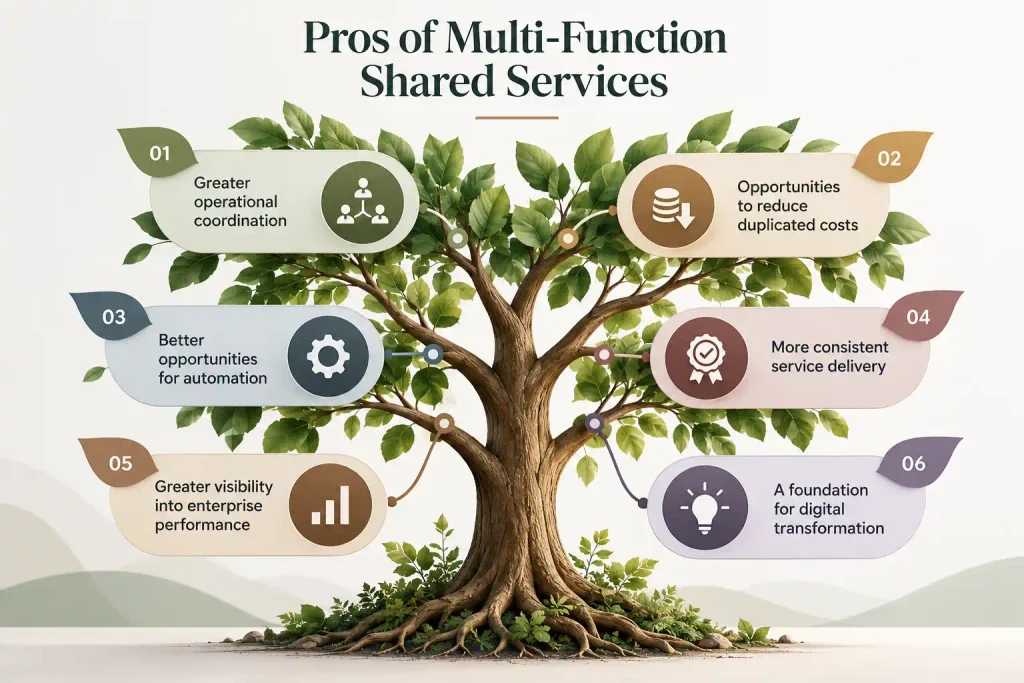
1. Greater operational coordination
Bringing functions together can improve communication and reduce handoff problems between departments. Teams can coordinate related activities and establish clearer responsibilities across interconnected workflows. For example, procurement and finance teams can work together to improve the purchase-to-pay process, from purchase requisition through supplier payment.
2. Opportunities to reduce duplicated costs
Organizations may be able to consolidate management structures, reporting capabilities, service management, and technology infrastructure. These opportunities do not guarantee lower costs. Benefits depend on implementation costs, process complexity, existing systems, and the extent of genuine duplication.
3. Better opportunities for automation
When several functions operate within a coordinated model, organizations can identify automation opportunities that span departmental boundaries. For instance, an employee onboarding workflow may connect HR administration, IT access provisioning, procurement, and finance-related activities.
4. More consistent service delivery
Shared governance and common service standards can help organizations deliver more consistent experiences across business units and regions.
5. Greater visibility into enterprise performance
A coordinated model can help leaders compare service levels, operating costs, and process outcomes across functions. This broader visibility supports better prioritization and resource allocation.
6. A foundation for digital transformation
Multi-function shared services can make it easier to coordinate investments in analytics, workflow automation, and AI-enabled operations. Rather than treating every function as an independent transformation project, leaders can explore improvements across related processes.
Cons of Multi-Function Shared Services
1. Greater implementation complexity
Bringing multiple functions together requires coordination across different teams, systems, policies, and leadership structures. The transition can be difficult if teams do not clearly define responsibilities and decision-making authority.
2. Risk of losing functional focus
A broad shared services model may prioritize standardization and cost reduction at the expense of specialized requirements. Organizations must ensure that finance, HR, procurement, and other functions retain the expertise needed to perform their responsibilities.
3. More demanding governance requirements
Leaders need clear ownership, escalation procedures, performance measures, and decision rights across functions. Without effective governance, teams may experience conflicting priorities or uncertainty about accountability.
4. Organizational resistance
Employees and functional leaders may be reluctant to change established processes or transfer responsibilities to a shared services structure. Clear communication and stakeholder involvement are essential to managing this transition.
5. Benefits may take longer to materialize
The initial investment in process redesign, technology integration, organizational change, and training can be substantial. Expected savings and service improvements may take time to achieve.
The key consideration is whether the benefits of greater integration justify the additional coordination and implementation effort.
Neither approach is universally better. The right choice depends on the organization’s current operating model, transformation objectives, resources, and ability to manage change.
How to Choose the Right Shared Services Model
Selecting between multi-function shared services and a single-function approach requires more than comparing potential cost savings. Organizations should assess how each model supports their operating priorities.
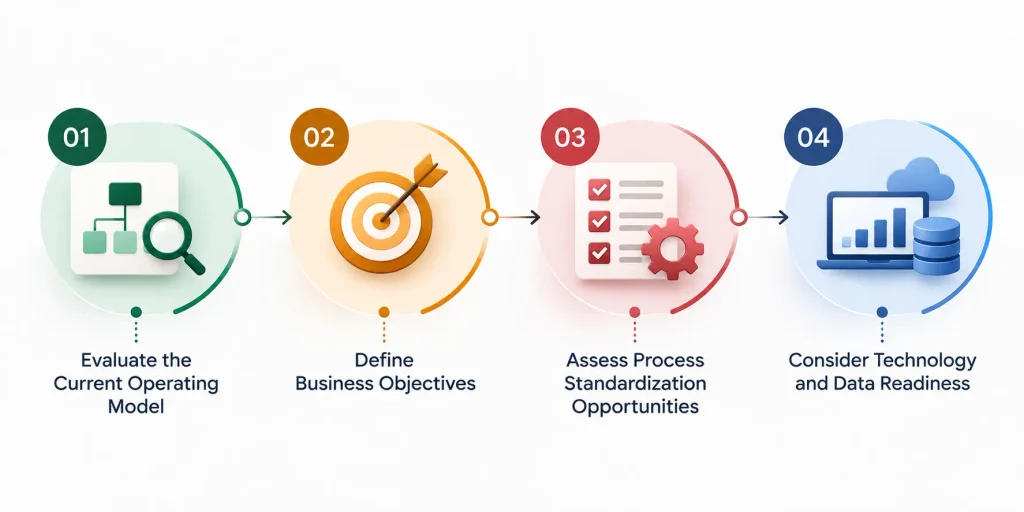
1. Evaluate the Current Operating Model
Start by understanding how business services are delivered today. Identify duplicated activities, inconsistent processes, unclear ownership, technology gaps, and recurring service issues. Determine whether these challenges exist within one function or across several departments.
If, for example, finance concentrates the primary problems, a single-function model may provide a practical starting point. If disconnected workflows across finance, procurement, and HR create wider inefficiencies, a broader model may deserve consideration.
2. Define Business Objectives
Clarify what the organization wants to achieve. Possible objectives include reducing operating costs, improving service quality, standardizing processes, strengthening controls, increasing automation, or creating greater visibility across business functions.
A clearly defined objective makes it easier to compare operating models and establish appropriate performance measures.
3. Assess Process Standardization Opportunities
Not every business process should be standardized in exactly the same way. Some activities, such as routine invoice processing or employee record updates, may be suitable for common workflows. Others may require specialist knowledge, local regulatory expertise, or different service arrangements.
Organizations should identify which activities can be standardized and which need to retain functional or regional flexibility.
4. Consider Technology and Data Readiness
Evaluate existing ERP systems, workflow platforms, automation tools, reporting systems, and data quality. A broader shared services model may create opportunities to consolidate technology and improve data visibility. However, integrating disconnected systems can increase complexity and cost.
Technology readiness should therefore influence both the design and pace of implementation.
Can Organizations Combine Both Models?
Yes. Organizations do not have to choose one model for every function across the enterprise. A hybrid approach can combine single-function shared services with a broader coordinating structure. For example, finance and HR may retain separate specialist teams while sharing service management, technology infrastructure, reporting capabilities, and selected governance processes.
Another option is to begin with a single-function model and gradually expand into multi-function shared services as processes become standardized and the organization develops stronger transformation capabilities. This phased approach allows organizations to build expertise, demonstrate results, and manage change at a sustainable pace.
The important consideration is to avoid creating unnecessary complexity. A hybrid model should have clear ownership, defined boundaries, and a practical reason for maintaining different arrangements.
Conclusion
Single-function and multi-function shared services offer different approaches to consolidating and managing business support activities.
Single-function shared services can provide specialized expertise, clearer functional accountability, and a manageable starting point for operational improvement. Multi-function shared services can create greater opportunities for cross-functional coordination, technology consolidation, and end-to-end process improvement, but they also introduce additional governance and change management challenges.
For CXOs, digital leaders, and transformation consultants, the decision should begin with the business problem rather than the organizational model.
By assessing current processes, defining measurable objectives, evaluating technology readiness, and understanding organizational capabilities, leaders can determine whether a focused or integrated approach is more appropriate.
Ultimately, multi-function shared services are most valuable when integration solves real operational problems. The goal is not simply to bring more functions together but to create a service delivery model that is efficient, accountable, adaptable, and aligned with business needs.