








Finding the best AP automation software for your finance team means wading through dozens of platforms that all claim to do the same things: capture invoices, match them to purchase orders, route approvals, and cut your cost per invoice. In practice, the differences show up in the details, which ERPs a tool actually integrates with, how well it handles messy or unstructured invoices, and whether it can scale with your transaction volume without breaking your workflow. This guide compares the top 10 AP automation platforms and AP automation solutions on the market today, breaks down which tool wins for which use case, and walks through exactly how to evaluate your options so you pick the right fit the first time.
What is AP automation software?
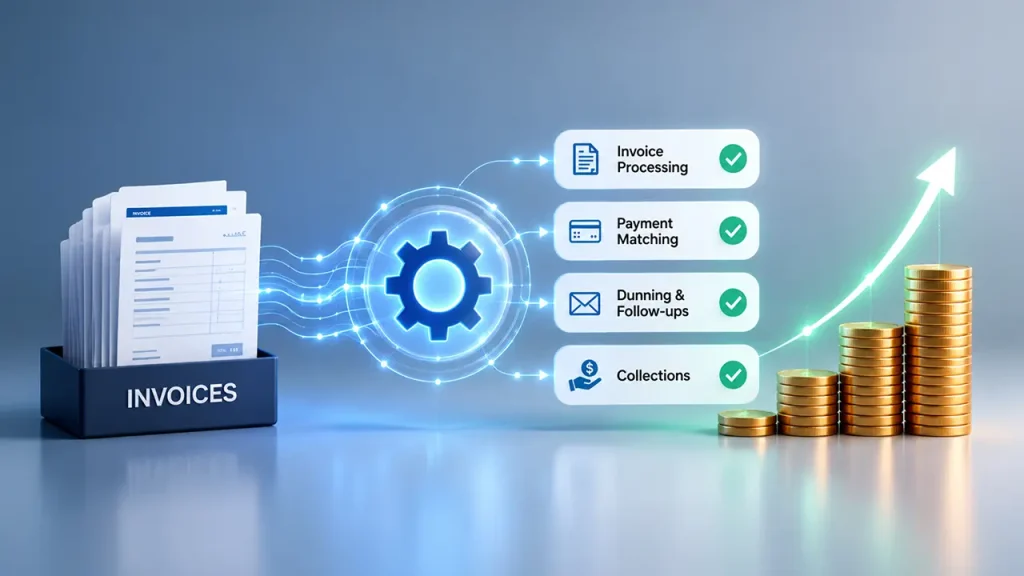
AP automation software is technology that replaces the manual, paper-and-email-driven accounts payable process with a digital workflow. Instead of a finance team keying in invoice data by hand, routing PDFs for approval, and chasing down signatures, the software manages the entire process from the moment an invoice arrives until it is paid. For finance teams evaluating the best AP automation software, these platforms can streamline the entire invoice-to-payment workflow while reducing manual effort.
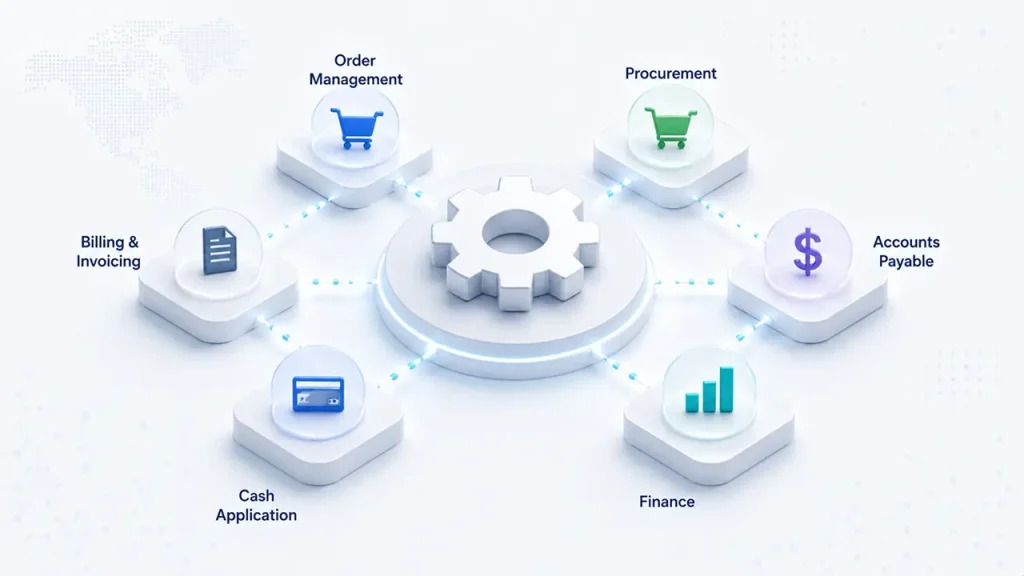
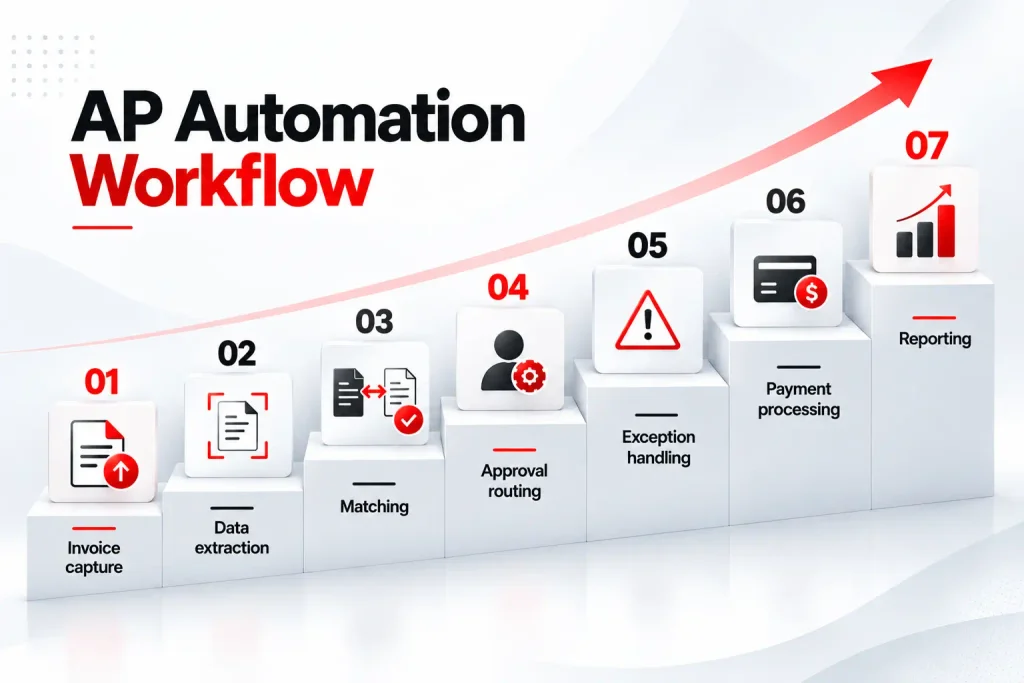
At a functional level, AP automation software typically covers:
- Invoice capture—pulling invoices in from email, vendor portals, EDI, or paper scans
- Data extraction—using OCR and machine learning to read line items, totals, vendor details, and PO numbers
- Matching—two-way or three-way matching against purchase orders and receiving records
- Approval routing—automatically sending invoices to the right approver based on amount, department, or vendor
- Exception handling—flagging mismatches, duplicates, or missing data for human review
- Payment processing—scheduling and executing payments via ACH, check, or virtual card
- Reporting—dashboards and audit trails for spend visibility and compliance
It’s worth distinguishing AP automation software from automation services. The software is the tool itself, the platform your team logs into. Services refer to the implementation partner who configures that tool, integrates it with your ERP, builds your workflows, and trains your team. Many finance teams find that the software is only as effective as the implementation behind it, which is why comparing AP automation vendors and pairing a strong platform with an experienced implementation partner tends to produce better results than a self-service rollout.
How we evaluated the best AP automation software
When evaluating the best AP automation software, we look beyond feature lists and vendor claims. Our assessment is based on what we have seen work or create challenges during real finance and AP automation implementations. We evaluate each solution across the following criteria:
- ERP integration capability: We assess how effectively the software integrates with major ERP and accounting platforms, including SAP, Oracle, NetSuite, Microsoft Dynamics, and QuickBooks. We look beyond basic connectivity to evaluate how smoothly invoice, purchase order, vendor, approval, and payment data flow between systems.
- AI capabilities: We evaluate OCR accuracy, intelligent data extraction, machine learning, and emerging agentic AI capabilities. The best accounts payable automation solutions should reduce manual intervention and handle variations in invoice formats, vendors, and process scenarios.
- Exception handling: Straight-through processing is only part of AP automation. We assess how effectively the software identifies exceptions, routes them to the right stakeholders, and supports resolution without disrupting the broader AP workflow.
- Pricing model: We compare pricing structures such as per-invoice, per-user, and subscription-based models, considering transaction volumes, scalability, and the overall cost of operating the solution.
- Implementation time: We evaluate the effort required for configuration, ERP integration, testing, workflow design, and deployment. Faster implementation can help organizations realize automation benefits sooner.
- Vendor support and ecosystem: We consider implementation assistance, ongoing technical support, integration capabilities, partner ecosystems, product maturity, and scalability. These factors help distinguish the best accounts payable software from solutions that may look strong on paper but are difficult to operationalize at scale.
Top AP automation software compared

| Software | Best for | Key features | ERP compatibility | Pricing model | AI capability |
| UiPath | Enterprise / shared services | RPA-driven workflows, document understanding, scalable bot orchestration | SAP, Oracle, NetSuite, Dynamics | Per-bot / enterprise licensing | Advanced ML + agentic AI roadmap |
| Stampli | Mid-market, AP-specific | Purpose-built AP interface, collaborative approval threads, vendor communication | NetSuite, Sage Intacct, Dynamics, QuickBooks | Per-user subscription | ML-based extraction (Billy the Bot) |
| Tipalti | Global / multi-entity | Multi-currency payments, tax compliance, supplier onboarding at scale | NetSuite, QuickBooks, Sage Intacct, Xero | Subscription + per-payment fees | ML extraction, fraud detection |
| Medius | SAP environments | Deep SAP integration, spend management, contract matching | SAP (native), Oracle | Subscription | ML extraction, growing agentic features |
| Bill.com | Small/mid-sized businesses | Simple invoice-to-pay workflow, easy setup, broad accounting software support | QuickBooks, NetSuite, Sage Intacct | Per-user subscription | Basic to moderate OCR/ML |
| AvidXchange | Real estate / healthcare | Industry-specific workflows, high invoice volume handling | Yardi, MRI, various industry ERPs | Per-invoice + subscription | ML-based extraction |
| Sage Intacct AP | Sage users | Native Sage integration, real-time dimensional reporting | Sage Intacct (native) | Included/add-on to Sage license | Moderate OCR/ML |
| NetSuite AP Automation | NetSuite users | Native SuiteApp integration, no third-party sync required | NetSuite (native) | Add-on module pricing | Moderate ML extraction |
| ApprovalMax | Approval workflows | Flexible, rule-based multi-step approval chains, audit trail | Xero, QuickBooks, NetSuite | Per-user subscription | Limited AI, workflow-focused |
| Artsyl | Document-heavy processes | Strong OCR/IDP for complex, high-volume document capture | SAP, Oracle, Dynamics, various | Per-invoice/module pricing | Advanced OCR/IDP |
UiPath brings RPA muscle to AP automation, making it a strong fit for large enterprises running shared services centers that need to automate across multiple systems, not just accounts payable.
Stampli is built specifically for AP, with a collaborative interface that keeps approval conversations attached to the invoice itself, a favorite among mid-market finance teams that want AP-specific functionality without a bloated platform.
Tipalti stands out for organizations paying suppliers across many countries and currencies, with built-in tax compliance and mass payment capabilities that most AP tools don’t handle natively.
Medius has some of the deepest native SAP integration on this list, making it a natural choice for finance teams that live inside SAP and don’t want a bolt-on tool.
Bill.com remains one of the easiest platforms to stand up quickly, which makes it popular with small and mid-sized businesses that need functional AP automation without a long implementation cycle.
AvidXchange has built out workflows specifically for real estate and healthcare, two industries with invoice patterns (recurring, property-based, high-volume) that generic AP tools handle less gracefully.
Sage Intacct AP is the obvious pick if you’re already on Sage Intacct, the native integration avoids the sync issues that come with bolting on a third-party AP tool.
NetSuite AP Automation offers the same advantage for NetSuite users: since it runs inside NetSuite as a SuiteApp, there’s no external system to maintain.
ApprovalMax focuses almost entirely on approval workflows, which makes it a good complement, sometimes a companion tool, for teams whose main pain point is routing and sign-off, not data extraction.
Artsyl leans hardest into document capture, with intelligent document processing (IDP) capable of handling messy, high-volume, unstructured invoice formats better than lighter-weight tools.
Best AP automation software by use case
Choosing the best AP automation software depends on the organization’s ERP environment, invoice volumes, automation maturity, and long-term transformation goals. Rather than treating one platform as the best option for every business, we evaluate AP automation solutions based on where they deliver the strongest fit.
1. Best for enterprise finance and shared services
UiPath is a strong choice for enterprise finance and shared services teams that need to automate AP alongside broader finance and operational workflows. Its combination of RPA, workflow automation, document processing, and AI capabilities makes it suitable for complex environments where AP automation needs to scale across entities, processes, and systems.
2. Best for SAP/Oracle environments
SAP Ariba is a strong fit for organizations deeply invested in the SAP ecosystem, particularly when procurement and accounts payable processes need to work closely together. For Oracle environments, Oracle Fusion Cloud ERP provides a similarly integrated approach, making these platforms strong candidates for enterprises looking to extend automation within their existing ERP landscape. For these environments, the best accounts payable software is often the solution that minimizes integration complexity while fitting existing finance architecture.
3. Best for NetSuite users
Tipalti stands out for NetSuite users that want to automate accounts payable and supplier payments while maintaining a strong connection with their ERP environment. Its capabilities across invoice processing, approvals, supplier management, and payments make it a practical option for growing finance teams that need more than basic invoice automation.
4. Best for agentic AI capability
Microsoft Copilot Studio is a strong option for organizations exploring agentic AI-driven finance workflows. It enables businesses to build AI agents that can reason across business processes, interact with enterprise systems, and support more adaptive workflows. As agentic AI continues to mature, organizations evaluating the best accounts payable automation should consider not only document processing but also how effectively a platform can handle decisions, exceptions, and multi-step tasks. For organizations exploring broader AI automation services and intelligent automation services, these capabilities can also support more intelligent and adaptive finance workflows.
5. Best for process-first implementation
Auxiliobits stands out for organizations that want a process-first approach to AP transformation. Software alone is not enough to deliver successful automation; organizations also need an implementation partner that understands process discovery, exception patterns, ERP integrations, workflow design, and change management. Auxiliobits applies a process-first, technology-second approach to identify the right automation opportunities before selecting and implementing the technology.
Explore its AP automation services to understand how this approach can be applied to invoice processing, approvals, exception handling, and broader accounts payable transformation.
Ultimately, the right choice among AP automation vendors depends on your existing technology stack, process complexity, and automation objectives, not simply the number of features a platform offers.
How to choose the right AP automation software for your team
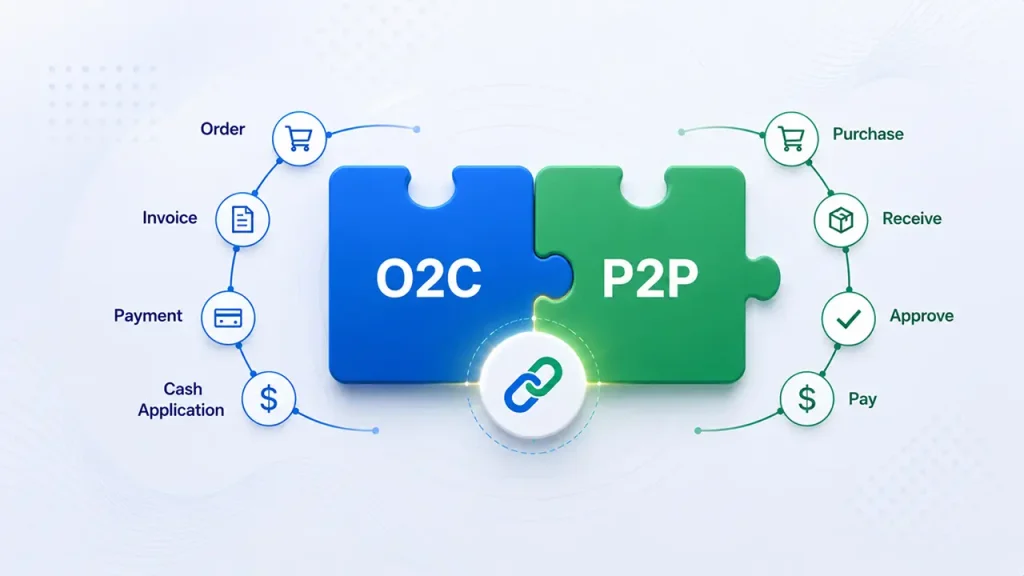
Selecting the best AP automation software requires more than comparing feature lists. The right solution should fit your existing finance environment, invoice workload, automation goals, and implementation capabilities. It should also align with the broader procure-to-pay automation strategy, particularly where procurement, purchasing, invoice processing, approvals, and payments need to work together. Use this checklist to evaluate AP automation solutions systematically:
- Check ERP compatibility first: Confirm that the platform integrates reliably with your existing ERP, whether it is SAP, Oracle, NetSuite, Microsoft Dynamics, or QuickBooks. Strong integration reduces manual data transfer and avoids unnecessary changes to established finance workflows.
- Evaluate invoice volume and complexity: Assess monthly invoice volumes, formats, PO and non-PO invoices, approval requirements, and exception rates. The best accounts payable software should handle your current workload while scaling as transaction volumes grow.
- Consider AI capabilities: For organizations processing unstructured or highly variable invoices, evaluate OCR, intelligent data extraction, machine learning, and AI-based validation. These capabilities can significantly reduce manual data entry and review.
- Compare pricing models: Understand whether AP automation vendors charge per invoice, per user, by transaction volume, or through a subscription. Compare total costs against expected processing volumes rather than looking only at the headline price.
- Assess implementation support: Determine whether the solution can realistically be deployed in-house or requires a partner-led implementation. Complex ERP environments often benefit from experienced implementation support.
- Check the agentic AI roadmap: If long-term automation is a priority, assess how the vendor plans to support AI agents, autonomous exception handling, and multi-step finance workflows.
- Validate with a proof of concept: Before committing, test the shortlisted best accounts payable automation options against representative invoices and real workflow scenarios. A POC can reveal integration issues, extraction accuracy, exception-handling gaps, and actual implementation effort before a larger investment.
AP automation software ROI: what to expect
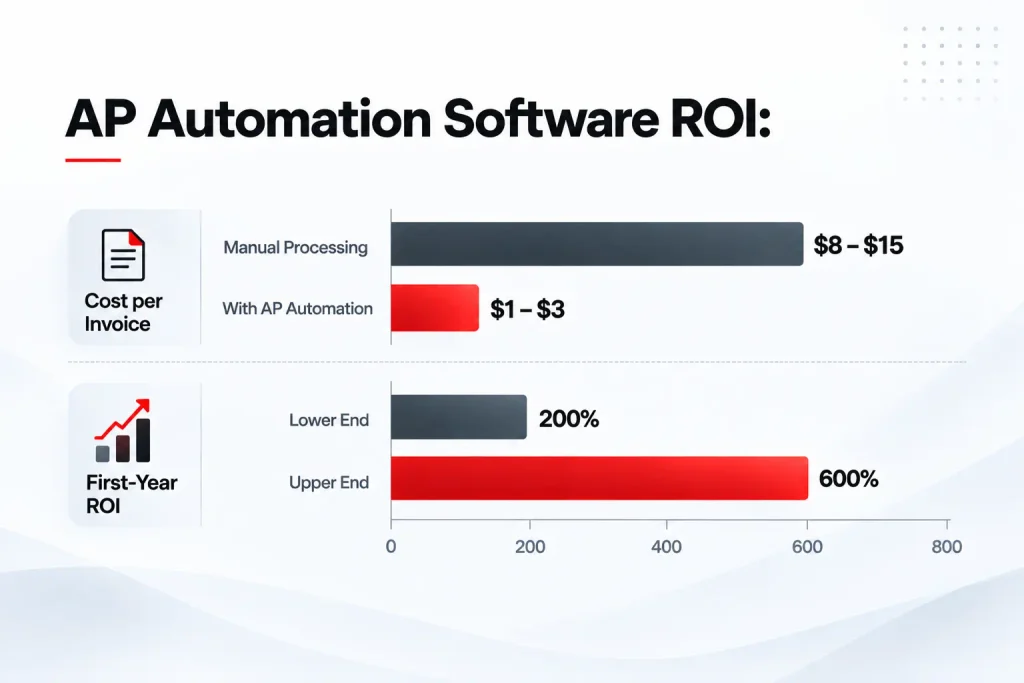
The ROI from AP automation depends on invoice volume, process complexity, existing AP costs, and the level of automation achieved. However, industry benchmarks provide a useful starting point for finance leaders building an AP automation business case. In many organizations, automation can reduce the cost of processing an invoice from approximately $8–$15 to $1–$3, particularly when organizations move from highly manual processing toward higher levels of straight-through processing.
First-year returns can also be significant. Depending on the starting point, implementation scope, and automation coverage, organizations may target 200%–600% first-year ROI, with a typical 3–9 month payback period. These figures should be treated as benchmark ranges rather than guaranteed results; the actual business case should be calculated using the organization’s own invoice volumes, labor costs, exception rates, and processing times.
Our implementation experience provides additional context. Across relevant client engagements, Auxiliobits has delivered 40–60% cost reductions, more than $200,000 in annual savings, and recovered 9,700+ hours of manual effort through AP automation initiatives.
When calculating returns, finance teams should consider more than labor savings. Faster invoice processing, fewer errors, improved visibility, stronger controls, and reduced exception-handling effort can all contribute to the overall automation ROI.
Alternatives to AP automation software
While the best AP automation software can streamline invoice processing, it is not the only approach organizations can consider. Depending on process complexity, internal capabilities, and transformation goals, businesses may also evaluate managed services, RPA, agentic AI, or outsourcing as alternatives or complementary approaches to traditional AP automation solutions.
- Managed services: Automation-as-a-Service can be a good fit for organizations that want automation benefits without building and managing the entire technology stack internally. This model combines technology with ongoing operational support, making it useful for teams with limited internal automation resources. Explore automation as a service to understand how this approach can support finance operations.
- RPA: Traditional robotic process automation works well for structured, repetitive AP activities with clearly defined rules, such as data entry, system updates, and invoice-status checks. It can be particularly useful for businesses that want to automate existing processes without immediately replacing their underlying applications. For organizations comparing the best accounts payable software, RPA can also complement broader automation platforms where legacy systems require additional automation.
- Agentic AI: Agentic AI represents the next evolution of automation, enabling systems to handle more complex, multi-step tasks and respond dynamically to exceptions. It makes sense for organizations looking to move beyond rule-based automation toward more autonomous finance operations. Learn more about agentic process automation for finance.
- Outsourcing: Outsourcing can make sense when an organization prioritizes reducing internal AP workload and transferring operational responsibility to an external provider. However, businesses should compare the long-term economics, control, visibility, and scalability of AP automation vs outsourcing before deciding.
For businesses evaluating AP automation vendors, these approaches do not always have to be mutually exclusive. RPA may handle legacy tasks, agentic AI can address complex decisions, and managed services can provide ongoing operational support alongside best accounts payable automation initiatives. The right combination ultimately depends on the organization’s processes, technology environment, and desired level of automation.
Not sure which AP automation solution is right for your team? Take our free AP Efficiency Assessment; it takes 3 minutes and gives you instant results showing where automation can save you the most time and money.