









Key Takeaways
- Agentic process automation goes beyond traditional automation. Unlike RPA, Agentic AI finance systems can reason, adapt to changing situations, and execute multi-step financial processes with minimal human intervention.
- Finance teams can automate judgment-based work. Intelligent AI agents operating within defined guardrails can now streamline processes such as invoice exception handling, reconciliations, compliance monitoring, FP&A, and treasury operations.
- Agentic AI reduces operational complexity while maintaining control. With explainable decisions, audit trails, and configurable approval workflows, organizations can improve efficiency without compromising governance or compliance.
- Choosing the right platform requires more than AI capabilities. Enterprises should evaluate explainability, ERP integrations, exception handling, security, permissions, and audit readiness before investing in an agentic automation solution.
- A phased implementation delivers the best results. Starting with high-volume, well-defined finance processes allows organizations to demonstrate measurable ROI, build trust, and expand agentic automation across the finance function over time.
Finance teams have spent the last decade automating what they could: invoice capture, three-way matching, reconciliation templates, and report generation. Robotic Process Automation (RPA) and scripted workflows removed a lot of manual clicking. But most finance leaders will admit the same thing in private: those tools still need a human to watch them, fix them when something changes, and make every judgment call that falls outside the script.
Agentic process automation is the next step in that evolution, and it’s built on a different foundation: Agentic AI finance systems that don’t just execute steps; they reason through them, adapt to exceptions, and take multi-step action toward a goal with minimal supervision.
If you’re evaluating automation investments for your finance function this year, understanding what agentic process automation actually is and how it differs from the RPA and workflow tools you may already own, is essential to making the right call. This guide breaks down the concept, how it works in real finance workflows, and what to look for as you compare solutions.
Agentic Process Automation, Defined
Agentic process automation (APA) uses AI agents, software built on large language models and decision-making frameworks, to plan, execute, and adjust multi-step financial processes autonomously, within guardrails set by your team.
The key word is agentic. An agent doesn’t just follow a fixed script. It:
- Perceives the current state of a task (an invoice, a ledger discrepancy, a vendor email)
- Reasons about what needs to happen next, given context and rules
- Acts using the tools and systems it has access to (ERP, email, spreadsheets, APIs)
- Adapts when something doesn’t match the expected pattern, instead of stopping and waiting for a human
This approach is a meaningful departure from traditional automation. A scripted bot breaks the moment a vendor changes their invoice format. An agent, by contrast, can recognize that the invoice still contains the same underlying data, extract it correctly, and continue the workflow, flagging only the exceptions that genuinely need a human decision.
How Agentic AI Finance Tools Differ From RPA and Traditional Automation
It’s worth being precise here, because vendors use “automation,” “AI,” and “agentic” almost interchangeably in their marketing, and the distinctions matter when you’re comparing options.
| Capability | Traditional RPA | Workflow / Rules Engines | Agentic AI Finance Systems |
| Handles structured, repetitive tasks | Yes | Yes | Yes |
| Adapts to format or process changes | No — requires reprogramming | Limited — requires new rules | Yes — reasons through variation |
| Makes judgment calls within guardrails | No | No | Yes |
| Chains multi-step tasks toward a goal | No — single task per bot | Partial — predefined sequences | Yes — dynamic sequencing |
| Learns from exceptions over time | No | No | Yes, with proper feedback loops |
| Requires constant maintenance | High | Moderate | Lower, but requires oversight design |
RPA is deterministic: if X, then Y, always. Agentic systems are goal-directed: given this outcome, figure out the right sequence of steps, using the tools available, and escalate what you can’t resolve confidently. That’s what makes agentic process automation viable for finance workflows that were previously considered “too judgment-heavy” to automate.
Where Agentic Process Automation Shows Up in Finance
Agentic AI finance applications tend to cluster around a few high-friction areas:
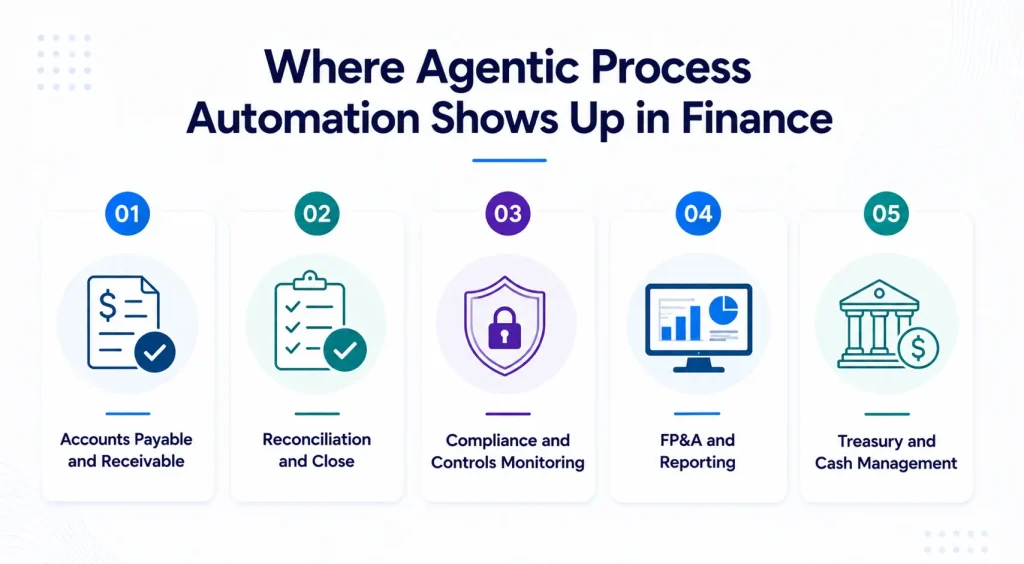
1. Accounts Payable and Receivable
Agents can ingest invoices in any format, match them against POs and contracts, flag discrepancies with context (not just a generic error code), route exceptions to the right approver, and even draft the follow-up email to a vendor, all without a human touching the routine 80% of volume.
2. Reconciliation and Close
Month-end close is a prime candidate because it’s repetitive but full of small judgment calls. Agents can compare ledgers across systems, investigate variances by pulling supporting documentation, propose adjusting entries, and produce a documented audit trail explaining why each decision was made.
3. Compliance and Controls Monitoring
Rather than running static rule-based checks, agents can monitor transactions continuously, reason about whether an anomaly fits a known risk pattern, and compile the supporting evidence a compliance officer needs to review, cutting investigation time significantly.
4. FP&A and Reporting
Agents can pull data from multiple systems, reconcile it, build the first draft of a variance analysis, and even answer natural-language questions from stakeholders (“why did marketing spend spike in March?”) by tracing the underlying transactions themselves.
5. Treasury and Cash Management
Agentic systems can monitor cash positions across accounts and entities, flag funding needs ahead of time, and recommend (or execute, within approved limits) transfers, reducing the manual monitoring burden on treasury teams.
Why Finance Leaders Are Paying Attention Now
Three things have converged to make this practical rather than theoretical:
- LLM reasoning has gotten reliable enough for narrow, well-defined financial tasks when paired with proper guardrails and human-in-the-loop checkpoints.
- Integration is easier. Modern agentic platforms connect to ERPs, banking APIs, and document systems without the brittle, custom-coded integrations RPA required.
- The labor case is undeniable. Finance teams are being asked to do more with flat or shrinking headcount, and the manual, judgment-light work that used to require analyst hours is exactly what agents handle best.
That said, agentic process automation isn’t a plug-and-play replacement for your finance team, and any vendor who tells you otherwise is oversimplifying. The real value comes from a deliberate rollout: clear guardrails, defined escalation paths, and a control environment that satisfies your auditors as much as it satisfies your CFO.
What to Evaluate Before You Choose a Solution
As you compare agentic AI finance platforms, a few questions separate the ones ready for enterprise finance from the ones still catching up:
- Explainability: Can the agent show its reasoning and the data it used to reach a decision in a format your auditors will accept?
- Guardrails and permissions: Can you define exactly what the agent can act on autonomously versus what requires sign-off and adjust that over time?
- System integration depth: Does it connect natively to your ERP, banking, and document systems, or does it rely on brittle middleware?
- Exception handling: How does it behave when it encounters something it hasn’t seen before, does it guess, stall, or escalate cleanly?
- Audit trail and compliance fit: Does every agent action produce a traceable, reviewable record suitable for SOX or internal audit requirements?
- Change management support: Does the vendor provide a path for your team to build trust incrementally, starting with low-risk processes before expanding scope?
These are the questions worth raising directly with any vendor demo, and they’re a good filter for separating genuinely agentic platforms from rebranded RPA.
The Bottom Line
Agentic process automation represents a real shift in what finance teams can hand off to software, not just data entry, but the judgment-adjacent work that used to require a person watching every exception. The technology is mature enough for well-scoped, high-volume processes like AP, reconciliation, and compliance monitoring, provided it’s implemented with the right guardrails and oversight.
If you’re building the case for agentic AI finance within your organization, the strongest starting point is a single, well-bounded process, something like invoice exception handling or close reconciliation, where you can measure time saved, error rates, and audit readiness before expanding scope.
Want to see how agentic process automation would apply to your specific finance workflows? Talk to our team about a tailored assessment of where agentic AI could reduce manual work in your close, AP, or compliance processes and what a phased rollout would look like for your organization.