








Key Takeaways
- Evaluate proven ROI, not vendor projections: Ask for comparable customer results, time-to-value data, and measurable hard and soft savings.
- Test implementation and integration reality: Validate the vendor’s experience with your ERP, financial systems, data migration, upgrades, and close-cycle requirements.
- Assess the full cost of ownership: Look beyond the quoted price to implementation, transaction fees, internal resources, support tiers, training, and change-management costs.
- Standardize vendor comparisons: Use the same weighted scorecard across every finalist so the decision is based on comparable evidence rather than sales pitches.
- Look beyond the demo: Strong customer references, quantified outcomes, clear support SLAs, and transparent answers about data ownership and implementation are critical indicators of a reliable long-term partner.
You’ve already made the case for automation internally. The business case is approved, the budget is earmarked, and your team has narrowed the field to two or three vendors. This is the stage where deals stall, not because automation doesn’t work, but because automation vendor selection is where good financial leaders slow down and ask the hard questions before they sign.
This guide is built for exactly that moment. It won’t re-explain why automation matters; you know that. Instead, it gives you a concrete framework for evaluating automation partners, the questions to ask in a final-round demo, the red flags that predict failed implementations, and the ROI math that should appear in your board deck before you commit budget.
Why Automation Vendor Selection Is Harder Than It Looks
Most finance and operations leaders don’t fail at automation because they picked the wrong category of tool. They fail because they picked a vendor that looked capable in a sales demo but couldn’t hold up under the realities of a multi-entity close, a legacy ERP, or an audit trail that regulators actually scrutinize.
A 2024 Deloitte CFO survey found that over 60% of finance automation initiatives fail to hit their projected ROI within the first year — and the leading cause cited wasn’t the technology itself but vendor-implementation mismatch: unclear ownership of data migration, underestimated integration complexity, and support models that couldn’t scale past the pilot phase.
That’s the risk this framework is designed to eliminate.
The 6-Point Framework for Evaluating Automation Partners
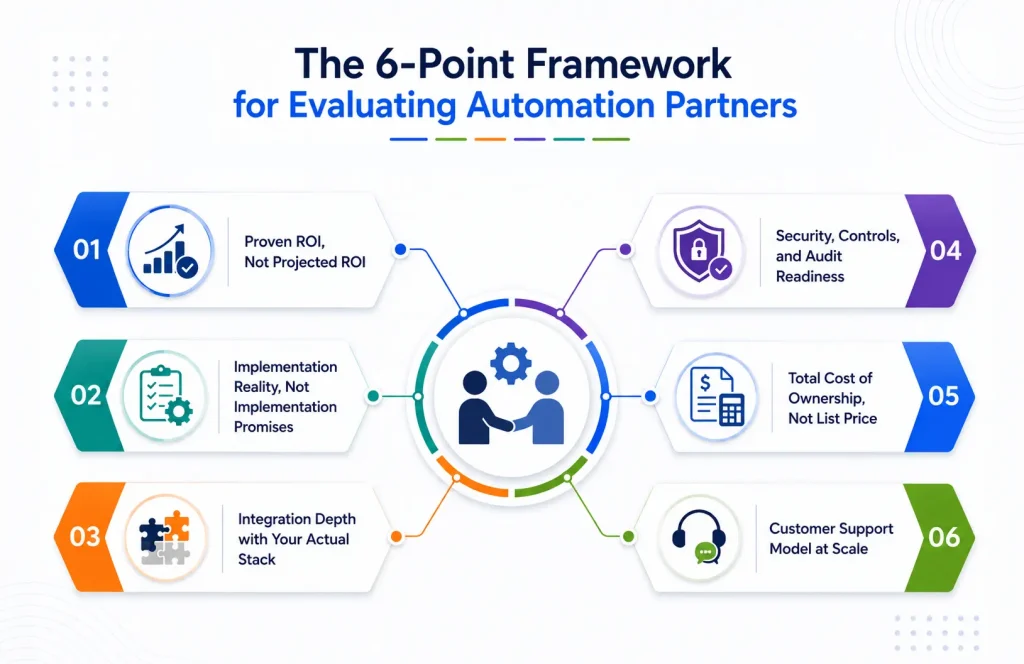
1. Proven ROI, Not Projected ROI
Any vendor can hand you a pricing calculator with optimistic assumptions. What you need is documented, audited outcomes from customers in your industry and at your scale.
Ask for:
- A minimum of three reference customers with a similar transaction volume or entity structure
- Time-to-value data (not just “time-to-go-live”) — how long until the tool paid for itself
- A breakdown of hard savings (headcount hours reclaimed, error remediation costs avoided) versus soft savings (faster close, better forecasting confidence)
Example — illustrative case study:
A mid-market manufacturing company (roughly 800 employees, $310M revenue) automated its accounts payable and intercompany reconciliation processes. Within 5 months, the finance team reduced manual reconciliation hours by 71%, cut month-end close from 9 days to 4, and recovered the platform’s annual cost within the first two quarters through reduced overtime and error-related rework.
If a vendor can’t produce a comparable, named or anonymized case study with real numbers, treat that as a signal, not a dealbreaker on its own, but a reason to push harder in diligence.
2. Implementation Reality, Not Implementation Promises
The sales cycle sells the vision. The implementation team delivers (or fails to deliver) the reality. Separate the two conversations explicitly.
Ask for:
- A named implementation lead you’ll work with post-signature, not just the sales engineer
- A week-by-week rollout plan for a comparable customer, including where that project ran over schedule and why
- Clarity on who owns data migration and reconciliation errors during cutover — the vendor, a systems integrator, or your internal team
Vendors confident in their delivery process will show you a real project timeline, including the bumps. Vendors that only show polished Gantt charts without historical variance often hide a weaker track record.
3. Integration Depth With Your Actual Stack
“We integrate with everything” is a marketing line, not a technical answer. CFOs should require proof of integration with the specific systems that carry financial risk if they break: your ERP, your banking rails, your tax engine, and your consolidation tool.
Ask for:
- A live demo using a sandbox that mirrors your ERP version (not a generic instance)
- Documentation on how the platform handles version upgrades on your ERP without breaking the integration
- A clear answer on API rate limits and what happens during peak processing (month-end, quarter-end, year-end close)
4. Security, Controls, and Audit Readiness
For finance functions, this isn’t a checkbox — it’s the difference between an automation partner and a liability.
Ask for:
- SOC 2 Type II report (not Type I — Type II proves controls operated effectively over time, not just at a point in time)
- Role-based access control granularity down to the transaction level
- A documented, unchangeable audit trail your external auditors can pull independently
- Data residency and retention policies that match your regulatory environment
If your auditors haven’t reviewed the platform’s control environment before go-live, you’re taking on undisclosed risk.
5. Total Cost of Ownership, Not List Price
BOFU pricing conversations go wrong when CFOs compare sticker prices instead of total cost of ownership over a 3-year horizon.
| Cost Factor | Often Excluded From Initial Quote |
| Implementation and configuration fees | Yes, in ~60% of initial proposals |
| Per-transaction or per-workflow overage charges | Frequently |
| Cost of internal FTE time for admin and maintenance | Almost always |
| Premium support tier required for SLA compliance | Frequently |
| Change management and training costs | Almost always |
Ask vendors directly: “Walk me through every line item that could appear on an invoice 18 months from now that isn’t on this proposal today.” A vendor confident in its pricing model will answer this question without hedging.
6. Customer Support Model at Scale
Pilot-phase support is almost always excellent — you’re a priority account during the sales-to-close window. The real test is what support looks like once you’re one of thousands of customers.
Ask for:
- Named support tiers with contractual response-time SLAs, not “we typically respond quickly”
- Escalation path for finance-critical outages (e.g., a broken close-cycle automation on the last day of the quarter)
- Customer retention and Net Revenue Retention (NRR) figures — vendors with strong post-sale support tend to publish these because they’re a competitive advantage
Automation Partner Comparison: Questions to Standardize Across Every Vendor
To keep your evaluation objective and defensible to your board — score every finalist against the same rubric.
| Evaluation Criteria | Weight | Vendor A | Vendor B | Vendor C |
| Proven ROI with comparable customers | 25% | |||
| Integration depth with existing ERP/stack | 20% | |||
| Security & audit readiness (SOC 2 Type II) | 20% | |||
| Total cost of ownership (3-year) | 15% | |||
| Implementation timeline & track record | 10% | |||
| Support SLA & escalation model | 10% |
Weighting will vary by organization — a highly regulated business may push security to 30%, while a fast-growing company may weight implementation speed higher. The point is consistency: score every vendor against the same criteria so the final decision is a comparison of facts, not competing sales pitches.
What Strong Customer Proof Actually Looks Like
Testimonials that say “the team is great to work with” don’t move a BOFU decision forward. What should appear in a vendor’s proof points:
- Named or verifiable customers in your industry or of comparable size
- Specific, quantified outcomes (hours saved, days removed from close, dollars recovered)
- A reference call you can actually schedule — not just a quote pulled from a case study PDF
- Renewal and expansion data, which signals customers who chose to stay after the honeymoon period ended
If a vendor’s proof points are vague, anonymized without explanation, or unverifiable, treat that as a gap to close in diligence — not something to overlook because the product demo looked polished.
Red Flags That Predict a Failed Automation Partnership
- Pricing that can’t be explained without a follow-up call to “check with the team”
- Reluctance to connect you with a reference customer who’s been live for over 12 months
- No clear answer on data ownership if you terminate the contract
- Implementation timelines that don’t account for your specific ERP version or entity complexity
- Support SLAs that exist verbally but aren’t written into the contract
Making the Final Call
By the time you’re evaluating final-round vendors, the question isn’t “Does automation work?” it’s “Which partner will still be delivering value 18 months after go-live, when the initial excitement has worn off and the platform needs to run quietly and reliably through every close?”
The CFOs who get this right treat vendor selection the way they’d treat any other capital decision: with a documented framework, comparable data across finalists, and reference checks that go beyond the names the vendor hands you.
Next step: Build your own scorecard using the framework above, send it to your remaining finalists, and require written answers — not verbal reassurances — before your next steering committee meeting. The vendor that answers every question directly, with data, is very often the one that becomes the safest long-term decision.
Ready to see how this framework applies to your specific ERP, entity structure, and close timeline? Schedule a working session with our team to get started