








Key Takeaways
- AP automation payback depends on more than labour savings. A complete ROI calculation should also account for reduced errors, faster processing, improved controls, payment optimisation, and finance capacity released.
- Invoice volume and processing costs shape the business case. Organisations with higher invoice volumes and greater manual effort per invoice typically have more opportunities to achieve meaningful AP automation ROI.
- Exception rates directly influence automation payback. Automating invoice capture alone may deliver limited value if mismatches, missing POs, approval delays, and other exceptions still require significant manual intervention.
- Touchless processing is a critical measure of automation value. Finance leaders should evaluate how many invoices can move through AP without human intervention rather than simply measuring whether invoices are processed digitally.
- Payback, ROI, and value realisation should be measured together. A strong AP automation business case should not only project financial returns but also track whether the expected savings, productivity gains, and operational improvements are actually being achieved.
Accounts payable automation is no longer simply a technology upgrade. For finance leaders, it is increasingly a question of capital allocation, operating-model efficiency, and measurable return.
The challenge is that AP automation ROI often relies on a straightforward comparison of software costs and labour savings. That approach misses much of the economic value. Automation can reduce invoice processing costs, accelerate cycle times, improve compliance, reduce duplicate payments, strengthen supplier relationships, and give finance teams greater capacity for higher-value work.
The more relevant question, therefore, is not “How much does AP automation cost?” but:
“How quickly will the investment pay for itself, and what value will it create after that point?”
The answer depends on the organisation’s invoice volumes, process complexity, current operating costs, automation coverage, and the extent to which the organisation captures benefits beyond labour reduction.
What Is the Payback Period of AP Automation?
The payback period is the time required for the cumulative financial benefits generated by AP automation to equal the initial investment.
A simple calculation is: Payback Period = Initial Investment ÷ Monthly Net Benefits
For example, suppose an organisation invests £120,000 in an AP automation programme and generates £20,000 in net monthly benefits.
Its estimated payback period would be: £120,000 ÷ £20,000 = 6 months
However, enterprise AP automation rarely delivers value through a single benefit category. A credible business case should account for multiple value drivers, including:
- Lower invoice processing costs
- Reduced manual data entry
- Fewer payment errors and duplicate payments
- Reduced exception-handling effort
- Lower dependency on manual approvals
- Improved early-payment discount capture
- Better working-capital visibility
- Reduced audit and compliance effort
- Improved supplier query resolution
- Greater finance capacity without proportional headcount growth
This makes payback a useful starting metric, but not the complete measure of AP automation ROI.
Why AP Automation ROI Is More Than Labour Savings
Traditional business cases for AP automation frequently begin with headcount.
For example:
Current AP team = 20 FTEs
Automation reduces manual workload by 25%
Potential capacity released = 5 FTEs
While this calculation can be useful, it can also underestimate the business case.
In many organisations, automation does not immediately eliminate five roles. Instead, it changes how finance capacity is deployed. Employees who previously spent significant time on invoice entry, matching, approval chasing and supplier queries can redirect their time towards cash management, financial analysis, controls, supplier strategy and exception management.
This distinction matters. The value of automation may therefore come from the capacity released rather than from headcount eliminated.
A mature AP automation business case should distinguish between:
1. Hard savings: Directly measurable reductions in operating expenditure.
2. Soft savings: Productivity and capacity improvements that may not immediately reduce expenditure.
3. Risk-adjusted benefits: Financial value generated by reducing errors, fraud exposure, compliance risk and control failures.
Strategic benefits:
Improvements in visibility, scalability, supplier experience and finance transformation.
A strong AP automation ROI model incorporates all four.
The Five Drivers That Determine AP Automation Payback
Not every organisation will have the same payback period. Five variables typically have the greatest influence.
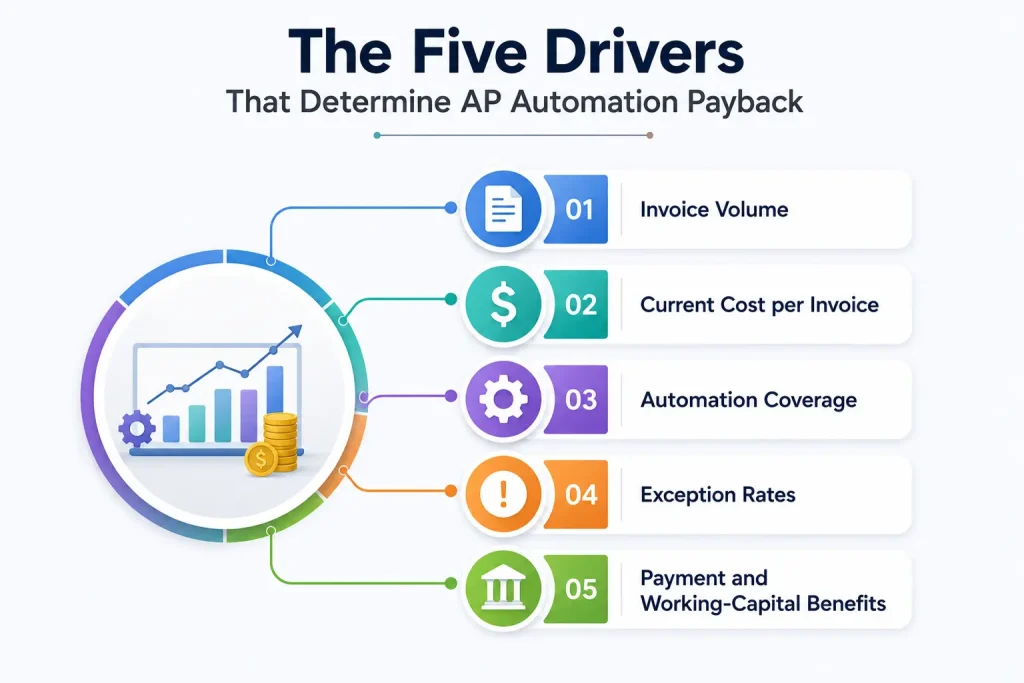
1. Invoice Volume
Higher invoice volumes generally create greater automation potential. An organisation processing 20,000 invoices annually may have a very different economic case from one processing 2 million invoices.
The relevant question is not simply how many invoices are processed, but how much manual effort is associated with each invoice. A high-volume organisation with complex matching, multiple approval layers and frequent exceptions may have significantly greater automation potential.
2. Current Cost per Invoice
Cost per invoice provides a useful baseline for determining the addressable opportunity. The calculation should include more than the AP clerk entering invoice data.
Consider the total process cost across:
- Invoice receipt
- Data extraction
- Validation
- PO matching
- Exception management
- Approval follow-up
- Payment processing
- Supplier queries
- Reconciliation
- Audit support
This creates a more realistic picture of the current cost-to-serve.
3. Automation Coverage
Automation does not necessarily mean every invoice becomes fully touchless. The business case should consider what proportion of invoices can realistically be automated and what percentage will continue to require human intervention.
For example: 80% straight-through processing + 20% exception handling
may deliver substantially greater value than a programme that simply digitises invoice capture.
This is why organisations should measure touchless processing rates, not just whether invoices are technically processed through an automation platform.
4. Exception Rates
Exceptions can significantly influence payback.
Invoices may require intervention because of:
- Missing purchase orders
- Incorrect quantities
- Price mismatches
- Tax discrepancies
- Duplicate invoices
- Supplier master-data issues
- Approval delays
If automation captures invoices but exceptions remain largely manual, the organisation may digitise the front end without fundamentally changing the economics of AP. Reducing exception rates is therefore central to improving AP automation ROI.
5. Payment and Working-Capital Benefits
One of the most overlooked components of AP automation ROI is the financial value created after invoice processing.
Better invoice visibility and faster approvals can help organisations:
- Capture early-payment discounts
- Avoid late-payment penalties
- Improve payment predictability
- Strengthen cash-flow forecasting
- Optimise payment timing
- Improve working-capital management
For larger enterprises, these benefits can materially change the payback equation.
How to Build an AP Automation ROI Model
ance leaders should establish a baseline before evaluating vendors or technology options.
A practical model can be structured around six inputs:
| Metric | Current State | Automated State |
| Annual invoice volume | Baseline | Same/forecast |
| Cost per invoice | Current cost | Expected cost |
| Manual touch rate | Current % | Target % |
| Exception rate | Current % | Target % |
| AP FTE capacity | Current | Future requirement |
| Payment optimisation | Current | Expected improvement |
The organisation can then estimate the annual benefits across several categories.
1. Labour and Capacity Savings
alculate the amount of AP capacity released through automation.
Rather than assuming every productivity gain becomes a headcount reduction, model scenarios:
- Conservative: capacity is redeployed
- Moderate: partial cost avoidance
- Aggressive: measurable headcount reduction
This produces a more credible business case.
2. Processing Cost Reduction
Compare current cost per invoice with expected automated processing cost. Even a relatively small reduction multiplied across hundreds of thousands of invoices can create substantial annual value.
3. Error and Duplicate Payment Reduction
Automation can introduce stronger validation and matching controls.
The ROI model should quantify the historical cost of:
- Duplicate payments
- Incorrect payments
- Overpayments
- Manual corrections
- Supplier disputes
The objective is not to claim that automation eliminates all leakage, but to estimate the realistic reduction in avoidable cost.
4. Early-Payment Discounts
If faster invoice approval enables the organisation to capture more supplier discounts, the business case should include the incremental value.
For example, an organisation that previously captured only a portion of available discounts may create additional value through faster processing and better visibility.
5. Compliance and Control Benefits
Manual AP processes often create control gaps.
Automation can strengthen:
- Approval workflows
- Segregation of duties
- Audit trails
- Supplier validation
- Policy enforcement
- Duplicate detection
These benefits may be harder to quantify, but they should not be ignored when calculating total economic value.
A Better Way to Think About Payback
A short payback period is attractive, but it should not become the only procurement criterion.
An automation programme that pays back in six months but requires significant manual intervention may create less long-term value than a platform with a slightly longer initial payback but substantially greater straight-through processing.
Finance leaders should therefore assess three measures together:
Payback Period — How quickly does the investment recover?
ROI — How much economic value does the investment create relative to its cost?
Value Realisation — How much of the projected value is actually being captured?
This third metric is particularly important. A business case can project a 200% ROI, but if automation adoption remains low, exception rates remain high and employees continue using manual workarounds, the realised return may be substantially lower.
What a Strong AP Automation Business Case Looks Like
A credible business case should move beyond technology features and demonstrate measurable operational outcomes.
Instead of saying, “The platform uses AI to automate invoice processing.”
The business case should establish: “Automation is expected to reduce manual invoice handling by X%, lower exception-related effort by Y%, increase touchless processing to Z%, and generate an estimated payback within X months.”
That shift from technology capability to economic outcome is what makes the business case relevant to CFOs and finance transformation leaders.
The business case should also include sensitivity scenarios.
For example:
| Scenario | Automation Adoption | Benefit Realisation | Expected Payback |
| Conservative | Lower | 70% | Longer |
| Expected | Target | 90% | Base case |
| Optimistic | Higher | 100%+ | Shorter |
This helps executives understand how changes in adoption, invoice volume and process performance affect the investment case.
The Bottom Line
The payback period of AP automation should not be treated as a single number that determines whether an investment succeeds or fails. For enterprise finance teams, it is better understood as one component of a broader AP automation ROI framework.
The strongest business cases consider the full economic impact: processing costs, finance capacity, exception rates, payment optimisation, control improvements, risk reduction and scalability.
More importantly, organisations should measure whether the value projected in the business case is actually being realised after deployment.
AP automation becomes strategically valuable when finance leaders stop measuring automation by the number of invoices processed and start measuring it by the value created per invoice.
That is the shift from AP digitisation to a more intelligent, scalable and increasingly autonomous finance operation.