









Key Takeaways
- Scaling requires more than automation. Sustainable receivables automation depends on strong data foundations, intelligent workflows, and the right implementation sequence—not simply adding more tools.
- Exception management determines scalability. As invoice volumes and customer diversity grow, disputes, deductions, and short payments increase faster than transaction volumes, making intelligent exception resolution essential.
- Data quality and customer segmentation come first. A unified data layer and behavior-based customer segmentation enable automation to make smarter decisions and adapt to different customer profiles.
- Follow a structured maturity framework. The SCALE approach—Stabilize, Categorize, Automate Exceptions, Layer Intelligence, and Extend Upstream—helps organizations build automation that continues to perform as they grow.
- Measure the right KPIs. Metrics such as straight-through cash application, exception auto-resolution, DSO by customer segment, collector-to-account ratio, and reconciliation variance provide a clearer picture of whether receivables automation is truly scaling.
Here’s an uncomfortable pattern we’ve noticed after sitting in on dozens of AR platform reviews: the teams that struggle most with scaling receivables automation aren’t the ones who automated too little. They’re the ones who automated too early, in the wrong order, and then mistook “we bought a tool” for “we scaled”.
If you’ve already automated invoice delivery, payment reminders, or a self-service portal, you’ve done the part that every vendor demo makes look easy. What almost never gets discussed—because it doesn’t sell software in a first meeting—is what happens at 3x your current invoice volume when the exceptions you used to handle by hand start arriving faster than any team can triage them manually.
Scaling receivables automation isn’t simply about processing more invoices. It’s about building an accounts receivable operation that can absorb increasing customer complexity, payment behaviors, disputes, deductions, and cash application challenges without requiring proportional increases in headcount.
We call this the Scale Cliff: the point where receivables automation that worked cleanly at low volume suddenly can’t keep up, not because the software broke, but because nobody built the foundation underneath it to bear more weight. This piece is our field-tested view of where that cliff shows up, why it’s more predictable than most finance leaders assume, and the sequencing we use to help teams avoid it.
Why Scaling Receivables Automation Breaks at Higher Volumes
Most receivables automation is designed often unintentionally around the customer base a company has on day one. Dunning cadences, matching logic, and approval thresholds all get tuned to whatever “normal” looked like at launch. That’s fine until growth changes what normal means.
The challenge with scaling receivables automation is that customer behavior rarely scales at the same pace as invoice volume. As organizations expand into new markets, industries, and geographies, payment patterns become more diverse, introducing exceptions that yesterday’s automation rules were never designed to handle.
In our experience advising finance teams through this transition, the scale cliff shows up in three specific, recurring failure modes—not vague “growing pains”, but identifiable breakpoints.
1. Exception Volume Grows Non-Linearly, Not Linearly
This is the part most finance leaders underestimate. Clean transactions scale roughly with invoice count. Exceptions—disputes, short pays, deduction claims, and misapplied cash—scale with customer diversity, which tends to compound faster than headcount growth.
A team that added 3x more customers often ends up with 5–6x more exception volume because new customer segments bring new payment behaviors your original rules were never built to handle.
As organizations focus on scaling receivables automation, exception management quickly becomes the biggest operational bottleneck. If your receivables automation platform routes every exception to a human queue by default, you haven’t automated collections—you’ve automated the notification that collections work still needs to happen.
2. Point Solutions Create “reconciliation debt”
We have seen teams layer a collections tool on top of an outdated cash application system and a separate credit system, with each one automated in isolation.
Individually, each tool looks like progress. Together, they create what we call reconciliation debt: the growing gap between what each system believes is true about a customer’s balance.
That debt is invisible at low volume and compounds silently until an audit, a customer dispute, or a bad debt write-off forces it into view.
Without a unified data foundation, scaling receivables automation becomes increasingly difficult because every additional workflow introduces another synchronization point that requires maintenance.
3. Static Rules Can’t Survive Customer Heterogeneity
A dunning sequence built for 50 mid-market customers in one vertical will misfire against an enterprise account with 90-day terms and a public-sector account with a legally mandated review cycle.
Rules-based automation isn’t wrong—it’s just brittle by design, and brittleness is invisible until scale exposes it.
Successful scaling receivables automation requires adaptive workflows capable of adjusting to different customer profiles instead of relying on rigid, one-size-fits-all rules. None of this is an argument against automation. This argument emphasises the importance of sequencing it correctly, a step that vendor conversations often overlook.
Four Prerequisites for Scaling Receivables Automation
Before layering on more automation, we ask finance leaders to honestly score themselves against four prerequisites. In our work, these four are the actual predictor of whether receivables automation scales cleanly or becomes another system someone has to babysit—more reliable, frankly, than which platform they choose.
1. One Source of Truth for Customer and Transaction Data
Scaling depends on a unified data layer, not five. If your customer master, invoice history, payment behavior, and credit terms live in different systems that “mostly” sync, you don’t have a data foundation. You have a reconciliation project waiting to happen.
A unified data model is one of the strongest indicators that your strategy for automating receivables as you scale is ready for sustainable enterprise growth.
2. Segmentation Before Automation, Not After
The teams we’ve seen scale successfully build customer segments—by risk, tenure, size, and payment behavior before they automate collections logic, not as a cleanup step afterward.
A customer with 18 months of on-time payment history should never receive the same dunning cadence as a new, unscored account. If your platform can’t apply different logic to different segments, you’re automating uniformity, not intelligence. Segmentation transforms scaling receivables automation from rule-based processing into customer-aware automation.
3. Exception Handling That Actually Resolves, Not Just Flags
This is the single biggest differentiator we look for.
Ask any platform one question: What percentage of deductions and short pays does it resolve without a human touching them, and how does it decide?
If the honest answer is “it creates a task for your team”, that’s a notification system wearing automation’s clothes. The most mature organizations prioritize autonomous exception resolution because it’s often the biggest driver of scalable AR operations.
4. Decision-Grade Visibility, Not Just Reporting
Month-end aging reports tell you what already happened. Scaling receivables automation requires real-time exposure by segment so a credit decision or collections escalation happens while it still matters, not three weeks later in a board deck.
Decision-grade visibility enables finance leaders to continuously optimize scaling receivables automation instead of reacting after performance declines.
Our Framework: SCALE
Rather than approaching scaling receivables automation as a software implementation, we recommend treating it as an operational maturity journey.
We use a five-stage sequence with finance teams to move through the process deliberately, rather than bolting on automation reactively as problems appear.
We call it SCALE.
S — Stabilize
Consolidate data sources and get cash application accuracy above 90% before adding a single new automated workflow. This is the least exciting phase and the one teams most want to skip.
Don’t.
C — Categorize
Build risk- and behavior-based customer segments. This is the step that determines whether every phase after it works. Most failed automation rollouts trace back to skipping this one.
A — Automate Exceptions
Introduce matching logic and machine-learning-based resolution specifically for deductions, disputes, and short payments, the highest-effort, lowest-automation area in almost every AR organization we’ve reviewed.
L — Layer Intelligence
Add predictive risk scoring and behavior-based cadence adjustments on top of your segments so automation gets smarter about this customer, not just faster at processing all customers.
E — Extend Upstream
Connect receivables automation to credit and order management so risk decisions happen before an invoice is issued, not after it’s overdue.
One of the biggest misconceptions around scaling receivables automation is that automation maturity comes from adding more workflows. In reality, it comes from improving the quality of data, decision-making, and exception handling before introducing additional automation layers.
Teams that try to start at “A” or “L” without “S” and “C” in place are the ones who come back a year later frustrated that their automation investment “didn’t work”—when what actually happened is that automation faithfully scaled a broken foundation.
Metrics That Matter When Scaling Receivables Automation
Generic DSO tracking hides more than it reveals. We push finance teams to track these instead because they map directly to where you sit in the SCALE sequence.
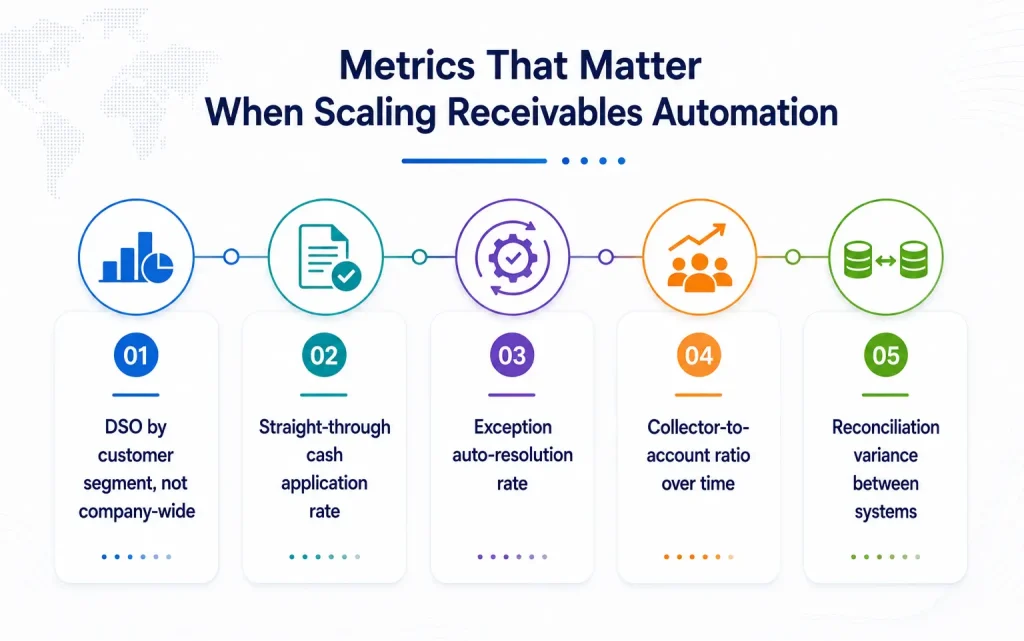
- DSO by customer segment, not company-wide — A rising blended DSO can hide a shrinking DSO in your best segment and a ballooning one in a risky segment.
- Straight-through cash application rate — The percentage of cash applied with zero manual touch.
- Exception auto-resolution rate — This measures not only the resolution time but also the fraction of cases that never reach a human.
- Collector-to-account ratio over time — Flat or improving as customer count grows is the clearest sign automation is absorbing complexity rather than displacing it.
- Reconciliation variance between systems — A rising number here is an early warning sign of the reconciliation debt we described earlier, often 6–12 months before it shows up in bad debt write-offs.
These KPIs provide a much clearer picture of whether your strategy for automating receivables as you scale is actually reducing operational effort or simply moving work between systems.
If your collector-to-account ratio is worsening as you grow, you’re not scaling receivables automation; you’re scaling headcount and calling it automation.
Where to Go From Here
Scaling receivables automation isn’t a technology purchase; it’s a sequencing decision.
Get the order right—Stabilize, categorize, automate exceptions, layer intelligence, and extend upstream and automation compounds in your favor. Get it backwards, and you spend a year spent debugging your foundation while paying for software that was never the actual bottleneck.
Organizations that stabilize data, segment customers, automate exceptions, and continuously layer intelligence create accounts receivable operations that become more efficient as they grow. Those that skip these foundational steps often discover that automation scales complexity just as quickly as it scales transactions.