







Key Takeaways
- O2C automation for shared services streamlines the entire order-to-cash lifecycle, improving efficiency and reducing manual effort.
- AI-powered automation enhances collections, cash application, and exception handling, enabling faster and more accurate financial operations.
- End-to-end integration across ERP, CRM, billing, and banking systems is essential for achieving scalable automation.
- Shared services organizations should prioritize solutions that offer intelligent workflow orchestration, governance, and multi-entity support.
- Successful O2C automation combines the right technology with standardized processes, clean data, and effective change management.
Shared services centers have transformed finance operations by centralizing transactional processes, improving governance, and reducing operational costs. Yet despite these advantages, the order-to-cash (O2C) process remains one of the most difficult functions to standardize across an enterprise.
Different business units often follow different order management workflows, customer-specific invoicing requirements, regional credit policies, and collections practices. As organizations grow through acquisitions or expand into new markets, these inconsistencies become even more pronounced. The result is delayed invoicing, rising Days Sales Outstanding (DSO), increasing disputes, and finance teams that spend more time resolving exceptions than creating value.
This is where O2C automation for shared services becomes a strategic advantage.
Rather than automating isolated tasks, modern O2C automation connects people, processes, and systems across the entire order-to-cash lifecycle. By combining workflow automation, artificial intelligence (AI), and intelligent orchestration, organizations can streamline operations, improve cash flow, and deliver a more consistent customer experience across business units.
If you’re evaluating O2C automation for shared services, this guide explains the challenges, technologies, implementation considerations, and best practices that finance leaders should understand before selecting a solution.
What Is O2C Automation for Shared Services?
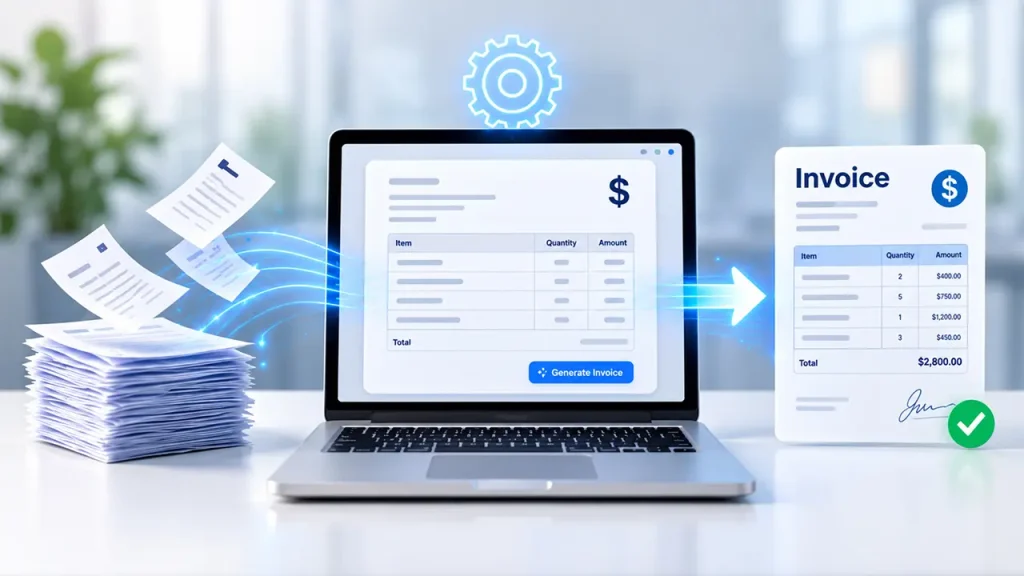
O2C automation for shared services refers to the use of intelligent automation technologies to streamline and optimize every stage of the order-to-cash process within a centralized finance organization.
Instead of relying on disconnected manual activities, spreadsheets, and email-based approvals, automation creates an integrated workflow spanning:
- Order validation
- Credit management
- Invoice generation
- Collections
- Cash application
- Dispute management
- Payment reconciliation
- Financial reporting
Modern O2C automation combines workflow orchestration, AI, machine learning, analytics, and enterprise integrations to manage both routine transactions and complex exceptions, unlike traditional robotic process automation (RPA), which primarily focuses on repetitive tasks.
For shared services organizations supporting multiple legal entities, geographies, currencies, or ERP systems, this centralized automation enables standardized processes while still accommodating business-unit-specific policies where necessary.
Why O2C Is Uniquely Challenging for Shared Services
Many finance processes are relatively easy to centralize because they follow standardized workflows. O2C is different.
Its complexity comes from the fact that it crosses organizational boundaries, business systems, and customer interactions.
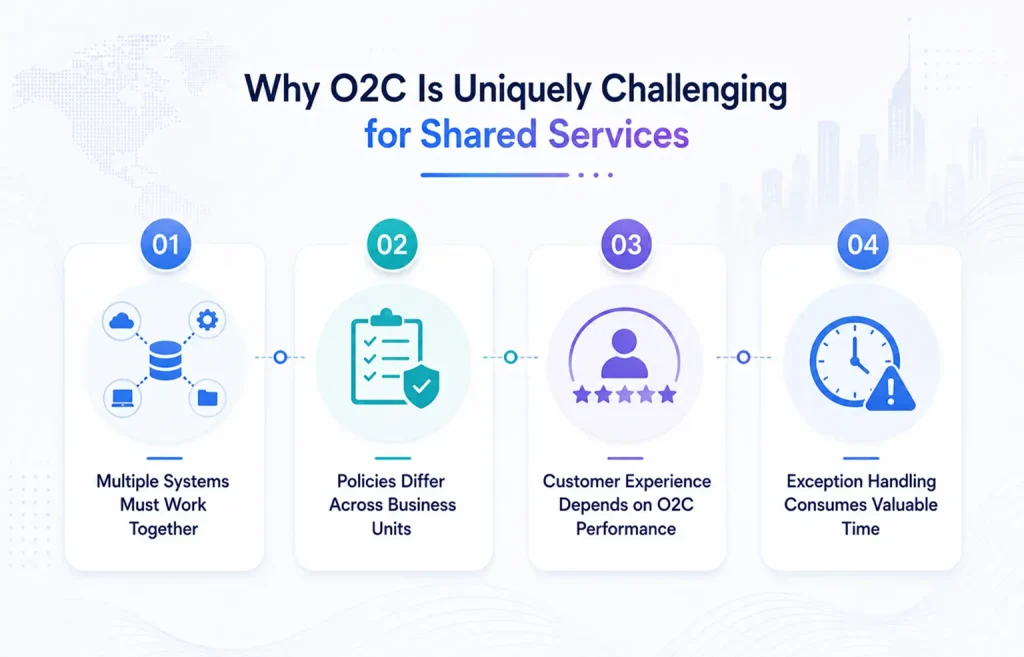
1. Multiple Systems Must Work Together
A typical order may pass through several enterprise applications before payment is received.
These often include:
- CRM platforms
- ERP systems
- Billing applications
- Tax engines
- Customer portals
- Banking platforms
- Credit bureau services
Shared services teams inherit the gaps between these systems. Employees frequently spend hours copying information, validating records, resolving inconsistencies, and manually transferring data between applications.
Without intelligent integration, even small delays accumulate across thousands of transactions.
2. Policies Differ Across Business Units
Many enterprises operate multiple divisions, each with its own:
- Credit approval rules
- Payment terms
- Pricing structures
- Customer hierarchies
- Collections strategies
- Dispute resolution processes
Although finance operations may be centralized, policy variations create multiple versions of the same workflow. This increases operational complexity and limits the benefits of standardization.
Modern O2C automation for shared services addresses this challenge by applying configurable business rules that adapt to different entities while maintaining centralized governance.
3. Customer Experience Depends on O2C Performance
Unlike accounts payable, O2C directly affects customers.
Errors such as:
- Incorrect invoices
- Duplicate billing
- Delayed credit notes
- Missed payment reminders
- Inaccurate account balances
can damage customer trust, delay payments, and increase dispute volumes.
Automating these processes helps organizations deliver consistent and accurate customer interactions while reducing revenue leakage.
4. Exception Handling Consumes Valuable Time
The majority of finance teams can automate straightforward transactions. The real challenge lies in handling exceptions such as:
- Partial payments
- Pricing discrepancies
- Missing remittance advice
- Invalid purchase orders
- Customer deductions
- Short payments
- Complex disputes
Traditional automation tools often stop when an exception occurs, leaving analysts to manually investigate every issue.
Intelligent O2C automation routes exceptions to the appropriate teams, provides contextual information, recommends next actions, and tracks service-level agreements (SLAs) until resolution.
How O2C Automation for Shared Services Works Across the O2C Cycle
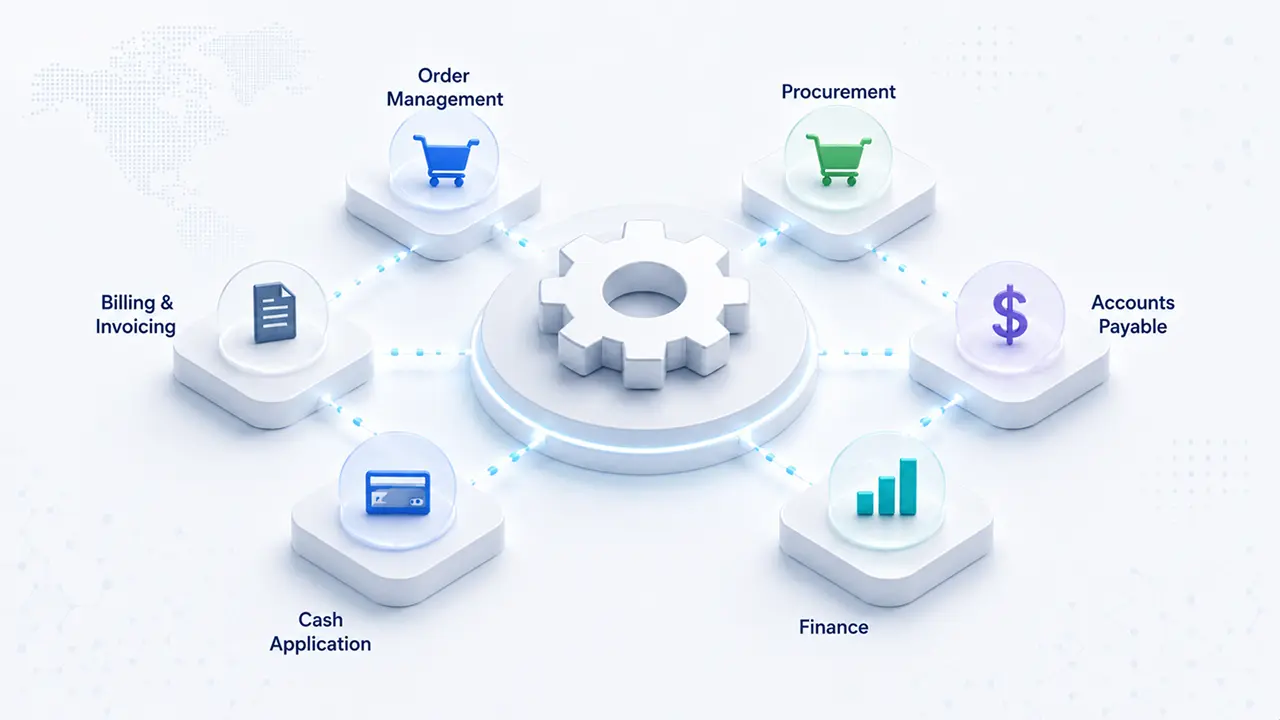
Successful automation doesn’t focus on just one activity. It connects every stage of the order-to-cash lifecycle into a single intelligent workflow.
| O2C Stage | Common Manual Challenges | How Automation Improves the Process |
| Order Management | Manual order entry, pricing errors, duplicate records | Automatically validates orders against contracts, pricing rules, and inventory before creating ERP transactions. |
| Credit Management | Slow approvals, inconsistent risk assessment | Uses predefined rules and AI-driven risk analysis to automate credit decisions while routing exceptions for review. |
| Invoice Generation | Manual invoice preparation, formatting issues, delayed delivery | Automatically generates compliant invoices and distributes them through customer-preferred channels. |
| Collections Management | Generic reminder emails and reactive follow-ups | Prioritizes accounts based on payment behavior, risk, invoice value, and predicted collection probability. |
| Cash Application | Manual matching of remittances to invoices | AI automatically matches payments, even when remittance information is incomplete or deductions are involved. |
| Dispute & Deduction Management | Spreadsheet-based tracking and slow resolution | Automatically assigns disputes to the right teams, monitors SLAs, identifies root causes, and provides real-time visibility. |
When these stages operate as connected workflows rather than isolated processes, organizations gain end-to-end visibility across the entire receivables lifecycle.
Instead of repeatedly transferring information between systems and departments, data flows automatically from one stage to the next, reducing delays, improving accuracy, and accelerating cash collection.
Perhaps more importantly, automation enables finance professionals to spend less time on administrative work and more time managing customer relationships, resolving complex exceptions, and improving working capital performance.
Benefits of O2C Automation for Shared Services
Implementing O2C automation for shared services goes beyond reducing manual effort—it enables finance teams to improve cash flow, increase operational efficiency, and deliver a better customer experience.
1. Accelerated Cash Flow
Manual invoicing, delayed collections, and slow dispute resolution often extend payment cycles and increase Days Sales Outstanding (DSO). Automating these processes helps invoices reach customers faster, prioritizes high-risk accounts for follow-up, and speeds up dispute resolution, allowing organizations to collect payments more quickly and improve working capital.
2. Greater Productivity
Finance professionals spend a significant portion of their day on repetitive activities such as validating orders, matching payments, and updating spreadsheets. Automation eliminates these low-value tasks, enabling teams to focus on customer communication, exception handling, and strategic decision-making.
3. Improved Cash Application Accuracy
Matching incoming payments to invoices can be particularly challenging when remittance information is incomplete or customers make partial payments. AI-powered automation analyzes historical payment behavior and remittance patterns to improve straight-through processing, significantly reducing manual intervention and accelerating bank reconciliation.
4. Enhanced Visibility and Compliance
Shared services leaders need real-time insights into receivables, disputes, collections performance, and cash flow. Modern O2C automation platforms provide centralized dashboards, audit trails, and performance analytics that improve decision-making while supporting compliance with internal controls and regulatory requirements.
5. Better Customer Experience
Accurate invoices, timely communication, and faster dispute resolution contribute to stronger customer relationships. By automating routine interactions and reducing errors, organizations can improve customer satisfaction while enabling finance teams to respond more effectively to complex issues.
How to Evaluate O2C Automation Solutions
Not every automation solution is designed for the complexity of shared services operations. While some organizations begin with basic RPA tools or ERP-native capabilities, these solutions often struggle when multiple business units, systems, or regional processes are involved.
When evaluating O2C Automation for Shared Services, focus on capabilities that support end-to-end process orchestration rather than isolated task automation.
1. Integration Across Enterprise Systems
The solution should integrate seamlessly with your ERP, CRM, billing platforms, banking systems, and customer portals. Native integrations reduce implementation complexity and ensure data flows consistently across the order-to-cash lifecycle.
2. Intelligent Exception Management
Automation should do more than process routine transactions. It should automatically identify exceptions, route them to the appropriate stakeholders, and provide contextual information that enables faster resolution.
3. AI-Driven Decision Support
Many vendors claim to offer AI, but it’s important to understand where intelligence is actually applied. Look for capabilities such as predictive collections prioritization, intelligent cash application, payment behavior analysis, and automated anomaly detection that deliver measurable business value.
4. Multi-Entity Support
Shared services organizations frequently manage multiple legal entities, currencies, languages, and regional compliance requirements. A scalable automation platform should support these variations without requiring separate implementations for each business unit.
5. Governance and Auditability
Every automated action should be transparent and traceable. Comprehensive audit logs, configurable approval workflows, and role-based access controls are essential for maintaining governance and supporting compliance initiatives.
Selecting the right platform is not simply a technology decision—it is an operational transformation initiative. The most successful organizations evaluate vendors using their own business scenarios and transaction data rather than relying solely on product demonstrations.
Conclusion
As finance organizations continue their digital transformation journey, O2C automation for shared services is becoming a critical capability for improving operational efficiency and accelerating cash flow. By connecting every stage of the order-to-cash lifecycle—from order validation and invoicing to collections, cash application, and dispute management—organizations can eliminate manual bottlenecks while gaining greater visibility into receivables performance.
However, technology alone is not enough. Long-term success depends on standardized processes, high-quality data, and a solution capable of orchestrating workflows across multiple systems and business units. Organizations that approach automation as a strategic transformation rather than a simple technology deployment are better positioned to reduce DSO, improve customer experiences, and scale finance operations with confidence.
As shared services continue to evolve, intelligent O2C automation will play an increasingly important role in helping finance teams work smarter, respond faster, and support sustainable business growth.