









Service Level Agreements (SLAs) are essential to managing performance, accountability, and service quality in Global Business Services (GBS) and shared services organizations. They establish measurable expectations between service providers and business stakeholders, which helps ensure that they deliver services consistently and efficiently. However, poorly designed SLAs can create unintended consequences. Teams may focus on meeting response-time targets rather than resolving issues, prioritize transaction volumes over accuracy, or optimize individual processes at the expense of the overall business experience.
Effective shared services SLS design must go beyond defining numerical targets. It should connect service commitments with business outcomes, operational realities, customer expectations, and continuous improvement. The objective is not simply to achieve green performance indicators but to ensure that the services measured are genuinely delivering value.
This requires organizations to understand which metrics matter, how they influence employee behavior, and where traditional service measurements can create undesirable results.
Why Traditional SLA Metrics Can Backfire
Traditional SLAs often emphasize easily measurable indicators such as turnaround time, response time, transaction volumes, and resolution rates. These metrics are useful, but they provide only a partial picture of service performance.
Consider an IT support team measured primarily on how quickly it responds to tickets. Employees may acknowledge requests immediately to meet the response-time target, even when meaningful resolution takes much longer. Similarly, a finance team measured on invoice-processing speed may prioritize completing transactions quickly without adequately checking accuracy.
In both situations, the SLA target is technically achieved, but the intended business outcome is compromised.
These problems arise when organizations treat metrics as isolated performance targets rather than indicators of service effectiveness. Poorly structured shared services SLS design can encourage teams to optimize what is measured instead of improving what actually matters.
The consequences may include:
- Reduced service quality: Employees prioritize speed over accuracy and completeness.
- Unnecessary rework: Errors increase when teams rush to meet processing targets.
- Poor customer experience: SLAs are achieved while stakeholders remain dissatisfied.
- Siloed operations: Individual teams optimize their performance without considering end-to-end outcomes.
- Unhealthy employee behavior: Teams focus on avoiding SLA breaches rather than solving recurring problems.
The solution is not to eliminate SLAs. It is to design them around balanced performance expectations.
Six Principles of Effective SLA Design for Shared Services
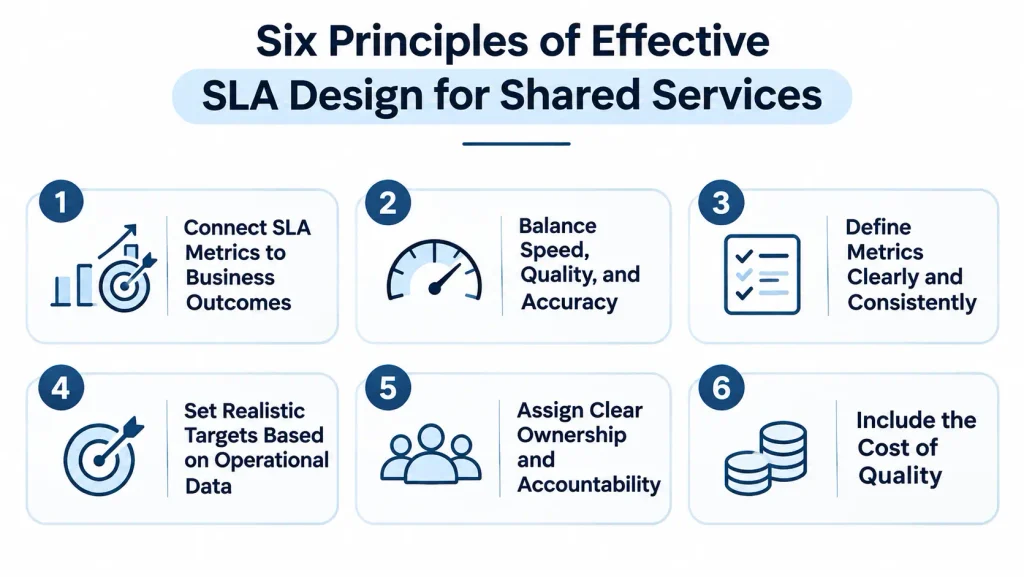
1. Connect SLA Metrics to Business Outcomes
Every SLA should have a clear business purpose. Before selecting a metric, organizations should understand what the service is expected to achieve and how its performance affects internal stakeholders.
For example, an accounts payable function should not be evaluated solely on invoice-processing turnaround time. Its performance also influences payment accuracy, supplier relationships, working capital, and financial control.
Similarly, an HR shared services team should not measure success only through the time taken to close employee requests. First-contact resolution, employee satisfaction, and accuracy of employee records are also important.
A practical approach is to connect each SLA with an outcome:
| Service area | Traditional metric | Business-oriented metric |
| Accounts payable | Invoice processing time | On-time payment rate and first-time accuracy |
| HR operations | Request response time | First-contact resolution and employee satisfaction |
| IT support | Ticket response time | Resolution time and service availability |
| Procurement | Purchase order processing time | Purchase order accuracy and policy compliance |
| Finance operations | Transaction volume | Reconciliation accuracy and close-cycle efficiency |
This approach ensures that SLAs measure the value of service delivery rather than just the volume of activity.
2. Balance Speed, Quality, and Accuracy
Speed is important, but it should never become the only measure of success. Shared services organizations need balanced SLAs that measure how quickly and correctly they complete tasks.
For example, measuring invoice processing through turnaround time alone can encourage employees to process invoices without sufficient validation. Adding first-time-right processing, exception rates, and duplicate-payment rates provides a more complete picture.
A balanced SLA framework should consider three dimensions:
- Speed: How quickly is the service delivered?
- Quality: Is the output accurate and complete?
- Experience: Does the service meet stakeholder expectations?
The weighting of these dimensions should reflect the service’s risk and business importance. A low-risk employee information request may reasonably prioritize speed, whereas a financial transaction involving regulatory controls requires stronger emphasis on accuracy and compliance.
Well-structured shared services SLS design makes these trade-offs explicit instead of allowing one performance target to dominate every decision.
3. Define Metrics Clearly and Consistently
An SLA is only useful when everyone understands exactly what is being measured. Ambiguous definitions can create disagreements between service providers and business stakeholders, particularly when different departments interpret the same metric differently.
For example, does ticket resolution time begin when a request is submitted, acknowledged, assigned, or accepted by the responsible team? Does the clock stop when a response is sent, or only when the user confirms that the issue is resolved?
These distinctions can significantly affect reported performance.
Every SLA metric should have a documented definition covering:
- Measurement objective: What business or operational outcome does it represent?
- Calculation method: How is the metric calculated?
- Start and end points: When does measurement begin and finish?
- Exclusions: Which situations are excluded from the calculation?
- Data source: Which system provides the measurement data?
- Reporting frequency: How often is performance evaluated?
Organizations should also standardize definitions across business units wherever services are comparable. This improves transparency and makes performance benchmarking more reliable.
Consistent definitions are a foundational requirement of effective shared services SLS design, particularly for organizations operating across multiple locations and business units.
4. Set Realistic Targets Based on Operational Data
Unrealistic SLA targets can damage service quality and employee morale. When teams set targets without considering actual transaction patterns, resource availability, process complexity, or historical performance, they may struggle to meet expectations consistently.
For instance, setting a universal four-hour resolution target for every IT ticket ignores the difference between a password reset and a complex infrastructure issue.
Instead, organizations should use historical performance data to establish realistic service commitments.
A structured target-setting process should include:
- Establish a baseline: Analyze historical performance across different service categories.
- Segment service requests: Separate routine, complex, urgent, and high-risk requests.
- Understand capacity: Consider staffing, technology, workload patterns, and dependencies.
- Consult stakeholders: Validate expectations with service owners and business users.
- Set improvement targets: Introduce achievable improvements and review them periodically.
Targets should be challenging enough to encourage progress but realistic enough to support sustainable service delivery.
Organizations should also distinguish between standard service commitments and priority-based commitments. Critical business incidents may require faster response and resolution than routine requests.
5. Assign Clear Ownership and Accountability
An SLA without clear ownership is difficult to enforce or improve. Shared services operations frequently involve multiple teams, systems, and business stakeholders. When responsibilities are unclear, service failures can remain unresolved because each team assumes another team is accountable.
Effective SLA governance should identify who owns the service, who monitors performance, who investigates breaches, and who approves corrective actions.
A responsibility structure may include:
- Service owner: Accountable for overall service performance and stakeholder expectations.
- Process owner: Responsible for process efficiency, controls, and continuous improvement.
- Operational team: Responsible for delivering services within agreed commitments.
- Business stakeholder: Provides feedback and validates whether service outcomes meet business needs.
- Governance team: Reviews performance trends, escalations, and corrective actions.
Ownership should extend beyond reporting SLA results. Responsible individuals must also have the authority and resources to address underlying performance problems.
Strong accountability ensures that SLA breaches trigger investigation and improvement rather than simply appearing in monthly reports.
6. Include the Cost of Quality
Service quality has financial implications that traditional SLAs often overlook. Processing errors, rework, incorrect transactions, missed payments, compliance failures, and repeated customer contacts all create additional operational costs.
For example, an invoice may be processed within the agreed turnaround time but later require correction because of inaccurate supplier details. Although the initial SLA appears successful, the organization incurs additional effort and potentially delays payment.
Organizations should therefore measure the cost of poor quality alongside traditional service metrics.
Useful indicators include:
- Rework rate and cost of reprocessing.
- Error-related transaction costs.
- First-time-right processing percentage.
- Number of repeat service requests.
- Financial impact of compliance failures.
- Cost associated with unresolved service issues.
This creates a stronger connection between service performance and financial efficiency.
In mature shared services SLS design, quality-related measurements help organizations understand whether faster service delivery is genuinely reducing costs or simply transferring costs into rework and exception management.
How to Build a Balanced SLA Scorecard
A balanced SLA scorecard prevents organizations from relying on one or two indicators to evaluate complex services. Instead, it combines operational, quality, experience, and business-impact measurements.
A practical scorecard could include the following:
| Measurement category | Example SLA or KPI | What it reveals |
| Timeliness | Turnaround time | Whether services meet delivery commitments |
| Responsiveness | First response time | How quickly requests are acknowledged |
| Quality | First-time-right rate | Whether work is completed accurately |
| Resolution | First-contact resolution | Whether issues are solved without repeated interactions |
| Experience | Stakeholder satisfaction | Whether services meet user expectations |
| Compliance | Control adherence rate | Whether required policies and controls are followed |
| Efficiency | Cost per transaction | Whether services are delivered economically |
| Improvement | Rework reduction | Whether operational quality is improving |
Not every service needs every metric. Organizations should select indicators based on service complexity, business risk, customer expectations, and strategic importance.
The scorecard should also distinguish between leading and lagging indicators. Leading indicators, such as growing exception volumes or increasing backlogs, can signal emerging problems. Lagging indicators, such as SLA breaches and customer complaints, show the consequences of issues that have already occurred.
Using both helps service leaders respond proactively rather than waiting for performance failures.
The Role of Automation and AI in SLA Management
As shared services operations become increasingly digital, automation and artificial intelligence can improve how organizations monitor, interpret, and manage SLA performance.
Traditional SLA reporting often relies on periodic reports generated from multiple systems. This can delay issue identification and make it difficult to understand why service levels are deteriorating.
Modern workflow platforms and AI-enabled analytics can provide more timely visibility into service performance.
Key applications include:
- Automated SLA monitoring: Tracks deadlines, processing times, and service commitments across workflows.
- Predictive alerts: Identifies requests that are likely to breach SLA targets based on workload, complexity, and historical patterns.
- Root-cause analysis: Helps identify recurring delays, bottlenecks, and sources of rework.
- Intelligent prioritization: Directs urgent and business-critical requests to appropriate teams.
- Performance reporting: Consolidates service metrics into dashboards for operational and executive reviews.
Agentic AI can extend these capabilities by coordinating tasks across systems, initiating permitted actions, and escalating exceptions when human intervention is required.
However, automation should not reinforce poorly designed measurements. If the underlying SLA rewards speed at the expense of accuracy, automating the process may simply accelerate the wrong behavior.
Technology must therefore support a well-defined service framework, with appropriate governance, validation, and human oversight.
Implementing an Effective SLA Framework
Improving SLA performance requires more than changing targets or introducing additional metrics. Organizations should approach the process systematically.
A practical implementation roadmap includes five steps:
- Review existing SLAs: Identify metrics that encourage undesirable behavior, lack clear definitions, or fail to reflect business outcomes.
- Map services and stakeholders: Understand service dependencies, customer expectations, operational risks, and end-to-end responsibilities.
- Redesign performance measures: Introduce balanced metrics covering speed, quality, accuracy, experience, and cost.
- Establish governance: Assign ownership, define escalation procedures, and standardize reporting requirements.
- Review and improve continuously: Use performance trends, stakeholder feedback, and operational data to refine service commitments.
Organizations should pilot redesigned SLAs in selected service areas before applying them across the entire shared services environment. This allows teams to identify unintended consequences, validate measurement definitions, and adjust targets based on real operating conditions.
A successful shared services SLS design framework should remain flexible enough to evolve as business priorities, service complexity, technology capabilities, and stakeholder expectations change.
Conclusion
SLAs are essential to creating accountability and consistency in shared services, but poorly designed metrics can encourage the wrong behaviors. Focusing exclusively on response times, processing volumes, or turnaround targets may create the appearance of efficiency while allowing quality issues, rework, and stakeholder dissatisfaction to grow.
Effective SLA management requires a balanced approach that connects service commitments with measurable business outcomes. Organizations should establish clear metric definitions, set realistic targets, assign ownership, monitor quality, and evaluate the complete cost of service delivery.
Ultimately, shared services SLS design should not focus on achieving the highest possible number of SLA targets. It should be about building a service environment where performance measurement encourages better decisions, stronger accountability, improved experiences, and sustainable business value.
When SLAs measure what genuinely matters, they become more than operational controls. They become instruments for continuous improvement and strategic performance management.