








Procurement leaders are under increasing pressure to reduce costs, improve supplier performance, strengthen compliance, and respond quickly to changing business requirements. However, when departments and geographies scatter purchasing activities, organizations often struggle with fragmented supplier data, inconsistent contracts, limited spend visibility, and duplicated effort. Procurement shared services offers a way to address these challenges by consolidating suitable activities while preserving the flexibility required by individual business units.
The objective is not to move every purchasing decision into a central team. Instead, organizations must determine which activities benefit from scale, which require local expertise, and how technology can connect both. A well-designed model combines centralized governance with responsive execution, enabling procurement to become a strategic business function rather than simply an administrative control point.
What Are Procurement Shared Services?
Procurement shared services is an operating model that consolidates selected procurement activities into a centralized function serving multiple business units, subsidiaries, departments, or geographic markets. Instead of every department independently managing routine purchasing activities, a dedicated team provides standardized services through common processes, systems, policies, and performance measures.
These services may include purchase requisition processing, purchase order administration, supplier onboarding, contract administration, procurement helpdesk support, spend analytics, and sourcing execution.
The structure can also support strategic procurement capabilities, although category strategy, major supplier negotiations, and high-value commercial decisions often remain under the direct ownership of procurement leadership.
The defining principle is shared delivery, not complete centralization. Business units retain responsibility for identifying their needs and providing operational context, while the central function delivers activities that benefit from consistency, specialist expertise, or economies of scale.
For example, a multinational manufacturer may establish a central procurement operations team to process purchase orders and maintain supplier records. Regional procurement teams can continue managing supplier relationships and market-specific sourcing decisions within enterprise-wide policies.
Which Procurement Activities Should Be Centralized?
The most effective operating models distinguish between activities that benefit from consolidation and those that depend on proximity to the business
Activities suited to shared services
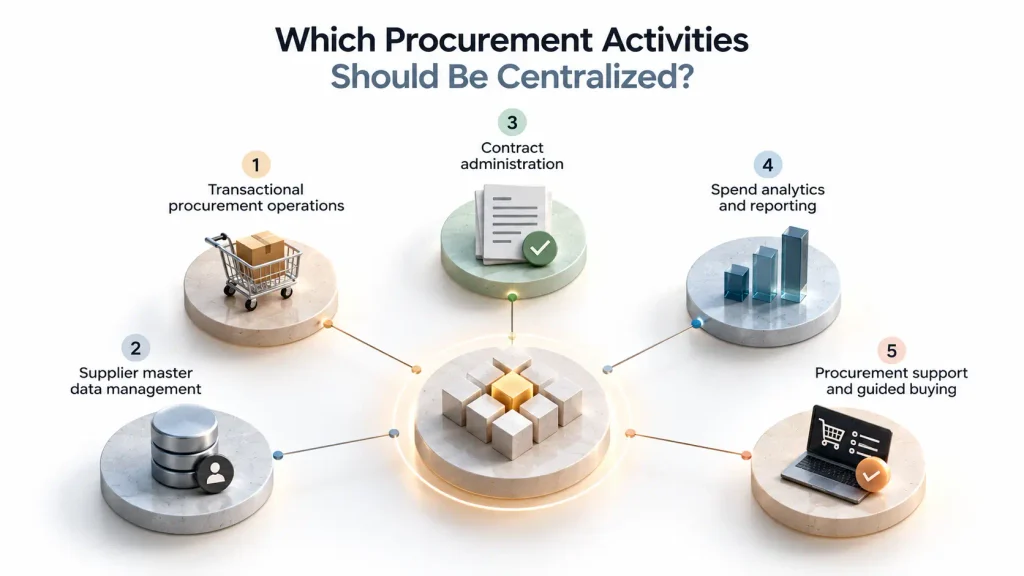
- Transactional procurement operations: High-volume, repeatable activities such as requisition validation, purchase order creation, order updates, and purchasing support are strong candidates for consolidation. Standardized workflows help reduce manual intervention, inconsistent processing, and avoidable errors.
- Supplier master data management: Maintaining accurate supplier records across multiple systems is difficult when ownership is fragmented. A centralized team can manage supplier onboarding documentation, data validation, duplicate detection, and record maintenance under consistent controls.
- Contract administration: Administrative activities such as maintaining contract repositories, tracking renewal dates, organizing documentation, and monitoring contractual milestones can be centralized. Category managers and legal teams may continue to handle strategic negotiations and decisions about commercial terms.
- Spend analytics and reporting: Consolidated procurement data enables organizations to identify spending patterns, supplier concentration, maverick spending, and opportunities for demand aggregation. A shared analytics capability can provide consistent reporting across business units.
- Procurement support and guided buying: A central helpdesk can resolve purchasing queries, guide employees toward approved suppliers, explain procurement policies, and help users navigate procurement systems.
However, centralization should not become a blanket rule. Complex sourcing decisions, urgent operational purchases, supplier innovation, and specialized category requirements may demand local knowledge or direct business engagement.
Centralizing Sourcing Without Losing Agility
The biggest challenge in designing a shared procurement function is balancing control with speed. Excessive decentralization reduces spend visibility and negotiating leverage. Excessive centralization can introduce approval bottlenecks, slow sourcing decisions, and distance procurement from business requirements.
Research from Gartner highlights this trade-off: centralized structures can improve purchasing leverage and standardization, but over-centralization can weaken responsiveness and supplier relationship management. <Cite refs={[“turn575860search0”]}/>
The solution is to separate centralized decision frameworks from decentralized execution where appropriate.
Adopt a center-led operating model
A center-led model establishes enterprise-wide policies, category strategies, supplier standards, technology platforms, and performance expectations. Business units retain defined decision-making authority for activities that require local expertise or immediate action.
For example, an organization may negotiate enterprise agreements for common software licenses, office supplies, or logistics services. Local teams can then purchase through approved arrangements without repeating the entire sourcing process.
This approach captures the benefits of collective buying power while allowing business units to respond to their operational needs.
Use risk-based approval thresholds
Not every purchase requires the same level of scrutiny. Applying identical approval procedures to a low-value office purchase and a strategic technology contract creates unnecessary delays.
Organizations should establish approval thresholds based on spend value, supplier risk, contractual complexity, regulatory exposure, and business criticality. Routine purchases from approved suppliers can move through streamlined workflows, while high-risk or high-value decisions receive additional review.
The result is stronger control where it matters and fewer unnecessary interventions in low-risk transactions.
Create clear exception pathways
Agility depends on what happens when standard procedures do not fit the situation. Urgent maintenance requirements, supply disruptions, unique technical specifications, and market-specific regulations may justify exceptions.
An effective process defines who can approve an exception, what evidence is required, how the decision is documented, and when retrospective review is necessary. This allows the organization to respond quickly without creating uncontrolled purchasing practices.
Designing an Effective Governance Structure
Governance determines whether centralization creates enterprise value or simply moves existing inefficiencies into a new organizational structure.
A successful procurement shared services model needs clearly defined ownership across procurement leadership, shared services, finance, legal, technology, and business units
1. Establish end-to-end process ownership
Procurement activities often cross multiple functions. A purchase may begin with a business request, move through sourcing and approvals, generate a purchase order, and eventually reach invoice processing and payment.
If each function optimizes its tasks without considering the complete process, delays and exceptions can accumulate between handoffs.
An end-to-end procure-to-pay owner should oversee process standards, performance measures, cross-functional dependencies, and improvement priorities. APQC similarly emphasizes the importance of end-to-end process governance and coordinated ownership across procurement and related functions.
2. Define decision rights
A responsibility matrix should distinguish between who sets policy, who executes transactions, who approves commercial decisions, and who owns supplier relationships.
For example:
- Procurement leadership owns enterprise sourcing strategy and procurement policy.
- Shared services owns agreed transactional activities and service delivery.
- Category managers lead category strategies and complex negotiations.
- Business units define requirements and provide operational input.
- Finance validates financial controls and budget alignment.
- Legal supports contractual risk assessment and complex negotiations.
The precise allocation varies by organization, but responsibilities must be explicit enough to prevent duplication and unresolved ownership.
3. Introduce service-level agreements
Service-level agreements (SLAs) establish measurable expectations for service delivery. Measures might include requisition processing time, supplier onboarding turnaround, purchase order accuracy, helpdesk response, and query resolution.
SLAs should reflect business priorities rather than reward speed alone. A team that processes requests quickly but generates errors or repeatedly sends work back for correction is not delivering effective service.
Implementation Roadmap: From Fragmented Procurement to Shared Services
Implementing procurement shared services requires more than reorganizing reporting lines. It involves redesigning processes, reallocating responsibilities, integrating technology, and securing adoption across the organization.
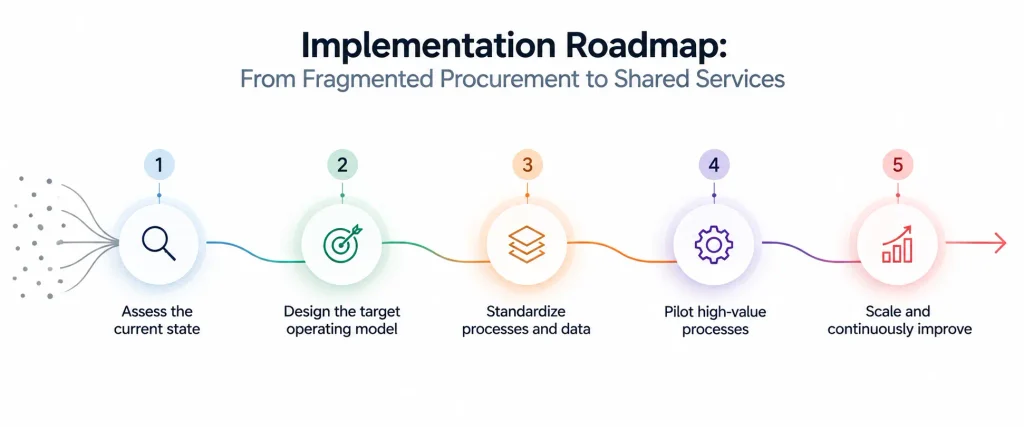
Phase 1: Assess the current state
Analyze procurement spend, transaction volumes, supplier fragmentation, process cycle times, systems, staffing, and existing controls. Identify duplicated activities and determine which categories or processes offer the strongest consolidation opportunities.
Phase 2: Design the target operating model
Define the scope of shared services, decision rights, governance arrangements, service catalog, location strategy, staffing requirements, and performance measures. Consult business units before finalizing responsibilities to avoid designing a model that ignores operational realities.
Phase 3: Standardize processes and data
Harmonize procurement policies, supplier classifications, approval rules, documentation standards, and reporting definitions. Resolve major data quality issues before migrating activities into a common environment.
Phase 4: Pilot high-value processes
Begin with repeatable, high-volume activities such as purchase order administration, supplier data maintenance, or procurement helpdesk operations. Test service levels, identify exceptions, and refine workflows before expanding.
Phase 5: Scale and continuously improve
Monitor performance, gather stakeholder feedback, analyze recurring exceptions, and expand automation where appropriate. Review the allocation of responsibilities periodically as business needs, supplier markets, and technology capabilities change.
Change management is essential throughout the transition. Employees need clear guidance on where to submit requests, which decisions remain local, how exceptions work, and whom to contact when service expectations are not met.
Common Mistakes to Avoid
Even a well-funded transformation can fail if the organization treats centralization as the goal rather than a means of improving procurement outcomes.
- Centralizing too much: Moving every sourcing decision into one team can create delays and weaken category expertise. Centralize activities according to their value drivers, not organizational convenience.
- Ignoring stakeholder needs: A technically efficient model may fail if business units perceive procurement as inaccessible. Involve stakeholders in service design and measure their experience.
- Automating broken processes: Digitizing unnecessary approvals and inconsistent procedures makes inefficiency harder to correct. Simplify and standardize workflows before automating them.
- Measuring activity instead of outcomes: High transaction volumes do not necessarily demonstrate value. Track realized savings, cycle times, quality, compliance, and business satisfaction together.
- Leaving accountability unclear: Procurement, finance, shared services, and business units must understand their respective responsibilities. Ambiguous ownership leads to duplicated work and unresolved exceptions.
Conclusion
Centralizing procurement does not have to mean sacrificing business agility. The most effective operating models consolidate repeatable work, common data, enterprise governance, and activities that benefit from scale while preserving local decision-making where market knowledge, urgency, or specialized requirements matter.
A well-designed procurement shared services model achieves this balance through clear decision rights, risk-based approvals, integrated technology, end-to-end ownership, and performance measures that extend beyond cost reduction.
Ultimately, the goal is not simply to process purchasing transactions more efficiently. It is to create a procurement function that delivers measurable commercial value, strengthens supplier relationships, improves compliance, and responds to business needs without unnecessary friction.